IN THIS ARTICLE
What pole numbers identify
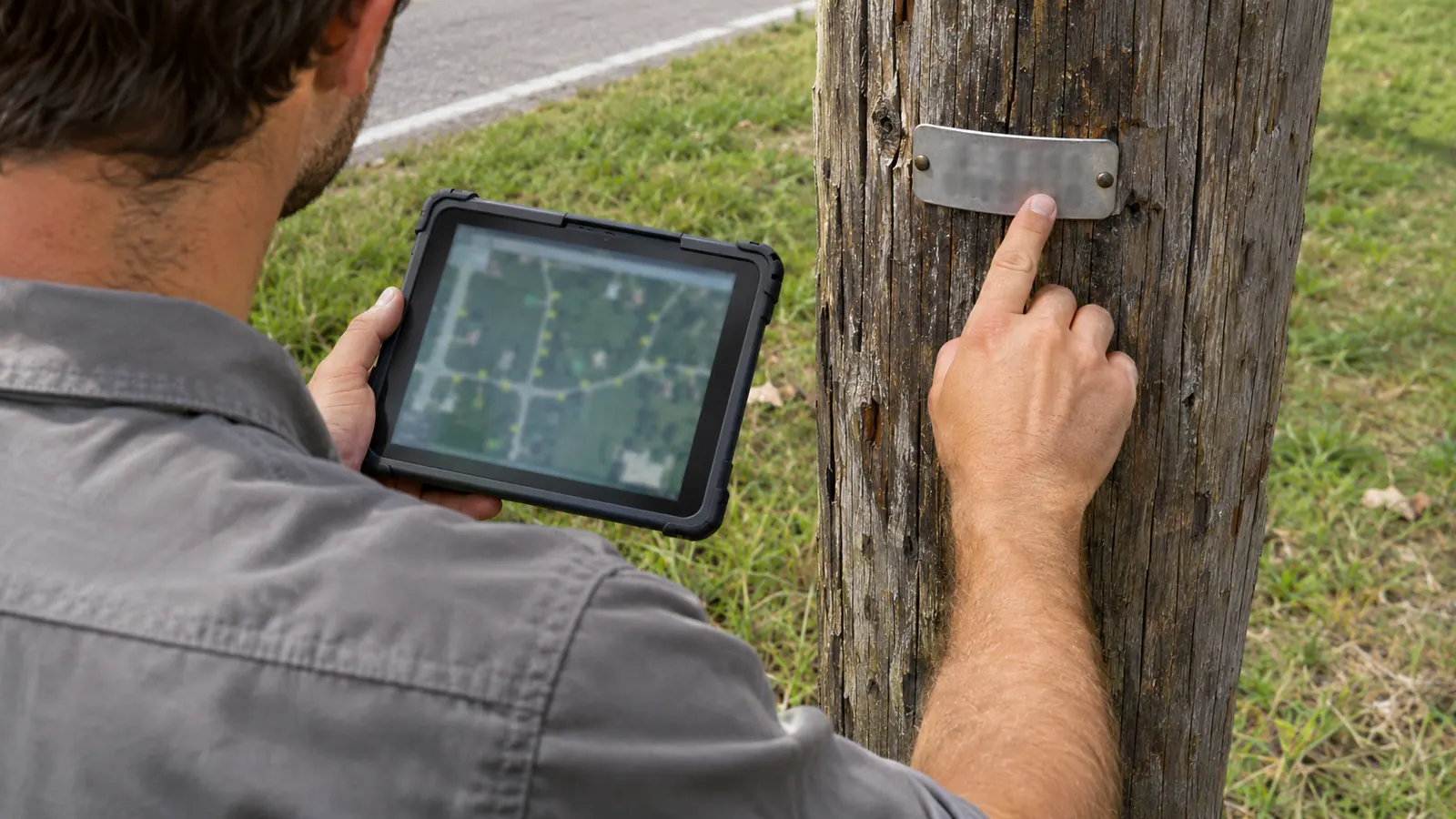
Pole numbers are the owner's identifiers on pole tags, with no universal format, linking field observations to the owner's asset records. Keep 2 fields separate: the owner ID and your project ID. A pole number establishes which support you mean; other pole markings describe its manufacture, inspection history or attachments.
A readable number can still land on the wrong drawing. A survey point moves during drafting, or someone sorts a spreadsheet and separates the tag from its photograph. The characters survive while their connection to the physical support disappears. We treat that connection as part of the survey deliverable, because every later decision needs to describe the same pole.
For an ISP preparing an attachment request, the number connects the proposed work to the owner's inventory. For a utility or co-op maintaining a map, it connects a field observation to an existing asset. We start with the owner's identifier and retain the evidence behind it. The receiving team should be able to follow that evidence without asking the field technician to reconstruct the visit.
Pole tag meaning depends on its purpose
An owner tag identifies an asset; a wood-pole brand describes the manufactured pole. Manufacturing information can also appear on a metal plate, so the material of a marker does not establish its purpose. Read the content before assigning a field name. Our guide to the parts of a utility pole places these markings within the larger structure without treating every visible number as an owner ID.
The first useful question is who issued the mark. An owner identifier may contain letters or punctuation, and its layout can change across an inventory. We preserve those characters in the raw transcription. A numeric-looking identifier belongs in a text field, because removing a leading zero can change the value a receiving record system expects.
An address or a map point can help locate a support, but neither supplies a missing owner number. If the marker cannot be read, record that condition and preserve the location evidence for reconciliation. Leave the ID unresolved. A plausible guess is difficult to detect once it appears in a clean application table.
Keep field readings separate from interpretations
We distinguish what the photograph shows from what someone believes the characters mean. The raw reading stays unchanged when the owner later confirms an identifier; the confirmed value belongs in a separate field with a reference to that confirmation. That separation lets a reviewer understand why the final package differs from the original capture.
Consider an illustrative transcription with a character that could be a zero or the letter O. Record the uncertainty explicitly. When both forms exist in the owner's records, choosing the closest map point does not settle which tag the technician photographed, especially where supports stand close together. Our preferred response is an evidence check before the value becomes a drawing label.
Field identity checks for duplicate tags, retired stubs and an owner ID beside a project ID belong in the utility pole inspection workflow.
Read pole markings by the record they describe
The table separates four kinds of information a field team may encounter. Its purpose is to decide where each reading belongs, rather than to prescribe a universal arrangement of tags on a pole. We keep the source photograph attached to the entry so that a reviewer can inspect the mark instead of relying on our interpretation alone.
Different markings answer different questions. A project can need manufacturing information for engineering while also needing the owner number for the attachment request; those needs do not make the values interchangeable, even when both appear beside each other in a field form. Read each in its own context. An empty field is preferable to a confident value copied from the wrong marker.
Decide where each type of information belongs before transcribing a full route. A form with a single field called number encourages the collector to choose whichever marking is easiest to read. We prefer explicit field labels. The owner ID can remain unresolved while a readable brand is retained in the manufacturing attributes, without creating a false asset match.
The recipient also needs to know what was searched for in the field. Agree whether the scope calls for every accessible marker or a specific owner tag, and record when that search is incomplete. This keeps a blank inspection field from being interpreted as evidence that nobody has inspected the support.
| Marking | What it describes | How to read it | Where we retain it |
|---|---|---|---|
| Owner number or asset tag | The owner's pole record | Preserve the complete identifier and confirm the issuing owner | Owner ID field with the tag photograph |
| Wood-pole brand | Manufacturing and treatment information | Decode the visible brand using the applicable legend | Separate pole attributes with the raw brand image |
| Inspection tag | An inspection or treatment event | Read dates and codes under the issuing program's legend | Inspection reference without assuming current acceptance |
| Attachment tag | An attacher or associated equipment | Match the tag to the particular facility it identifies | Attachment record tied to the pole |
Owner numbers and tags
The owner's numbering convention governs the asset ID. Do not infer a district or installation sequence from a prefix unless the owner confirms that meaning. Some values look geographic. That appearance alone does not make them coordinates, and a neighboring tag cannot supply a missing character through an assumed counting sequence.
We capture the full tag, including any nearby indication of its issuer, before transcribing the identifier into the agreed field. A close view should show the characters; a wider view should establish which support carries them. Both views matter. A sharp crop of a plate gives the reviewer little help if its relationship to the pole is lost.
Wood-pole brands under ANSI O5.1
ANSI O5.1-2022, Wood Poles: Specifications and Dimensions, is the current edition listed by Accredited Standards Committee O5. The North American Wood Pole Council's wood-pole FAQs describe manufacturing marks that identify the supplier and treating plant, treatment year, wood species, preservative, class and length. The information can be branded into the wood or embossed on a recessed metal tag.
Read a brand against its applicable legend. Class and length describe different properties; the marked length refers to the manufactured pole, including the portion set below ground. We keep measured aboveground height separate. A treatment year also needs its own label, because it does not establish the date the pole entered service at its present location.
The brand supports engineering input checks. It cannot establish the pole's current condition or demonstrate that a proposed attachment is acceptable, so our field record preserves the readable attributes without turning them into a loading conclusion. If the brand is incomplete, retain the visible text and the photograph. Request supporting records for the missing attributes.
Inspection tags
An inspection marker can refer to a visit or a treatment operation. Its date and symbols have meaning within the issuing program, and we ask for that program's legend before interpreting an unfamiliar mark. Photograph the entire marker. A punched date without its headings can be ambiguous when the image is separated from the pole.
We retain an inspection tag as a reference to supporting records. It does not provide the full inspection report or settle present suitability for an attachment, particularly when the field survey identifies a condition that needs the owner's attention. Record the visible condition independently. The owner can connect it to the inspection history and determine the required response.
Attachment tags
An attachment marker may identify the party associated with a cable or equipment. Follow the marker's physical association from a safe ground position before assigning it to a specific attachment record. Nearby facilities can belong to different parties. A label on one cable should not be copied across all communication facilities on the pole.
We record uncertain attachment ownership as unconfirmed and keep the photo available for clarification. The attachment ID stays subordinate to the pole record, where its measured height and observed type can be reviewed together. Tag presence alone does not establish permission to attach. The owner's acceptance records remain necessary for that determination.
Capture pole numbers with the survey measurements
Fielding should produce a connected record, not an album and a separate list of numbers. Before collection starts, we agree on the owner ID field and the receiving team's measurement conventions. The field technician needs to know how to record an unreadable value and where to attach evidence that requires review. Those choices belong in the collection instructions.
Build the record around the physical support
Our ground-based survey captures the tag or owner ID with the pole measurements and photographs. Height readings need an identified reference, and attachment observations need to point to the support where they were taken. We keep span measurements connected to their endpoints. A span describes the relationship between poles, so a record attached to only one unidentified end leaves the engineer with an avoidable question.
Use the same pole reference while capturing each observation. Creating the tag record at the pole and assigning photographs later from memory invites a mismatch when the route contains similar supports. We recommend checking the image association before leaving the location. That check can catch a legible photograph stored against the wrong survey point while the technician still has the field context.
Capture tip: Keep an unedited source photograph for each tag reading. A cropped image can help a reviewer see the characters, but the source view preserves the surrounding context used to associate the mark with its support.
Preserve uncertainty through the handoff
A missing tag and an unreadable tag deserve different entries. In the first case, the technician did not find a marker within the accessible observation area; in the second, the marker was present but its characters could not be established. We retain that distinction. It tells the receiving team whether to request another reading or seek identification through the owner's records.
The limitation of our ground-based approach is that an obscured tag can remain unreadable even when the pole and its attachments are visible. State that gap plainly. Do not alter a marker or reach into equipment to complete a form; the unresolved identifier needs an agreed follow-up through the owner and the authorized field scope.
We also separate observed values from values supplied by the owner. If the owner provides a number after collection, the package should identify it as a record-based confirmation rather than imply that the field photograph clearly showed it. Preserve the original observation. A reviewer can then understand both the accepted identifier and the evidence available at capture.
Check the exported record
An export can damage an identifier without changing the underlying field capture. Text converted to a number may lose its leading zeros, and a spreadsheet may display a long value in scientific notation. We check the exported owner ID against the source reading before delivery. Review the actual file the receiving team will use.
Our intake check also follows a photograph back from the exported pole record. The image reference must work outside the collector's original workspace, where a local file path or a session-specific link may no longer open. Test the handoff itself. A package is easier to use when the recipient can inspect the evidence directly from the delivered records.
Carry the identifier into applications and make-ready
The application needs a stable relationship between each requested attachment and the owner's pole record. The pole list in an attachment application should use the confirmed owner identifier while retaining the project's separate drawing reference. We carry that relationship forward when design revisions change the route or the scope of work.
Attachment applications
We check the application against the field record before submission. The photograph and the proposed attachment should resolve to the same physical support, even when the receiving form uses different column names from the survey export. Preserve the agreed mapping between those fields. Renaming a column is harmless only when its meaning stays the same.
An unresolved owner number should remain visible to the person preparing the submission. Do not hide it behind a project label that looks complete. Ask the owner how to identify the support in the request and retain the response, so the application uses an accepted reference rather than an undocumented substitute selected by the applicant.
Make-ready packages
Make-ready drawings need the same owner ID used in the application. We retain the project reference beside it so the design team can follow sheet callouts without replacing the owner's identifier. A calculation or work note must resolve to the intended support. Otherwise a correct engineering result can be applied at the wrong location.
Our make-ready engineering uses field information to develop the pole-specific work package. The ID gives that package a stable reference; the observed geometry and engineering determine what work is required. Engineering is 100% in-house at Draftech. A readable tag starts the connection, but the measurements still have to support the design.
Revision tip: When a drawing label changes, update the cross-reference to the owner ID in the same revision. Keep the prior label in the revision history so an earlier application comment can still be traced to the correct support.
As-builts and changed supports
A replacement pole can change the relationship between an approved drawing and the installed support. Record the identifier assigned to the replacement and retain its connection to the prior asset under the owner's convention. Do not silently overwrite the old value. The closeout reviewer needs to understand which support carried the approved work and which support remains in service.
We recommend checking the final owner ID against the installed condition before closing the record. Retained attachments may move during construction, and the final documentation should describe their actual support rather than simply inherit the preconstruction association. The as-built record should make that change traceable. A drawing revision alone does not show what was observed after the work.
Historical references still serve a purpose after replacement. Keep them searchable without presenting a retired identifier as the current pole number, because maintenance staff may later receive a work reference created before the change. The owner determines the asset naming convention. The closeout package should preserve the history needed to apply it consistently.
Choose the next step for your pole records
For ISP attachment teams: Resolve owner identifiers before treating the application list as ready for submission. Keep a separate project reference for drawings, and assign unresolved readings to a named follow-up. This gives your application coordinator a specific question to take to the owner instead of an apparently complete row with uncertain identity.
For utilities and co-ops: Define which identifier the receiving inventory treats as authoritative and provide the conventions for replacement supports. Make that decision before accepting bulk field records. An inventory update should preserve the relationship to existing asset history, especially where a change in naming could otherwise detach inspection information from the support it describes.
For survey and mapping teams: Test a representative record through the intended export before expanding collection. Confirm that the owner ID stays intact and that its photograph opens from the delivered package. Our recommendation is to settle the receiving format early, because a reliable field reading loses value when the final file changes its meaning.
Draftech International provides turnkey telecom and power infrastructure, with accountable delivery across the project lifecycle. Our partner profiles identify the people responsible for that work. For this scope, start with a ground-based field survey built around the pole records your receiving engineer needs. The collection package should answer the identification questions that would otherwise interrupt engineering intake.
When tag readings and measurement records do not agree, our pole data collection service captures the tag or owner ID, heights, attachments, spans and photos in a connected field package. Contact us about your collection scope, or email info@draftech.com, with the available records and receiving requirements so we can define the handoff around those gaps.
For a qualifying route, Draftech engineers the first 20,000 linear feet at no cost, from feasibility and field survey through permit approval. Our free engineering offer gives you a way to bring those early identification questions into the route's engineering package; the owner reviews each request before Draftech commits the package.