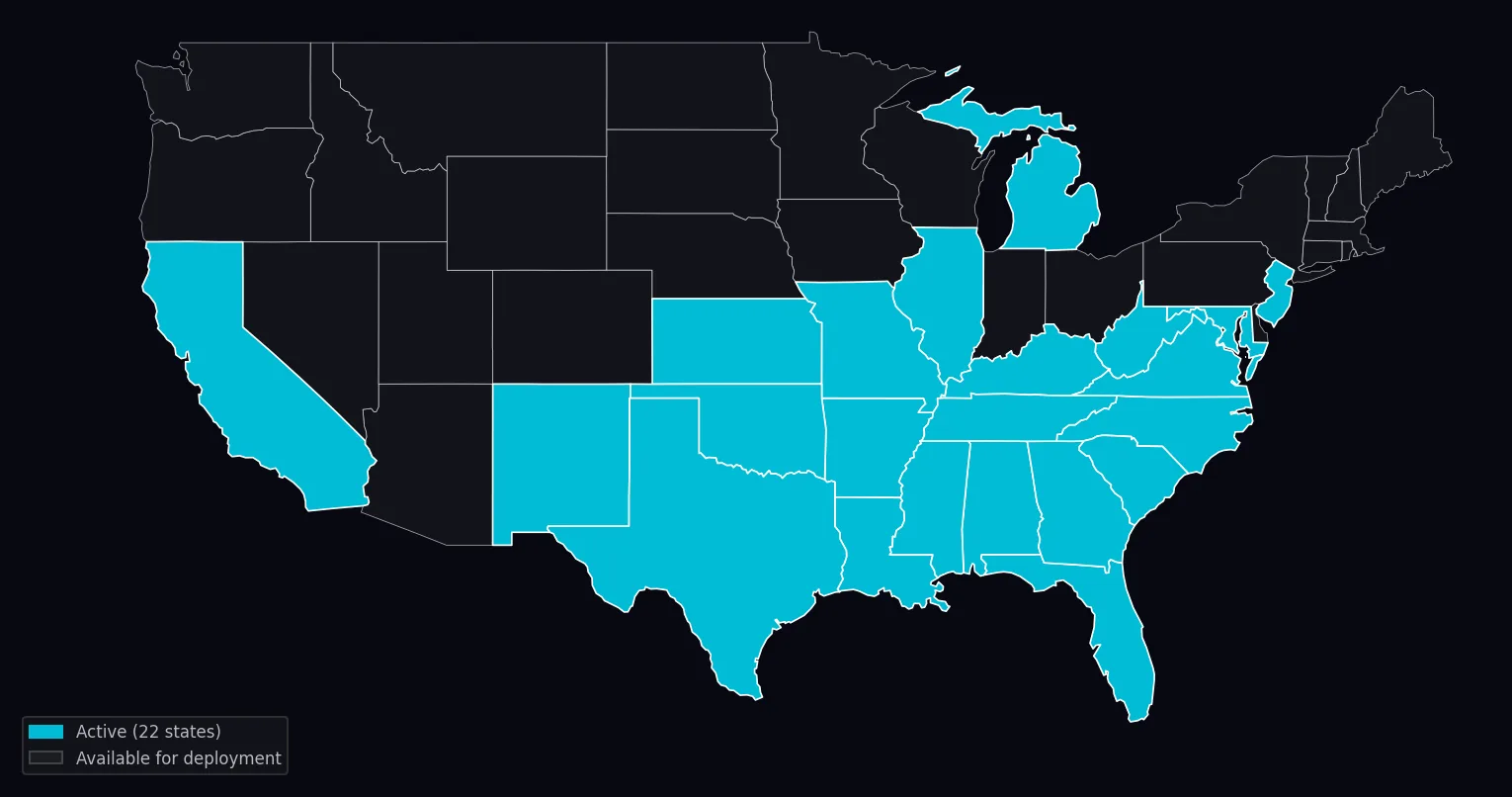
Explore the funding map and state guides further down this page to connect BEAD funding details with engineering plans for your build. We help ISPs, electric cooperatives and subgrantees turn awarded locations into fiber routes, pole attachment packages and permit drawings. Active in 24 states. Available across all 50 U.S. states.
NTIA announced the last final proposal approval on August 25, 2026, completing approvals for all 56 states and territories. Subgrant agreements are being signed state by state, so an approved proposal alone does not establish a project's construction schedule. We use the awarded locations, agreement requirements and state submission formats to define the engineering work needed before crews can build.
An award identifies the locations to serve; engineering establishes how fiber reaches them. We develop routes through field survey, pole loading analysis, make-ready design and permit coordination, then prepare construction-ready drawings that reflect those findings. Our BEAD engineering services connect the funded scope to the design packages and records a subgrantee needs through construction and closeout.
A route can cross several approval jurisdictions before it reaches the next group of homes. Florida's FDOT and Texas's TxDOT govern work within their respective state road rights-of-way, while county roads and tribal lands introduce separate coordination. In New Mexico, Oklahoma and Montana, identify tribal permitting needs during route planning so the design schedule accounts for each authority's review.
Construction changes must carry through to the network records used for closeout and maintenance. We reconcile the installed route with the design and prepare GIS deliverables with attributes such as fiber count, conduit type, splice locations and fiber distribution hub placement. The state's submission requirements guide the package format, while the owner's network record needs guide its continuing use.
Rock and steep slopes in West Virginia and Kentucky affect aerial span analysis and underground bore planning. Florida and Louisiana bring hurricane hardening and saltwater corrosion into aerial design decisions, while agricultural drainage complicates some Midwest boring routes. We evaluate those conditions during field survey and route development to identify where the proposed construction method needs adjustment before drawings are issued.
Use the state guides to connect funding status with the physical work ahead. Each guide brings together the program's October 2026 position, permitting authorities and regional engineering conditions, helping you identify which award records, utility information and route data to gather before we scope the design effort for your build.
Request a State Proposal Read Our BEAD Engineering BlogThe Infrastructure Investment and Jobs Act established the $42.45 billion BEAD program; in June 2023, NTIA allocated $41.601 billion to the 50 states, DC and five territories, with $40.863 billion going to the 50 states. NTIA's June 2025 "Benefit of the Bargain" restructuring required states to reselect subgrantees. As of October 9, 2026, NTIA has approved $18.150 billion for deployment across the 50 states, and every state's approved deployment total is below its original allocation. Select a state on the map or in the list below it to open its guide showing the original allocation, approved deployment funding, approval date, funded locations, technology mix and subgrantees.
We keep engineering 100% in-house, connecting field survey findings to route design, make-ready packages, permits and as-built records. When the scope includes construction, we offer full turnkey construction through Draftech-managed crews under our QA/QC and safety program. That gives the owner a single point of accountability for carrying the engineered route through the work in the field.
Start with the state that holds your award or planned service area. Its guide pairs BEAD program details with terrain, utilities and permitting authorities, so you can assess the route's engineering needs in context. For a build spanning state lines, review each guide against the portion of the network in that jurisdiction.
Choose the state of your build in the form below, then send your location list, available route files and known pole or permitting issues. We will review those materials to identify what is ready for design and what needs field verification, and we will respond within one business day.
Awarded a BEAD subgrant? Claim Your Free Design Segment
Or reach us directly: info@draftech.com | 305-306-7407
Active in 24 states. Available across all 50 U.S. states. Certified MBE.
NTIA's original allocations include Texas ($3.313B), California ($1.864B) and Missouri ($1.736B). Those figures describe the funding allocated to each state, rather than its approved deployment total. Each state guide separates these amounts in its opening BEAD panel and identifies funded locations, technology mix and subgrantees. Use those deployment details to understand the approved build's scope.
Yes. We can review a proposed build in any U.S. state, including one where we do not currently have an active project. Bring the awarded location list, grant requirements and available infrastructure records to the scoping discussion. We assess field survey needs, permitting jurisdictions and pole attachment work before establishing the engineering deliverables and schedule.
We support independent ISPs, electric cooperatives, municipal broadband providers, tribal providers and cable operators expanding into fiber. A BEAD subgrantee can engage us for route engineering, make-ready and pole attachment packages, permit coordination, construction drawings and closeout records. For tribal service areas, we include tribal permitting coordination in the route planning discussion so it informs the scope from the start.
Confirm the awarded locations and agreement status with the state broadband office. NTIA's July 14, 2026 request called for removing satellite locations shown as served or non-residential on the new FCC map. Its September 3, 2026 Supplemental Deployment Policy Notice opened a second round for missed or newly unserved locations using roughly $21 billion in savings; other uses await NTIA guidance. Establish which locations belong in your design scope before scheduling surveys.
The state's required fields and submission format determine how we organize the network data. We prepare attributed shapefiles and geodatabases covering the specified route, fiber, conduit, splice and hub information, then check the package internally against those requirements. Aligning the records with field changes gives the broadband office and network owner a consistent account of what was constructed.