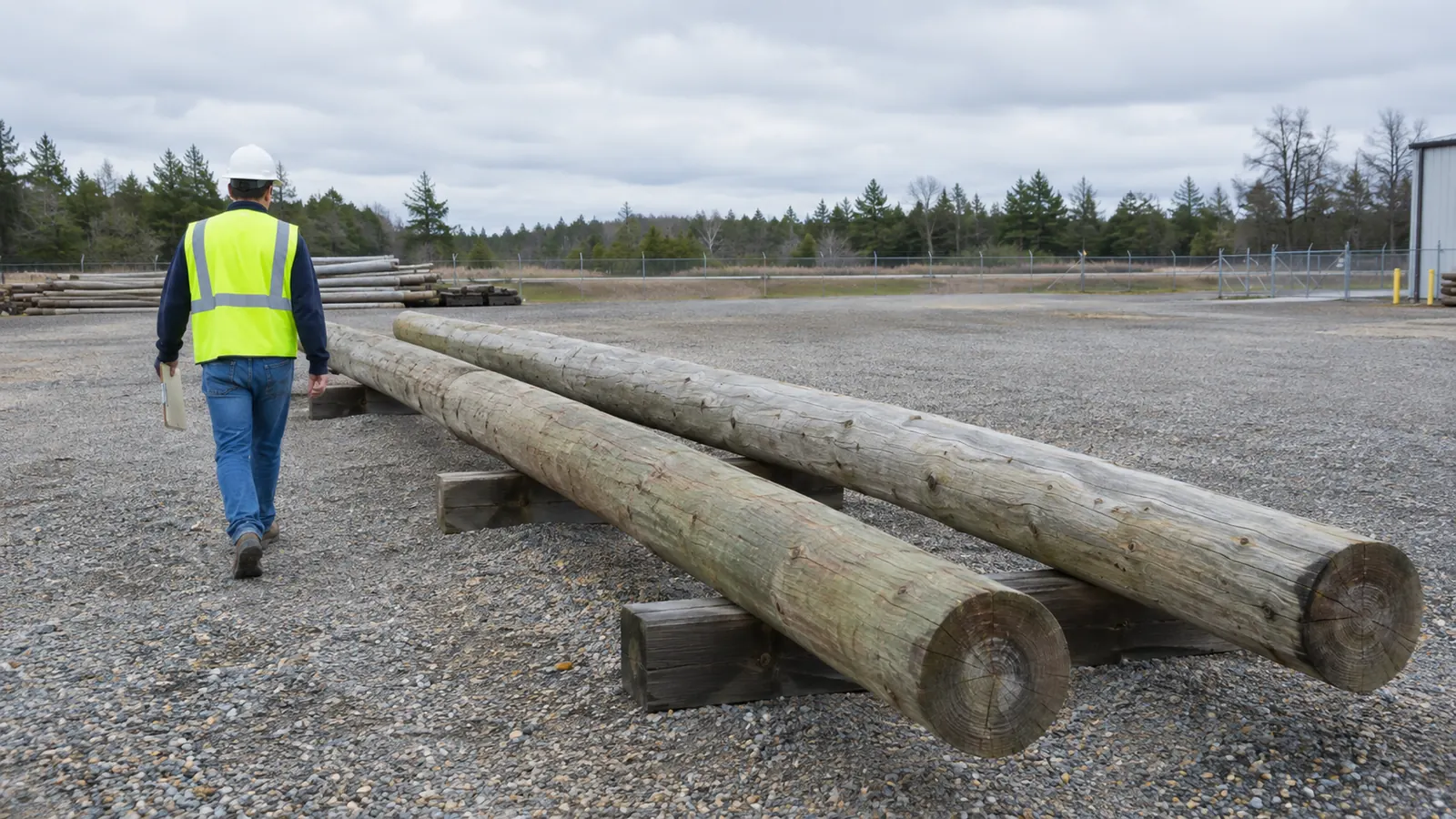
A make-ready note that says replace with Class 3 does not say which species, which length or which circumference table that class came from. The loading file then inherits a catalog pole that may not be the pole in the ground, and the construction sheet repeats the same blank.
This page uses ANSI O5.1-2022, Wood Poles: Specifications and Dimensions, approved August 18, 2022 by the American National Standards Institute. Accredited Standards Committee O5 developed it, and the American Wood Protection Association publishes it. As of September 2026 it remains the edition in force. We stay on single-pole distribution classes. H-class tables and H-frame structures stay off this page.
Read the 2022 edition before you pick a class
An ANSI O5.1 pole specifications guide maps wood-pole class, length and species to the minimum circumference at 6 ft from the butt and at the top, plus the designated fiber-stress value that sizes that class. ANSI O5.1-2022, approved August 18, 2022, is the edition in force as of September 2026.
The 2022 text describes the poles as simple cantilever members subject to transverse loads only. That sentence is the structural premise of the class tables. It is not a permission to skip guyed, dead-end or angle conditions in the loading model. Fiber-strength values in the standard apply only to poles that meet or exceed the minimum quality specifications. A pole that fails a defect limit is not a Class 4 pole with a discount. It is out of spec.
ANSI O5.1 pole specifications guide starts with the 2022 edition
ASC O5 still lists ANSI O5.1-2022 as current. ANSI O5.2-2025, approved September 2025, covers glued-laminated timber for utility structures. That later document does not withdraw the solid-sawn pole specification. We record O5.1-2022 on the criterion sheet and we do not back-date a model to a 2017 or 2015 circumference table because a yard still has the old printout.
The 2022 revision is the edition that added Modulus of Elasticity values next to the fiber-stress table. The North American Wood Pole Council Technical Bulletin Wood Utility Pole Design Values in the NESC reprints that combined table so designers have one public source for both numbers. If a model still carries a 2017 fiber-stress row and a silent MOE default, the section is not on the 2022 basis even if the class number looks familiar.
Our NESC compliance engineering services guide is where adopted safety-code edition and owner construction criteria live. ANSI O5.1 is not the NESC. It is the wood-pole specification the loading model reads for section and designated strength. Mixing the two into one unlabeled Class 3 note is how a reviewer loses the trail.
Class is a horizontal load, not a brand size
Class is a horizontal-load rating applied 2 ft from the tip. A Class 4 pole is sized so that load is 2,400 lb. A Class 2 pole is sized for 3,700 lb. The class number is not a diameter, a mill brand or a length. Length is a separate selection. Species is a separate selection. The tables then give the minimum circumferences that make that class load work for that species and length.
| Class | Horizontal load 2 ft from tip | Min top circumference | Min circumference 6 ft from butt |
|---|---|---|---|
| 1 | 4,500 lb | 27 in | 41.0 in |
| 2 | 3,700 lb | 25 in | 38.5 in |
| 3 | 3,000 lb | 23 in | 36.0 in |
| 4 | 2,400 lb | 21 in | 33.5 in |
| 5 | 1,900 lb | 19 in | 31.0 in |
| 6 | 1,500 lb | 17 in | 28.5 in |
Those 40-ft Southern Pine and Douglas-fir rows are the ones we use most on distribution make-ready. Class 7 exists on shorter lengths. Classes 9 and 10 exist for lighter communications-only structures. We do not put them on this table because a fiber overbuild on a joint-use distribution line almost never starts there. H-class poles stay out for the same reason. They are not the distribution replacement we specify from a make-ready model.
Class load is applied 2 ft from the tip
The 2,400 lb Class 4 figure is not the groundline moment and it is not an NESC wind case. It is the classification load that, combined with designated fiber stress, produces the minimum circumference at 6 ft from the butt. A 40-ft pole with a 6 ft setting has 32 ft from groundline to the load point 2 ft below the tip. The class tables were built so each species in that class can support that horizontal load. They were not built so a designer can skip the loading district, the ice case or the owner construction standard.
Top circumference is fixed by class, not by species. Class 4 is 21 in at the top whether the pole is Southern Pine or western red cedar. The 6-ft-from-butt circumference is what changes when fiber stress changes. That is why a Class 4 cedar is a fatter pole than a Class 4 Southern Pine of the same length, and why a class stamp without a species is not a complete specification.
Measure circumference where the standard tells you
The classification point is 6 ft from the butt. It is not groundline, and it is not the brand face. For a 40-ft pole the industry setting rule of 10 percent of length plus 2 ft happens to land at 6 ft, so the classification point and the groundline coincide on that one length. A 45-ft pole sets at 6.5 ft. A 50-ft pole sets at 7 ft. The 6-ft circumference then has to be adjusted along the taper before anyone talks about groundline stress.
One thing I still catch in our own models is copying the approximate groundline-distance column as if it were a setting-depth spec. ANSI O5.1-2022 states that those figures are not recommended embedment depths. They exist so scar, straightness and similar quality rules have a defined groundline when a definition is needed. Setting depth remains an owner or construction-standard decision. Treating the column as an embedment table is a reading error, and we have made it.
The 6-ft-from-butt point is the classification measurement
A field tape around the pole at chest height is not an ANSI class check. The measurement that classifies the pole is 6 ft up from the butt, taken as circumference, against the species-and-length row in the 2022 table. Top circumference is the second required dimension. We record both. A pole can meet the 6-ft minimum and still fail the top minimum, and the other way around.
Photographs of a brand face help identify the mill mark and the claimed class. They do not replace the two circumference readings. If the brand says Class 4 and the 6-ft tape reads under the species minimum, the loading input is the measured section, not the stamp. Our pole attachment structural analysis guide is where that measured section becomes a model object. The specification only tells you what the new or claimed class was supposed to be.
For RUS-financed distribution work, treated-wood construction units still have to land on a real class and a named species. Our RUS compliant engineering services guide is the bulletin and Form 236 path. ANSI O5.1-2022 remains the dimension source underneath those units. We do not let a 1728F unit code stand in for a missing circumference.
Fiber stress belongs to the species
Designated fiber stress is a species value, conditioned for the seasoning method the standard already accounts for. ANSI O5.1-2022 and the North American Wood Pole Council reprint give Southern Pine and coastal Douglas fir 8,000 psi. Western larch is 8,400 psi. Lodgepole pine and red pine are 6,600 psi. Western red cedar and ponderosa pine are 6,000 psi. Northern white cedar is 4,000 psi.
That is why two poles with the same class number are not interchangeable. A 40-ft Class 4 Southern Pine needs 33.5 in at 6 ft from the butt. A 40-ft Class 4 western red cedar needs 36.5 in at the same point to carry the same 2,400 lb classification load at the lower 6,000 psi designation. Ordering a cedar Class 4 to replace a Southern Pine Class 4 without checking circumference is not a like-for-like change. It is a different section.
Fiber stress is a species value
MOE arrived in the 2022 table as a mean value beside those fiber-stress rows. Southern Pine is listed at 2.13 million psi. Coastal Douglas fir is 2.38 million psi. Western red cedar is 1.43 million psi. A deflection-sensitive attachment, a long span or a joint-use communications underbuild can care about that number even when the class load is unchanged. If the model still uses a single default MOE for every species, the 2022 table is not actually in the file.
We do not pick a mill. We pick a species group the 2022 table recognizes, then we write class, length and the two circumference minima on the replacement sheet. Conditioning method (steam, kiln, Boulton, air) is already folded into the designated values. Recalculating fiber stress from a green-wood handbook is how a designer leaves the standard without noticing.
Self-critical note: we can over-trust a catalog Class 4 because the software fills species and circumference from a library. That library is only as current as the edition it was built from. We now force the criterion sheet to name ANSI O5.1-2022 and the species before the replacement class is issued. Both circumference minima go on that same sheet.
Pick replacement class from the loading result
Class on an existing pole is a loading input. Class on a replacement pole is a loading output. Those are different jobs, and we keep them on different rows. The existing pole contributes measured or branded class so the model has a section, plus species, length and the two circumferences. Proposed attachments then decide whether that section holds, once NESC load cases and the owner criteria are applied. If it does not, the replacement class is whatever section carries the proposed condition, not a one-class bump from the stamp that failed.
A one-class bump is a habit, not an analysis. Moving a failing Class 5 to a Class 4 can still fail if species, length or guy geometry did not change. Moving it to a Class 3 can be oversized if the governing case was a missing guy rather than a thin pole. Our pole loading analysis runs the proposed condition first, then writes the replacement class from that result. The 2022 table supplies the section. It does not pick the class in advance of the loads.
ANSI O5.1 pole specifications guide for replacement class
The replacement sheet we issue names class and length, then species, both circumference minima and the ANSI O5.1-2022 basis. Setting depth is taken from the owner construction standard, not from the groundline-distance column. If the owner has a preferred species, that preference is an owner criterion and we label it that way. It is not a secret upgrade of the designated fiber stress.
Make-ready that includes a pole change still has to close as a facility instruction, not as a note to bring the pole into compliance. Our make-ready engineering package carries the replacement class into the construction revision with the same pole identifier the loading file used. A new pole that arrives with a new owner tag keeps the old-to-new relationship on the index. Losing that link is how a Class 3 gets set on the wrong hole.
I would rather hold a replacement class than issue a Class 3 note that does not name species or length. The yard will fill the blanks. The model will not match what gets set. Holding the class until those two fields are written is slower on the first day and cheaper than restaking a pole that was never the section we analyzed.
Recommendation: who specifies class, length and species
For a cooperative replacing storm-broken distribution poles, the class call should come from the proposed load case on that circuit, not from the class stamp on the broken stick. Write species from the owner's standard, length from attachment height and setting depth, and both circumference minima from the 2022 row that matches those three. Do not order by class number alone.
- Overbuilder on existing joint-use plant: treat branded class as a hypothesis. Measure the 6-ft circumference where it can be reached, or hold the pole and run the model on a stated assumption. Do not upgrade class in the application because a catalog default looked light.
- Cooperative or municipal owner buying replacements: specify class, length, species and both circumference minima on the purchase sheet, citing ANSI O5.1-2022. A Class 4 line with no species is not a bid item a mill can fill without guessing.
- Program with mixed Southern Pine and cedar: keep species on the same row as class. A cedar Class 4 and a Southern Pine Class 4 are not interchangeable sections at 40 ft, and a mixed-species yard will ship the one it has if the sheet is silent.
Draftech's engineering on this work is in-house. We write the class sheet from the loading result and the 2022 tables. We do not sell poles and we do not name mill brands. When construction is in scope, full turnkey setting is delivered by Draftech-managed subcontract crews under our QA/QC and safety program. Crews set the specified pole. They do not pick the class.
Read the replacement note as if the loading file were closed. It should still name class, length, species, both circumference minima and ANSI O5.1-2022. A phrase such as Class 3 or better is not a specification. The receiving engineer should be able to order the pole, or reject it, from that sheet without calling the original designer.
Before releasing a full replacement package, an owner can test Draftech on a qualifying route. Through our free design offer, Draftech engineers the first 20,000 linear feet at no cost, from feasibility and field survey through permit approval. A Draftech owner reviews each request before we commit the package.
Start with the existing pole's species and the 6-ft circumference, not with a catalog class bump. Ask Draftech to write the replacement class from the loading result, then send the owner construction standard or the missing measurement to the engineering team before the yard is called.