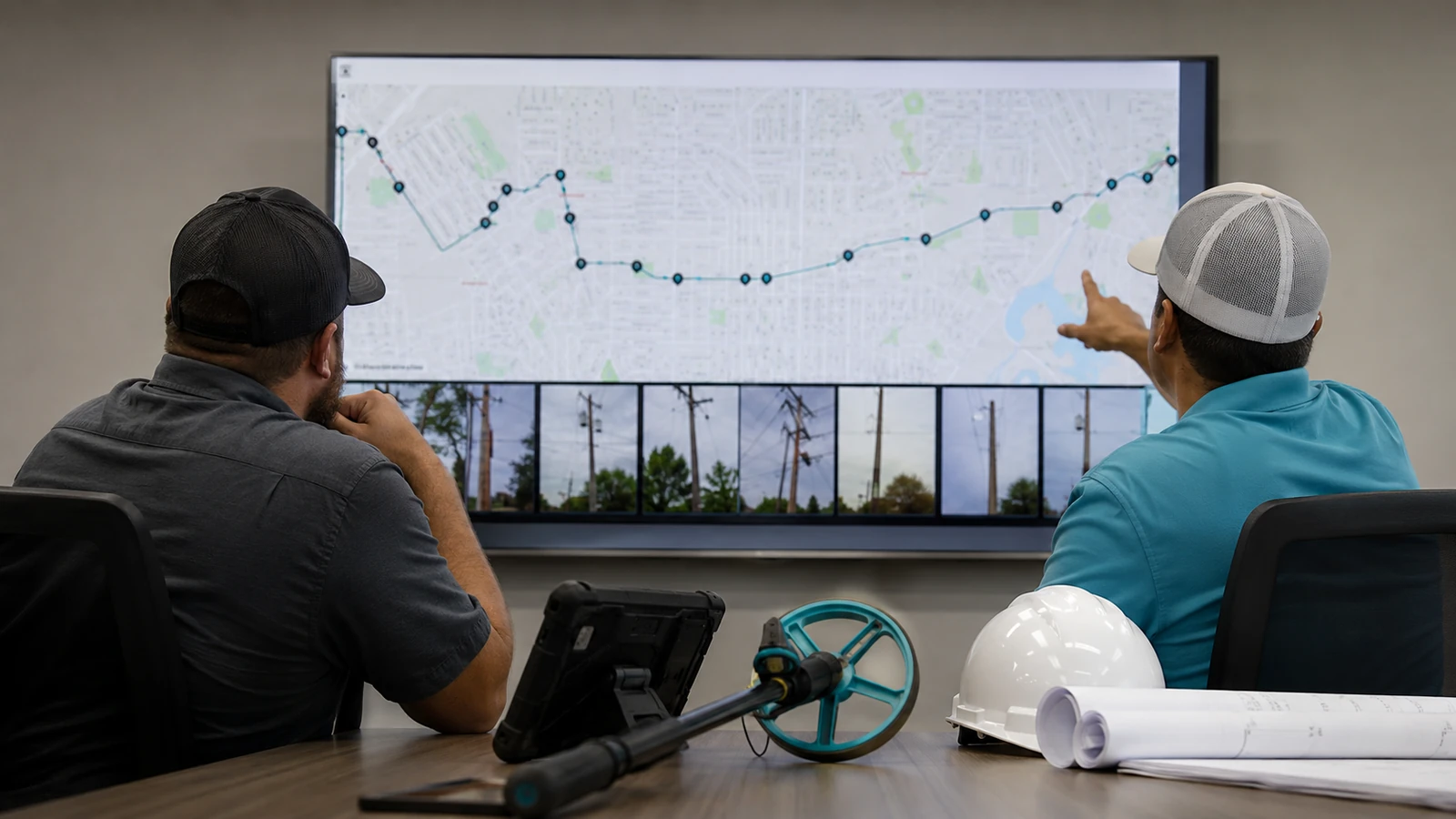
Make-ready delays rarely live in one spreadsheet row. A survey exception can block an estimate, an unpaid estimate can prevent notices and one unresolved power-space move can hold a construction segment whose communications work is otherwise complete. Reporting a route as eighty percent ready says very little about whether a crew can build the next span.
This guide treats make-ready as a pole-specific control process from application through verified closeout. Federal timelines provide useful clocks where they apply, but the pole owner, jurisdiction, agreement and approved work method still govern the actual route. The management job is to make those dependencies visible before they become field surprises.
Aerial Fiber Make-Ready Management: The Core Control
Aerial fiber make-ready management coordinates the evidence, decisions, notices and work needed to create an approved attachment path on existing poles. Under current 47 CFR 1.1411, a covered utility has 10 business days to determine application completeness, but that first clock is only one dependency in a pole-specific route plan.
The controlling federal source is the current 47 CFR 1.1411 timeline. It distinguishes ordinary, mid-sized and large orders; it also separates surveys, estimates, communications-space work, work above the communications space, self-help and one-touch make-ready. Applicability is not universal. State certification, owner status and the governing agreement can place a project under a different process, so we record the authority beside every clock rather than copying federal dates into every tracker.
Management begins with one stable pole record. The application ID, owner pole ID, field ID, proposed design, survey status, estimate line, make-ready scope, notice date, work owner and closeout evidence must stay connected. If a replacement pole receives a new identifier, we preserve the old-to-new relationship. If a route revision removes a structure, we close that record with the design revision instead of deleting it from history.
The route plan should answer a practical question: which contiguous spans can be released for construction without crossing a blocked pole? That requires more than a completion percentage. We track each pole's current gate and the next event that changes it, then roll those records into construction segments. A segment is ready only when its permits, attachment approvals, make-ready work and field-verifiable conditions support the issued design. Prove the state.
Our make-ready engineering explainer separates survey, analysis, design, coordination and closeout. Management connects those disciplines without pretending they are interchangeable. A permit coordinator cannot approve a structural assumption. An engineer cannot declare another owner's transfer complete from a design note. Each decision stays with the party authorized to make it.
Schedule control: Put the authority, start event, due event, responsible party and evidence of completion beside every clock. A date without those fields is not a managed deadline.
Make-Ready Gates, Clocks and Evidence
We manage the route through decision gates. Each gate has an entry event and an exit artifact, while exceptions remain attached to specific poles. The table uses the current federal process as a reference where it applies. It is not a promise that every owner follows the same timeline, nor does it compress mid-sized and large-order provisions into ordinary-order dates.
| Gate | Federal reference for covered ordinary orders | Exit evidence | Common hold |
|---|---|---|---|
| Completeness | 10 business days; resubmission review in 5 | Written completeness state | Missing owner-required field |
| Survey and merits | 45 days from complete application | Survey and grant or supported denial | Identity or access exception |
| Estimate | 14 days after survey completion | Detailed itemized estimate | Scope or cost-basis question |
| Communications work | Completion date no later than 30 days after notice | Transfer and inspection evidence | Existing attacher dependency |
| Above-space work | Completion date no later than 90 days after notice | Utility work record | Electric work or outage constraint |
| Closeout | Post-work notices and inspection records as applicable | Accepted final pole state | Damage, code or as-built exception |
Current 47 CFR 1.1411 sets different timing for larger orders. A mid-sized order is above the lesser of 300 poles or 0.5 percent of the utility's poles in a state and extends through the lesser of 3,000 poles or 5 percent. A large order extends above that band through the lesser of 6,000 poles or 10 percent. Advance notice and meet-and-confer provisions also apply. We classify the order before building the schedule.
The clock starts only from its defined event. Application receipt is not the same as a complete application. Survey completion is not the same as estimate acceptance and payment. Notice issuance is not the same as work mobilization. We retain the notice or portal record that proves each start event, then calculate the applicable date under the governing rule or agreement. If the basis changes, the schedule record shows who approved the change and why.
The FCC's 2018 Third Report and Order, FCC 18-111, adopted the federal one-touch make-ready framework for simple work and explained why complex work and work above the communications space remain outside that option. The current regulation is the operational source. Our one-touch make-ready guide covers the eligibility and notice boundary. The order supplies history and rationale, which matters when teams assume OTMR is a universal shortcut. It is not.
The Exception Register
An exception must name the pole, blocked decision, current evidence, responsible party, requested action and release event. Generic labels such as utility issue or engineering hold are too weak. Name the event. A useful entry says that the owner tag conflicts with the application record and identifies the image or owner confirmation needed to close it. This detail lets a coordinator escalate the right question without rereading an entire email chain.
We also separate delay reason from clock status. A pole can be inside an allowed review period and still carry a design risk. It can be past a target date while the parties are properly managing an owner-approved outage window. The dashboard shows both facts. That distinction prevents schedule reporting from turning every open item into owner delay or hiding a real miss behind a broad coordination label.
Scope and Sequence the Make-Ready Work
Survey data must support the scope at pole level. We reconcile pole identity, existing attachments, proposed elevation, span relationships, guys, equipment and observable conditions with the application design. The survey record also identifies access constraints and facilities whose owner cannot be established. We do not assign a transfer to the nearest logo or cable tag by intuition. Ownership uncertainty remains an exception until accepted records resolve it.
Engineering converts those records into discrete work items. Communications make-ready may involve rearranging an existing facility within the communications space. Above-space work can involve electric facilities and demands utility control. Structural work can add support or trigger replacement, while clearance work may alter the proposed attachment elevation. The tracker preserves these scopes separately because they carry different performers, notices, prerequisites and evidence of completion.
Sequencing should follow physical dependencies. A new pole must be installed before transfers to it can close. Electric-space work may need an outage or specialized crew before communications transfers are safe. A riser relocation can depend on underground access. We connect predecessor and successor events at the affected pole, then test the route for contiguous release. The pole loading calculator can provide an early planning screen, but it does not close a structure-specific analysis dependency. A target month attached to every item does not create a sequence.
Estimate and Authorization Control
Estimate review checks that the pole population and scope match the accepted survey. Under current 47 CFR 1.1411, a covered utility's estimate must be detailed and itemized, with pole-by-pole charges where requested except for fixed costs that are not reasonably calculable that way. We keep commercial approval with the authorized party and engineering validation with the technical reviewer. Neither one silently approves the other's questions.
Payment and notice records belong in the schedule because they trigger later work. We preserve estimate version, acceptance, payment confirmation and affected-attacher notice. A revised estimate should not overwrite the earlier basis. Keep it visible. The delta needs a reason and pole list. That history is essential when a route revision removes work, a survey correction adds work or the final invoice differs from the estimate after completion.
Self-help and OTMR require explicit eligibility review, contractor qualification, notice and post-work controls. Current 47 CFR 1.1412 requires contractor qualifications tied to utility safety and operational guidance, NESC guidance where utility guidance is unavailable, applicable laws and utility thresholds. We never let the schedule choose the method. The authorized process and technical classification determine whether self-help is available for a particular scope.
Execute, Inspect and Close Each Pole
Field execution starts from an issued work package. It identifies the pole, facility owner, approved move, sequence, required notices and stop conditions. Redlines capture an approved deviation; they do not authorize the crew to redesign around an unknown condition. If the observed pole or facility does not match the package, the affected work stops and returns through the exception path. Stop there. That discipline is slower for one moment and much faster than repairing an unauthorized move.
Safety controls remain with the employer and authorized utility procedures. The OSHA telecommunications standard, 29 CFR 1910.268, requires training before covered work and addresses overhead-line practices, personal climbing equipment and public work areas. For work more than 4 feet above ground on poles or towers, paragraph 1910.268(g) requires the applicable positioning or fall-arrest system subject to listed exceptions. A project tracker never substitutes for the employer's safety program.
Completion evidence should show the actual pole state. We require the work order reference, completion date, performer, photographs suited to the scope, redline or no-change confirmation and inspection status. A photograph of a truck beside a pole proves very little. Finish the record. The evidence should make the moved facility, new support, transferred plant or replacement relationship clear enough for an independent reviewer to compare against the approved package.
Post-work issues stay pole-specific. Damage, a code concern, an incomplete transfer, an abandoned facility or an as-built mismatch receives its own owner and closure evidence. Federal self-help and OTMR provisions include notice and inspection periods, but the actual project may be governed by a different authority. We schedule the applicable review rather than marking work complete the moment a field crew leaves.
Segment Release
A construction segment is released from the lowest level up. Pole records must show approved attachment status and completed prerequisite work. The issued fiber design must match those conditions, while route permits and traffic controls must also support the planned activity. We then freeze the release revision and identify any open items outside the segment. This keeps a later pole exception from contaminating work that was legitimately ready.
Our make-ready timeline guide explains the separate application, survey, estimate and work clocks in more detail. For management, the crucial point is that a clock report and a buildable-segment report answer different questions. Keep both. One protects procedural accountability; the other protects construction from arriving at a pole whose prerequisite work is still open.
Closeout rule: Release a pole from evidence of the completed state, not from a contractor's verbal completion report or a percentage on a route dashboard.
Aerial Fiber Make-Ready Management Release Decision
Our candid limitation is that management cannot manufacture capacity, safe access, contractor availability, an outage window or another facility owner's response. It can expose the dependency early, preserve the applicable clock and keep unaffected segments moving. Use that record. When the underlying technical or legal decision belongs to the utility, regulator, counsel or existing attacher, we record that boundary rather than promising a date we do not control.
Release by Program Role
For an ISP program manager: fund pole-level status control before construction forecasting. Release contiguous segments only from verified approvals and completed prerequisites. Escalate named exceptions with evidence, a responsible party and an exact closure event. Do not substitute route-level frustration or a broad percent-complete report for a pole-specific request.
For a utility or joint-use administrator: publish the required application fields and keep denials, estimates, notices, scope changes and completion records tied to stable pole IDs. Make the next action and required evidence unambiguous, then preserve the approved revision so field completion can be compared with the intended scope.
Draftech's in-house aerial fiber make-ready management and engineering connects application evidence, pole analysis, work packages, dependency tracking and closeout. That directly addresses the disconnected clocks and ambiguous pole status described above while preserving the owner's decision authority. Construction, when included, is delivered full turnkey through managed subcontract crews under Draftech QA/QC and safety oversight.
If you need a make-ready route converted from scattered portal exports and emails into a pole-specific release plan, email our make-ready team. We will separate technical holds from procedural clocks, identify the evidence needed to close each exception and show which contiguous segments are actually ready for the next owner or construction decision.
Talk to our make-ready team about your pole queue. We can connect applications, engineering decisions, work dependencies and closeout evidence before open poles reach construction.