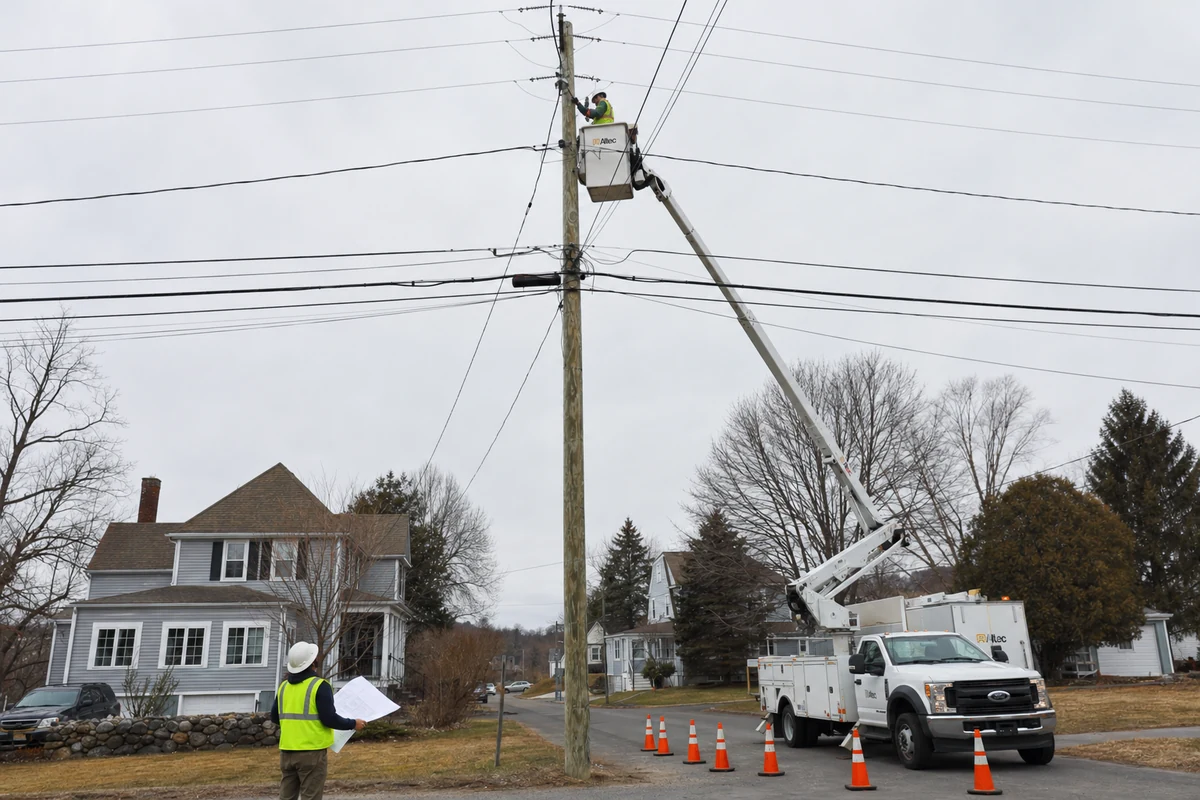
Most fiber builds don't fall behind in construction. They fall behind in make-ready. Make-ready engineering is the process of preparing utility poles for a new fiber attachment, and it's the phase that determines whether your 8-month build takes 10 months or 18. This article explains exactly what make-ready engineering covers, the 5 phases from field survey to clearance, what drives timelines, and who pays for what. If you're a project manager or ISP executive looking at your first aerial fiber deployment, get familiar with this process before you build a Gantt chart, because the schedule you set before make-ready is complete is mostly fiction.
What Is Make-Ready Engineering?
Make-ready engineering is the process of surveying, analyzing, redesigning, and rearranging existing attachments on utility poles so that a new fiber attacher can meet National Electrical Safety Code (NESC) clearance requirements without creating safety violations. Every utility pole has defined vertical zones: power space at the top, a neutral zone, and communications space below. A new fiber cable must fit within compliant spacing in the communications zone, and on most poles that have been around for 20 or 30 years, that space is already occupied.
People often think make-ready is just moving wires. It isn't. It includes structural analysis to determine whether a pole can physically support an additional attachment load, formal permit applications to the pole owner, coordination with multiple entities that may have existing attachments on those poles, and, in cases where poles are overloaded or undersized, physical replacement of the pole entirely. A single route of 500 poles can involve negotiations with an investor-owned utility, two rural electric cooperatives, an incumbent telephone company, and a cable MSO, all with different application processes and different timelines.
Why does make-ready exist at all? Utility poles are privately owned infrastructure. When a telecom company or ISP wants to attach fiber to poles it doesn't own, it has to ask. And before the pole owner agrees, it needs to know the pole can handle the load, that existing attachments won't be compromised, and that the new attachment will comply with NESC clearance standards. Make-ready engineering is the structured process that answers all of those questions: on every pole, across every owner, before a single construction crew shows up with a reel of fiber.
For a detailed look at what these timelines look like in practice, see our guide on the make-ready engineering timeline for fiber deployment. The short version: plan for more time than you think.
Phase 1: Field Survey
Everything starts with boots on the ground. Field survey is the process of walking the proposed fiber route, stopping at every pole, and documenting what's actually there. Not what aerial imagery suggests is there: what is actually physically present. For each pole, a trained field technician records the pole owner, height, class, species, estimated age, and existing attachments with measured heights using a height stick or laser measurement tool. That means every cable, every piece of equipment, every existing violation.
That data goes into a database that directly feeds the pole loading models and make-ready design in Phase 2. The quality of the field survey determines the quality of everything downstream. A field crew that records attachment heights to the nearest foot instead of the nearest inch will produce a pole loading analysis with built-in errors. A crew that misses a cable or records the wrong pole owner creates downstream problems that can delay applications by weeks when the utility finds the discrepancy during its own review.
This is why experienced engineering firms do their own field survey services rather than relying on aerial imagery or desktop work. Aerial tools have improved significantly (they can give you a rough route alignment and approximate pole locations), but they can't tell you the exact height of a cable television drop, the condition of the pole hardware, or whether there's a secondary transformer bracket that changes the load calculation. That information only exists at street level, with a trained eye and a measuring tool.
On a medium-complexity route of 600 poles in accessible terrain, a two-person field crew with good tools and a clean data collection protocol can complete the survey in 3 to 4 weeks. Rural routes with limited road access, mountainous terrain, or dense vegetation run longer: 5 to 7 weeks is realistic. Rushing the field survey to save time is how projects end up repeating Phase 2 after the pole loading analysis reveals gaps in the input data.
Phase 2: Pole Loading Analysis
With field data in hand, the engineering team runs structural models on each pole. The two dominant platforms in the industry are O-Calc Pro and SPIDAcalc. Both apply NESC loading standards to the actual physical parameters of each pole (height, class, species, existing attachments, proposed attachment) to determine whether the pole can handle the new load at the proposed attachment height.
The outcome of pole loading analysis divides poles into three categories. Poles that pass at the proposed attachment height need no rearrangement: the new fiber can go on at the specified height without any structural issue. Poles that fail at the proposed height but pass if attachments are rearranged to different heights need make-ready work to create the required clearance. And poles that fail regardless of attachment position (usually because the pole itself is too old, too small, or already overloaded) need a stub pole added alongside the existing structure or a full pole replacement before any new attachment is possible.
This analysis is what goes into make-ready applications. Every pole loading calculation, every proposed attachment height, every required rearrangement: all of it documented and submitted to the pole owner as the technical basis for the application. A pole loading analysis with errors or missing data is an application that comes back with a deficiency notice. And each deficiency notice typically restarts the utility's review clock.
Our pole loading analysis services integrate directly with the field survey workflow: the same data collected in Phase 1 feeds the structural models without manual re-entry, which eliminates a common source of transcription errors and speeds up the analysis phase by 1 to 2 weeks on most projects. For a comparison of the two major platforms, see our breakdown of NESC pole loading compliance for fiber attachments.
Phase 3: Make-Ready Application
Pole loading analysis results in hand, the attacher files formal attachment applications with each pole owner on the route. This sounds straightforward. It isn't. A single fiber route regularly crosses poles owned by an investor-owned utility, one or more rural electric cooperatives, an incumbent local exchange carrier, and sometimes a railroad or municipality. Each of those entities has its own application process, its own fee schedule, and its own review timeline.
The application package includes the pole loading analysis results, the proposed attachment height for each pole, hardware specifications, and the proposed make-ready scope: what work needs to happen on each pole before the new fiber can go on. Under FCC pole attachment rules, investor-owned utilities (IOUs) have defined response windows: 45 days to complete their survey and provide a cost estimate. That's the rule. Reality varies. Utilities with active joint-use programs and dedicated staff often hit this window. Smaller cooperatives, especially those that aren't under FCC jurisdiction because they're in states with their own pole attachment regulatory frameworks, operate on their own tariff timelines, and some of those take 4 to 6 months to return a survey response.
This is where most timeline surprises happen. You can control how fast you submit a complete, clean application. You cannot control how fast the utility responds. Some utilities in states like Alabama, Georgia, and Mississippi are not under FCC jurisdiction at all, meaning the FCC's 148-day maximum timeline doesn't apply, and there's no federal enforcement mechanism if the utility takes longer. If your route crosses those utilities, build the timeline accordingly.
The utility coordination process is a discipline in itself. Knowing which utilities are responsive, which have backlog issues, and how to structure applications to minimize deficiency notices is something that comes from doing this across enough projects and enough states to recognize the patterns.
Phase 4: Make-Ready Rearrangement
Once applications are approved and make-ready costs are agreed to, the physical work begins. Make-ready rearrangement is the process of moving existing attachments, primarily cable television and telephone facilities, to new heights on the pole to create the required clearance for the incoming fiber cable. On simple poles, this might mean raising a cable TV drop 8 inches. On complex poles with multiple communication attachers, it can mean a multi-crew, multi-day operation to restack everything within the communications space while maintaining all existing NESC clearances.
Who does this work depends on the jurisdiction. In traditional make-ready, each existing attacher on the pole sends its own crew to move its own equipment, sequentially. A pole with cable TV, telephone, and a legacy ISP attachment means three separate crews, scheduled independently, each waiting for the prior work to be completed before they can start. The coordination overhead alone can add weeks.
In One-Touch Make-Ready (OTMR) jurisdictions under FCC rules, the new attacher can hire a single qualified contractor to perform rearrangement on cable and telephone attachments in one mobilization, cutting the sequential crew problem significantly. OTMR applies to "simple" make-ready work on FCC-regulated poles. Complex make-ready (work involving wireless attachments, pole replacement, or equipment that requires specialized knowledge) still proceeds under the traditional process.
Rearrangement on a pole with multiple owners and tight spacing can require multiple crews, multiple days, and re-inspection before the work is certified as complete. Each rearrangement generates as-built data (the actual measured heights of all attachments after work is done) that feeds directly into Phase 5. Sloppy as-built documentation in Phase 4 creates clearance inspection failures in Phase 5. The chain of custody on this data matters.
Phase 5: Final Clearance and As-Built Documentation
Once rearrangement is complete, the attacher or their engineering firm conducts a final inspection of each pole to verify that all attachments, existing and new, meet NESC clearance requirements. This is the validation step. The pole loading analysis predicted what was needed; the rearrangement performed it; the final inspection confirms it was done correctly. When the attacher is a wireless carrier rather than a fiber ISP, the same sequence runs with heavier structural stakes: our wireless make-ready engineering covers attachment programs from loading analysis through utility coordination.
When a pole passes inspection, the pole owner issues a clearance letter. That letter is the authorization to attach fiber to that pole. Without it, the construction crew cannot legally lash cable. Projects that skip or rush this step, or that send construction crews into sections of route before all clearance letters are received, create significant liability exposure and often end up with poles where cable was lashed before clearance was confirmed, requiring forced removal at the attacher's cost.
As-built documentation records the final configuration of every pole in a GIS-compatible format: attachment heights, equipment descriptions, pole owner, GPS coordinates, pole tag numbers. This package is required by most grant programs, including BEAD, for project closeout. It's also the reference document when the next attacher comes along and needs to know what's on the pole. Producing clean, accurate as-built documentation at Phase 5 instead of trying to reconstruct it six months later is worth every hour it takes.
The full as-built package (clearance letters, pole-by-pole records, GIS deliverables) is what closes out the make-ready phase and hands the route to construction. Fiber construction crews lashing cable to cleared poles is the payoff for everything that came before it. Don't shortchange Phase 5 to save a few days.
Who Pays for Make-Ready?
The new attacher pays. That's the rule under FCC regulations and most state telecom frameworks, and it means the ISP entering the market pays for the pole owner's actual costs of rearrangement, including paying for other attachers' technician time to move their equipment. It also means the ISP pays for any pole replacements or stub poles that the structural analysis requires before the new attachment can go on.
Make-ready costs vary enormously based on route complexity. Simple routes with minimal conflicts and no pole replacements might run $200 to $500 per pole. Routes with significant attachment density, older pole infrastructure, or high failure rates on the structural analysis can run $2,000 to $5,000 per pole or more when pole replacements are factored in. Budget shock is common among ISPs who see their first make-ready cost estimate from a utility after assuming those costs would be minimal. The actual numbers are knowable in advance: our make-ready cost per pole breakdown shows what utilities charge and where the money goes.
There are legitimate grounds to push back on make-ready cost estimates that include pre-existing violations or deferred maintenance that isn't actually caused by the new attachment, but doing so requires a detailed review of the pole loading analysis and usually an independent engineering assessment. That's additional time and cost, but it's sometimes worth it on large routes where inflated estimates can add hundreds of thousands of dollars to project costs. For detailed guidance on what these numbers look like in practice, see our breakdown of make-ready cost per pole for fiber budget planning.
"Make-ready is one of the few phases in a fiber build where the timeline is almost entirely outside your control. The pole owner sets the schedule. Your job is to make sure your engineering is flawless going in, because a rejected application adds 60+ days."