- What Actually Drives Make-Ready Cost Per Pole
- Cost Breakdown: Rearrangement, Guy Wire, Pole Replacement, Redesign
- Why Field Survey Quality Changes Your Budget by Millions
- OTMR vs. Standard Make-Ready: When Each Makes Sense
- Why ISPs Consistently Underestimate Make-Ready
- What a Realistic Per-Pole Budget Looks Like
- Frequently Asked Questions
I've sat in more pre-construction budget meetings than I can count where the make-ready line item is a round number someone pulled from a vague recollection of a project two states away. "$500 a pole," someone says. Or "$1,000." And everyone nods, and it goes into the pro forma, and six months later that number is the source of a very uncomfortable conversation with the CFO.
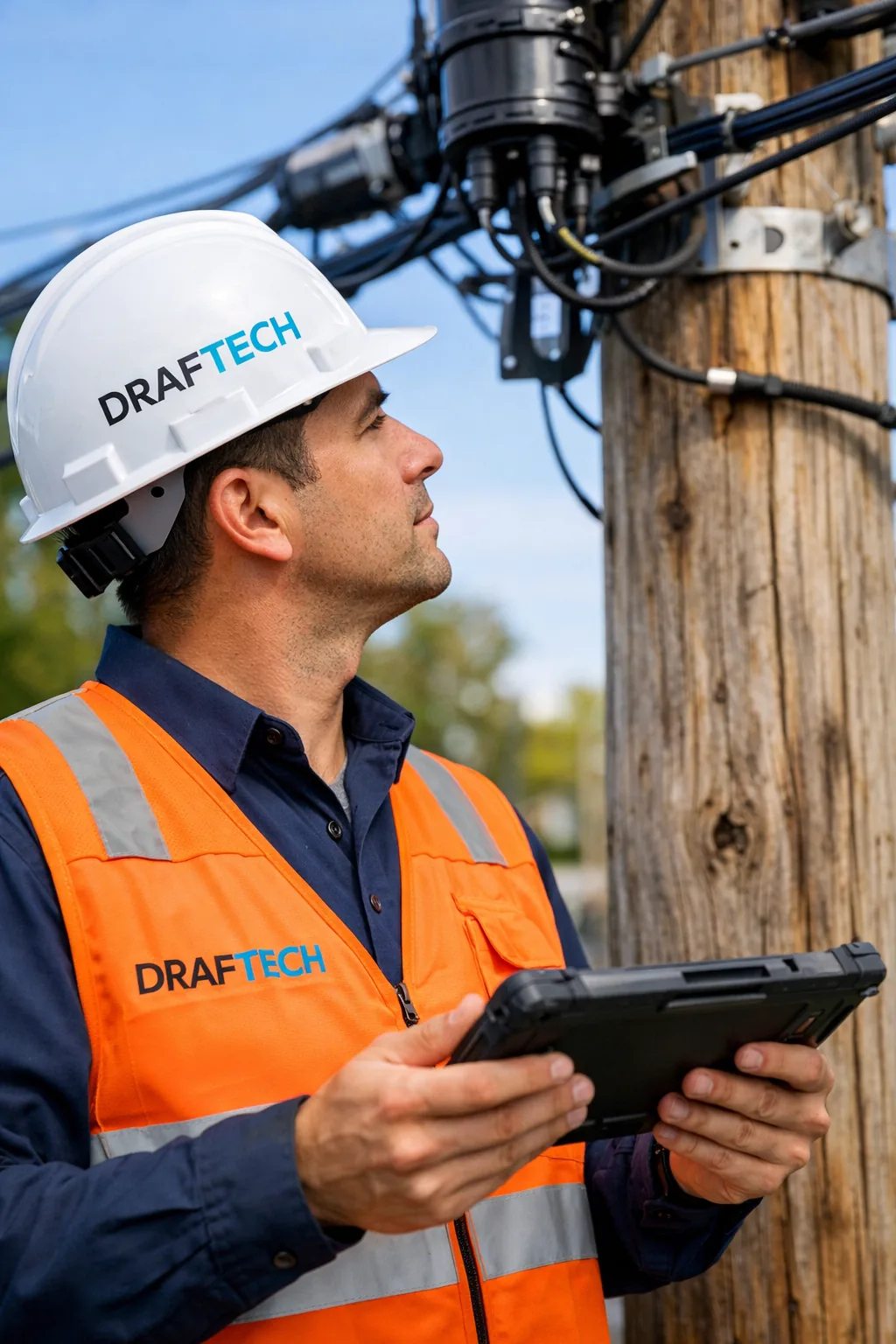
Structural integrity starts before construction. Draftech's pole loading analysis service covers O-Calc Pro and SPIDAcalc analysis, NESC compliance, and joint use applications for fiber attachments across 24 states.
Make-ready cost per pole for fiber is not a fixed number. It's a distribution, and the high end of that distribution is where projects actually live. After 15-plus years engineering aerial fiber across rural Tennessee, coastal Florida, the upper Midwest, and dozens of other markets, I can tell you that budgeting make-ready as a single average figure is one of the most reliable ways to blow your construction pro forma.
This article is about what make-ready actually costs, why the real number almost always exceeds the estimate, and what a properly built budget should look like before you commit to a fiber route.
What Actually Drives Make-Ready Cost Per Pole
The instinct is to think about make-ready as a pole replacement problem. And yes, pole replacement is the most expensive single line item, but it's not where most of the cost comes from on a typical project. Most make-ready dollars are spent on rearrangements, coordination time, re-inspection fees, permit revisions, and the carrying cost of schedule delays. Pole replacement is the dramatic exception. The slow grind of coordination is the everyday reality.
Here's what actually shows up on invoices when you break it down:
- Labor for rearrangements: moving existing attachments to create clearance space. Each entity on the pole charges separately.
- New hardware: replacement strand, new down-guys, anchors, pole bands, and attachment hardware for the new cable.
- Permit fees: most utilities and municipalities charge per-pole application fees ranging from $35 to $275 per pole, and re-application fees when work changes.
- Make-ready engineering: the pole loading analysis with O-Calc Pro, field survey, make-ready drawings, and permit package preparation. This is typically billed per pole and runs $80 to $220 depending on complexity.
- Coordination delay costs: carrying costs on capital, project management overhead, and schedule compression elsewhere to compensate for make-ready delays.
- Re-inspection fees: after make-ready work is completed, most utilities require a formal re-inspection before your attachment is permitted. That's another fee, another scheduled visit, another wait.
None of those costs appear in a $500-per-pole make-ready estimate. But every one of them is real.
Cost Breakdown: Rearrangement vs. Guy Wire vs. Pole Replacement vs. Route Redesign
Not all make-ready is the same, and the distribution of work types on your route determines your actual cost. Let me give you the numbers we actually see in the field, not the optimistic figures that end up in project proposals.
| Work Type | Typical Cost Range | Timeline Impact | Notes |
|---|---|---|---|
| Simple rearrangement (telecom only) | $380 to $900/pole | 4 to 12 weeks | Each entity bills separately; coordination adds cost |
| Complex rearrangement (multi-party) | $900 to $2,100/pole | 8 to 20 weeks | 3+ entities on pole; sequencing requirements drive delay |
| Guy wire addition | $1,100 to $2,400/pole | 6 to 14 weeks | Anchor ROW can block this option in urban areas |
| Pole replacement (same height/class) | $2,200 to $3,800/pole | 12 to 24 weeks | Includes transfer of all existing attachments |
| Pole replacement (upgrade, taller/higher class) | $3,400 to $6,500/pole | 16 to 32 weeks | Material lead times have extended significantly post-2022 |
| Route redesign (avoid problem poles) | $4,000 to $12,000+ per segment | 8 to 16 weeks added | Engineering rework, new permits, potential ROW exposure |
On a recent rural build in eastern Tennessee (847 total poles, 31-mile route) we saw make-ready required on 341 poles (about 40%). Of those, 218 were simple rearrangements, 74 required guy wire additions or complex rearrangements, and 49 required pole replacement. The blended make-ready cost worked out to $2,340 per affected pole, or about $936 per total pole on the route. The original project budget had estimated $450 per total pole. That's a $413,000 gap on a single route.
And that's not an unusual story. The gap between estimated and actual make-ready cost is consistent across markets.
A note on pole replacement material lead times: As of early 2026, Class 1 and Class 2 wood pole availability has improved compared to 2022 to 2023 peaks, but lead times in some markets still run 10 to 16 weeks from order to delivery. If your make-ready package includes 37 pole replacements and material lead times slip, your entire construction schedule slips with them. Always verify current availability in your specific market before finalizing timelines.
Why Field Survey Quality Changes Your Budget by Millions
Here's the thing about make-ready engineering that doesn't get talked about enough: the estimate you get before construction is only as good as the data behind it. And the data behind most make-ready estimates is GIS records, utility permit databases, and aerial imagery, none of which tell you what's actually on those poles today.
We talk about field survey data accuracy a lot because garbage-in-garbage-out is the most persistent and expensive problem in aerial fiber construction. A pole loading analysis run on outdated attachment records isn't a structural analysis: it's a spreadsheet exercise that gives you false confidence.
I've watched projects where the pre-construction make-ready estimate was based on GIS data showing an average of 4.2 attachments per pole. After field survey, the average was 6.1. That difference, 1.9 attachments per pole, completely changed the loading picture. A significant percentage of poles that appeared to pass NESC pole loading compliance requirements at 4.2 attachments were failing at 6.1. The make-ready scope nearly doubled. So did the cost.
What a proper field survey catches that records don't:
- Unauthorized attachments: cables and equipment added without permits, which the utility doesn't know about and which don't appear in any system
- Pole condition issues (rot, lean, cracking at the ground line) that affect structural capacity and may require replacement regardless of loading
- Actual attachment heights vs. permitted heights (these are almost never the same)
- Guy wire condition and anchor integrity
- Transformer and equipment loads not captured in attachment records
- Span lengths that differ from GIS due to pole repositioning over the years
Our process for strand mapping and aerial plant assessment specifically targets these discrepancies because we've learned (the hard way, on early projects) that trusting utility records alone costs more than a proper field survey every single time.
If your make-ready estimate was built without a fresh field survey, assume it's wrong. Not because the engineers were careless, because the underlying data doesn't reflect reality.
OTMR vs. Standard Make-Ready: When Each Makes Sense
One Touch Make-Ready (OTMR) is one of those processes that sounds like an obvious win until you're actually in the middle of it. The concept is straightforward: instead of each existing attacher sending their own crew to a pole over the course of many months, you hire one qualified contractor to do all the simple make-ready work in a single visit. Less coordination, less waiting, lower total cost.
That's true, but only under specific conditions.
OTMR works well when:
- The majority of make-ready work on your route is simple rearrangement of telecom attachments
- The pole owners in your market have adopted OTMR procedures under FCC rules or state PUC orders
- You have a qualified make-ready contractor who is approved to work on the relevant utilities' poles
- The route doesn't have a high percentage of poles requiring structural work: guy wires, reinforcement, or replacement
OTMR doesn't save you money when:
- A significant share of poles require work in the power space, which OTMR doesn't cover: electric utility crews still have to come out separately
- Pole replacements are needed: those aren't simple rearrangements and can't be handled under OTMR procedures
- The utility has implemented OTMR procedures in ways that add their own friction (forms, pre-approval requirements, dispute processes) that slow things back down
- You're in a rural cooperative territory where OTMR hasn't been formally adopted
On a central Florida corridor project we worked in 2024 (about 1,200 poles, mix of urban and suburban) OTMR saved us roughly 9 months of schedule and reduced total make-ready cost by about 22% compared to what standard process would have been. But of those 1,200 poles, only 340 had make-ready work, and almost all of it was telecom-space rearrangement. That's a best-case OTMR scenario.
On a different project in rural Kentucky (older plant, more structural problems, mostly electric cooperative poles) OTMR was essentially irrelevant because 60% of the make-ready required power space work or pole replacement. Schedule and cost were driven by the co-op's internal processes regardless.
The NJUNS pole attachment application process matters here too. Markets where utilities are actively using NJUNS for make-ready coordination tend to move faster regardless of whether OTMR is in play: the workflow infrastructure is already there. Where utilities are still running make-ready on paper-based processes, you're going to wait regardless of what FCC rules say.
Why ISPs Consistently Underestimate Make-Ready
I've never understood why this problem persists as long as it has. The pattern is well-documented. Every experienced OSP engineer I know has seen the same budget gap on project after project. And yet ISPs continue to underestimate make-ready in their initial budgets at a rate that borders on systematic. Why?
A few reasons, honestly.
First, make-ready estimates are often built before field survey data exists. Pro formas get built during the feasibility phase, when the project is still competing for capital against other routes, and make-ready costs are estimated from GIS and permit records. By the time the real survey data comes in, the budget is already committed. Revising it upward is a difficult conversation nobody wants to have.
Second, the variability of make-ready is not captured in averages. A project with 500 poles might have 150 that need nothing, 250 that need simple rearrangement at $600 each, and 100 that need pole replacement at $4,500 each. The average is about $1,714 per affected pole. But the variance matters as much as the average, and if you estimated $600 flat across the board, you're $3,900 short on every replacement pole.
Third, permit fees and soft costs are routinely ignored. Engineering, re-inspection fees, make-ready management overhead: these are real costs that often add $150 to $350 per pole to the total. On a 2,000-pole route with 800 poles requiring make-ready, that's $120,000 to $280,000 in soft costs that never appears in the estimate.
Fourth, schedule delays have real financial cost. Make-ready timelines consistently exceed estimates, and delayed construction means delayed revenue, extended construction financing costs, and in BEAD-funded projects, potential compliance risk. Those costs are hard to quantify at the budgeting stage, but they're not zero.
The right answer is to build make-ready budgets from field-verified data, with scenario-weighted cost modeling rather than flat per-pole averages, and with explicit contingency for pole replacement rates that exceed the initial estimate. That requires doing more work earlier in the project cycle, which is uncomfortable when the pro forma still isn't approved. But it's far less uncomfortable than the alternative.
Understanding make-ready engineering timelines is part of this picture too. Cost and schedule are linked, and a realistic timeline estimate is as important as a realistic cost estimate when you're modeling project returns.
What a Realistic Per-Pole Budget Looks Like
Alright. You want actual numbers. Here's how we build make-ready budgets for different project types, based on what we've actually spent across projects in the field.
Dense Urban / CLEC Territory
Lots of attachers on every pole. High percentage of poles with clearance issues. OTMR often available. Power space work is usually minimal because utility infrastructure is underground in many urban cores.
Expected make-ready rate: 45 to 65% of poles. Blended cost per affected pole: $1,400 to $2,600. Primary cost driver: multi-party coordination and complex rearrangements. Pole replacement rate: 8 to 15% of affected poles.
Suburban / Mixed Plant
This is where most ISP builds happen: suburban and exurban areas with a mix of newer and older plant. Electric utility poles with existing telecom attachers. Some overhead, some underground.
Expected make-ready rate: 30 to 50% of poles. Blended cost per affected pole: $1,100 to $2,200. Primary cost driver: rearrangements plus a moderate pole replacement rate. Blended replacement rate: 10 to 18% of affected poles.
Rural / Older Plant
This is where surprises live. Poles that haven't been formally assessed in decades. High rates of structural issues. Longer supply chains for replacement poles. Often electric cooperative territory, which means slower make-ready processes.
Expected make-ready rate: 35 to 60% of poles. Blended cost per affected pole: $1,800 to $3,400. Primary cost driver: pole replacement, often 20 to 35% of affected poles need it. Make-ready can easily run $1,200 to $1,600 per total pole on the route (affected and unaffected combined) for BEAD budget modeling.
We've seen rural projects in the Southeast where blended make-ready ran $2,340 per total pole (not per affected pole, per total pole) because the replacement rate was so high and the utility coordination process so slow that carrying costs compounded the direct expense. That number should be in your budget model if you're building in older rural plant.
For BEAD applicants: If you're modeling a BEAD-funded project and your make-ready budget is under $800 per total aerial pole in rural territory, your budget is probably underfunded. State-level BEAD reviewers are increasingly scrutinizing make-ready contingency in engineering cost certifications. A defensible make-ready number, backed by a field-verified pole survey, is worth more to your application than an optimistic estimate that gets questioned during review.
The role of O-Calc Pro vs SPIDAcalc comparison matters here because the analysis tool you use affects what the utility accepts, and re-running an analysis in the required format after the fact eats time and money. Know what your pole owner requires before you start engineering.
If you want a make-ready cost estimate you can actually defend (one built from field survey data, proper loading analysis, and realistic work-type distribution) our make-ready engineering services are built specifically for that kind of deliverable. We don't give round numbers. We give you the breakdown, the scenario models, and the confidence interval, because that's what actually helps you manage a project.