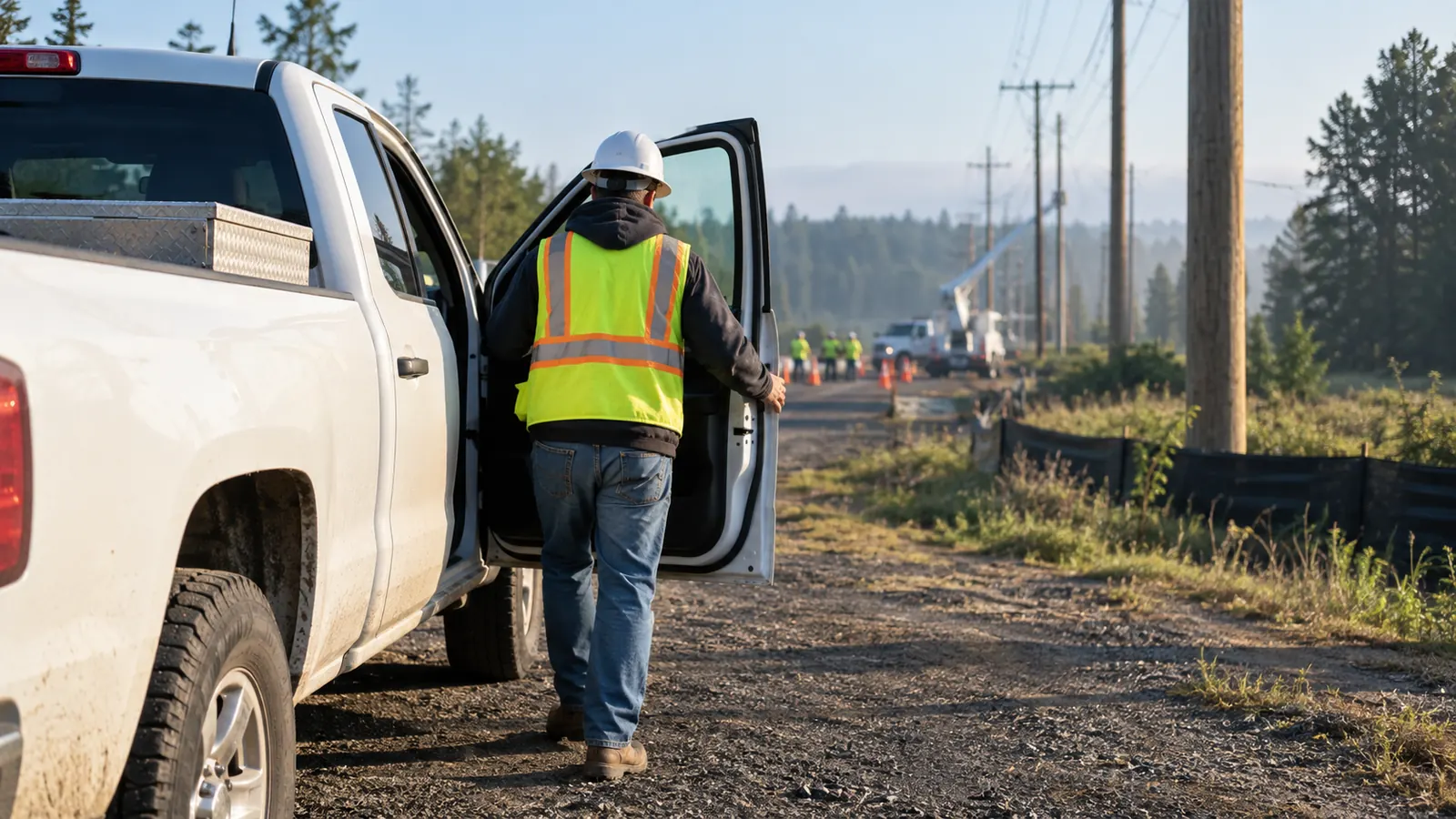
A pole record is useful only when the next engineer can identify the structure, understand how measurements were taken and see what the crew could not verify. A folder of attractive pole photographs does not meet that test.
Our physical pole inspections supply field data for attachment and loading workflows. We document each measurement and test, including any access restriction that limited the work. That record gives the next engineer a way to distinguish completed inspection work from an unresolved field question before using the information in an analysis.
Define the Utility Pole Inspection Scope Before Dispatch
A utility pole inspection checks pole identity, attachments and geometry, visible condition, groundline condition and supporting photos for an engineering or maintenance decision. Our 5-record method organizes identity, geometry, condition, loading inputs and photo provenance. Draftech's own trained inspectors perform groundline testing, including sounding, boring and excavation, under the owner's program.
Attachment screening requires different field evidence from loading input or make-ready scoping. A visit can cover all of those needs when the collection schema accounts for them in advance. The buyer must settle that requirement before the crew leaves, because an attachment-only record may lack evidence needed for a later loading request.
Before dispatch, we confirm the inspection methods. We agree on them with the pole owner and establish which findings its maintenance program requires. The agreement also states whether testing is required at the groundline, and any area left untested stays identified in the engineering record, with the access restriction that prevented the crew from completing the work.
What the Dispatch Scope Names
A procurement form can call every site visit an inspection. The required analysis may remain unspecified. We resolve that gap with a scope matrix linking each requested field to its downstream engineering decision, and once the matrix is complete, we staff the visit so the collection work matches the buyer's requirements.
Each field entry needs context. A later reviewer must be able to trace its source and understand its limitations. Working with the pole-data buyer, that reviewer should reach the same bounded conclusion, but a missing source or unexplained restriction holds the affected decision until we resolve the gap in the survey record.
Dispatch is the point at which the office hands the agreed work to the crew. Any unresolved collection requirement belongs back with the buyer before fieldwork begins. Leaving it for inspectors to settle at the pole asks them to make a project decision without the information that the office used to plan the visit.
The collection device keeps those instructions visible throughout the visit. Production pressure can otherwise turn a defined assignment into a generic inspection, with crews collecting familiar details while overlooking the fields the buyer requested. Keeping the agreed instructions at hand helps inspectors follow the assignment while they are still at the structure.
An added loading-input request reopens dispatch when the original assignment covered attachments alone. We resolve the change in the office before collection resumes, including the extra fields the revised work requires. The crew should receive a settled instruction rather than improvise additions on the last poles of the day and leave the earlier records incomplete.
Establish Pole Identity Before Measuring Attachments
The pole number in a photograph is not always the pole number in the owner's system. Route sequence can break. Duplicate tags happen. Replacement structures sit a few feet off the retired stub. Offset coordinates look precise while pointing at the wrong asset. Confirm the structure against the owner record before taking measurements.
A Pole Record Must Survive the Office Join
An identity record lets office reviewers reconcile field evidence with the owner and project inventories. Capture the visible owner identifier and retain a project identifier, then record coordinates with their collection method. Route sequence and an overview photograph provide context; an exception note explains any discrepancy. At review, check whether all of these entries identify the same structure.
If a crew measures the correct structure but files the record under an adjacent or retired identifier, loading inputs attach to the wrong asset even though every measurement looks plausible. Identity errors are quiet. The numbers still parse. The overview and route context are what expose them.
The pole owner defines its authoritative asset identifier and acceptable location accuracy. Draftech's collection schema governs the project record within those owner requirements. Neighboring aerial-plant evidence is covered in strand mapping and aerial plant assessment. It does not replace this identity join.
Office review picks one pole and walks it from field photo to owner inventory. If the join fails, stop. Do not average two nearby tags. Do not copy the adjacent pole's number because the database wants a value. We keep duplicate-tag cases on an exception list until the owner names the surviving identifier. We use the photograph to verify that the field record matches the owner inventory.
An overview photograph must show the pole in route context. We require it because a close attachment shot can be technically sharp and still belong to the wrong structure when duplicate tags sit one span apart; the reviewer needs the wider view to match that detail to the correct pole.
When a replacement pole stands beside a retired stub, we record both identifiers and which one carries the attachments, rather than letting the crew pick the tag that scanned cleanly. The owner inventory needs that distinction to reconcile the attachment record with the structure in service.
A GPS point can leave the structure uncertain when the collector accuracy is wider than the span. Our records state the collection method beside the coordinate. The loading engineer checks that method before accepting a handheld or survey-grade point for the intended use.
| Decision | Evidence form | Consequence if unresolved |
|---|---|---|
| Dispatch scope | requested fields mapped to a named downstream decision | crews collect abundant data that still cannot support the analysis |
| Office identity join | owner ID, project ID, coordinates with method, route sequence and overview photo | loading notes attach to the wrong asset while measurements look plausible |
| Geometry with method | attachment points, datum, tool, line of sight and confidence | clearance and loading reviews inherit precision the field record never possessed |
| Visible condition only | condition type, location on the structure, image scale and access limits | the owner either ignores a real condition or chases a diagnosis the record never established |
| Analysis-ready QA | required fields, photo match, span continuity, outliers and revisit reasons | the apparent schedule gain becomes office rework and return visits |
Measure Geometry With Method and Visibility Attached
An attachment height needs a datum and method before another engineer can reuse it. Surface grade changes the number. So does pole lean. Camera angle lies. Vegetation blocks the shot. An unlabeled estimate disguised as measurement is worse than a blank. A bounded estimate can still be useful.
IEEE C2-2023, the 2023 National Electrical Safety Code, covers practical safeguarding for overhead supply and communication lines. Adoption, owner standards and project criteria determine the controlling requirements. The Code does not appoint Draftech, the owner or the contractor to a role the project assigned elsewhere.
Geometry Evidence Includes How It Was Obtained
Each geometry observation records the value with its datum and tool, then states the line of sight and confidence in the result. The packet covers attachment points and communication-space relationships, with guy observations and span directions documented beside inaccessible features. We describe what the crew could see and what remained outside its view; an invented confidence score cannot supply that missing evidence.
Engineering hold: Stop the affected item when office staff treats an estimated photo height and a direct field measurement as equivalent inputs. Keep accepted identity work. Name the missing method. Reopen only that dependency after recollection or a documented estimate bound.
Without that hold, clearance and loading reviews may treat an estimated height as a direct measurement. Adjacent code context lives in NESC context for attachment engineering. It does not convert a photo guess into a measured height.
A useful hold identifies the missing datum and the loading or clearance decision it affects. It also states whether recollection or a bounded estimate can close the issue, giving office reviewers a reason the pole remains open. A general request for more information leaves that connection unclear. Any photo-derived height retains its estimate bounds through review.
Each geometry packet records lean, grade at the measurement point and whether the attachment was visible from the ground. Without that context, a later reviewer may mistake an estimate for a direct measurement, so we document the limits while the crew is still at the pole. Guy leads, risers and mid-span equipment belong in the same geometry packet when they affect the loading or make-ready question. We mark features that were not visible as unobserved so an empty cell cannot be read as zero. If a laser shot taken from a driveway cannot see the communication space, we document the estimate bounds or revisit before accepting an attachment height.
When vegetation blocks the upper attachments, we keep that blockage on the pole record so the loading engineer can decide whether to accept a partial geometry packet or send the crew back with a different vantage. That decision depends on knowing which attachments were measured and which remained hidden.
Record Visible and Groundline Condition
Visible damage and groundline findings share the same pole identifier. Trained Draftech inspectors perform groundline testing under the owner's program, using methods that can include sounding, boring and excavation at the groundline. The record names the method and test location, then documents findings and access limits; a surface photograph alone cannot establish hidden decay or residual strength. Our pole inspection and replacement engineering connects that evidence to the next engineering decision.
A generic good or bad label hides the evidence the owner needs to act. We describe visible conditions with their location and keyed photographs, then document groundline test results with the method that produced them. Observation and test results remain distinguishable in the record so a reviewer can see what supports the finding and what still requires follow-up.
Document the Limits of the Inspection
An inspection record needs a clear account of the work completed and the areas the crew could not examine. Photographs support the visible-condition entries, while documented test results carry the findings from the methods used. We keep those sources identifiable so the person reviewing a condition can follow it back to the evidence collected at that pole.
The owner or loading engineer receives condition findings with their supporting evidence and any incomplete work identified. Our explanation of how pole loading analysis uses field evidence follows that handoff into engineering. Observed traffic or falling-object risks also go to the owner for attention, with their urgency recorded separately from any conclusion about residual strength.
If the poles you are inspecting are part of a qualifying route, we engineer the first 20,000 linear feet at no cost, from feasibility and field survey through permit approval. You can request the free design package for that route. The owner reviews each request before Draftech commits the package.
A condition observation is recorded with its location, photo and access limit, and residual strength is judged from groundline test results and the owner's criteria, never from a photograph.
Falling-object and traffic-risk observations have a separate field from wood condition. We identify the immediate hazard there and leave the status of decay testing in the condition field, so the owner can escalate site control while the inspection record still shows whether that testing has been completed or remains outstanding.
A pole leaning toward a travel lane calls for a specific observation the owner can act on promptly. We record the lean and its direction, identifying the nearest surface use so the concern is clear. A generic comment in the loading model leaves too much unexplained; the owner needs that field detail to proceed with site control while the strength assessment is completed.
Rotated or displaced hardware needs a keyed photograph and a visible-condition entry that names the component. Its current position on the structure gives the later reviewer the detail needed to understand what the crew observed. Filing that evidence only under a generic damaged-pole code would obscure the specific hardware condition that prompted the entry.
When access is limited to one side of the structure, we record that limit beside every unobserved quadrant so the loading engineer does not treat silence as a clean face. Before accepting the condition record, the engineer reviews those gaps and determines which views still need to be collected in the field.
A pole-data buyer should be able to tell a cited NESC context note from an owner identifier rule and from a Draftech collection control. Mixing those three is how a field schema pretends to be a utility database standard. Draftech's in-house engineering practice records the observation. It does not rewrite the owner's asset system.
A damage report locates the finding. It includes image scale, with access limits stated where they affect the evidence. Groundline findings remain attached to that pole's record, and the report identifies any testing still incomplete so the owner can base a maintenance decision on the work performed and see where further inspection remains necessary.
Release Pole Records for Analysis Only When Complete
The Five-Record Acceptance Test
Visiting every pole can still leave a route waiting for engineering acceptance. Unresolved identifiers may prevent an inventory match, while blocked sight lines or missing dimensions can stop analysis. We review whether the provider has kept the field record coherent through revisions and delivered a usable file before treating the collection work as accepted.
We check completeness and internal consistency. Our quality review resolves exceptions before the record moves into analysis. Required fields and photo-to-record matches need validation, with span continuity checked across neighboring structures, while outlier review and revisit reasons also belong in the same review. Each item needs an assigned owner and a defined point at which it can be accepted. Our five-record method takes more field time per pole than a photo sweep, a trade-off for records an engineer can use.
Draftech performs engineering and field-data QA in-house, while the employer retains field-safety responsibilities under the task-specific program. If construction is added later, we provide full turnkey construction through Draftech-managed crews under our QA/QC and safety oversight. The inspection data checklist supports acceptance of the records; field safety remains governed by the program for the work being performed.
Payment tied to visited poles can close an invoice before anyone checks whether engineering can use the file. The office then inherits unresolved assumptions and the return trips needed to address them. Contracting against accepted records makes that review part of completion, so the apparent field schedule gain does not become rework after delivery.
Sample both routine and difficult structures. Start with a replacement pair, an obstructed sight line or another known exception, then trace that exception into a crew-ready revisit. A package that documents only easy structures protects its completion percentage rather than the route. One missing neighbor can break span continuity. A completed pin map is still incomplete when its photographs cannot be reconciled to pole identifiers.
A revisit instruction needs to tell the crew which gap to resolve at the pole. Name the missing datum or blocked sight line; if the identifier is in conflict, identify the tag that needs verification. Specific wording gives the returning crew a task it can act on the next day and lets the office check whether recollection closed the issue.
After identity is settled, scan adjacent attachment heights for abrupt unexplained changes. Treat each change as a question: confirm the datum, structure match and field method before loading it into analysis.
Photo provenance closes the package. If an image and its geometry packet cannot be tied to the same identifier, hold that record even when every numeric field is populated. An orphan image can give the wrong pole convincing measurements.
ISP attaching along an owner route: require owner-inventory reconciliation and a visible exception queue.
Cooperative maintaining its own plant: define the groundline testing required by your inspection program before dispatch. We keep the test results distinguishable from attachment measurements in the shared pole record. Require the report to identify untested areas so maintenance decisions reflect the evidence collected.
Loading engineer inheriting the file: require the datum and method, then return only the unresolved locations for targeted recollection.
Provide the analysis-ready survey revision when approaching our fiber construction management service. If turnkey work is separately procured, the managed crew framework records who performs it. Email the same accepted revision to info@draftech.com so scope review begins from the actual field record.