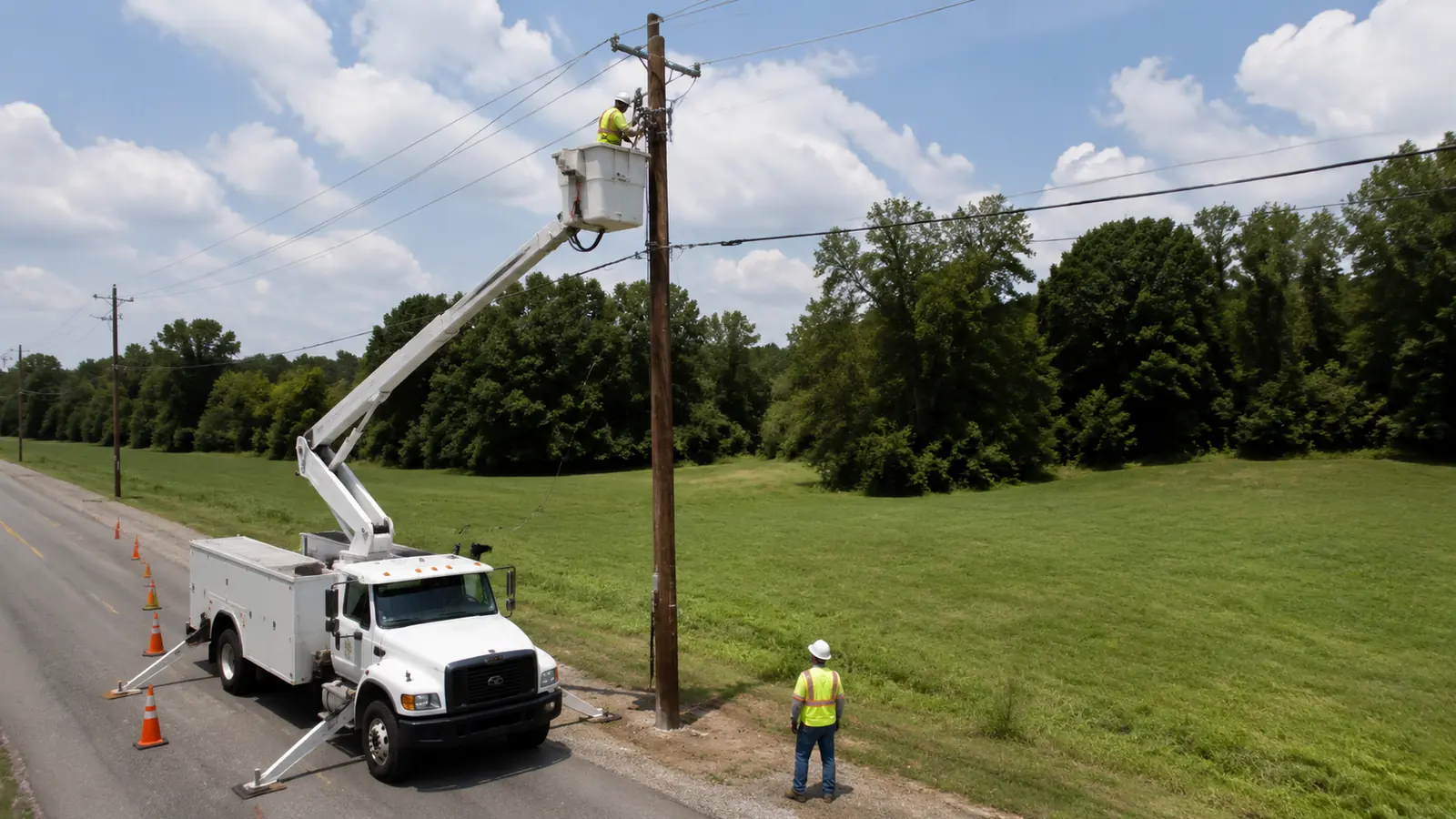
Overhead distribution work becomes expensive to correct once poles are framed, conductors are installed and concealed conditions are covered. The useful question is not whether a crew can build quickly. It is whether engineering releases, field evidence, safety controls, inspections, and the installed record stay connected while the work advances.
This guide covers Draftech's control method for distribution and make-ready work only. It does not cover transmission or substations, and it does not replace the utility's standards, the controlling contract or the contractor's project safety program.
Overhead Distribution Line Construction Starts With 6 Release Controls
Overhead distribution line construction is the controlled installation of distribution poles, anchors, framing, grounding, conductors, and associated equipment from an approved engineering package. Draftech recommends 6 release-control families as project guidance, not an industry measurement: design basis, access, materials, structure work, conductor work and closeout evidence.
We start with the issued construction basis, because staking, structure units, material approvals, permits, owner standards and field limits must point to the same revision. A drawing can be technically sound and still be unusable if the pole schedule names an older unit or the crew has a superseded stake sheet. Our release record identifies the controlling files and the authority allowed to revise them.
We next confirm access and authority. Easements, right-of-way limits, traffic controls, environmental restrictions, outage requirements, and switching roles belong in the release review before equipment mobilizes. A pole location that cannot be reached lawfully is not construction-ready. Neither is a segment whose public protection or operating authority remains undefined.
Overhead Distribution Line Construction Release Record
Our release record separates engineering intent from contractor means and methods. Draftech's engineering is performed in-house. Full turnkey construction is delivered through Draftech-managed subcontract crews under Draftech's QA/QC and safety oversight, with one point of accountability for accepted scope. Crew planning remains the contractor's responsibility unless the contract assigns a specific control elsewhere.
The safety basis must be visible without pretending that an article is a safety plan. OSHA 29 CFR 1910.269 is the named federal standard for electric power generation, transmission and distribution work. The project team must apply the provisions that control its actual tasks, exposures, qualifications, and working conditions through an approved program.
For owners who need the engineering release and managed field delivery held in one workstream, our full turnkey utility construction scope connects in-house engineering with managed crews. We do not describe that model as management-only, and we do not claim that all physical construction is self-performed today. The distinction keeps responsibility accurate.
A useful inspection record also separates observed fact plus required correction and accepted disposition. Mixing those fields invites a photo caption to be mistaken for approval. We identify who observed the condition, which controlled requirement applies, who can accept the response and where the corrected evidence lives. That structure gives owner representatives and crew supervisors the same view of open work without turning field notes into an alternate design package.
| Release control | Evidence before work | Release question |
|---|---|---|
| Design basis | Issued drawings, staking, units, approvals | Is one revision controlling? |
| Access and authority | Rights, permits, outage and traffic controls | Can the segment be entered and worked? |
| Materials | Approved poles, hardware, equipment records | Do received items match the package? |
| Structures | Pole, anchor, framing and grounding evidence | Can concealed work be accepted? |
| Conductors | Pulling plan, condition, sag and inspection records | Does installation match engineering intent? |
| Closeout | Redlines, tests, punch closure and as-builts | Can operations reproduce the installed condition? |
Hold the structure record. Verify before concealment. Memory is not evidence.
Build the Pole, Anchor, Framing, and Grounding Record
Structure work needs evidence before the next activity hides it. We require stable structure identifiers across the stake sheet, pole schedule, inspection form, photographs, redlines and final record. That linkage matters more than a folder full of unlabeled images. A reviewer should be able to move from the approved unit to field evidence without relying on the superintendent's memory.
Material control begins with the approved schedule. Pole class and length, framing hardware, anchors, guys, grounding components, and line equipment must be reconciled to the applicable unit before installation. We route substitutions and damaged material through the designated approval path instead of allowing an available item to become an undocumented design change. Availability is not acceptance.
Pole location and orientation should reconcile with the issued stake and approved field change. Soil, groundwater, rock, access, or an underground conflict can invalidate an assumed installation approach. Our control is to preserve the observed condition, identify its effect, and obtain the required engineering or owner decision before concealment. A photograph alone does not authorize a changed location.
Anchor and guy records should show which design condition was built and whether the installed geometry matches the accepted arrangement. Framing inspection does the same for orientation, hardware, equipment zones and interfaces with existing attachments. The fiber construction safety guide explains how asset IDs and hold points keep quality evidence usable after crews leave.
Grounding and bonding are checked against the project's electrical design and owner requirements, not a generic drawing pulled from another program. We retain the required installation and test evidence under the structure ID. If a result is required for acceptance, its method, status, reviewer, and disposition belong with the record rather than in an unindexed email chain.
Release the segment carefully. Field changes stay controlled. Stop when authority is unclear.
Control Conductor Installation, Field Changes, and Inspections
Conductor work begins with a segment release that identifies the accepted structures, pulling limits, crossings, public controls, weather restrictions and communication responsibilities. We treat roads, existing energized facilities, communications attachments and other interfaces as planned controls. The contractor's work plan must align with the engineering package and safety program before setup becomes production.
Condition evidence should follow the conductor from reel receipt through installation and final inspection. Damage, a changed pulling setup, an unexpected crossing or a moved support can affect engineering intent. Our review distinguishes a contractor means-and-methods adjustment from a design change. When the arrangement changes loading, geometry, clearance, or equipment assumptions, in-house engineering reviews it.
Sag and final geometry are accepted through the method and criteria named by the controlling design, not through visual uniformity. The record ties each accepted section to its source data and inspection status. We avoid publishing a generic clearance or sag value because the controlling edition, conductor, span, loading basis, owner standard, and field context determine the applicable requirement.
Field changes enter one decision path: observed condition, affected assets, technical effect, required approvals, accepted response, implementation evidence and final redline. This prevents a conversation at the truck from becoming the only record of a permanent change. It also gives the inspector a clear basis for deciding whether work can continue or must wait.
Traffic and public controls remain a separate release even when the electrical scope is ready. A segment can have approved engineering and still lack authority to occupy the roadway. Our guide to a utility coordination process addresses the same coordination principle: the approved field arrangement, permit conditions and actual work sequence must agree.
Draftech field guidance: place the quality hold before work is concealed or the crew leaves the segment. This timing principle is company guidance, not an industry statistic and it keeps a fix from becoming a remobilization.
Inspection status must remain visible to production planning. We distinguish work observed and accepted, work observed with an open finding, work not yet observable and work awaiting another authority. Those are workflow states in Draftech's recommended control method, not industry performance categories. The point is practical: a pole count does not show whether framing, grounding, conductor condition, and public restoration have reached the same acceptance state.
Contracts divide work. They cannot erase interfaces. Name the owner.
Choose a Delivery Model Without Blurring Accountability
Delivery language affects how field decisions are controlled. In a fragmented model, engineering, procurement, construction, inspection, and closeout can sit under separate contracts with separate issue logs. That can work when the owner has staff to integrate them. It fails when every party assumes another party owns the interface between a changed stake, a material substitution and the accepted record.
Draftech's model keeps engineering in-house and offers full turnkey construction through Draftech-managed subcontract crews under our QA/QC and safety oversight. We provide a single point of accountability for the accepted scope while preserving the contractor's responsibilities. This is more than management-only, but it is not a claim that all construction labor is self-performed.
Owners comparing models should test four interfaces: who controls the design basis, who accepts a field change, who closes inspection findings and who reconciles the as-built. Those questions are Draftech selection guidance, not a measured industry ranking. The broader NESC pole loading compliance guide explains why decision ownership matters even when contracts divide the physical work.
The alternative can win when an owner already has experienced construction integration staff, established utility crews and a mature record system. In that case, a focused engineering package may be appropriate. Our recommendation is unhedged: do not buy a turnkey label unless the contract names the interfaces, evidence, field-change path, and acceptance authority that make the label operational.
Procurement should carry those interfaces into deliverables and meeting authority. We recommend naming the party that issues the construction basis, receives contractor questions, approves engineering changes, releases concealed work, verifies punch closure and accepts the final record. This is Draftech contract-scoping guidance, not a universal allocation. A different owner can assign the roles differently, but silence leaves the highest-risk decisions to assumption.
Safety accountability also stays explicit in a turnkey model. Managed crews work under the approved project safety requirements, qualifications, operating controls and stop-work authority. Draftech's safety oversight does not convert an article, a QA form, or a coordination meeting into the contractor's safety program. We align the delivery interfaces so field production does not outrun the authorities and protections that govern the actual task.
Closeout starts now. Split truth fails. Test the retrieval chain.
A candid limitation of our managed-crew approach is the front-end control work: engineering releases must be current, field authority must be named, and evidence paths must be agreed before production accelerates. We accept that burden. Our vendor qualification path supports delivery, but no qualification record replaces project-specific operating authority. That burden is worthwhile because a crew cannot preserve engineering intent when the controlling drawing and field authority remain disconnected from the evidence destination across separate contract records. Owners choosing separated delivery should assign one person enough authority to reconcile each approved change with inspection evidence before a contractor conceals the condition or leaves the segment. Turnkey buyers should still test the contract language because a label does not define who can stop work or who accepts the corrected asset record after installation.
Release Closeout Only When the Installed Record Reconciles
For utility owners with an internal integration team: use separated contracts only when one named authority can reconcile engineering changes, crew evidence plus inspection findings and the final asset record across every handoff. For programs seeking one accountable workstream: select full turnkey delivery when the contract explicitly preserves in-house engineering control while assigning physical construction to qualified managed crews under project QA/QC and safety requirements.
Closeout starts during construction, not after the last crew demobilizes. We collect redlines, structure records, material dispositions, inspections, required tests, permit evidence, photographs, and punch items under stable identifiers as the work advances. A final drafting pass cannot recreate a concealed anchor condition or explain which field change reached the installed line.
The closeout review compares the issued basis, approved changes, field evidence and final asset record. Every difference is either reconciled or carried as an explicit exception with an owner and disposition. The construction closeout process uses the same principle for telecom work: an attractive PDF is not enough when operations cannot trace the evidence behind it.
Operations should be able to retrieve a structure, identify its accepted configuration, locate supporting evidence, and see any restriction without calling the original project manager. We recommend that retrieval test as Draftech guidance, not as an industry pass-rate claim. If the chain breaks, the handoff returns for correction before the final release.
File format is secondary to control. Native records may support GIS or asset systems, while reviewable documents preserve an accepted issue. We require both to express the same identifiers, status, and configuration when both are contract deliverables. A correct database paired with a stale PDF still creates split truth. The final transmittal should name every file, revision, owner, and known exception so superseded material cannot look current.
The final review should sample ordinary structures and examine every unresolved exception. Ordinary samples test whether the production workflow is consistent; exceptions test whether the decision path works under pressure. This is Draftech QA guidance rather than an industry sampling rule. The owner may require a different review depth, and the contract remains controlling. What matters is that the selected method is recorded before final acceptance begins.
Restoration and acceptance should stay linked as well. Surface repair, drainage, access, removed temporary controls, and owner punch findings may sit outside the electrical drawing, but they still affect release. We place those obligations in the same closeout index with their responsible authority and evidence location. This prevents technical completion from being mistaken for final contractual acceptance while restoration or permit conditions remain open.
For distribution owners, the decision is straightforward. Use a separated model when your organization can control every interface itself. Use Draftech's utility construction delivery when you want in-house engineering, managed subcontract crews, field QA/QC, safety oversight, and closeout tied together through one accountable workstream. Our power scope remains distribution and make-ready, never transmission or substations.
If an upcoming distribution build has unresolved release controls, inspection ownership, or closeout requirements, email info@draftech.com. We can review the engineering and delivery boundaries before procurement language or field sequencing makes the gaps harder to correct.
Talk to our utility construction team about your distribution program. Bring the current design basis, delivery model, and open interface list so the first discussion can focus on decisions rather than slogans.