- What Is Microtrenching?
- The Cost Numbers: What You Actually Pay Per Foot
- Depth Requirements and Why They Matter More Than You Think
- Microtrenching: Where It Actually Works
- Traditional Trenching: When the Old Method Is Still the Right Method
- HDD as a Third Option, and Why It's Not Always a Last Resort
- Reinstatement Methods and Long-Term Pavement Integrity
- The Municipal Acceptance Problem
- Making the Call on a Real Project
The short version: microtrenching fiber optic underground deployment typically costs less because it requires less excavation and pavement restoration. Traditional open-cut trenching costs more because it requires excavation, backfill, compaction, and more extensive pavement restoration. That gap is real, and in a competitive market where underground fiber construction can eat 40 to 60% of total project cost, that difference changes IRR models significantly. But the cost comparison only tells part of the story, and the part it doesn't tell is the one that gets projects into trouble.
We've built fiber underground using all three methods (microtrenching, conventional open-cut, and HDD) across dozens of projects in all 50 U.S. states. Each method wins under specific conditions and fails badly under others.What frustrates me is how often the choice gets made in a spreadsheet rather than in the field. With someone picking microtrenching because the per-foot cost looks right, without accounting for the permitting picture, the utility conflict density, or the pavement age in the specific corridor they're building through. So when does microtrenching actually save money? It depends on the surface.
This breakdown is meant to give you the actual engineering picture: costs. Depths, reinstatement realities, and the cases where each method is the right call or the wrong one.
What Is Microtrenching?
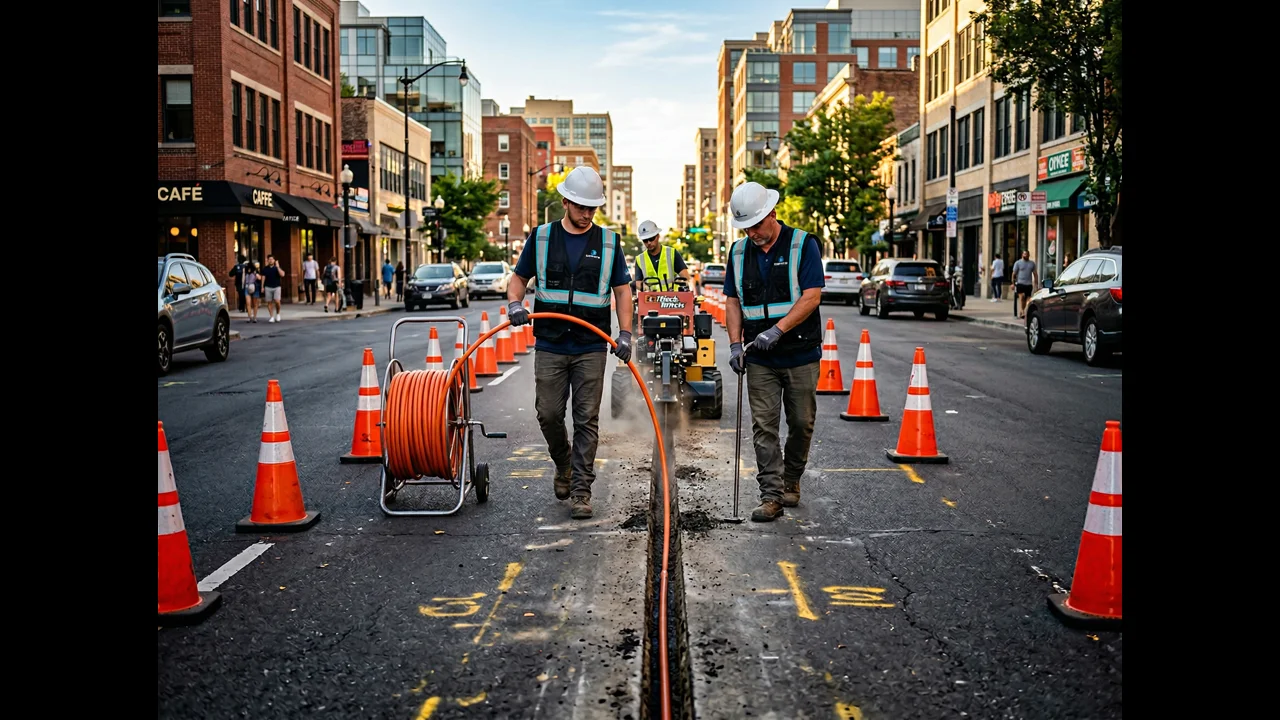
Microtrenching is a fiber installation method that uses a narrow, shallow saw cut in pavement to hold fiber conduit, then seals the slot. Typical cuts are 12 to 18 inches deep and 1 to 2 inches wide. We evaluate whether that proposed shallow route fits the corridor before selecting it.
A micro trencher is the saw machine that cuts the slot, using a rotating blade to follow the planned alignment through pavement. Once the saw has cut the slot, crews clear out the debris, place the fiber conduit in the cleaned opening, backfill around it, and seal the pavement surface to close the opening.
We consider microtrenching for paved fiber routes, including commercial streets and arterial corridors where the municipality accepts a shallow installation. It can also serve planned developments with suitable pavement and documented utilities. The useful question is where the saw can follow the route without repeated interruptions, which we assess before committing a corridor to this method.
The Cost Numbers: What You Actually Pay Per Foot
Let's get specific about what goes into these cost ranges, because the per-foot number alone is misleading without understanding what's included.
| Method | Depth | Width |
|---|---|---|
| Microtrenching | 12 to 18" | 1 to 2" |
| Traditional Open-Cut | 30 to 48" | 12 to 24" |
| HDD (Horizontal Directional Drill) | Variable (3 to 20 ft) | N/A (bored) |
Microtrenching's cost efficiency comes from the saw-cut process: a rotating blade cuts a 1 to 2 inch slot in existing pavement, conduit or microduct is placed directly in the slot, and the trench is sealed. No excavation, minimal spoil disposal, faster production rates. A crew can microtrenching 500 to 800 linear feet per day in good conditions. That same crew doing conventional trenching might cover 150 to 250 feet per day.
Traditional trenching cost drivers are pavement saw-cutting, excavation, conduit bedding (sand or pea gravel depending on spec), backfill and compaction in lifts, and pavement restoration, which in some municipalities means milling and overlaying the entire lane width even if you only cut an 18-inch trench. That lane-width resurfacing requirement alone can substantially increase traditional trench costs in certain jurisdictions.
At the high end of traditional trenching costs, you're typically looking at urban corridors with congested utilities, rock excavation, dewatering requirements, or very strict pavement restoration specs. I've seen projects in the Northeast where pavement restoration drove traditional trenching costs much higher in commercial downtown zones. In those cases, microtrenching's lower excavation and restoration costs can make it look like a different world entirely.
But here's where the cost model breaks down: if microtrenching produces a failure (a fiber hit by subsequent utility work, a section that heaves after a hard freeze cycle, or a restoration that cracks within 18 months), the remediation cost can be much higher than the initial installation cost. It's the cost of mobilizing a new crew, cutting the failed section out, splicing damaged fiber, restoring the surface again, and dealing with any service disruption for active customers. That higher cost for the affected sections can erase the savings from a much longer run.
Depth Requirements and Why They Matter More Than You Think
Microtrenching typically targets 12 to 18 inches of cover. Some microtrench installations go as shallow as 10 inches in residential sidewalk applications. Traditional underground fiber construction targets 30 to 48 inches of cover, with most municipal standards requiring a minimum of 36 inches under paved surfaces and 24 inches under unpaved areas.
That depth difference isn't just a spec number. It defines which utilities you share space with.
At 12 to 18 inches, you're in the same depth zone as irrigation lines, low-voltage picture lighting, older telecom copper, and some municipality-installed conduit that predates modern utility mapping. At 30 to 36 inches, you've dropped below most of that and you're sitting alongside gas distribution, water mains, and power distribution, which are better documented and better marked. Neither depth is risk-free, but the shallow zone that microtrenching occupies has the least reliable utility mapping and the highest density of undocumented stuff in the ground.
This is exactly what bit a project we reviewed. The deployment was using microtrenching on a route through a mixed residential and light-commercial neighborhood where the pavement was in reasonable shape and the municipality had conditionally approved the method. Within the first 800 feet, the crew hit three utility conflicts: one water service lateral, one old telco conduit, and what turned out to be a private irrigation main that wasn't on any utility map. None of the three were damage incidents; the crew stopped and called 811 each time. But three conflicts in 800 feet meant three stop-work periods, three coordination calls with the utility owners, and a week of schedule impact. The project manager had budgeted zero utility conflicts in the first mile based on the utility records. That assumption was wrong.
The project's utility mapping in older residential zones is simply not reliable enough for confident shallow installations. The project eventually completed, but the superintendent told me afterward that if he'd known the conflict density going in, he'd have proposed conventional trenching for that specific corridor and saved two weeks of schedule disruption.
Microtrenching: Where It Actually Works
Microtrenching is genuinely excellent in the right conditions. Done well, it delivers fiber underground faster and cheaper than any other method while producing a durable, long-lasting installation. The conditions that favor it are specific enough that I can list them:
- Pavement in good condition. Microtrenching works best in pavement that's 5 to 15 years old, firm enough to cut cleanly, not so old that the base course has deteriorated or the asphalt is brittle. New pavement (0 to 3 years) is often excluded by municipal moratorium. Very old pavement tends to crack wider than the cut during the saw process, creating a wider restoration challenge.
- Low utility conflict density. Areas with modern, well-documented underground utilities and low density of informal or undocumented installations. New subdivisions and planned commercial developments are generally the best candidates. Older urban cores are generally the worst.
- Commercial or arterial streets with reasonable municipal acceptance. More on this in the permitting section below, but municipally-maintained arterials tend to have better utility documentation and more consistent pavement quality than residential streets.
- Mild to moderate freeze-thaw exposure. Deep freeze-thaw cycling (the kind you see in Minnesota, Wisconsin, upstate New York) is hard on microtrench installations. The shallow depth puts the trench seal in the active frost zone, and repeated freeze-thaw cycles can break the seal and create water infiltration paths. Microtrenching deployments in the Mid-Atlantic and Southeast perform significantly better than those in northern climates.
- Straight routes with minimal crossings. Every time a microtrenched route crosses an existing utility or has to navigate around a conflict, the production rate drops and the per-foot cost climbs. Routes with lots of utility crossings erode microtrenching's cost advantage fast.
Charlotte, North Carolina is a good case study. The city has conditionally approved microtrenching on commercial and arterial corridors where pavement is in good condition, and the projects that have followed those guidelines have generally gone well. One deployment we supported there covered 4.7 miles of commercial arterial in six weeks using microtrenching, keeping production costs low under those favorable conditions. That was genuinely excellent execution under the right conditions. But when the same contractor proposed microtrenching for the residential distribution network in an adjacent neighborhood (older streets, more informal utility density), the city engineer rejected it. That rejection was correct. The residential streets in that area had documented issues with undocumented utility installations from a 1980s-era development, and the risk profile wasn't comparable.
Traditional Trenching: When the Old Method Is Still the Right Method
Conventional open-cut trenching gets a bad reputation because it's expensive, disruptive, slow, and nobody loves seeing a dug-up road. But it's the right answer more often than microtrenching advocates admit, and it's the only method that gives you consistent depth, predictable utility conflict management, and long-term protection for fiber in difficult environments.
The cases where traditional trenching wins:
- Rural routes on unpaved or low-traffic roads. No pavement restoration requirement changes the economics entirely. Traditional trenching in rural dirt or gravel roadbed costs less than in paved urban corridors, and the pavement cost differential with microtrenching disappears. You get 36+ inches of cover and proper protection without paying the premium that urban pavement restoration creates.
- Routes with high utility conflict density. When 811 locates show multiple utilities crossing or paralleling your proposed route at varying depths, open-cut gives you full visibility of the conflict zone and room to work. Microtrenching a route with three utility crossings per 100 feet is a recipe for schedule disaster.
- Cold climates with deep frost penetration. In Minnesota and Montana and upstate New York, getting fiber 36 inches down gets it below the active freeze-thaw zone. Microtrenching at 14 inches in those climates is asking for pavement movement problems within three winters.
- Locations where future road work is anticipated. If a road is scheduled for mill-and-overlay within five years, microtrenched fiber at 14 inches may be cut by milling equipment or damaged by paving equipment. Traditional depth gives you protection against future surface treatment.
- Municipal corridors with strict depth minimums. Some jurisdictions simply require 36-inch minimum depth under any paved surface, period, no exceptions. Traditional trenching is the only method that reliably delivers that depth.
The aerial-vs-underground cost comparison in our guide to aerial vs. underground fiber construction cost gets into the broader economics of underground vs. aerial, but within the underground decision, traditional trenching's durability advantage is often what justifies its cost premium over a 20-year asset life.
HDD as a Third Option, and Why It's Not Always a Last Resort
Horizontal directional drilling gets framed as the expensive option of last resort, and in some contexts that's accurate. But I'd argue HDD should be treated as a complementary method to whichever primary trench approach you're using, not an alternative to it.
On almost every underground fiber route, there are locations where neither microtrenching nor conventional trenching is viable: road crossings on arterials with median barriers, waterway crossings, railroad right-of-way, driveways with elaborate hardscaping, sections through active construction zones. HDD is the standard approach for these locations regardless of which trench method you're using along the rest of the route.
HDD costs are lower for short, simple bores in favorable soil and rise for long crossings in rock or congested utility environments. For a 200-foot road crossing, HDD can cost less than the alternative of open-cut across an active four-lane arterial with traffic control, lane closure permits, and the city engineer watching every move.
There's also a hybrid approach worth knowing about: microtrenching the main corridor, using HDD for road crossings and utility-congested sections, and spot-switching to conventional trench in areas where the pavement is too deteriorated for a clean microtrench cut. This hybrid method is how experienced underground fiber contractors manage complex routes efficiently. You're not committed to one method for the whole project. You're choosing the right tool for each segment.
Our team handles the traffic control planning for underground fiber construction, and the method selection often drives the MOT requirements more than any other factor. HDD eliminations of road crossings consistently reduce the traffic control cost and schedule impact for those specific segments.
Reinstatement Methods and Long-Term Pavement Integrity
The way the trench gets closed matters as much as how it gets opened. This is where microtrenching projects most often disappoint over the long term.
Microtrenching reinstatement options include: hot bituminous sealant (the most common), cold-pour sealant, polymer concrete fill, and proprietary sealing compounds like SpecSeal or similar products. The quality of the seal application (temperature, curing time, surface prep) determines whether the installation holds up through the first winter. A rushed seal applied in cold weather (below 50°F for most hot-pour products) or on a wet surface fails fast. The crack that opens up is a water infiltration point, and water in a shallow microtrench in cold weather is a freeze-thaw problem that degrades every winter.
Traditional trench reinstatement is more forgiving because the trench is wider, allowing proper compaction in lifts and a more substantial pavement patch. A properly compacted, saw-cut, straight-edged conventional trench patch with quality asphalt can outlast the original surrounding pavement. Microtrenching done right also produces a durable result, but the margin for execution error is much smaller.
Municipal inspectors in jurisdictions that have seen microtrenching fail tend to be skeptical of the method based on what they've observed, which feeds into the permitting challenges covered in the next section.
The Municipal Acceptance Problem
This is where a lot of microtrenching projects lose time and money before a single foot of fiber goes in the ground. Municipal acceptance of microtrenching as a permitted underground fiber construction method varies enormously, not just between states, but between cities in the same state, and sometimes between neighborhoods within the same city.
The broader pattern we see: commercial and arterial streets get approved more often. Residential streets get rejected more often. And cities that have had a bad microtrenching experience (a sealant failure, a contractor who didn't follow specs, a pavement that cracked within a year) have often updated their standards to restrict or prohibit the method in more contexts as a result.
The permitting picture makes it essential to engage with municipal engineering departments early, ideally before the project design is finalized. As our team covered in depth in the breakdown of ROW permitting delays in fiber deployment, the permit process for underground fiber construction is not a formality. It directly shapes what construction methods are available to you and where.
Charlotte, NC, a split decision: The city approved microtrenching on commercial corridors where pavement met their condition index threshold and utility mapping was current. On a proposal for the adjacent residential network, the city engineer denied the microtrenching permit, citing pavement age (avg 22 years in the residential zone) and inadequate utility documentation from pre-GIS installations. The contractor had to switch to conventional trenching for those streets, which added 6 weeks to the schedule and approximately $340,000 in cost that hadn't been budgeted under the microtrenching assumption.
This kind of split decision (approved for commercial, denied for residential) is actually pretty common. It's not arbitrary. It reflects real differences in pavement quality, utility documentation, and risk tolerance between those street types. The problem is when contractors and ISPs assume uniform approval across a service area and build their project timeline and budget around that assumption.
Utility conflict concentration: Beyond the conflict hits mentioned earlier, the project also encountered a section where a 1970s-era duct bank for a public utility ran at 15 inches of depth for approximately 600 feet along the proposed route. The microtrenching approach simply couldn't work for that segment: there was no depth clearance. That section required conventional trenching and a crossing plan, adding cost and complication that hadn't been in the original scope. The lesson: old utility infrastructure in cities can be just as problematic as in other metros.
Making the Call on a Real Project
Method selection for underground fiber construction should come out of a documented decision matrix applied to each segment of the route, not a single choice applied to the whole project. Here's the process we walk through:
- Pull utility records and review conflict density for the corridor. Any section with more than one documented utility crossing per 100 feet should be flagged for conventional trench or HDD consideration.
- Assess pavement condition index (PCI) for each street. Most municipalities score their pavement. Streets with PCI below 60 are generally poor candidates for microtrenching. Streets with PCI above 75 are reasonable candidates if the municipality accepts the method.
- Confirm municipal permit scope before finalizing design. Do not build a microtrenching project schedule until you have written confirmation from every relevant municipality about which streets they'll permit microtrenching on. This conversation happens at the design phase, not after submission.
- Identify HDD crossings and include them regardless of primary trench method. Every road crossing, waterway, and railroad gets a bore. That's not a negotiation. It's standard practice.
- Build the cost model with real reinstatement specs. Get the municipality's actual pavement restoration specification before calculating costs. Lane-width resurfacing requirements can fundamentally change the economics of any trench method.
The right underground fiber construction method is the one that gets your fiber in the ground at the right depth, with municipal approval, on a timeline that meets the project schedule, at a cost the project economics can support. Sometimes that's microtrenching. Sometimes it's conventional trenching. Usually it's some combination of both, with HDD at the crossings.
Our guide to ROW permitting challenges covers the permit process in more detail, and if you're still in the network design phase, the underground construction planning elements of aerial vs. underground fiber construction cost might help you frame the overall method question.
If you're standing in front of a project where the method selection is genuinely uncertain (different streets, different municipal jurisdictions, mixed pavement conditions), reach out to our team at info@draftech.com. We've navigated this exact problem on dozens of deployments and can help you build a defensible, cost-realistic method selection for each segment of the route.