HOME ABOUT SERVICES BLOG CAREERS CONTACT
Traffic Control
Updated April 2026

Maintenance of Traffic for Fiber Optic Construction

MUTCD-compliant MOT plan design, lane closure permit coordination, and work zone safety support — for an overview of fiber optic construction safety OSHA requirements, see our detailed guide. Integrated with your aerial and underground fiber build from day one.

22
Active States
44,000+
Miles Designed
600+
Field Engineers
5
Engineering Partners

Maintenance of Traffic Fiber Construction: Where Projects Stall or Get Shut Down

Maintenance of traffic (MOT) for fiber construction involves designing MUTCD-compliant work zone plans, obtaining lane closure permits from state DOTs and municipalities, and coordinating traffic control requirements with the overall permitting package. Non-compliant MOT plans cause stop-work orders, permit rejections, and construction liability exposure. MOT planning must begin concurrently with ROW permitting — not after permits are approved.

Maintenance of traffic doesn't get the same attention as fiber design or pole loading. It's treated like a checklist item right up until the moment a county road inspector shuts down a bore crew because the work zone didn't meet the required taper length, or until a state DOT flags a non-compliant lane closure setup and pulls the permit. Then it becomes the most important thing on the project.

We've seen it. On a 67-mile underground deployment in northern Tennessee, a subcontractor set up a lane closure on a state-maintained two-lane without the required advance warning signs at the correct distance for a 55 mph posted speed. The state DOT inspector drove through at 7 AM and issued a stop-work order by 8. Two days of mobilized crew, sitting. The crew time alone cost more than the MOT plan would have.

That's the version where nothing actually goes wrong from a safety standpoint. The other version — where something does go wrong, a worker gets hit, or a motorist causes a crash in an improperly set up work zone — carries liability exposure that no fiber budget can absorb.

MUTCD compliance is federal baseline, not ceiling. 47 of the 50 states have adopted state-specific traffic control supplements that go beyond the federal MUTCD. If your MOT plan was designed to federal standards only, it may not satisfy the state DOT that issues your permit. We design to the applicable state supplement, not just the federal document.

The other dimension of maintenance of traffic that gets underweighted is its connection to the permitting timeline. Lane closure permits are issued by the same agencies that are approving your ROW permit in many jurisdictions. If your MOT plan is incomplete or non-compliant, it can hold up the entire permit package — not just the lane closure approval. As we covered in our article on ROW permitting delays in fiber deployment, the permit phase is already one of the top reasons projects experience fiber construction permitting delays that slip their construction schedules.
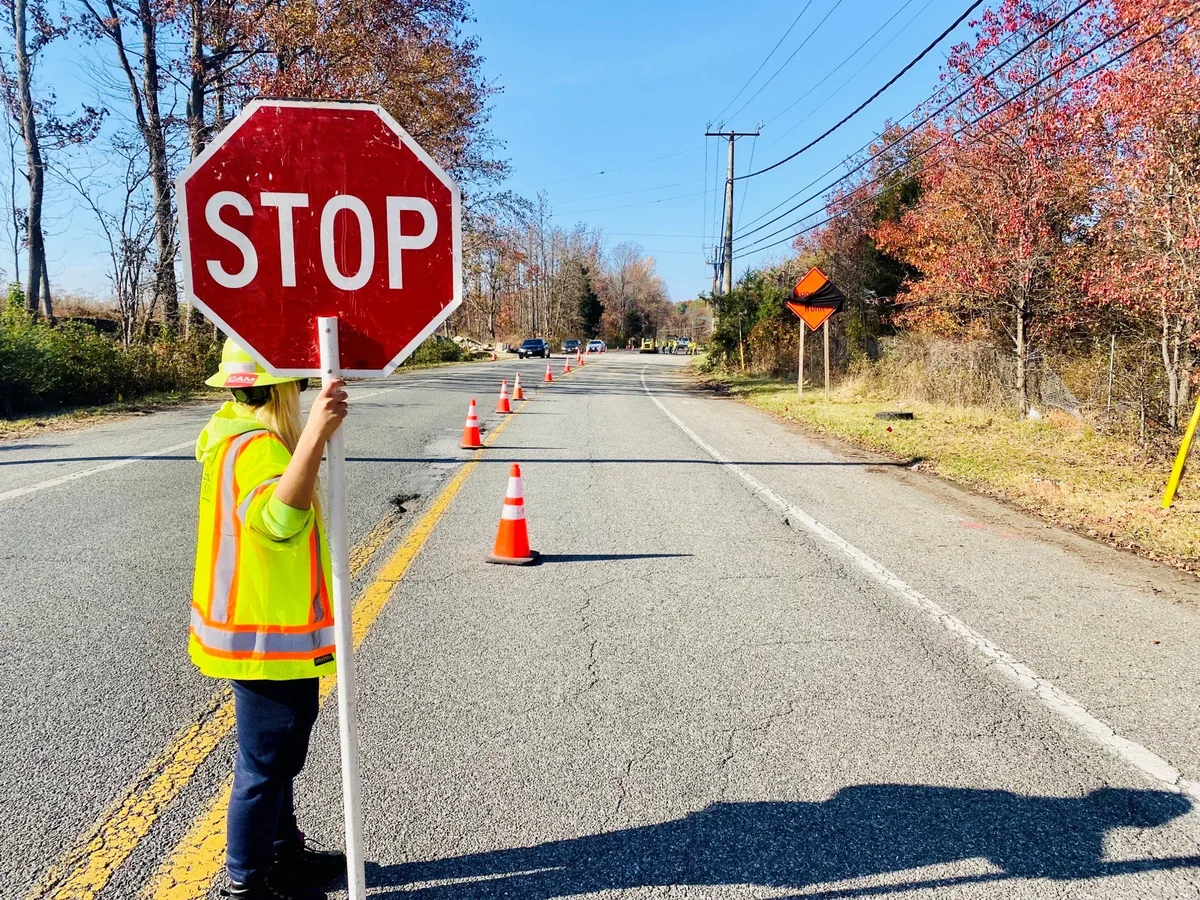
Maintenance of traffic work zone for fiber optic construction
MOT Services We Provide
  • ✓ MUTCD-compliant MOT plan design
  • ✓ State DOT supplement compliance review
  • ✓ Lane closure permit applications
  • ✓ After-hours and night work permit coordination
  • ✓ Signage and channelization design
  • ✓ Work zone phasing plans
  • ✓ PE-sealed traffic control plans

How We Design MUTCD-Compliant MOT Plans for Fiber Construction

MUTCD-compliant MOT plans for fiber construction include advance warning sign schedules, lane configuration diagrams, taper length calculations, flagger positioning, arrow board requirements, and night work provisions — all designed to match the actual construction activity, not a generic template. Aerial lashing operations, directional bore crossings, and stationary splice crews each require different work zone geometry. We design to the applicable state supplement, not just the federal MUTCD baseline.

A lot of people think MOT plans are simple: throw some cones on a drawing and label the signs. For a shoulder closure on a rural two-lane, there's a version of that which works. But once you're dealing with a multilane arterial, a signalized intersection, a school zone, or a work zone that spans multiple shift changes, the design work is more involved than it looks.

For fiber construction specifically, the MOT plan has to account for how construction is actually going to proceed. Aerial lashing work on a roadway requires completely different work zone geometry than a directional bore crew working at a road crossing. A crew pulling cable from a trailer that moves along the route every 20 minutes needs a different approach than a stationary splice crew at a vault. We design MOT plans to match the actual construction activity — not a generic template.

Standard Plan Components

Every MOT plan we produce includes:

  • Advance warning sign schedule — sign types, spacing calculations based on posted speed limit per MUTCD Part 6 table, and placement distances from the activity area
  • Lane configuration diagram — plan view of the work zone showing lane widths, buffer and transition zone lengths, and channelizing device spacing
  • Taper design — merge taper and downstream taper length calculations per MUTCD formulas, with adjustments per state supplement where applicable
  • Flagger positioning — when flagging is required, flagger locations and sight line documentation
  • Arrow board requirements — size, mode (sequential or flashing arrow), and placement for lane-reduction closures
  • Channelizing device schedule — cone, drum, or barrier selection based on road classification and work duration
  • Night work provisions — retroreflective device specifications, lighting requirements, and any enhanced visibility requirements per state supplement

For intersections or work zones with traffic signals, we coordinate with the local traffic engineering department on signal timing modifications during construction — something that gets skipped constantly on fiber projects and results in significant backup and complaints from the municipality.

State-Specific Variations We Know Cold

The federal MUTCD provides the framework. In practice, what controls your permit approval is the state supplement. Here's what we see diverge most often:

State Key Variation from Federal MUTCD
Florida FDOT Design Standards Index 600 — adds specific crashworthy barrier requirements on SHS roads and stricter advance warning distances on high-speed corridors
Texas TxDOT TCP requirements mandate PE-sealed plans for all closures on state-maintained roads, regardless of closure duration
North Carolina NCDOT requires 72-hour advance notification for all lane closures on state-maintained roads; same-day closures require District Engineer approval
Ohio ODOT has a separate TCP prequalification process — contractors must use a prequalified TCP designer for closures on NHS routes
Georgia GDOT's Work Zone Safety Program requires a Worksite Safety Inspector (WSI) on high-risk work zones, adding a staffing requirement that surprises out-of-state contractors

Working in 22 states means we've built up the institutional knowledge of what each state DOT actually requires — not what the MUTCD says they should require. There's a difference, and it matters when you're trying to get a permit approved in 5 business days.

One thing that slows permit approval more than almost anything else: submitting a TCP that uses federal MUTCD sign codes but doesn't reference the correct state supplement version. Some states updated their supplements in 2021 or 2023. An MOT plan referencing an outdated standard comes back for revision every time.

Traffic Control Services for Aerial and Underground Fiber Builds

Traffic control services for fiber construction cover aerial lashing operations, directional bore road crossings, night work lane closures, school zone work, bridge attachments, and signalized intersection coordination. Aerial and underground construction require fundamentally different work zone geometry. A moving lashing crew, a stationary bore crew, and a splice crew at a vault each need separate MOT plan configurations to comply with MUTCD and state supplement requirements.

The MOT requirements for aerial lashing work differ significantly from underground directional boring. We know both — and the specific work zone challenges that each construction method creates.

🚧

Aerial Construction MOT

Aerial lashing and pole transfer crews work along the road shoulder and often need intermittent lane encroachments for equipment positioning. We design mobile work zone plans for moving operations, flagging setups for individual pole work, and shoulder closure configurations that meet AASHTO clear zone requirements.

⚙️

Underground Bore & Trench MOT

Road crossings via directional bore are the most common trigger for a lane closure permit in fiber construction. We design point-specific work zone plans for each bore crossing, accounting for bore entry pit dimensions, spoil management area, equipment staging, and the bore exit location on the opposite shoulder.

🌙

Night Work Plans

High-traffic corridors increasingly require after-hours lane closures to avoid daytime restrictions. Night work MOT plans require enhanced lighting specifications, retroreflective device upgrades, and in some states — pre-approval from the traffic operations center. We've processed night work permits in urban cores including Nashville, Charlotte, and Jacksonville.

🏫

School Zone & Special Conditions

Work zones within school zones, hospital zones, or near controlled access facilities have additional restrictions in most states — typically prohibiting closures during school arrival/dismissal hours and requiring enhanced signage. We flag these conditions during the design phase, not after permits come back rejected.

🌉

Bridge & Overpass Work

Fiber attachment to bridge structures requires specific MOT plans coordinated with both the bridge owner (state DOT, county, or municipality) and sometimes a separate structural review. The work zone geometry is typically more constrained than at-grade work, and crew access requires careful sequencing to avoid complete traffic shutdowns.

🚦

Signalized Intersection Coordination

Work zones affecting signalized intersections need coordination with the local traffic signal operations department for temporary timing adjustments during construction. This often gets overlooked, resulting in signal phases that don't align with the reduced-lane traffic flow. We handle the coordination as part of the permit package.

Traffic Control Permit Coordination for Fiber Builds: Lane Closures and DOT Approval

Traffic control permit coordination for fiber builds requires lane closure applications submitted to state DOTs, municipalities, and county road departments — often simultaneously with ROW permit applications, not after them. State DOT lane closure permit review typically runs 8–15 business days. Municipal permits vary from 5 to 21 days. Treating lane closure permits as a construction afterthought routinely adds 3–6 weeks to project start dates.

Here's something that doesn't show up in most project schedules until it causes a problem: lane closure permit approval timelines vary dramatically by jurisdiction, and they don't always move in sync with your construction mobilization date.

State DOT lane closure permits on NHS routes can take 10–15 business days for standard approval. Some states have expedited review processes that run 5 days — for a fee. Municipal lane closure permits in major cities often require separate applications to both the traffic engineering department and the public works permitting office, and those two departments don't always talk to each other. We've tracked lane closure permits in Atlanta that took 23 business days through a mandatory inter-agency review chain that nobody warned us about on the first project.

The practical implication: lane closure permits need to be in the queue at the same time as the ROW permits, not after them. If you're waiting for the ROW permit to be approved before you apply for lane closures, you've added 3–6 weeks to your construction start date in jurisdictions with long review cycles.

On a 44-mile rural deployment in eastern Kentucky, the county judge-executive's office — which issued the county road permit — had a 30-day review requirement that wasn't on any published schedule. We found out at submission. Our permitting team tracked weekly with the county office and got it expedited to 18 days, but it still pushed the construction start by two weeks. Know the actual timeline, not the posted timeline.

We track permit status across all active jurisdictions on a project and give the PM a weekly status report that shows current approval stage, outstanding agency questions, and projected approval date. That visibility lets the construction schedule be built around realistic dates rather than optimistic ones. For a broader look at how permitting timelines affect construction schedules, our article on ROW permitting delays in fiber deployment covers the systemic causes in detail.

The financial side matters too. BEAD-funded projects have construction milestones tied to disbursement schedules. A lane closure permit that's pending when a milestone date hits can create a documentation problem with the state program office even if construction is otherwise on track. Our permitting team has worked through those scenarios with BEAD subgrantees in multiple states — see our breakdown of BEAD funding engineering requirements for 2026 for the full picture on compliance obligations.

Permit Types We Process

  • State DOT lane closure permits — for work on state-maintained roads including US highways, state routes, and NHS facilities
  • Municipal street permits — coordinated with city traffic engineering and public works departments
  • County road permits — county engineer or county commission approval depending on state law
  • Special event coordination — working with local authorities on construction blackout windows around major events
  • Emergency work notifications — expedited permit processes for cable repairs and emergency restoration
  • Night and weekend work permits — required separately in many jurisdictions from the standard lane closure permit

Integration with the MOT Plan

Every permit application we submit includes the corresponding MOT plan — formatted to the specifications of the reviewing agency. Some state DOTs want PDF only. Some require CAD-native files submitted through an online portal. Some require paper submissions with wet-ink stamps. We've navigated all of these.

When a permit comes back with agency comments — which it does about 31% of the time on first submission based on our internal tracking — we process revisions and resubmit within 48 hours as a standard turnaround. Common resubmittal triggers: sign spacing recalculation on speed limit transitions, flagger positioning on intersections, and night work lighting specifications.

By the Numbers
Avg. state DOT lane closure permit review 8–15 days
Municipal lane closure permit review 5–21 days
First-submission resubmittal rate ~31%
Our resubmittal turnaround 48 hrs standard

Integrating Maintenance of Traffic with Fiber Construction Planning

Integrating maintenance of traffic with fiber construction means reviewing construction sequencing during the design phase to identify segments where lane closure permit timelines will constrain the schedule, flagging roads requiring night work before crews mobilize, and coordinating MOT plan revisions with the ROW permit tracking system. MOT integrated early prevents the most common schedule failures: crews mobilized to segments where permits haven't cleared.

There's a version of MOT services that's purely transactional: you send us the route, we produce the plans, you file for permits, everybody goes home. That works for simple builds on rural roads where the work zone requirements are straightforward.

For anything more complex — a build that runs through multiple municipalities, crosses state highways and county roads and city streets all in the same week, or has an aggressive construction schedule that requires parallel permitting on multiple segments — MOT needs to be integrated into the construction planning from the beginning, not bolted on at the end.

What that looks like in practice: our traffic control team reviews the construction sequencing during the design phase and flags road segments where lane closure permit timelines will constrain the schedule. We identify segments where night work will be required — either because daytime closures aren't permitted or because the traffic volume makes daytime flagging impractical — and we work those permit applications in ahead of time, not the week before the crew arrives.

On a 112-mile fiber build in central Florida, we identified 7 segments on FDOT District 5 roads where the construction schedule called for daytime lane closures during a period that overlapped with a spring break tourism peak that FDOT had pre-designated as a closure blackout window. We caught that at the design phase and rescheduled those segments to night work — avoiding a certain permit rejection two months later.

The other integration point is with the field survey team. During the pre-construction survey, our field techs document road geometry at planned work zone locations — lane widths, shoulder widths, intersection geometry, sight distances, and any fixed objects near the work zone that affect setup. That data feeds directly into the MOT plan design and prevents the most common resubmittal trigger: a plan that specifies a standard lane width that doesn't match what's actually on the ground.

Work Zone Phasing

On longer construction segments where the work zone moves with the crew, we design multi-phase MOT plans that cover the full construction corridor rather than one static crossing location. Each phase shows the work zone configuration for a defined construction stage — bore crew at crossing A, lashing crew between poles B and C, splice crew at vault D. The construction PM can flip through the phases and know exactly what the permitted work zone setup looks like at each stage.

This matters especially when construction crews are subcontracted and may not be familiar with the specific permit conditions in a given state. A well-organized phasing plan reduces the risk of a field crew improvising a work zone setup that doesn't match what was permitted.

Coordinating MOT with Permitting

Our MOT and permitting teams work out of the same project structure — which means lane closure permit applications are integrated with the ROW permit tracking, not managed in a separate silo. When a municipal ROW permit gets approved with special conditions (nighttime-only work, specific hours of lane closure, no work during school hours), those conditions immediately feed into the MOT plan revision queue. We don't let conditions get buried in a permit approval document that nobody reads until a field inspector shows up.

For the full picture of how permitting and ROW acquisition work alongside MOT, our permitting services page covers the complete permit coordination workflow, including municipal ROW, railroad crossings, and environmental compliance.

MOT & Traffic Control FAQ

Direct answers to what we get asked most often about maintenance of traffic for fiber construction.

Maintenance of traffic (MOT) in fiber construction refers to all the planning, signage, equipment, and personnel required to safely manage vehicle and pedestrian traffic through or around an active construction work zone. For fiber projects, this covers everything from a basic one-lane shoulder closure on a rural county road to a full lane closure on a state highway with a traffic management plan reviewed and approved by the state DOT.
MOT plans are typically prepared by the engineering firm or a specialized traffic control designer working with the construction team. For fiber projects, the OSP engineering firm often handles MOT plan production as part of the overall permitting and design package — since the work zone configurations are closely tied to the construction methods (aerial vs. underground, bore vs. trench). Draftech prepares MOT plans in-house as part of our permitting and construction support services.
The Manual on Uniform Traffic Control Devices (MUTCD) sets the federal baseline for all temporary traffic control in construction work zones. For fiber construction, key MUTCD requirements include proper advance warning sign placement and spacing based on posted speed, taper length calculations for lane closures, qualified flagger positioning and certification, and minimum channelizing device spacing. States can and do adopt more restrictive standards — Texas, California, and Florida, for example, all have state supplements that go beyond MUTCD on certain road classifications.
Traffic control costs for fiber construction vary widely depending on road classification, state requirements, and construction duration. For a typical underground bore under a two-lane rural state highway, expect $3,200–$7,500 per crossing for flagging, signage, and equipment. Lane closures on multilane arterials in urban areas can run $1,800–$4,200 per day including certified flaggers, arrow boards, and channelizing devices. High-traffic corridors requiring after-hours night work add a 35–60% premium. The MOT plan design itself is separate from the field execution costs.
Lane closure permit requirements depend on jurisdiction. State DOT highways require a lane closure permit through the state transportation department — most require 72-hour advance notice at minimum, with some requiring 10 business days for arterial closures. Municipal streets require permits through the local public works or traffic engineering department. Many jurisdictions also require a Traffic Control Plan (TCP) sealed by a licensed PE as part of the permit application for closures on higher-classification roads.
Yes — we handle both. Our permitting team submits lane closure permit applications to state DOTs and municipalities as part of the overall ROW permitting package for fiber projects. The MOT plan design is produced by our traffic control designers and formatted to the standards required by each agency. We track permit approval timelines and coordinate resubmittals when agencies request revisions, which happens regularly on complex intersections and high-traffic corridors.

Get MOT Right Before the Crew Mobilizes

The best time to deal with MOT is during design — before the permit applications go out and well before construction starts. If you're already in permitting and need MOT plans fast, we can turn around standard configurations in 5–7 business days. If you're planning a build and want to make sure traffic control is properly scoped into the schedule and budget from the start, that's an even easier conversation. Our team operates across 22 states and has worked through the permit requirements in most of the jurisdictions you're likely to be working in.

Talk to Our Team

Or reach us directly: info@draftech.com