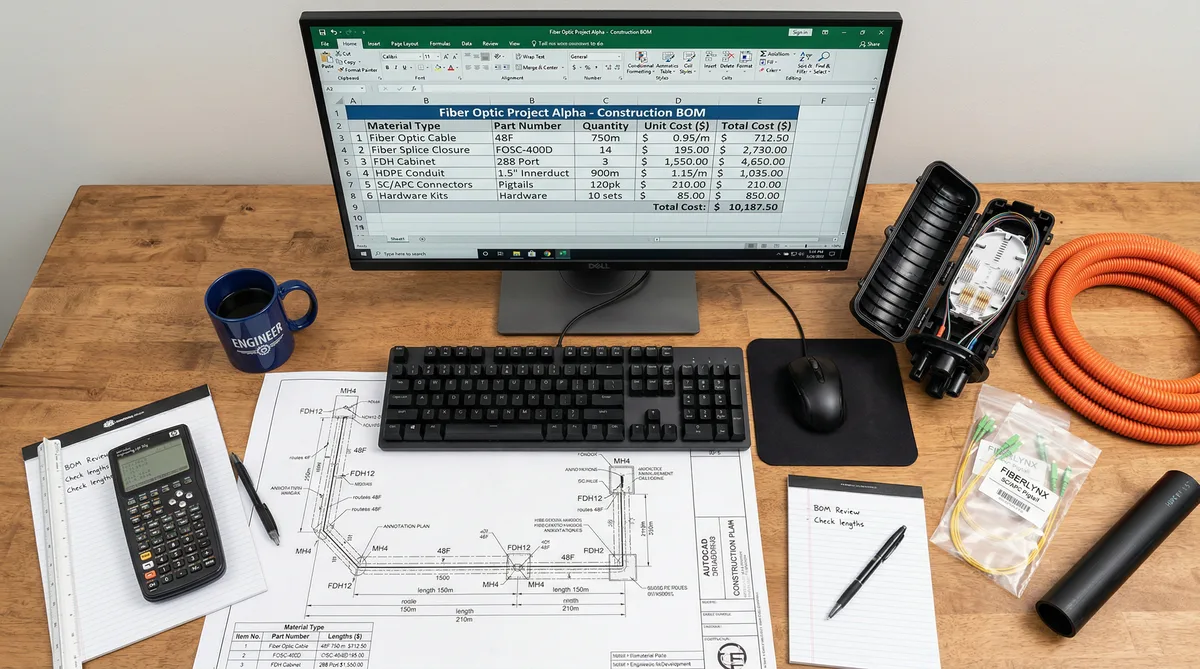
The fiber optic construction BOM template is the document that either holds a project together or quietly unravels it. I've seen contractor bids come in 23% over budget because the LLD team forgot to include snowshoe brackets on an aerial route that crosses a highway. I've seen procurement delays push a construction schedule out six weeks because somebody assumed the material list from a similar project would transfer. It didn't, because this one had a 10% longer drop length average. And I've watched BEAD grant applications get flagged during cost review because the BOM wasn't organized to match NTIA's reporting categories.
So this is a practical walkthrough of how to build a fiber construction BOM that's actually complete: organized in a way procurement can work with, matched to your construction drawings, and bulletproof enough to survive a grant audit. Not theory. How we do it on real projects.
What Goes Into a Fiber Construction BOM: The Full Category List
First, a framing note: a fiber optic construction BOM template isn't just a shopping list. It's a structured document that mirrors the construction package: every section of the drawings maps to a BOM category. If your BOM has categories the drawings don't support, something's wrong. If your drawings show work that doesn't appear in the BOM, materials got missed.
Here's how we structure the category breakdown. This applies to a full FTTH distribution build. Scale up or down based on scope.
Aerial Plant Materials
- Strand (messenger wire): Specify gauge (6M, 10M, 16M, 25M) based on span lengths and wind/ice loading from your pole analysis. Don't use a single grade across an entire route. Rural spans can push 175 to 200 feet between poles; that requires heavier strand than your suburban 100-foot spans.
- Lashing wire: Typically 0.045" galvanized steel for standard distribution cable, 0.065" for larger counts. Add 10% for lashing overlap: people forget the figure-8 pattern adds real footage.
- Suspension clamps and dead-end clamps: Count dead-ends at every tangent point, angle point, and at pole lines crossing roads.
- Snowshoe (figure-8) brackets and pole brackets: Required at every pole. Count from the pole placement map. Don't estimate. Count.
- Cable suspension hardware: Preformed eyes, J-hooks, lashing rings.
- Pole tags and identification markers
Underground and Conduit Materials
- HDPE conduit: Specify outer diameter (1.25", 2", 4") and wall type (SDR 11, SDR 13.5) for each segment. Don't lump all conduit together: cost and procurement lead time vary significantly between sizes.
- Innerduct: 1" SDR 13.5 corrugated innerduct for fiber protection inside larger conduit. Track separately from the conduit itself.
- Handholes (vaults): Specify by size: 17"×30", 24"×36", 30"×48" are typical. Smaller sizes at fiber-only splice points; larger at joint-use or major branching points.
- Handhole covers, frames, and inserts
- End caps and conduit plugs
- Tracer wire: Required in most jurisdictions for utility locate compliance.
- Warning tape: Detectable 6" tape above conduit runs. This one gets dropped surprisingly often.
Fiber Cable and Passive Optical Network Equipment
This is the most technically complex BOM section. Separate fiber cable by fiber count, cable type, and route type. Don't aggregate everything into a single "fiber cable" line item. Procurement needs to know whether they're buying 288-count all-dielectric loose-tube or 48-count armored for the underground drops.
- Distribution cable: Specify count (12F, 24F, 48F, 96F, 144F, 288F) and type (ADSS, ADSS with gel, lashed, armored, direct-buried). Separate aerial and underground quantities for the same count.
- Drop cable: Typically 2F or 4F drop for single-family, 12F or 24F for MDU drops. Include both pre-terminated and bulk field-terminated quantities based on your drop design.
- Splice closures: Aerial dome closures, underground splice trays. Specify capacity: a 12-tray closure and a 4-tray closure are different line items.
- Fiber distribution hubs (FDHs): Specify port count and enclosure type (pedestal, aerial, wall-mount). Our guide to FDH sizing for FTTH covers how to calculate the right capacity for your serving area.
- Fiber access terminals (FATs) and network access points (NAPs): Count from the network design: each serves a defined group of drops.
- Splitters: 1x4, 1x8, 1x16, 1x32. Specify split ratio and insertion location (FDH-mounted vs. in-line).
- Optical connectors: SC/APC for everything on a PON network. Track field connector quantity separately from factory-terminated.
- Patch cords and pigtails
Grounding, Bonding, and Miscellaneous
- Grounding rod and clamps (required at every FDH pedestal and at intervals on aerial strand)
- Bonding wire (6 AWG or 4 AWG bare copper)
- Cable identification tags and handhole markers
- Marker balls (for underground locating)
- Warning tape (see above: list it here if not already under underground)
- Cable gel and sealing kits for splice closures
- Pressure testing equipment (if specifying pressurized conduit systems)
The items most often missing from a first-pass BOM: slack loop cable at every underground structure (add 3 to 4 feet per vault), splice tray quantity when using multi-tray closures, innerduct end caps, marker balls, and detectable warning tape. On a project, the first-pass BOM was short 1,200 feet of slack cable and 47 marker balls. Small things. Real money.
How the BOM Maps to the Construction Package
Every section of the construction package deliverables generates BOM line items. This is the critical link: if you're building your BOM from the drawings rather than estimating from general knowledge, you catch the gaps.
Here's the mapping:
- Route plan sheets → conduit footage, strand footage, handhole/vault placement count
- Profile sheets → bore length, depth transitions, conduit size changes at transition points
- Pole placement map → per-pole hardware quantities (snowshoe brackets, strand, clamps)
- Splice schedule → closure count, splice tray count, fiber count at each point
- FDH/FAT placement map → enclosure count by type, splitter count, connector quantities
- Drop design sheets → drop cable footage, NAP count, terminal count
- Grounding plan → rod count, bonding wire footage
Don't skip the splice schedule when pulling BOM quantities. A common mistake is counting splice closures but forgetting to count trays: a closure might be spec'd for 12 trays but you only need 6 for the first build-out. Fine. But the BOM should still list what's being installed on day one, not what the enclosure can theoretically hold later.
Sample BOM Category Breakdown
This is a simplified version of the category structure we use on a mid-size FTTH distribution build, roughly 15 miles of mixed aerial/underground route serving 1,200 homes. Real project numbers.
| Category | Material | Unit | Est. Qty | Notes |
|---|---|---|---|---|
| Aerial | 6M Galvanized Strand | ft | 39,400 | Includes 8% waste factor |
| Aerial | Lashing Wire (0.045") | ft | 39,400 | Match strand footage + 10% overlap |
| Aerial | Snowshoe Brackets (pole) | ea | 284 | Count from pole map |
| Underground | 2" HDPE SDR 11 | ft | 21,600 | Distribution conduit, 7% waste |
| Underground | 1.25" HDPE SDR 13.5 | ft | 8,900 | Drop conduit segments |
| Underground | Handhole 17"×30" | ea | 63 | Splice-only locations |
| Underground | Handhole 24"×36" | ea | 14 | Branching and FDH pedestals |
| Fiber | 144F ADSS (aerial) | ft | 26,800 | Distribution feeder, 8% waste |
| Fiber | 48F Armored (underground) | ft | 23,200 | Includes slack loop allowance |
| Fiber | 4F Drop Cable (aerial) | ft | 91,000 | Avg 75 ft drop × 1,200 homes + 10% |
| PON Equipment | FDH (72-port pedestal) | ea | 9 | ~130 homes per FDH serving area |
| PON Equipment | NAP (8-port) | ea | 158 | ~7 to 8 homes per NAP |
| PON Equipment | Splitter 1×8 (FDH-mounted) | ea | 144 | 16 per FDH |
| PON Equipment | Aerial Splice Closure (4-tray) | ea | 22 | Per splice schedule |
| Misc | Grounding Rod + Clamp | ea | 11 | One per FDH + splice points |
| Misc | Detectable Warning Tape | ft | 31,000 | Match underground conduit run |
Common BOM Mistakes That Show Up in Every Bid Season
Budget blowouts from material lists are almost always the same handful of errors. Worth naming them explicitly.
Forgetting Slack Loop Cable
Every underground handhole needs a slack loop. That's 3 to 4 feet of additional cable per structure, coiled and stored in the vault for future splicing or repair. On a route with 77 underground structures, that's 231 to 308 feet of cable you haven't accounted for, and the extra 48F armored cable raises material costs that should have been captured in the BOM from the start.
Under-Counting Splice Trays
A splice closure isn't a splice tray. An aerial dome closure with 12-tray capacity holds 12 trays of 12 splices each: that's 144 splice capacity. If you're only using 48 fibers, you need 4 trays, not 1 closure. The BOM should list tray count separately from closure count. Procurement needs both, and they're often sourced from different vendors.
Wrong Conduit Size Assumptions
I've reviewed BOMs that spec'd 2" HDPE for an entire underground route when the construction drawings clearly showed 4" on the main feeder segments and 1.25" on the lateral runs. The estimator used a single conduit size. The 4" conduit costs more than the assumed size, and that budget gap grows when you're talking thousands of feet. Worth going back to the [aerial vs underground cost](https://draftech.com/blog/aerial-vs-underground-fiber-construction-cost) breakdown to see where conduit sizing drives overall project economics.
No Waste/Scrap Factor
Never use 0% waste. Ever. Construction generates scrap: cut-offs, damaged sections from bad bores, mis-measured runs. The right waste factor depends on material type:
- Fiber cable (underground): 5 to 7%
- Fiber cable (aerial): 8 to 12% (lashing adds length)
- HDPE conduit (standard bore): 5 to 7%
- HDPE conduit (urban, many bends): 10 to 15%
- Lashing wire: 10% minimum
- Innerduct: 3 to 5%
- Drop cable: 10 to 15% (field lengths vary, ends get damaged)
On a project outside Bozeman, MT (heavy rock in the ground, difficult directional bores), we ran a 14% conduit waste factor and still came in right. A team that ran 5% would have had a procurement gap mid-construction.
How to Structure the BOM Spreadsheet for Procurement
The BOM is only useful if the procurement team can work with it. That means structure matters as much as content. Here's what we include in every column:
- Category (Aerial / Underground / Fiber / PON Equipment / Misc)
- Item description (specific enough to order from)
- Manufacturer part number (or acceptable alternates)
- Unit of measure (ft, ea, reel)
- Design quantity (from drawings)
- Waste factor %
- Order quantity (design qty × waste factor)
- Unit cost (from vendor quote or budget estimate)
- Extended cost
- Preferred vendor
- Lead time (weeks)
- Notes
That lead time column is one most BOMs skip. It shouldn't be skipped. FDH pedestals from some manufacturers are running 18 to 22 weeks out right now. If procurement doesn't see that on the BOM, construction will hit a gap. Our splice point placement guide has more detail on how design decisions at the LLD phase affect procurement timing.
Grouping by Route Section vs. Grouping by Material Type
Some teams prefer to organize the BOM by route section (Route A, Route B, each segment separately). That works for phased construction. But for procurement, the roll-up by material type is what the purchasing team actually uses: they need to know the total reel count for fiber, not which sections it comes from. Build both views if you can: a roll-up tab for procurement, a section-by-section detail tab for the construction team.
Aerial vs. Underground vs. Hybrid: BOM Differences That Matter
Aerial and underground BOMs aren't just different in quantity. They're different in category structure. On a pure aerial route, conduit and vaults don't appear at all. On a pure underground route, strand and lashing wire are absent. A hybrid route, which is most of what we actually build, needs both sections fully populated, and the handoff points between aerial and underground need their own line items: aerial-to-underground transition hardware, riser conduit, weatherhead kits.
Aerial BOMs also include weather-specific hardware that underground BOMs don't touch: ice and wind load ratings on strand spec, vibration dampeners in areas with consistent high winds, additional dead-ends where spans exceed local loading standards. This matters on routes through mountain passes or flat prairie states where sustained wind loads are a real design input, not a checkbox.
Underground BOMs, on the other hand, are much more sensitive to soil conditions. Rocky terrain means more bore footage, heavier conduit spec, and sometimes alternative installation methods (rock saw, vacuum excavation) that change the material list. The construction package deliverables should document soil condition findings from field survey so the BOM reflects actual ground conditions, not assumed ones.
BOM Accuracy and Bid Quality
A BOM that's off by 8% on materials means a bid that's off by 3 to 4% overall, and at $2.1M total project cost, that's $63,000 to $84,000 of exposure. Contractors pad their bids precisely because they don't trust the BOM they receive. When the BOM is precise, detailed, and clearly tied to the drawings, contractors can price tighter, which means lower bids for your project owner.
The inverse is also true. I've seen projects where the BOM was obviously a rough estimate: round numbers everywhere, no part numbers, a single "fiber cable" line item for the whole route. Every contractor that priced that job built in a 12 to 15% material contingency. The project owner paid for that uncertainty.
BOM for BEAD Projects: NTIA Cost Reporting Requirements
If you're on a BEAD-funded build, the BOM structure matters beyond procurement: NTIA requires cost reporting at a level of detail that a sloppy BOM can't support. Specifically, subgrantees need to separate capital expenditures by cost category (materials, labor, equipment, overhead) and tie costs back to specific network segments for the matching funds calculation.
That means your BOM needs to be structured to map to the reporting categories from day one. Bundling materials and equipment costs together, or aggregating multiple project phases into a single BOM, creates cleanup work at reporting time. We've seen subgrantees have to reconstruct BOM detail from invoices at audit time. Not fun, especially when vendors use different descriptions than the BOM does.
Separate your BEAD BOM by: eligible/ineligible cost categories, funded phases, and reporting periods. The extra columns at BOM setup take 20 minutes. The audit reconciliation without them takes weeks.
One more thing on BEAD BOMs: NTIA's cost reporting templates use specific cost categories that don't always match how vendors invoice. Set up your BOM with a "NTIA cost category" column from the start. Map every line item before procurement runs the first PO, not after.