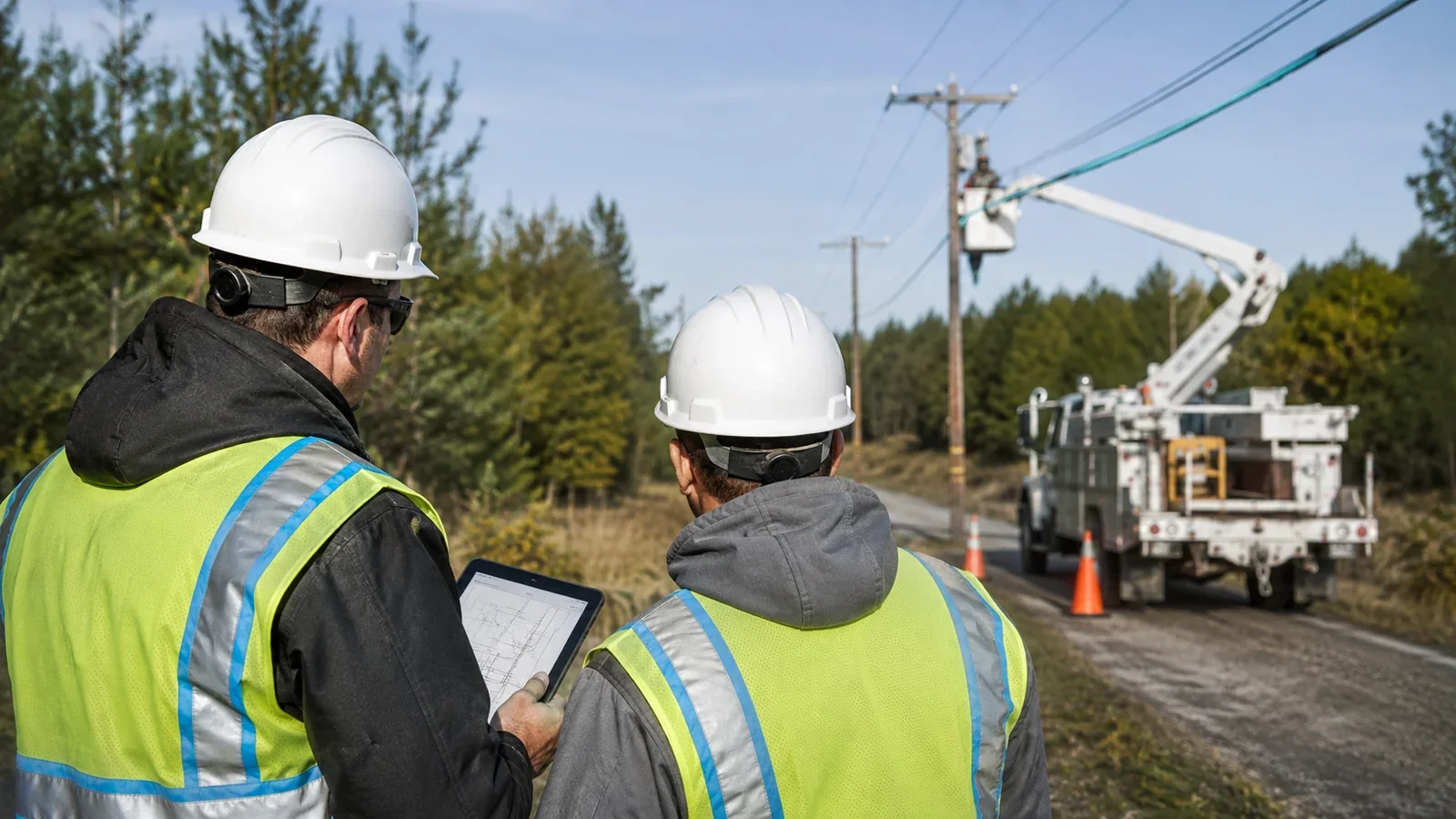
Aerial construction schedules fail one pole at a time. A permit can cover the route while a pole-owner notice remains open, make-ready can be marked complete while the field configuration differs and a reel can be available while the next workfront lacks safe access. Route-level percent complete hides those release conditions.
Pole work reaches the field only after several authorities and dependencies align. This article follows that narrow workfront decision from approved design to an accepted batch, including daily evidence and hold-point disposition. It leaves broad OSP construction-management definitions and inspection checklists to their dedicated pages, while keeping pole-owner rights and employer safety duties explicit.
Aerial Plant Construction Management Starts at the Pole Batch
Aerial plant construction management controls each pole batch through 6 release conditions: attachment authority, completed make-ready, approved design, available materials, safe work access and named acceptance evidence. Draftech holds a workfront when any condition is unresolved, then records field changes by pole before the owner accepts the segment.
The batch boundary should match how crews can execute and how owners can review; a whole route is too broad when one railroad crossing or pole replacement blocks only a short segment. A single pole is too narrow for material and traffic planning. We group a controllable run of poles while retaining individual pole status and exception identity.
Federal pole-attachment rules require careful jurisdiction. 47 U.S.C. 224 defines the federal framework and excludes cooperatively organized entities plus government-owned entities from its definition of utility; current 47 CFR 1.1411 supplies timelines for covered pole access. Neither source automatically controls every owner, state or attachment agreement. The register names the actual authority before scheduling.
Make-ready completion is a field condition, not a spreadsheet color; we require the pole owner's completion or release evidence plus a configuration check where project procedures call for it. The make-ready engineering timeline guide covers upstream timing; this article controls whether a finished workfront can actually receive cable.
Build the Pole-Level Release Register
The release register joins design sheet and pole ID with attachment authorization, make-ready status and material plan; it also names traffic-control plus access requirements and the required closeout evidence. Each field has a source plus date. Verbal confirmation can trigger a verification task but does not silently become permanent authority.
We review the issued pole package against current field identity before release. Pole replacement, transfer work or changed communications space can invalidate an earlier detail. Engineering resolves design implications in-house. Construction managers keep the affected pole on hold until the owner or engineer with delegated authority releases the change.
Pole identity. Field tags and design IDs can diverge after replacement or transfer work; we compare the physical tag, owner record and issued sheet before releasing attachment details. If two structures could satisfy the same note, that pole does not move. The register shows the conflicting identifiers and the person responsible for resolving them, sparing the crew from installing the right assembly on the wrong structure.
Make-ready proof. A completed status can hide an unfinished transfer or changed configuration; the batch record pairs the owner's notice with the current pole observation where project procedures require one. An untransferred cable or occupied communication space keeps that pole out of the crew list. Adjacent poles may proceed, but the exception cannot disappear inside a route-level completion percentage.
| Release condition | Evidence before work | Hold trigger |
|---|---|---|
| Authority | Permit, license or owner release | Scope or pole identity mismatch |
| Make-ready | Owner completion status | Unfinished transfer or replacement |
| Design | Current issued pole package | Field configuration conflict |
| Materials | Matched cable and hardware | Unapproved substitution or shortage |
| Access and safety | Task plan plus traffic controls | Unsafe or unauthorized work area |
| Acceptance | Required photo, redline and test index | Missing pole-level evidence |
Control Installation Through Daily Workfront Evidence
Daily control starts with the poles actually available, not the planned production total. The manager confirms work limits plus issued revision and reel assignment. Crew employers control means, methods and employees. The pole owner controls its facilities. We coordinate evidence and QA hold points without substituting a schedule decision for those responsibilities.
Field deviations receive a pole-specific record before work advances past the affected condition. A changed attachment height can affect clearance review and neighboring facilities. A different hardware arrangement can affect bill of material and owner acceptance; we route the deviation to engineering rather than asking a crew to convert an observation into design authority.
Materials are reconciled to approved assemblies. We track reel identity and installed cable segment plus closures and attachment hardware required by the owner. Substitutions remain on hold until approved. The OSP construction inspection hold-point guide covers broader inspection; here the evidence stays attached to the pole batch and release state.
Production evidence includes start and end pole plus installed footage source and exceptions. Photos are indexed to stable pole IDs rather than dumped by date. Redlines identify the issued detail affected. This lets engineering update records without reconstructing which image or note belonged to each workfront.
Keep Safety and Traffic Authority in the Right Hands
Safety scope follows the actual task. OSHA 29 CFR Part 1926 applies to construction work and 29 CFR 1926.453 addresses aerial lifts; work near electric supply facilities can implicate additional construction requirements based on the task and employer. We name applicable procedures without blending telecom work with electric-utility operations or claiming that a project checklist replaces employer obligations.
Traffic control also depends on the road authority and approved plan; FHWA's 11th Edition MUTCD is the current federal manual for traffic-control devices, while adoption plus project requirements determine field applicability. The construction manager verifies that the authorized traffic-control setup matches the work location and sequence. Field crews do not improvise a new traffic pattern to protect production.
One limitation of pole-batch control is that a late exception can strand a crew. That cost is visible and frustrating. We still prefer a documented hold over installing against uncertain authority. The management improvement is earlier pole reconciliation and alternate released workfronts, not pressure to erase the exception.
Stop-work and emergency authority must be clear before mobilization. Each employer retains responsibility for its employees and methods. The owner retains operating authority. We record who can stop work plus who can clear technical, access or safety holds. A project manager does not sign away those separate responsibilities in a single production meeting.
Close Every Pole Before Releasing the Segment
Pole-level closeout happens while evidence is still recoverable. We reconcile installed cable and hardware plus redlines and photographs before the crew leaves the area when practical. Missing evidence becomes an open item with owner and due action. Percent complete excludes poles that lack the project's acceptance evidence.
Segment release compares the installed state with issued design and approved deviations. Optical testing follows contract criteria and path identity. We preserve native results plus setup context and link them to the cable segment. A test pass cannot cure an unauthorized attachment or missing owner acceptance.
The overhead distribution construction guide explains shared corridor controls for power work. Aerial fiber closeout keeps communication attachment evidence separate while coordinating common access. The network owner and pole owner make their respective acceptance decisions under governing agreements.
Match Reels, Hardware and Access to Released Poles
Cable logistics must match workfront length and splice plan. We record reel identity, start and end poles, approved slack locations and remaining length. A substituted reel that forces a new splice location pauses that segment for engineering review; otherwise the crew can consume cable that was reserved for the next batch. The final reel log explains the sequence without reconstructing it from warehouse tickets.
Hardware match. Approved assemblies can vary by pole class and owner standard. Before installation, the staged hardware is checked against the issued detail and material identity. A substitute with different dimensions or loading implications goes back to engineering and, when required, the pole owner. It is faster to hold one assembly at the truck than to reopen an attachment after the owner rejects the closeout photograph.
Road and property access can expire or carry notice conditions. The daily release cites the authorized date, boundary and notice receipt. If the crew would have to cross outside that area, dispatch selects another released batch instead. This small check avoids mobilizing reels and lifts to a workfront that the field team cannot lawfully reach.
Report Daily Limits and Clearance Conflicts
Production totals need a physical beginning and end. The daily report names the first and last stable pole IDs, then marks placed and accepted status separately. If reported footage crosses a held structure, the range is split at that pole rather than rounded into a continuous run. The discrepancy reaches the next coordination meeting as a location, not a vague quantity question.
Workfront rule. A route permit does not release every pole. Confirm pole-owner authority, completed make-ready and current field identity for the exact batch before labor and reels move into position.
Clearance deviation. A field conflict can affect communication space and neighboring facilities. The crew captures the measured condition and stops at the affected attachment. Engineering evaluates the design consequence and the pole owner provides any disposition within its authority. Work resumes only against a controlled revision; a photograph labeled good is not a clearance decision.
Index Pole Photos, Tests and Restoration Holds
Images without asset identity create expensive closeout archaeology. Required views are linked to pole, date and work event as they are collected. An unmatched image remains unmatched; reviewers do not guess from vegetation or file order. When the view cannot be recollected, the owner receives the precise evidence gap for that pole instead of a folder that merely looks complete.
Test boundary: Optical evidence must match the installed segment and splice state. Native files retain cable identity, endpoints, setup context and the owner's criteria. A passing trace for the previous splice revision does not close the current path. The team either retests the installed configuration or leaves that segment visibly unaccepted.
Aerial work can still leave access or property conditions open. Restoration evidence and the responsible owner or agency response are tracked apart from optical test status. A clean test cannot close damaged access or an unremoved traffic-control item. Segment status therefore shows the remaining property obligation and who must clear it.
Brief Crews and Record Separate Owner Acceptances
Pre-job briefing: The daily briefing uses the released pole list and current revision plus known holds. It states work limits and the evidence expected before the batch advances. Crew employers deliver their required safety communication and control their methods. The project briefing does not replace those duties. Its role is to ensure that production, engineering and closeout begin from the same authorized workfront.
A credible recovery plan uses another fully released batch rather than skipping an unresolved condition on the planned run. We confirm materials plus access and design for the alternate before moving labor. The schedule records why the sequence changed and whether reel or splice assumptions moved with it. This protects production without converting a pole hold into undocumented field discretion.
Owner communication: Pole-owner questions receive the exact pole identity plus issued detail and measured conflict. Broad email summaries can hide which structure needs a decision. We keep response evidence beside the release register and avoid interpreting silence as approval. When the owner issues a revised condition, engineering updates the package and the construction manager confirms that affected crews received the controlled revision.
Pole-owner attachment acceptance and network-owner optical acceptance can occur at different times. We record each decision separately. A passed fiber test does not approve hardware placement, while an accepted attachment does not prove path performance. Segment status shows both gates plus restoration and record completion so the project cannot collapse several authorities into one completion percentage.
Plan the Next Shift from Pole-Level Holds
The next-shift plan should be assembled from released poles, not copied from the original route sequence. Start with the last accepted structure from the prior shift, then list the poles whose authority, make-ready, design, materials and access evidence remain current for the planned date. A held pole is shown with the physical stop point it creates. Dispatch can then choose a continuous batch or a fully checked alternate without asking the crew to interpret the register at roadside.
Conditions discovered after mobilization need a short path back to a decision. The field lead records the pole ID, measured or observed condition, affected detail and work already completed nearby. Engineering can answer the design question while the construction manager checks whether adjacent poles remain independent. If they do, the crew may continue on the documented remainder. If the span, reel assignment or traffic setup depends on the held pole, that dependency closes the workfront until a revised instruction reaches the field.
At shift end, reconcile staged, installed and accepted quantities separately. Reel usage should agree with the pole range and planned slack, material returns should identify the batch and each photograph or redline should resolve to a stable structure. This review is also the best time to discover a missing closeout view while the crew and lift are still nearby. The following shift begins from that reconciled record, not from an optimistic footage total carried forward in the schedule.
The Next Crew List Comes from Released Poles
A construction manager builds the next crew list from the pole-batch register, not from the original route sequence. Current attachment authority is mandatory. The same structure also needs completed make-ready evidence, an issued detail matching field identity, materials, access and a named closeout requirement. We prepare that register and the supporting records in-house through our aerial fiber construction management service; our accountability model keeps employer and owner boundaries visible.
The dispatch test is practical: if one pole lacks authority, a usable detail or matched material identity, remove it at an approved stop point or hold the dependent span. Clearance on adjacent structures does not release it.
Closeout carries the same pole range, drawing revision, reel assignment and exceptions the crew received. Attachment acceptance and optical acceptance remain separate, so one cannot silently close the other. For a review of a specific batch, send the current pole list, make-ready status and reel plan through the contact form or info@draftech.com; we return the hold locations and decision owners rather than presuming release.