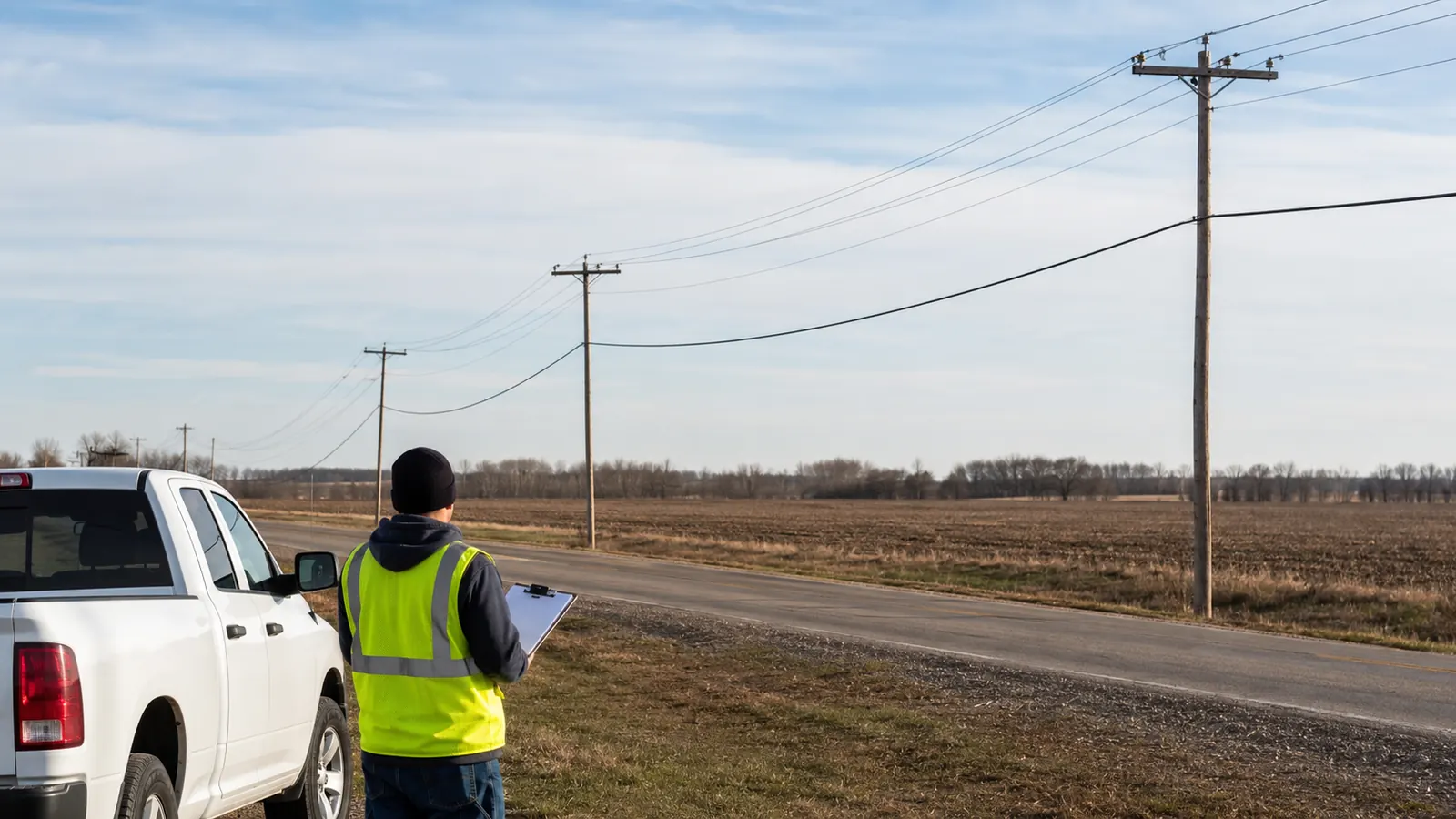
A colored overhead route can still leave a crew without a carrier to lash to, even after a drawing goes to the field with every pole painted and the last spans still have no named support method. The reel date then sits while the workfront looks finished.
This article stays on the installation path a managed crew can actually build, and clearance code questions belong in the companion guide rather than in these headings. The paired underground article owns soil and burial. We keep the topics apart so a reviewer can tell installation design from clearance evaluation.
Aerial Fiber Optical Cable Installation Design Defines the Support System
Aerial fiber optical cable installation design converts a route into a buildable overhead support system. IEEE C2-2023, the 2023 National Electrical Safety Code, is the overhead-line basis we record, subject to adoption. The pole owner still accepts the attachment. A colored route is not yet that package.
The route line says where fiber intends to go. It does not say whether the cable is lashed to new strand or placed on an existing support the pole owner has already accepted. Freeze the support concept before anyone orders material. An unnamed carrier on an otherwise finished sheet is still an open span.
Publication of IEEE C2-2023 does not make it project law by itself. Overhead-line rules apply through adoption or incorporation by the relevant authority, and we record the edition beside the span it actually governs rather than leaving a cover note to speak for every pole. When a pole-owner construction standard is stricter, we write that owner rule on the same sheet instead of pretending the two bases are identical.
Aerial Fiber Optical Cable Installation Design Support Decisions
A single aerial symbol that hides a change in support method is a defect, because loading assumptions then diverge from the material list and the construction sequence follows the wrong carrier before the first span is installed. Name the carrier on every span. If the method changes, the span group changes with it.
Lashed plant does not share hardware or sag assumptions with self-supported cable. Mixing those methods under one aerial symbol is how a material list lies: loading inputs and construction sequence then follow a carrier the pole owner never accepted on that span. Keep the methods apart.
Pole identity has to survive the office join before anyone argues about strand size. Duplicate tags break that join quietly. Replacement structures with offset coordinates still look plausible while pointing at the wrong pole. We require an overview photograph and a route sequence on the same record because identity errors parse as real measurements and then travel into loading inputs as if they were true.
Guying needed for a new strand run is part of support rather than an optional later sketch. If the anchor easement is missing, the span is not ready, and issuing it anyway only relocates the stop from the office to a crew that cannot set an anchor the ground has no right to receive. Anchors have owners, which is why we find them before the workfront is colored.
We freeze a pole-by-pole support concept before strand or cable is ordered. The limitation of that preferred freeze is that the last unresolved pole can hold the reel date while a colored route would have looked finished. We do not recommend releasing those spans as ready just to protect a construction start, so the unnamed carriers stay on hold and the accepted remainder stays visible.
Ownership belongs on that same concept sheet, and so do existing attachments, because proposed hardware has to sit with span direction and span length or a later guy or riser that never made the sheet will be treated as optional scenery. Route exceptions stay in the open while the path is still being frozen.
Carry Clearance Criteria Into Span Geometry
A road crossing needs geometry of its own on the span sheet, because the surface that actually sits under the cable is the case the crew will be asked to meet. A general IEEE C2-2023 citation in the cover notes does not give them that target. Supply-space relationships need a different cut from that crossing.
The companion guide on aerial fiber clearance design requirements goes deeper on the code question. This package still has to carry the resulting geometry into construction. Attachment elevations and sag assumptions have to live on the span, not in a cover note.
| Decision | Evidence form | Consequence if unresolved |
|---|---|---|
| Support concept | Named carrier written on the span, joined to pole records and measured lengths. | Loading assumptions diverge from the material list before the first span is installed. |
| Clearance as geometry | Measured elevation at the crossing, with the owner criterion that actually controls that location. | Reviewers cannot reproduce the clearance conclusion. |
| Handling and splice access | Cable data on the same sheet as reel length, plus a standing place the splice can actually use. | Crews improvise storage at the roadside. |
| Make-ready readiness | Owner response printed against the span it binds, not averaged into a route-wide ready date. | Managed crews arrive at poles whose owner conditions remain open. |
| Bounded workfront issue | One revision letter a supervisor can state without opening a second folder. | Redlines lose their connection to the engineering release. |
Clearance Becomes an Installation Dimension
IEEE C2-2023 remains the overhead-line basis we already named, though state adoption can add a requirement the national edition does not carry, and a pole-owner standard or a permit condition can control a crossing the typical never saw. Designers who cite the code in general notes without showing field inputs leave crews without a target they can set.
Reviewers cannot reproduce a clearance conclusion that has no measured evidence. The span sheet has to carry the measured elevation at the crossing where the road actually sits, because that input is what turns a code citation into an installation dimension a crew can set. A bounded estimate can be useful, but an unlabeled estimate disguised as measurement cannot, so we write the method beside the number.
Attachment height without a datum is not a reusable number. Grade changes what the value means. Lean or a blocked sight line can change it again before the crew ever sets hardware. We write the method beside the value because crews cannot install a mystery. Copying a passing rural span onto a road crossing without restating the surface type, and without restating the owner criterion that actually controls that location, is how a later rejection appears.
Buildings and terrain can rewrite the controlling case after the typical was already drawn. Reopen that span. When a later survey revises a crossing profile, we reopen the installation dimension rather than leaving last week's target on a construction sheet that still names IEEE C2-2023 in the cover, because the code citation did not change while the measured ground did.
Design Cable Handling and Splice Access Before Reels Arrive
A splice can land over a travel lane because the fiber count looked tidy on the schematic. Safe staging did not exist there. Traffic blocked the reel, so the crew then tried to invent a shoulder.
If a splice sits over a travel lane with no approved pull-off: move the splice or move the traffic control. Do not hope the crew invents a shoulder.
USDA Rural Utilities Service Bulletin 1753F-152, RUS Form 515c, Specifications and Drawings for Construction of Aerial Plant, is a dated contract reference that applies when incorporated and does not become a nationwide construction mandate merely because a rural typical looks familiar. Manufacturer limits still govern the selected cable. Read the incorporation clause first.
Reel Logic Changes the Aerial Workfront
Splice locations chosen from cable count alone often fail the access test, which is avoidable if access is treated as a design input rather than a later count check. Cable survives installation only if the route respects the product, including bend radius on the pull that was actually staged.
Reel direction is a design decision when the route has one legal staging pad and a creek on the other side, because a reverse pull that was never staged will be billed as a crew problem after the cable has already been damaged mid-span. We pick the pull before the cable is ordered, since that damage is a missing handling plan rather than a skill issue.
Slack storage that looks generous on a plan can still be unusable if the pole sits in a cut slope. Access is part of the splice, and a count of spare fiber does not create a place to stand, so we move the splice or rebuild the standing place if the slope cannot take a bucket.
Where aerial plant meets a riser, this article owns the pole and the direct-buried fiber design for underground segments owns the ground. Both releases should print the same station number at that riser, because a trench that inherits aerial headings loses cover authority the moment restoration hides the plant. Stop at the riser and name it.
If manufacturer tension limits disagree with the planned pull, we restage the reel rather than asking the crew to protect the cable by feel, because a limit that lives only in a catalog sheet will not be present when the tension comes on. Two spans that look similar on plan can still demand different staging, and that difference has to be visible before the truck is loaded.
When reel length and slack storage disagree, we restage before the pull rather than hoping extra cable will find a pole that can hide it, because slack is a designed quantity. Bucket access has to be checked against the same splice point: an optically convenient landing that cannot be occupied without a lane closure the traffic-control sheets never covered will be rewritten in the field after the reel is already committed.
Close Make-Ready and Owner Conditions Before Crews Mobilize
Make-ready actions sit on one clock, and owner work sits on another that rarely shares a start date, so an attachment design can be complete while the pole is not ready. Design completion is not permission to attach.
The neighboring make-ready process is described in make-ready engineering for telecom attachments. This installation package still has to show which spans are actually releasable, including permit limits that can sit on a calendar the drawing never mentioned.
Section 224 of Title 47 of the United States Code excludes cooperatively organized entities from its statutory utility definition, so federal pole-attachment procedures are not automatically universal on a cooperative pole even when the neighboring investor-owned span on the same feeder is bound by them. Ownership has to be confirmed before anyone imports a clock the pole owner never granted, and jurisdiction has to be confirmed the same way, with owner policy following those two facts rather than a cover-note assumption.
Pending owner response is not a construction week. Print the hold against the span list. Mobilizing into that pole wastes a managed crew and a permit window.
Separate technical readiness from owner authorization. Schedule only the spans where both are real, and leave the others on hold so a colored route cannot impersonate a released workfront. Crews cannot invent missing make-ready. Averaging those clocks into a route-wide ready date is how managed crews arrive at poles they cannot touch.
Loading inputs that never make it onto the installation sheet become a surprise when the pole owner asks which attachment height was approved, because a separate loading report in another folder is not an installation dimension a crew can set. The installation design has to carry the approved position, which means joining the files before the span is issued.
If a cooperative pole sits beside an investor-owned pole on the same feeder, we confirm ownership and agreement before any federal attachment clock is used as a schedule input. Mixed ownership is a readiness fact rather than a drafting inconvenience. Section 224 does not paper over that split.
Material dependency belongs on the same map when hardware lead time is the real stop. A designed span with no approved clamp is not a released span, so we name the missing item and let the rest of the workfront move without dragging the blocked poles along as if they were ready.
Release Aerial Workfronts One Bounded Span Group at a Time
Rural ISP building a new feeder: release only the spans whose support method already agrees with owner status and whose clearance geometry is already a settable dimension on that same revision. Hold every span that still lacks a named carrier rather than painting a route-wide color-up ready to protect a start date.
Overbuilder on occupied poles: keep make-ready holds visible on the issued group instead of averaging them into a route-wide ready date that sends managed crews to poles they still cannot touch. A PDF that looks complete will not open a pole the owner has not released, so show the open poles before anyone rolls. If the same feeder mixes cooperative poles with investor-owned spans, split the workfront at the ownership change; Section 224 does not automatically supply that clock.
The Bounded Aerial Release Package
Draftech's engineering is in-house. When construction is included, full turnkey delivery uses Draftech-managed subcontract crews under Draftech QA/QC and safety oversight. A self-perform construction crew is being built, and it is not the present delivery model. The field still returns redlines to the issued revision, and field copies that no longer share one revision are a defect.
A workfront PDF that covers many miles under one revision letter cannot tell a foreman what is authorized this week. We bound the physical limits to a span group a supervisor can state without opening a second folder, and we keep the material list on that same revision so the truck is not loaded from a newer sheet than the geometry. The redline path has to land on that issued set. If supervision still needs another folder to explain the hold points, the transmittal failed. Stop there.
When a later owner response frees a held pole, we issue that span as a new workfront increment rather than silently expanding last week's PDF, because the as-built has to show when authorization actually arrived rather than implying the pole was always in the original group. Verbal substitutions do not ride along. If the approved attachment position changes, the span returns to engineering.
Permit limits belong on the workfront index when a lane restriction or a seasonal window actually changes which spans can be built this week, because a technically complete aerial design still fails if the issued group cannot be reached legally. Schedule the reachable group and hold the rest.
If the issued group is the question you need answered, send that bounded workfront to info@draftech.com and we will review it against how we run fiber construction management. Design work stays with the in-house engineering model. When construction is procured as turnkey, the performing-party identity is the managed crew framework.
A bounded span group is easiest to release when the engineering that produced it is ours. For a new aerial feeder, Draftech engineers the first 20,000 linear feet at no cost. That includes make-ready and permit drawings, and the package is carried to permit approval. Every request is reviewed by our owner before we commit.