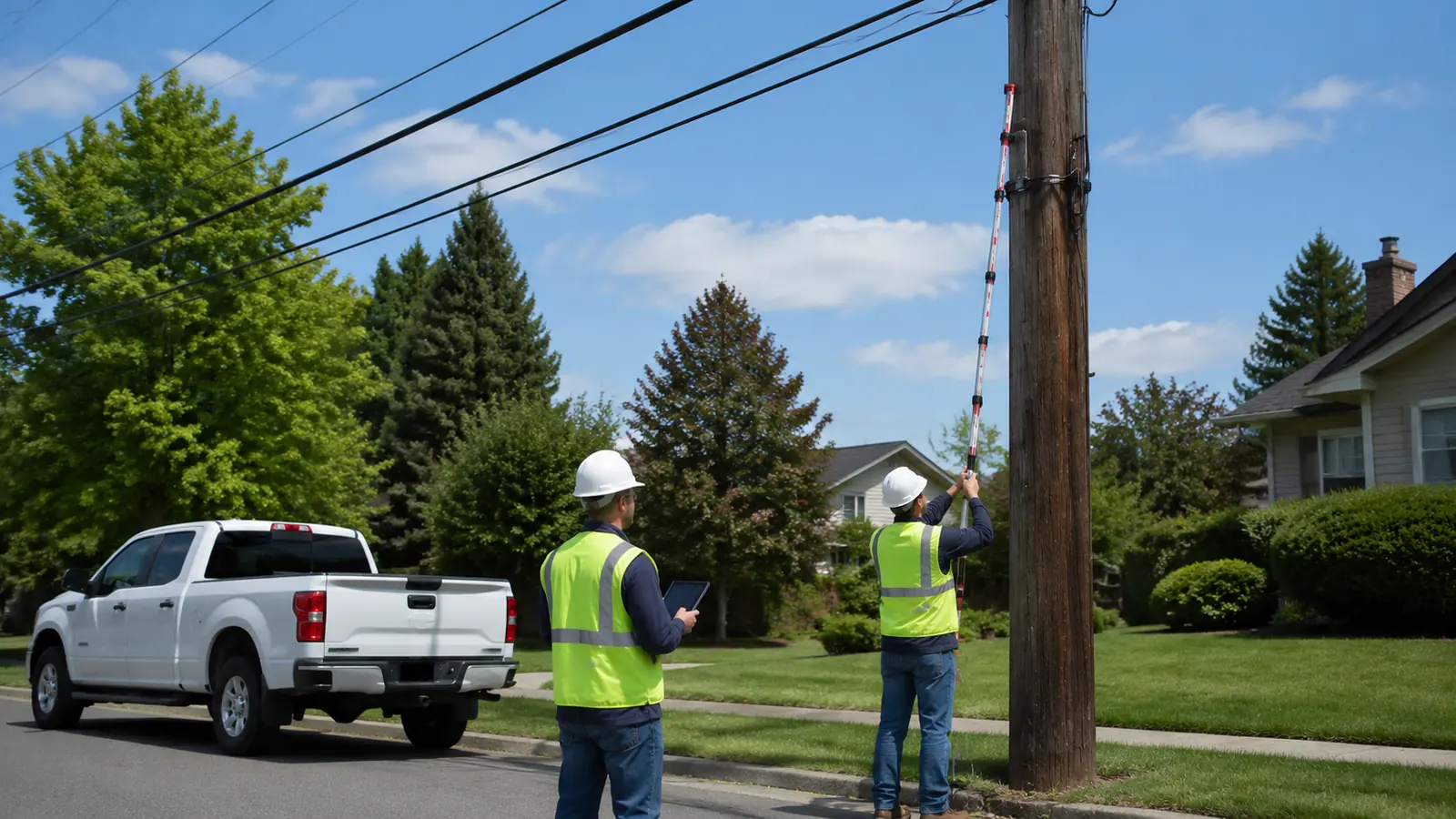
A structural model can be internally consistent and still describe the wrong pole. The failure usually begins with an unmatched photograph, an attachment measured from an unclear datum, or a span assigned to the wrong neighboring structure. Our field scope must prevent those records from looking complete when the evidence is not complete.
This guide treats collection as an engineering evidence process. We explain what to record, how to separate measured facts from assumptions, where QA should stop a record, and how to release a package that a second qualified reviewer can reconstruct without asking the original collector to explain every field.
What Utility Pole Loading Field Measurement Must Capture
Utility pole loading field measurement is the controlled capture of structure and attachment geometry, plus span and guying evidence, used to build a pole model. Our 5 evidence groups require every material value to retain an ID with its unit and method; a photograph and review state must also remain attached before analysis begins.
The field record must represent the whole structure, not only the proposed communications attachment. That means recording the pole with its existing supply and communications facilities; the span relationships and mounted equipment also belong in the record. Guys and anchors matter. So do risers and observable condition. A missing service drop or a guy placed in the wrong quadrant can distort the load picture even when the proposed cable record itself is correct. We require the collector to show what acts on the pole and where it acts.
Federal attachment policy is not a field form, but it explains why traceable structure and attachment records matter. The FCC Pole Attachments program is our named federal reference for the governing attachment framework. The pole owner, contract, current engineering standard, and project scope still control the accepted data fields. We never substitute a generic checklist for the receiving utility's requirements.
We connect the collection scope to our pole loading analysis workflow before field deployment. The analyst identifies model-critical attributes and accepted measurement methods, then specifies required units plus stop conditions; the field lead converts those requirements into a record schema and a fixed photo sequence. This handoff is where an attractive mobile form becomes an engineering instrument rather than a collection exercise.
Field Evidence and Pole Data QA Controls
Our collection plan uses 2 layers: a required record for every structure and an exception path for conditions the form cannot resolve. Required fields prevent silent omissions. The exception path prevents a crew from guessing simply to close the record. Each exception names the affected pole or span and the missing evidence. It also states the possible design consequence and assigns a responsible reviewer; the event that allows release is defined on the same exception. An honest unknown is controlled data. An unlabeled estimate is not.
Before collection starts, we test the schema against 1 representative pole record. The pilot must carry a value from observation through photo indexing and map review, then through exception handling into model import; this dry run exposes unit drift and truncated identifiers as well as fields that cannot express an unusual condition. We correct the schema before scaling the same defect across the route.
| Evidence group | Required field record | QA comparison | Release decision |
|---|---|---|---|
| Pole identity | Tags, coordinate, route sequence, material | Map, context photo, adjacent IDs | One structure confirmed |
| Vertical geometry | Datum, method, units, attachment heights | Profile, pole photo, equipment position | Measured values separated from estimates |
| Span geometry | Neighbor, direction, length, line angle | Both span ends and route map | Continuous span relationship |
| Guys and anchors | Height, direction, lead, anchor position | Pole-to-anchor and anchor-to-pole views | Support geometry confirmed |
| Equipment and site | Type, mounting, risers, access, condition | Detail images and context images | Loads and constraints identified |
Photographs and measurements must agree as a set. A close image can establish a tag or hardware detail but cannot prove the route context; a wide image can establish adjacent spans yet still fail to resolve the bolt or cable. It may also leave an anchor connection unclear. We therefore specify coverage rather than promising that 1 universal photo count fits every structure. The QA reviewer asks whether every modeled object can be traced to clear evidence at the correct pole.
- Pole identity: owner tag and secondary identifier; coordinate and route sequence; material plus markings; observable condition.
- Attachment geometry: facility owner and type; measured height at the pole face; mounting offset with its supporting photograph.
- Span relationships: neighboring structure and direction; length method with line angle; crossing context plus continuity status.
- Support system: guy height and direction; lead with anchor location; shared hardware plus braces; visible condition.
- Site evidence: equipment and risers; access limits with grade changes; obstructions in the roadway context; open exceptions.
This table is our 5-part review framework, not an industry statistic. It gives field staff a release vocabulary that engineering and QA can use without translation, although a record can pass identity while remaining blocked for span geometry. That distinction keeps a localized gap from stopping an entire route while preventing the affected pole from entering structural analysis under false certainty. We prefer a visible hold to a clean dashboard built on assumptions.
Utility Pole Loading Field Measurement by Asset Type
Pole identity comes first because every later value inherits it. We require the owner number and any secondary tag; the mapped route sequence must agree with a coordinate collected by the approved method because every later value inherits that identity. A context photograph should show enough of the neighboring corridor to reconcile the record. Duplicated tags, replacement poles, and stale map points remain exceptions until the route relationship is proved. Our strand mapping and aerial plant assessment process applies the same connected-corridor principle.
Vertical geometry needs a repeatable ground reference. The collector records the datum at the pole face and the method used. The unit stays beside the value, while any obstruction that affected the observation stays visible. Each attachment is a separate object with owner and facility type; its height must identify the side of pole and image reference. We do not collapse several communications cables into one note. A profile only becomes reviewable when another person can tell exactly where every height began and which object it describes.
Span geometry must reconcile from both ends. We capture the neighboring structure, span direction, length source, line angle, crossings, and any change in grade that affects interpretation. A straight-looking photograph is not a bearing, and a line on a base map is not proof that the field connection follows it. For loading context, our NESC pole loading compliance guide explains why structure, facilities, and environmental design basis must be reviewed together.
Guying requires more than a yes-or-no field. The record shows guy attachment height with direction and lead distance. Anchor position stays tied to shared anchors or sidewalk guys; braces and observable defects remain separate fields. Vegetation can hide the anchor. Parked vehicles and grade can do the same. When the approved method cannot establish its location, we hold the support geometry rather than drawing a convenient quadrant. Two opposing photo directions usually make the relationship easier to review, but the accepted evidence rule remains project-specific.
Equipment and site conditions complete the model context. Transformers, crossarms, streetlights, risers, cabinets, and other mounted objects need type and position records appropriate to the analysis. Roadways, driveways, retaining walls, vegetation, and access limitations explain why a measurement may need follow-up. We also keep safety boundaries explicit. The OSHA Telecommunications standard, 29 CFR 1910.268, is a named federal safety reference; the employer's approved procedure governs field execution.
Condition observations need disciplined language. A collector can record cracking, decay indicators, damaged hardware, excessive movement, or another visible condition within the approved scope, but that observation is not automatically a structural rating. We retain the image with its location, while the observation method and escalation status stay on that same condition record so no reviewer has to infer which observation triggered follow-up. Engineering or the pole owner determines the required follow-up. This boundary prevents a field adjective from entering the model as an unsupported material property.
Access limitations are part of the evidence package, not a production excuse hidden at closeout. We record the side of the pole that could not be viewed and explain the reason. The affected attributes remain blocked until the approved next action closes them. A later visit may do that. An owner record or alternate safe viewpoint may also work, while an accepted assumption requires its own approval. Until then, the record stays visibly constrained. That discipline protects both the collector and the engineer asked to use the result.
Field control: Put the measurement method beside the value. A height without its datum, unit, and method looks final even when it cannot be reproduced.
QA Gates Before Pole Loading Analysis
We use 3 review gates before a structure reaches modeling. Completeness comes first, followed by relationship review and engineering readiness. Completeness confirms required fields or a documented exception. Relationship confirms that IDs and photographs agree with the coordinates; neighboring poles must also connect to the recorded attachments and spans as one coherent structure. Engineering readiness prevents a missing or estimated value from silently altering utilization or clearance review. It also protects the make-ready scope and any replacement decision. These are Draftech release gates, not measured performance claims.
The first gate can be partly automated. Required fields, unit formats, duplicate IDs, missing photo references, and broken route sequences are suitable machine checks. Automation cannot decide whether the photograph actually shows the claimed anchor or whether an apparent attachment is assigned to the correct owner. A qualified reviewer inspects every exception and a risk-based sample of ordinary records. We keep the check proportionate, but we never allow form completion to stand in for engineering review.
Correction requests should be specific enough for a crew or records reviewer to close in 1 pass; we identify the pole and disputed attribute first, then show the current evidence that caused the hold. The request explains why it fails and names acceptable replacement evidence. A note such as verify pole is not actionable. A note that names the unmatched owner tag and requests a context image tied to both adjacent structures is actionable. We track correction status beside the source record rather than in a detached email chain.
The relationship gate works at corridor level. A pole can look complete in isolation while its outgoing span points to the wrong neighbor or disappears at a crew boundary. We compare both span ends against route order. Attachment continuity and known crossings receive a separate corridor check. If the route breaks, the affected records return with a precise correction request. Our make-ready engineering timeline guidance shows why unresolved owner and field dependencies must remain visible rather than being absorbed into an optimistic schedule.
Revision control matters when records are corrected after initial sync. We preserve the original observation and changed value beside the supporting evidence; the editor remains named while the review state carries its effective revision into every downstream use. The current model input should point to the accepted record, while the history explains why an earlier value was superseded. Overwriting the field value may make the screen cleaner, but it destroys the trail a utility reviewer needs when a model changes between submissions.
Engineering readiness separates facts from accepted assumptions. Blocked inputs remain a third, unmistakable state. A fact retains evidence. An assumption retains its basis and approver, with scope stated separately. A blocked input names the evidence required for closure. The modeler should never have to infer which category applies from cell color or a private message; when the receiving utility requires a particular platform, our QA package also preserves the mapping from source fields into the model. The O-Calc Pro and SPIDAcalc comparison is a useful reminder that tool choice does not repair weak source data.
- Completeness gate: required fields are present or marked inaccessible; not-applicable fields and named exceptions are explicit.
- Relationship gate: structure IDs agree with photos and map positions; spans must connect with their attachments across the corridor.
- Readiness gate: every model-critical uncertainty is resolved or carried as an approved assumption that remains visible.
Release Decisions and the Analysis Handoff
Release should be segmented by consequence. A missing cosmetic context image may require correction without changing a structural decision. An uncertain attachment height or span relationship can stop the affected model. So can an unresolved pole identity or anchor position. We state the release rule before collection so field and engineering teams do not negotiate quality after the route is captured. The decision log records who accepted each assumption and which output depends on it.
The handoff includes native field data with indexed photographs and the controlled route map. Units remain with the coordinate reference and method metadata; exception status carries the current revision plus QA approval. We also test an exported record because identifiers can be correct in the source system and disappear in a spreadsheet or model import. One independent reviewer should reconstruct a representative pole from source evidence without the collector's private notes. If that cannot be done, the package is not analysis-ready.
Our own limitation is straightforward: even a disciplined evidence package cannot make an obstructed anchor visible or turn an owner record into a field measurement. We stop the affected model when the approved method cannot support the value. No polished dashboard fixes that.
Our in-house engineering team uses this evidence chain to remove avoidable ambiguity from pole models and make-ready recommendations before an owner submission. Teams can use the pole loading calculator for an early planning check, but it does not replace a structure-specific model or utility review.
For a utility or engineering reviewer: require the evidence status, accepted datum, and exception owner before releasing a pole to analysis. If any model-critical value is still merely plausible, hold that structure. Be direct.
For an ISP or construction program manager: connect the field schema to the analysis requirements before mobilization, then fund targeted recollection instead of asking modelers to repair gaps by assumption. Our in-house pole loading analysis team carries those inputs and decisions as one controlled workstream without hiding blocked records.
If you need a field schema reviewed before mobilization or a route package assessed before modeling, email our team. We will focus the discussion on the receiving utility's requirements and the uncertain asset classes, then define the evidence needed to release each structure.
Talk to our pole loading team about your route. We can align field evidence, exception rules, and analysis QA before an incomplete record becomes a structural assumption.