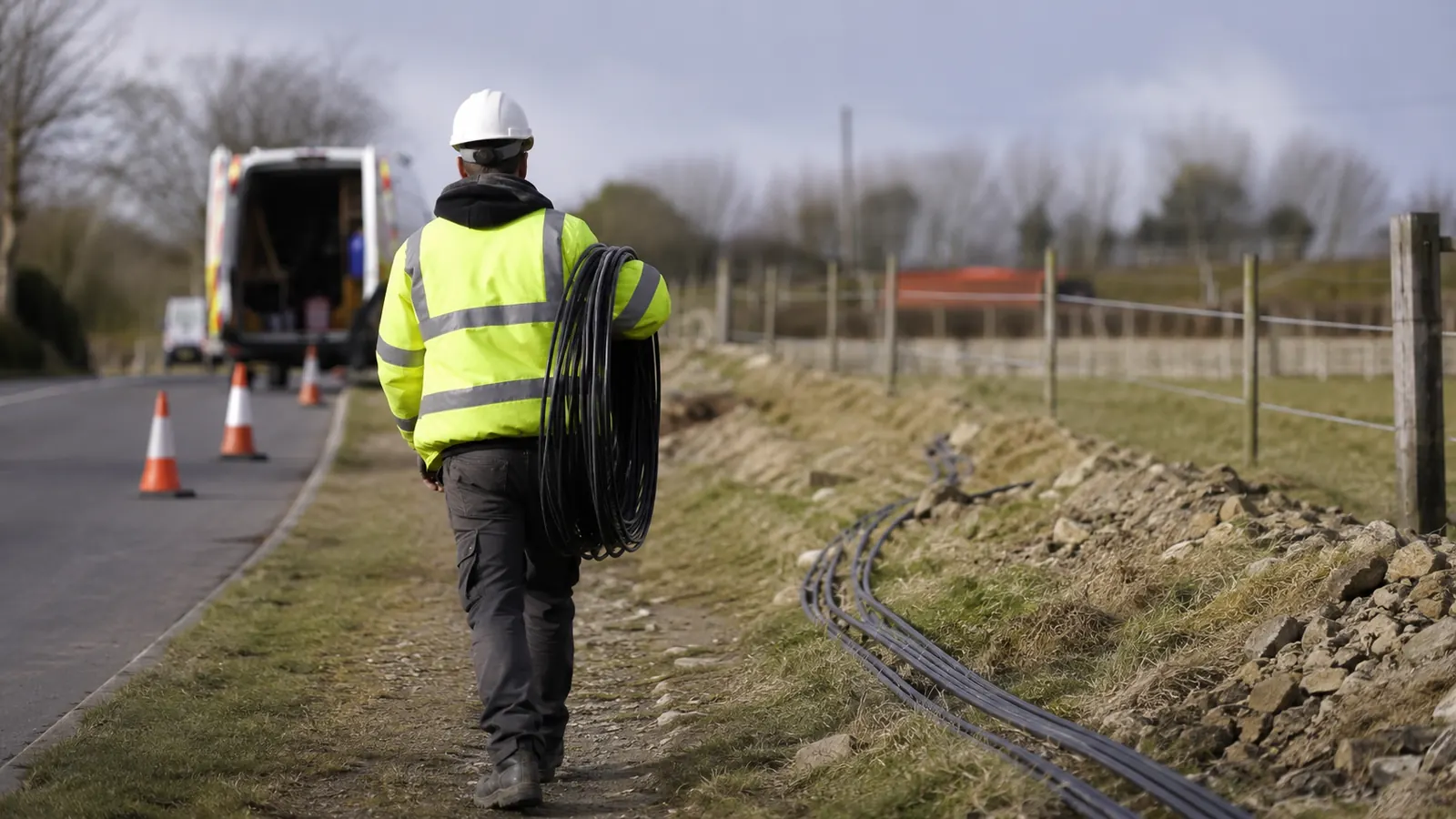
A superintendent copied last week's typical application onto this week's shoulder job because the county road looked the same on the aerial. The crew arrived with a reel trailer and a boom that reached past the white line. The sheet still showed a parked excavation on the gravel.
This article stays on the temporary traffic control design. A state lane closure permit runs on a different clock and consumes an accepted MOT concept. It does not produce one. We write the operation first, then size the zone around the ground the crew will actually occupy.
MOT Plan Fiber Optic Construction Starts with the Current MUTCD
An MOT plan fiber optic construction package is the temporary traffic control design for one named fiber method. Its federal basis is the Federal Highway Administration Manual on Uniform Traffic Control Devices, 11th Edition with Revision 1, dated December 2025. Revision 1 took effect March 5, 2026.
We put that edition in the title block because the sheet has to name the book it was drawn under. The December 2023 base publication is no longer the current federal publication for the sheets we issue. Temporary traffic control lives in Part 6. Federal Highway Administration 23 CFR 655.603, Standards, sets the national standard framework, and each state carries a legally effective version through an approved supplement or a full state manual. States and other Federal agencies shall adopt changes within two years from the effective date of the final rule. Federal publication date and legal effect on one specific road are separate findings, so we record both before we issue plans.
Write the Fiber Operation Before Opening a Typical
Write down what the crew will actually do before anyone opens the typical application library. The note has to fix the work method. It also has to fix the reach of the equipment with the boom up and the outriggers set, and the ground where people will stand. If there is a trench, depth and width belong in the same note. Duration belongs there too. Posted speed belongs there because Part 6 ties warning distance to roadway condition such as posted speed. Available sight distance is a field fact, not a drafting preference, and we write the source beside each value so a changed operation triggers a real review instead of a quiet reuse of last week's sheet.
Some of those values come from a site visit. Others come out of the accepted construction plan or the agency's own record of the corridor. Occupational Safety and Health Administration 29 CFR Part 1926 Subpart G, Signs, Signals, and Barricades, reaches worker protection as a construction safety matter. Section 1926.200(g)(2) requires traffic control devices used for protection of construction workers to conform to Part 6. That is not the same job as the traffic control design the road authority reviews under Part 6 for drivers and pedestrians. A sheet that folds both into one generic compliance note leaves a reader unable to tell which authority was actually designed for.
Edition check: the basis of design should name Revision 1 by number and name the state manual or adopted supplement that governs the corridor in question.
Close the basis of design record with a sketch of the work rather than a device count. The sketch has to show the people and machines on the ground, together with the excavation, during the phase that squeezes the corridor hardest. That is the phase a reviewer will use to decide whether the remaining open path still works, and it is rarely the one the schedule treats as the main event. If the contractor later arrives with equipment that reaches past what the sketch shows, the mismatch is visible on its face and we revise before the shift starts.
Our preferred typical library start has a real limitation: it saves drafting hours while hiding the actual work envelope from the reviewer. We still keep those typicals on the wall as starting geometry, never as a released plan. One thing I have always found sloppy is issuing a typical application as the finished MOT sheet because the geometry looked familiar. We do not recommend that.
Grow the Zone from the Work Envelope Outward
Start at the activity area. Part 6 describes a temporary traffic control zone as often divided into four areas used as needed based on engineering judgment. Advance warning and the transition sit upstream of the activity area. Termination sits downstream of it. Sizing then runs outward from the ground the fiber work genuinely occupies. Upstream warning answers to that job. Downstream recovery follows the same logic, not a preference formed back in the office.
A shoulder handhole needs a protected excavation and truck access without surrendering a travel lane. A bore receiving pit near an intersection can reach into turning paths while the lane stays nominally open, which is exactly the reach a clean plan view hides. A moving aerial pull relocates its protected space during the shift, so swapping a title block will not convert one of those drawings into another. We draw the envelope first, and only then do we look at whether a typical even belongs on the sheet.
What the Sheet Has to Prove for Each Fiber Method
| Fiber method | Controlling exposure | Why a borrowed typical fails |
|---|---|---|
| Shoulder handhole, one shift | Protected excavation and truck access that stay on the shoulder | A lane-closure typical occupies pavement the crew never needed |
| Bore receiving pit at an intersection | Pit reach into turning paths while the lane stays nominally open | Plan view hides the corner the pit actually occupies |
| Moving aerial pull | Protected space that relocates as the reel advances | A fixed pit typical is already wrong after the first span transfer |
| Night restoration on a collector | Device visibility under the lighting the accepted clock assumed | A daytime sheet installed after dark has no night notes to work from |
| Second accepted closure on the same corridor | Peak-hour conflict with neighboring work already authorized | Two individually acceptable sheets still collide on the same hour |
Device spacing and dimensions come from the applicable manual and from the speed basis printed on the sheet, applied with engineering judgment to the geometry actually in front of you on that corridor. No universal taper formula gets published here. The plan names the source behind every governing value. Where an agency standard drawing supplies the layout, the project records the current drawing identifier and any approved project-specific modification. Could an inspector opening the file months from now tell which sheet was in force? That is the test we use in review.
Drawing offices, ours included, get attached to a clean plan view. Grade fights the drawing. Parked cars do too. A queue then builds at the wrong hour. We run constructability review against the planned work and the corridor evidence before release for exactly that reason. A taper that draws beautifully and cannot be installed without blocking a driveway has already failed even if the paper still looks symmetrical.
Draw the Path the Vehicle Plan View Leaves Blank
The base drawing a designer inherits is almost always a vehicle drawing. Curb ramps share the corridor the fiber crew wants. They show up on the day of the pull whether or not the sheet acknowledged them. That is a miss. We treat it as a design failure rather than a field surprise, because the public path was already there when the survey was taken.
A Blocked Curb Ramp Is a Design Failure
Trace the existing sidewalk and curb ramps straight through the work limits before anything temporary gets drawn. Where the work touches one of them, the plan has to draw an approved continuous route in its place. A general note reading maintain access will not resolve a blocked curb ramp. The note relocates the problem onto the flagger holding the sign that morning, which is how a missing line on the sheet becomes a field argument.
The 11th Edition increased attention to vulnerable road users across the manual. Revision 1 is the current federal publication we issue against. What goes on the sheet is the governing Part 6 provision and the agency's accessibility requirement, matched to the site geometry rather than a dimension invented from a policy memo or a length copied from another job. Field review checks the temporary route against what the selected layout and the authority prescribe. Treatment on a suburban collector and treatment on a downtown block will not look alike, and we do not pretend they should.
Driveways and side streets create decision points of their own. A truck backing into a bore setup can cross the temporary pedestrian route. A queue can seal off a business entrance. A flagger station that looks obvious from one approach can sit hidden around a curve from the other. We put each of those interactions on the plan with a stated method for maintaining or temporarily controlling the movement, because access continuity is what the reviewer will be looking for when the sheet arrives.
Adjacent work can defeat a sheet that is sound on its own terms. Federal Highway Administration Guide to Project Coordination for Minimizing Work Zone Mobility Impacts, FHWA-HOP-16-013, is a coordination guide rather than a traffic control design standard. We use it for one narrow purpose: checking the accepted closure concept against neighboring projects and recurring events before mobilization. Two individually acceptable plans that occupy the same peak hour still hand the corridor a conflict, and that conflict will not show up on either title block.
Phase Only When the Protected Space Actually Moves
Fiber construction changes shape inside a single shift. Setup takes less room than the excavation that follows it. Restoration can reopen one path while another stays protected. A cable pull creates an exposure that travels with the reel, which is why we split the work into phases only where the protected space or the public path genuinely changes. A phase boundary invented for tidiness hands the crew one more transition to get wrong. Every phase gets a start condition. It also gets a layout a crew can work inside, then a drawn move into the one after it.
Installation Order for MOT Plan Fiber Optic Construction Devices
A plan has to be installable before it protects anything. Show the order that establishes advance warning first, then channelization, then activity area protection, with removal running that sequence backward so the last device picked up is the first one the public needed. Device delivery and storage cannot sit in the traffic space those same devices are supposed to create. Means and methods stay the contractor's call. What the design cannot do is demand an impossible first move, such as setting taper devices from a lane the taper has not opened yet.
Night work moves the assumptions a sheet was drawn on. We state the lighting and clock the design assumed, and we name the authority who may modify or suspend the work when a condition drifts outside those limits. A parked piece of equipment can also kill a sight line the sheet counted on. The competent field authority stops, then either adjusts under an approved provision or asks for redesign. Rain is not a separate typical; it is a reason to check whether the assumed visibility still matches the released sheet.
The telecom work zone traffic control field guide covers how these layouts behave once crews are running them. The fiber ROW compliance checklist covers the permit conditions and closeout evidence that trail the job. Design is where this article stays. A lane closure authorization or a compliance inspection consumes the plan. Neither one repairs geometry that never matched the construction work.
A changed bore pit can trigger a focused review of the affected phase alone. An added vehicle can do the same. The revised sheet states the limits it touches and the instructions it supersedes, while pages that did not change keep their prior revision number so crews know which pages actually matter. One bounded change never forces a reissue of the whole corridor package.
First move: advance warning stands before the work space is occupied. A pallet of drums parked in the lane the taper still needs has already created an unplanned closure.
How to Choose and Release an MOT Plan
County shoulder handhole job: protect the excavation and hold a continuous side path. Intrusion into the hole is the controlling hazard. A borrowed lane closure typical will occupy road the crew never needed. Take the narrowest layout the approved work allows, and do not let a familiar typical talk you into a full lane take.
Signalized intersection pull: settle approach visibility and transition geometry first, then confirm that queue storage fits inside the accepted limits. A shoulder typical will never generate those lengths. A moving aerial pull needs a traveling protected space tied to the support vehicles, because a fixed activity area drawn for a pit is already in the wrong place before the second span transfers.
Overbuilder on a tight permit clock: release the MOT concept before the lane closure request leaves the office. The request consumes the accepted sheet. It cannot invent the geometry. We hold the filing if the equipment envelope on the sheet is not the envelope the contractor will actually bring, even when the permit clock is already running.
Final review runs the plan against the accepted work package and the equipment envelope, then against the route geometry. After that we put the general notes next to the plan views and look for a contradiction. Details get the same treatment. The device schedule is last because it is where a shoulder-only narrative can still sit beside an equipment diagram that crosses the lane line. That pairing is worth hunting first. The release log records the work and the conditions the plan covers, so a later change gets tested against a written basis rather than a recollection.
Closeout keeps the approved plan revision together with the agency conditions and the field change records the owner requires. A later claim should be answerable from those controlled records rather than a phone gallery. Crews verify that what got installed matches what was released before anyone treats the shift as closed. If an adjustment was approved, it gets recorded on the same revision trail. Anything outside those limits gets escalated before the next shift starts.
Traffic control carries real money. The estimator should work from the accepted work method and its phases rather than from a generic allowance. If a permit later narrows the available window, we recheck whether the work and the setup remain feasible inside that condition before crews or materials move. The scope should name who owns design and who owns device rental, because those two invoices do not belong to the same decision.
A separate DOT permit coordination process carries the accepted plan through agency review. Our permitting and utility coordination service ties the design record to that submission, so the MOT concept and the lane closure request stop running on two clocks. The Draftech engineering team holds the in-house design record. Where the assignment includes construction, Draftech delivers full turnkey work through Draftech-managed crews, and the engineering record stays inside the firm.
Draw the work, not a template. Ask the permitting team to review an MOT concept against the planned fiber work.
Send the settled construction method and the equipment reach to info@draftech.com along with the road data. Station limits give a designer enough to start. The cross section at the tightest point helps if you add the shift plan. From there the questions get specific: what that road authority requires, and which phase decides the layout everything else lives with.
The permit package that carries an MOT plan can start without a design budget. Draftech's free 20,000-foot design offer produces the survey, construction drawings and permit submittals for the opening segment of a route and carries them to approval.