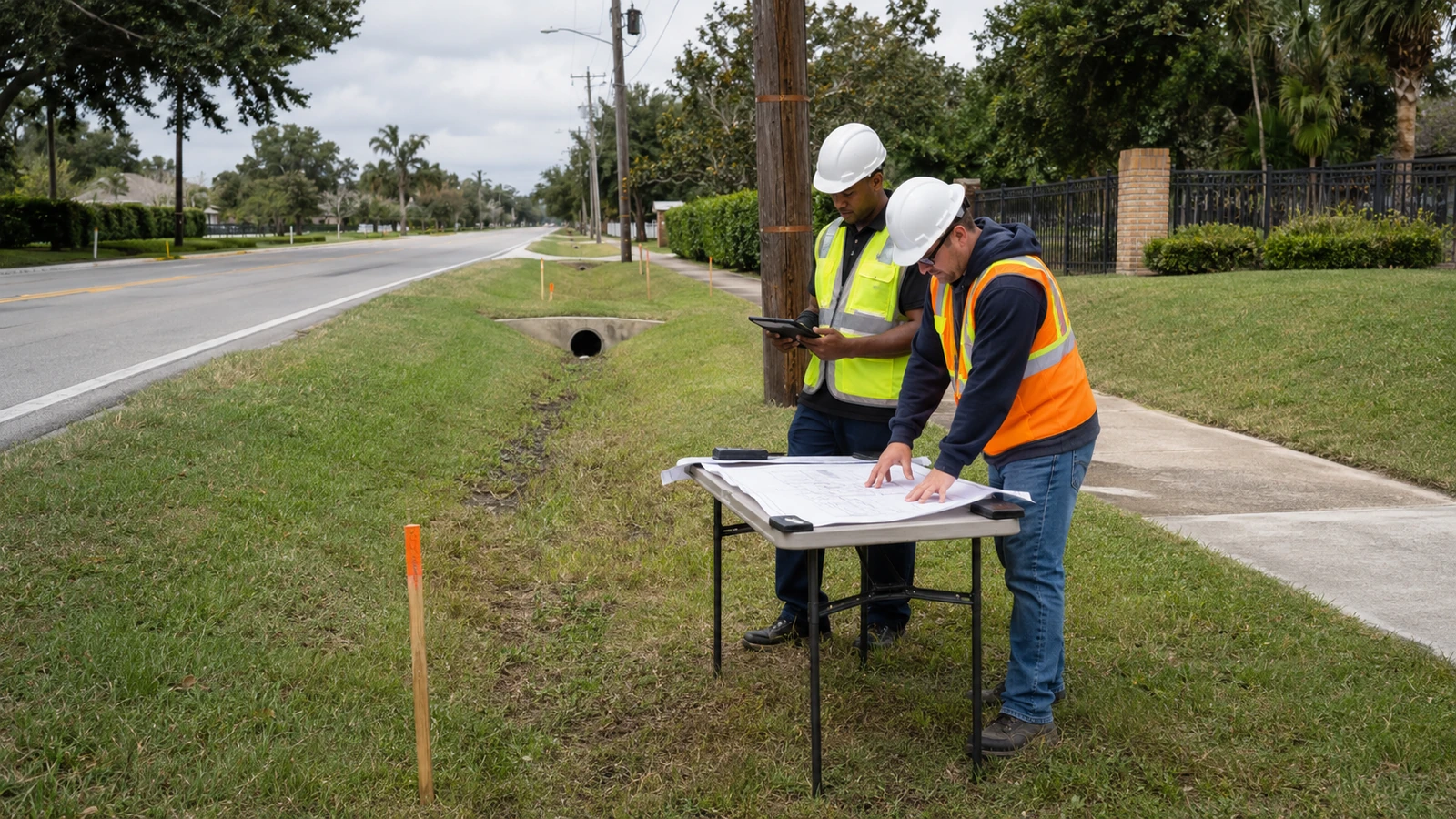
A permit stamped approved can still fail in the field. The crew may receive an old sheet or miss an inspection hold point. A bore shift can leave approved limits. Compliance breaks when permit conditions, daily work and closeout evidence live in different systems with no common segment identity.
This checklist creates that common control without claiming one national construction rule. We connect issued permits to field release and utility evidence. We also cover traffic control, excavation, restoration and change records. The controlling agency plus applicable law determine the actual requirements for each route.
Fiber Construction ROW Compliance Checklist Release Gates
A fiber construction ROW compliance checklist is a segment-based control that ties permitted scope to field work and closeout; use 5 release gates: issued authority, accepted drawings, utility evidence, work-zone controls and inspection readiness. Replace every generic check with the controlling agency's current conditions plus applicable employer and legal requirements.
Start by defining the segment. The permit identifier and plan station limits should appear in the field package. We record the issued revision plus effective conditions. Where several jurisdictions touch one mobilization, each segment keeps its own authorization; one permit should never be used as a general corridor pass because the crew can physically continue across a boundary.
The permit itself remains the controlling agency record. A field digest can highlight work hours or contact requirements, but it does not replace the issued document; we keep the permit accessible and link every digest item to a condition or plan note. That prevents a project summary from silently changing the agency's language.
Drawing release requires stable revision identity. Plan and profile sheets must belong to the same accepted set. Bore details and traffic plans need their referenced versions. Superseded sheets are removed from active field folders rather than marked by filename convention alone; if the agency issues conditions after drawing acceptance, those conditions join the release package before work begins.
Utility evidence needs a defined purpose. Design records and field designation can support conflict review. Excavation notice duties operate under applicable law and timing, which this article does not generalize across states. We retain current field evidence with the segment; a map from an earlier design phase should not be mistaken for a current locate response or clearance to excavate.
Work-zone control follows the road authority's accepted plan and applicable standards. The FHWA MUTCD 11th Edition page identifies Part 6 for Temporary Traffic Control. The agency's adoption and project conditions govern use; a typical application is not self-approving, and a traffic-control drawing should match the actual construction method plus road context.
Excavation control belongs to the employer's competent-person and safety process where applicable; OSHA 29 CFR 1926 Subpart P addresses excavations, including protective-system and inspection provisions for covered work. A ROW permit does not replace that safety program. Conversely, safety compliance does not grant occupancy beyond the permit.
Inspection readiness means required notices and hold points are understood before mobilization. We assign who contacts the agency and what record confirms notice. The actual notice period comes from the permit or agency source. We do not invent a lead time. A crew schedule cannot waive an inspection gate simply because equipment has arrived.
Our self-critical note is explicit: a large compliance checklist can encourage box checking without field understanding. The limitation is serious. We recommend short, segment-specific release cards backed by the full permit file. If a check cannot identify evidence or stop unauthorized work, rewrite it. A checked blank is worse than a visible unresolved condition.
Release rule: No segment enters construction until the permit ID, accepted plan revision and field limits agree.
Fiber Construction ROW Compliance Checklist Matrix
The 7 rows below are evidence categories, not universal requirements. We map each row to the controlling agency's permit and current policy. Applicable law can add independent duties; the matrix works because one named record proves release, while field verification shows whether the approved control still fits site conditions.
| Control | Release evidence | Field verification | Closeout record |
|---|---|---|---|
| Authority | Issued permit and segment limits | Work stays inside jurisdiction | Final agency disposition |
| Drawings | Accepted revision set | Method and alignment match | Controlled redlines |
| Utilities | Current conflict and locate evidence | Marks plus exposed conditions reviewed | Conflict disposition |
| Traffic | Accepted work-zone plan | Devices match field conditions | Inspection evidence |
| Excavation | Applicable safety controls | Competent review under employer program | Required safety record |
| Restoration | Agency detail and material basis | Repair matches approved scope | Restoration acceptance |
| Changes | Written amendment path | Changed work is held pending decision | Approved revision record |
Permit, Drawings and Segment Boundary
The field release card begins with authority. We identify the road owner or other controlling party and the permit limits. The card points to the issued document and accepted sheet set. It also shows adjacent boundaries that are not authorized; this is especially useful where a county road reaches a state highway or private crossing within one construction day.
Method matters as much as alignment. A permitted bore cannot be converted to open cut by field convenience. Pit locations and staging areas may affect traffic or restoration. We compare the planned method with accepted details during the preconstruction brief. Any mismatch becomes a hold before surface disturbance, then follows the agency's amendment process.
Utility Evidence and Excavation Controls
Utility evidence is refreshed at the field stage under applicable requirements. The fiber utility coordination workflow helps separate owner records from field observations. We retain unresolved conflicts and expose them to supervision; white lining or other premarking is applied only as required by the relevant one-call law or project procedure. No universal state rule is claimed here.
Field marks can differ from design records. The response is not to choose whichever position favors production. We stop affected work and use the project's escalation path. Test holes or other exposure methods require approved scope plus safety controls; the resulting evidence returns to design and permit control when alignment or method could change.
Traffic Control, Access and Housekeeping
The work zone needs verification after setup and as conditions change. Devices should match the accepted plan plus field geometry. Access for road users and emergency response remains within agency requirements. We check whether equipment or material has migrated outside the approved area; a tidy plan does not protect traffic when the actual setup occupies a different lane or shoulder.
Work hours and lane restrictions come from the controlling permit. We include them in the daily brief without turning them into general rules for other routes; if weather or traffic conditions make the setup unsuitable, field supervision uses the applicable plan and authority path. Production targets do not override a stop decision.
Restoration, Inspection and Records
Restoration control begins with the preconstruction condition. Photos should be located by segment and date. The accepted detail identifies repair scope for pavement or shoulder impacts. Ditches and vegetation can need separate treatment; we avoid the weak instruction to restore everything as required when the field team has not received the agency detail that defines the obligation.
Inspection records need the permit identifier and location. We capture the agency observation plus any corrective direction. Contractor quality checks remain distinct from agency acceptance. A passing internal inspection does not close an agency condition. Likewise, an agency visit does not certify every employer safety duty. Each record stays within its authority while sharing the same segment reference.
ROW Change Control, Redlines and Closeout
Every field change starts with classification. We ask whether it affects occupancy location, installation method, traffic control or restoration; if yes, the affected work is held while the authorized project party contacts the agency. Emergency direction follows applicable law and permit terms; this guide does not invent an emergency exception. Written decisions are attached to the same segment package.
Redlines document actual conditions and approved changes. They should show location with the project's accepted reference system. Notes identify the source and date; a cloud on a PDF is insufficient when reviewers cannot tell who observed the condition or whether the permit authority accepted the change. Controlled redlines become an input to as-builts, not a substitute for amendment approval.
Permit closeout starts before the final crew leaves. We review inspection conditions and restoration status. Required photos or test records are indexed. Open corrective items remain assigned. The agency determines closure under its process. We do not report final acceptance merely because civil work stopped or fiber testing moved to another team.
Schedule pressure often surfaces as a permit issue. The ROW permitting delay guide explains how packages and reviews affect deployment. In the field, the answer is narrower: do not work around a missing authorization; resequence only to an independently released segment with safe access and complete controls.
Railroad boundaries require separate handling. The railroad fiber crossing permit guide covers railroad agreements and engineering context. A road permit does not authorize entry onto railroad property; if both authorities touch one bore, the construction manager confirms that each required authorization and condition is active before releasing that crossing.
Records should survive personnel changes. We store the issued permit and accepted plans under stable identifiers. Daily evidence references those identifiers. Closeout files include the agency disposition. Messaging threads can support context, but they should not be the only location for a scope decision or inspection outcome.
Change rule: A redline records a change; only the controlling authority can approve occupancy outside the issued scope.
Fiber Construction ROW Compliance Checklist Limitations
This article cannot provide nationwide depth or separation values. It does not set work hours and notice periods. Those requirements can vary by agency plus applicable law. The checklist therefore starts with source control. Every project-specific threshold should cite the current permit, adopted standard or legal requirement that actually governs the segment.
Federal highway policy supplies principles within its scope. 23 CFR 645.211 utility accommodation provisions address traffic protection and restoration in state policies for covered Federal-aid highways. They are not a county permit checklist for every local road. The controlling agency must identify its adopted rules and written authorization.
The broader FHWA memorandum “Utility Accommodation and Other Uses of Highway Right-of-Way” recognizes that communication facilities interact with highway safety and operations under federal, state and local law. We use that authority layering as a discipline. We do not represent FHWA material as local approval or assume a route is federally covered because broadband funding is involved.
A checklist also cannot prove competent field performance. It cannot replace supervision or the employer's safety program. It does not verify hidden utilities by itself. The checklist can expose missing evidence and define stop points. That is valuable, but candid limits prevent the document from becoming a false certificate of compliance.
Draftech provides in-house ROW permit and compliance support for field package control, agency conditions and closeout records. Full turnkey construction is available through managed crews under project controls. Draftech does not claim that a checklist grants occupancy or replaces the controlling agency's inspection and acceptance authority.
ROW Compliance Final Recommendation by Field Role
Our recommendation is firm: release construction by permit segment, not by route enthusiasm. Put authority and revision identity at the top of the field package. Make stop points explicit. Preserve closeout evidence as work occurs. If conditions and field reality disagree, hold affected work and ask the controlling authority.
Permit manager: issue a segment register with controlling sources. Make every condition traceable to the permit. Confirm amendment contacts before mobilization. Keep agency closure separate from internal completion.
OSP engineer: release one accepted drawing set and remove superseded files. Tie utility evidence to location. Review field conflicts before alignment changes. Convert approved redlines into controlled as-built inputs.
Construction supervisor: brief crews on limits and stop points. Verify the work zone against actual conditions. Hold changed methods or alignment pending authorization. Record inspections and restoration by permit segment.
Program executive: ask for independently released mileage rather than one corridor status. Do not pressure teams to cross an authority boundary. Require evidence for closeout claims. Back field stop decisions when the permit package is incomplete.
Confirm Draftech's available service areas before staffing a regional build. Review Draftech's engineering team when assigning release roles. If field folders and issued permits have drifted, email our ROW team with the segment register and accepted plan revision.
Review the ROW field controls. We can align permit conditions, construction release and closeout evidence by segment.