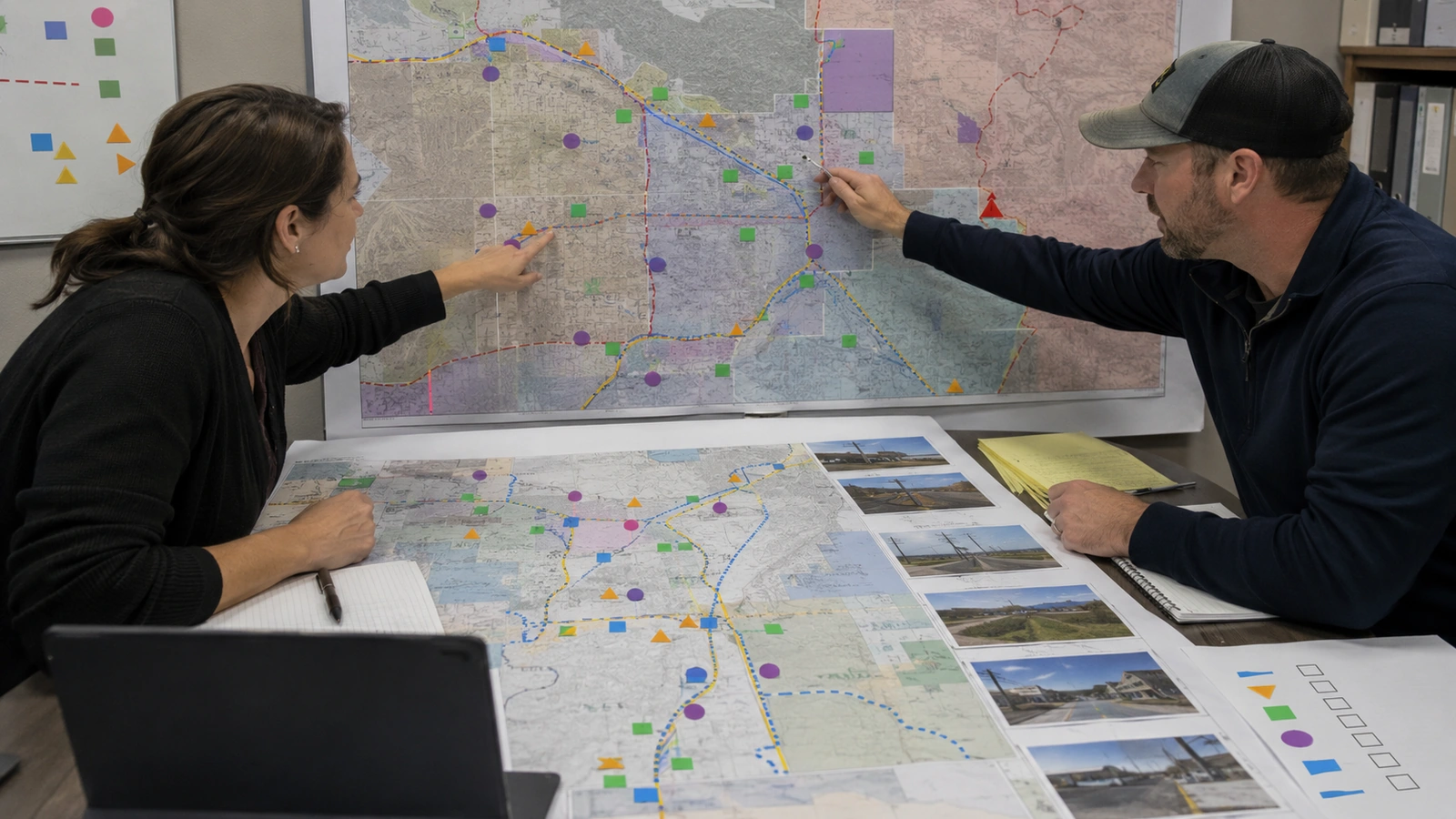
Permit delay is often discussed as if the agency owns every day on the schedule. That diagnosis is too convenient. Wrong jurisdiction, unstable drawings and unanswered dependencies can consume weeks before a reviewer has a complete decision package. Agency workload is real, but applicant-controlled delay is real too.
This guide separates those causes without promising a universal approval clock. We show how to map authority and test completeness. We also cover comment aging, external dependencies and construction release. The controlling agency keeps approval authority, and its current rules govern each permit.
Fiber Broadband Permit Delay Mitigation Controls
Fiber broadband permit delay mitigation is the controlled removal of applicant-side blockers while preserving agency review authority; use 5 gates: jurisdiction, package completeness, dependency ownership, comment disposition and field release. This does not guarantee approval speed. It makes delay measurable and prevents incomplete work from being mislabeled as agency review time.
Begin by defining the clock. We separate preparation from agency possession, then identify pauses for applicant response or outside approval. A single submitted date is not enough; if the agency rejects intake because a required agreement is missing, the package was delivered but not necessarily accepted for technical review. The register should preserve that distinction without assigning blame.
Jurisdiction mapping is the first schedule control. Every segment needs a named road or property authority and a source. County transitions matter. Municipal boundaries can do the same. State highway crossings and railroad parcels remain separate paths; when authority is uncertain, we isolate that segment instead of sending a corridor-wide package to the most convenient office.
Completeness must be agency-specific. We take the controlling office's current checklist and translate it into a document register. Each requirement has an owner plus revision. Evidence can include route sheets and application forms. Agreements or work-zone plans may sit on different internal schedules; the register shows whether the permit can enter review without pretending that every item is an engineering drawing.
Design stability matters because repeated route movement resets technical understanding. We define a permit baseline with station limits and method. Later changes are classified by effect on occupancy, traffic or restoration. Minor drafting corrections should not be confused with a changed bore location; reviewers need a concise change record, while project managers need to know whether the schedule baseline still means anything.
Dependencies require named authority. A railroad license cannot be closed by a county reviewer; a utility conflict may need owner records or a design decision before the road permit can advance. Environmental review can carry its own scope. We show each dependency beside the permit but do not merge approvals into one vague percentage-complete status.
The FHWA Utility Principal Documents page identifies federal utility accommodation rules and broadband coordination provisions for applicable Federal-aid contexts. That framework supports organized notification and coordination. It does not create one national local-permit deadline, nor does it let an applicant bypass state or local authority; applicability must be established for the actual route.
Federal accommodation policy also preserves written control. 23 CFR 645.211 addresses written arrangements, installation methods and traffic protection in state policies for covered highways. We use those categories to test evidence. The controlling agency's adopted requirements still decide the package, especially where local roads or non-Federal-aid segments are involved.
Our self-critical note is blunt: a detailed permit dashboard can create administrative work that does not move one drawing or agreement. That limitation deserves attention. We recommend the smallest register that identifies authority, blocker and next decision. If a field cannot change an action or explain the clock, remove it. Tracking is not mitigation by itself.
Clock rule: Separate applicant preparation, active agency review and external dependency time before reporting delay.
Fiber Broadband Permit Delay Mitigation Matrix
The 6 lanes below convert a broad delay complaint into decisions. They are management controls, not agency deadlines. We tailor evidence and escalation to the office that holds authority; a permit can be healthy while waiting on a stated review step, yet it becomes unmanaged when the project cannot name the blocker or response owner.
| Control lane | Evidence | Delay signal | Required decision |
|---|---|---|---|
| Authority | Segmented jurisdiction map | Office cannot confirm control | Resolve permit path |
| Completeness | Agency checklist register | Intake item remains missing | Complete or formally scope |
| Design baseline | Accepted revision identity | Route keeps moving | Freeze or rebaseline |
| Dependencies | Named external approvals | Permit waits on unknown owner | Assign authority and action |
| Comments | Response and disposition log | Issue returns unchanged | Resolve root cause |
| Release | Issued permit and conditions | Field package is premature | Hold construction segment |
Jurisdiction and Intake Readiness
A jurisdiction matrix needs route segments rather than a list of agencies. We tie each segment to centerline references and known crossings. The office determines whether the source is an agency map or written confirmation. We date the source because service boundaries and permit instructions can change. Ambiguous transitions are opened as decisions before the final package is assembled.
Intake readiness is binary for each required artifact. Drafting progress does not make a missing signature partly complete. We also distinguish not applicable from not provided, with the basis recorded. If staff accepts phased submittals, that path should be documented by the agency. An internal decision to omit material is not an approved phased review.
Design Baseline and Change Control
The permit baseline should identify the route revision and installation concept. Plan sheets need stable stationing or another accepted location system. A comment response log points to the exact changed sheet. We avoid replacing whole files with silent edits; the reviewer can then evaluate the response without searching for changes, and the field team can later identify which design was actually permitted.
Change control is especially important when utility conflicts appear; the utility coordination process for fiber construction explains how record evidence and field findings move into design decisions. We keep that work connected to permit sheets. A conflict cannot be closed by deleting its note or shifting a line without confirming the new occupancy basis.
Dependencies, Comments and Escalation
Each external dependency needs a deliverable and decision owner; the owner should be the party with authority to produce or accept the evidence, not simply the project coordinator who sends reminders. We track the permit impact and next action. A generic waiting status hides whether the route needs an agreement, engineering revision or applicant response.
Comment logs should preserve the agency's wording and the applicant response. We identify the affected document, then record disposition. If the same issue returns, the team should examine whether the response answered the technical concern. Repeated resubmittal is not progress. It can signal that the drawings and narrative are solving different versions of the route.
Agency Contact and Decision Records
Agency contact should be purposeful. A request for status includes the permit identifier and last completed step. It should also identify any applicant response that remains open. We avoid daily inquiries that add noise without supplying new information; escalation is appropriate when the published process or documented next action has become unclear, but the agency chooses its review priority.
Verbal guidance is useful for clarification but fragile as a release basis. We summarize material direction and ask the agency to confirm through its accepted channel. The permit file retains that response. We do not turn an unanswered email into approval. Written permit issuance and conditions remain the controlling construction record.
Permit Portfolio Control and Construction Release
Portfolio reporting should aggregate only comparable states. Submitted, accepted for review and issued are different milestones. A route returned for applicant revision should not remain in active review on the dashboard; we report counts by milestone and show aged blockers by responsible decision. That approach is less flattering than one completion percentage, but it gives managers something they can act on.
Batching can help when one agency accepts corridor packages, but the office defines acceptable scope; a large batch can also spread one missing agreement across many otherwise ready segments. We recommend package boundaries that match authority and design stability. Do not batch only for dashboard convenience. A permit portfolio is governed route by route even when reporting is consolidated.
The ROW permitting delay strategies provide broader schedule context. This guide takes a narrower position: mitigation begins with applicant controls, then uses respectful agency communication. It does not label every long review as preventable; some applications need substantial technical or legal review, and only the controlling office can decide when that review is complete.
Construction release remains segment-specific. We require the issued permit and accepted design revision. Conditions need to reach supervision. Inspection notices and work-hour limits are scheduled before mobilization. If one permit is missing, the schedule can resequence to an independently authorized segment, but managed crews do not cross the boundary merely because equipment is already nearby.
Field changes return to the authority defined by the permit. A shifted bore or staging area may change traffic control and restoration impacts; redlines document the proposed or completed condition, depending on agency direction, but they do not independently authorize occupancy. We capture written amendment decisions and update the construction package before releasing changed work.
Closeout can affect future access and portfolio credibility. Required inspection records and restoration evidence should be gathered by permit segment. Open corrective work remains visible. We avoid calling a permit closed because cable placement ended. The agency determines acceptance and release of any related obligation under its rules.
Portfolio rule: Report milestone counts and named blockers, not one blended permit-complete percentage.
Permit Delay Limitations and Authority Boundaries
No source supports one national approval duration for fiber permits. County workload can differ from state review, and railroad agreements follow another authority. Project complexity matters. So do applicant response times. This guide offers controls, not a timeline promise. Any forecast should state its source and assumptions, then update when the actual permit path changes.
FHWA requirements apply within defined federal contexts. They do not replace local ordinances or state accommodation policies; the FHWA memorandum on utility accommodation and other highway right-of-way uses explicitly discusses federal, state and local consistency. We verify applicability instead of attaching federal language to every local route.
State examples also resist generalization. Caltrans wired broadband resources describe California state-highway policy and district permit contacts. Those materials may inform a California state route. They do not set a county process elsewhere. Every requirement register should name the controlling agency and current source rather than copy a neighboring jurisdiction's checklist.
Mitigation cannot manufacture authority or complete missing field evidence. It cannot guarantee that an agency accepts a design position. It also cannot remove independent environmental or property approvals; we can make responsibility visible and prepare a coherent response, while the designated public or private authority retains the decision. That is the candid limit of permit management.
Draftech provides in-house broadband permitting coordination for jurisdiction maps, package control and comment dispositions. Full turnkey construction can follow through managed crews after the required authorizations are issued. We do not claim that project management shortens a statutory process or grants access before the controlling agency acts.
Fiber Broadband Permit Delay Mitigation Recommendation by Role
Our final recommendation is unhedged: control applicant readiness before escalating agency delay. Freeze a usable baseline and expose dependencies. Respond to comments with traceable revisions. Then forecast from recorded milestones, not optimism. Where the authority or issued conditions remain unresolved, hold the affected construction segment.
Broadband executive: require milestone-based reporting across the portfolio. Ask how much time sits in applicant response or outside approvals. Do not reward submission volume when packages fail intake. Protect agency relationships by escalating with facts.
Permit manager: maintain one authority map and one source register. Separate technical comments from agreements. Assign every blocker to a decision owner. Remove dashboard fields that do not drive action.
OSP engineering lead: issue stable permit baselines and concise revision logs. Resolve utility evidence at the sheet level. Rebaseline openly when route changes affect occupancy. Never let a clean PDF conceal an unresolved conflict.
Construction manager: mobilize only to independently authorized segments. Carry permit conditions into crew briefings. Route method changes through the agency process before work leaves approved scope. Preserve inspection and restoration evidence through closeout.
Check available Draftech service areas before assigning a multistate portfolio. Review Draftech's engineering leadership when setting decision roles. If the dashboard cannot distinguish applicant time from review time, email our permitting team with the route register and latest agency response.
Audit the permit delay controls. We can convert route status and agency comments into an accountable release plan.