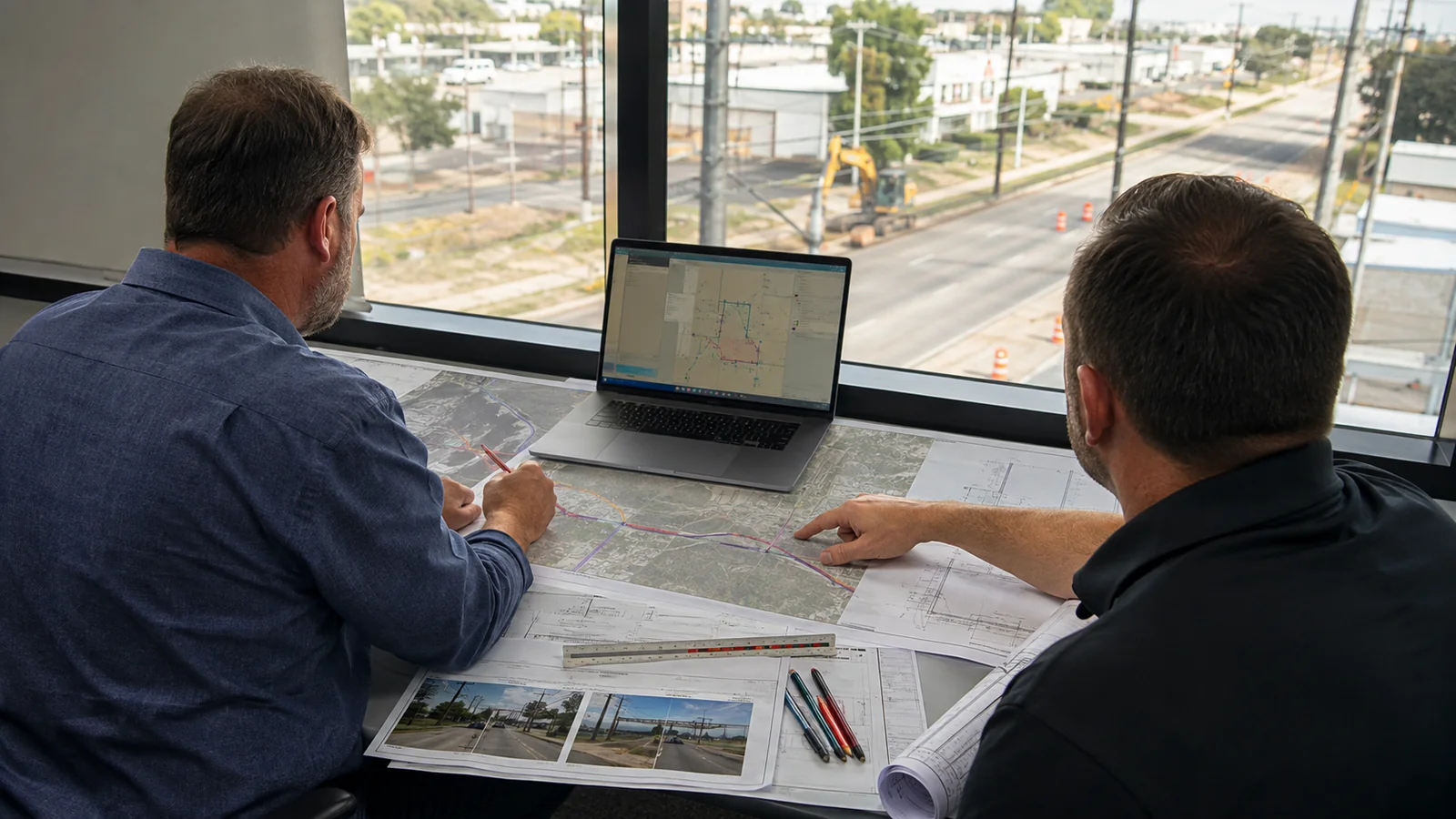
- Common Causes of Fiber Permit Delays: Five Delay Classes
- Separate the Completeness Owner from the Technical Reviewer
- Name the Decision Owner for a Technical Conflict
- Scope Jurisdiction, Environmental and Historic Holds
- Diagnose Revision Mismatch and Applicant Resubmittal
- Choose the Next Question for the Review Owner
A delayed fiber permit is not one condition because an intake reviewer may be deciding whether the submission can enter technical review while a traffic reviewer may already be questioning the work zone plan. The applicant may owe work. A corrected sheet is one example. Calling all 3 situations slow approval hides the current decision owner and sends the team toward the wrong response.
We keep this guide with diagnosis. It identifies who owns the present review decision and classifies the hold before anyone chooses a control. The ROW permitting delay article addresses broader portfolio strategy without supplying a universal schedule. Our fiber permit tracking software comparison covers tool selection. This article does not design a tracking workflow.
Common Causes of Fiber Permit Delays: Five Delay Classes
The common causes of fiber permit delays fit 5 classes in our framework. We start with completeness holds and technical conflicts. The remaining classes are jurisdiction-specific requirements, revision mismatches and applicant-caused resubmittals. Diagnose the delay by preserving the authority's words. Then name the person or discipline that owns the current decision.
Start with the permit object named by the authority because a municipal street-use permit is not the same decision as a state highway encroachment permit review. Pole access belongs to the relevant asset owner. A railroad license remains a property-owner decision. Environmental review also belongs to the agency with the applicable action. One corridor can touch several authorities without turning their decisions into one combined fiber approval.
The Federal Highway Administration Utilities Program explains that states decide whether utilities may occupy highway right-of-way and under what conditions, while FHWA's 2017 memorandum Utility Accommodation and Other Uses of Highway Right-of-Way notes that utility occupancy can affect safe highway operation and maintenance. These sources support authority-first diagnosis. They do not establish a nationwide fiber permit form or one review clock.
We use the authority's own message as the starting evidence because portal wording can be broad and a label such as returned does not by itself reveal whether intake failed or a technical reviewer requested a correction. Read the notice first. Identify the unresolved decision. If the notice is unclear, ask the receiving contact which role owns the next determination instead of assigning a cause from the label alone.
- Completeness hold: the receiving intake role needs package evidence before the application can proceed.
- Technical conflict: a discipline reviewer or asset owner has identified an issue with the proposed work.
- Jurisdiction-specific requirement: a named authority must decide whether its local condition applies.
- Revision mismatch: the applicant's submitted materials no longer describe one proposal.
- Applicant-caused resubmittal: the response misses the stated request or adds unexplained scope.
We use these 5 labels as Draftech's diagnostic framework. They are not agency statuses and do not predict approval. The framework has one job: connect the authority's language to the person who can answer it. The following sections show how to make that distinction without rebuilding a submission checklist or a permit management system. The authority still decides.
Separate the Completeness Owner from the Technical Reviewer
Completeness is an intake decision that asks whether the receiving authority has the material needed to begin or continue its process before a substantive reviewer acts. A technical review asks whether the proposed work meets the applicable requirements within that reviewer's discipline. The package can be carefully coordinated yet still lack an item required by the recipient. It can also be complete enough for review while containing a technical conflict.
Caltrans provides a useful state-scoped example because its September 2020 Utility Encroachments Permit Application Guide, Including Broadband says every form space should be completed or marked not applicable. The guide lists possible support material by scope. Examples include construction plans and a location map. It also discusses site-specific traffic control, applicant authorization and certain environmental or stormwater documentation. Those examples belong to California's process. Another authority can ask for a different intake set.
When the notice names a missing signature or authorization, the receiving intake role owns the completeness decision and the applicant owns the response, while an engineer should not revise route geometry unless the authority's notice actually questions the design. Conversely, a drainage comment is not cured by proving that the application form was filled out. The drainage reviewer owns the technical determination even though the applicant must supply the answer.
The aerial fiber permit submission checklist covers package release for aerial work. This article does not repeat that file-by-file check. For delay diagnosis, retain only the notice that defines the hold and the exact permit object it concerns because one document can show why the review stopped when the reviewer has stated the missing decision clearly.
| Delay class | Evidence that identifies the hold | Current decision owner | Diagnostic question |
|---|---|---|---|
| Completeness hold | Intake notice names absent or unreadable submission material | Receiving intake role | What exact evidence must be accepted before review proceeds? |
| Technical conflict | Reviewer comment names a design or work-method concern | Named agency discipline or asset owner | Which technical relationship is unresolved? |
| Jurisdiction-specific requirement | Authority cites a local condition or separate legal interest | Authority responsible for that condition | Who decides applicability at these route limits? |
| Revision mismatch | Submitted materials describe different versions of the proposal | Applicant's responsible design or document lead | Which submitted version is the authority reviewing? |
| Applicant-caused resubmittal | Response omits the request or introduces unexplained scope | Applicant response owner | What part of the stated request remains unanswered? |
We use the table to classify evidence rather than creating a status vocabulary, so preserve the authority's exact phrase beside the Draftech class to keep the distinction visible when 2 reviewers use the same portal label differently. It also keeps a Draftech inference from being mistaken for an agency decision.
One illustrative record is enough for this diagnosis: County engineering comment 14 questions the proposed bore beneath culvert C-7, the county drainage reviewer owns the technical determination and the applicant owes a profile tied to the current sheet. That sentence preserves the source concern and names both sides of the decision, while a future article on fiber network permit status tracking will own record design and reporting details.
Name the Decision Owner for a Technical Conflict
A technical conflict is a specific relationship that the reviewer cannot accept from the submitted evidence and that must be tied to a named technical decision owner. For underground fiber, the question may concern a bore profile near drainage or a crossing relationship with a known utility. For aerial work, a pole owner's attachment decision can remain separate from a road authority's occupancy review. Diagnose the exact relationship before calling the route delayed by engineering.
FHWA's Subsurface Utility Engineering program page states that accurate utility information available early can help designers avoid conflicts and reduce redesign caused by unexpected facilities, but that principle does not make every record drawing or one-call mark field truth. If a reviewer questions a crossing, name the utility fact that remains uncertain. Then identify whether the road authority or the utility owner controls the disputed relationship.
Caltrans form DOT TR-0413, revised March 2023, is another state-specific example because it asks for plans showing certain subsurface high-priority utilities near an installation and lateral dimensions to known facilities. The form also addresses traffic plans under California requirements. It demonstrates the kind of evidence one authority may review. It does not export California seal rules or plan requirements to another state.
Traffic control can have its own decision owner, and the current federal publication is the Manual on Uniform Traffic Control Devices, 11th Edition with Revision 1, dated December 2025. It governs traffic-control devices within its scope. The receiving road authority may have adopted standards and a local submission procedure. If the comment concerns pedestrian access or shoulder use, identify the traffic reviewer rather than relabeling the whole permit incomplete.
- Geometry question: name the roadway or structure relationship under review.
- Utility question: state the uncertain facility fact and identify the deciding owner.
- Traffic question: connect the work activity to the site condition the reviewer cited.
- Authority question: confirm which organization can make the requested determination.
Utility coordination has a broader field and design workflow, but that workflow is not the purpose here. Delay diagnosis stops once the permit comment has been tied to the controlled utility fact and the decision owner. The project's qualified professionals then choose the appropriate investigation or design response under the governing requirements.
Scope Jurisdiction, Environmental and Historic Holds
Jurisdiction-specific requirements are part of the actual review, not exceptions to a national process. The National Telecommunications and Information Administration's 2024 article Important Ideas to Streamline Broadband Permitting and Support Internet for All Deployments notes that state and local governments can establish distinct permitting processes and regulations. It also identifies several public interests that can be involved. Applicability still depends on the place and the governmental action.
Municipal examples show why the decision owner matters. Seattle's Utility Work in the Right of Way page distinguishes permit classes and explains that scope changes can require revised material followed by further review. Denver uses its own right-of-way permit procedures. Neither city's instructions govern a route elsewhere, and Draftech's service areas do not replace a local authority check. A county road authority can also have different requirements from a city that the same corridor enters.
Environmental or historic review must be connected to the action that triggers it. The Advisory Council on Historic Preservation's March 2024 Program Comment for Federal Communications Projects offers an alternative Section 106 path for federal agencies that use it within scope. It should not be described as a step in every local fiber permit. Identify the federal agency and the undertaking before assigning a historic review owner.
Apply the same discipline to wetlands or stormwater questions. A route inside transportation right-of-way is not automatically outside every environmental requirement. Yet a generic resource concern does not prove that a separate authorization applies. Record the location-specific issue in plain language, then ask which agency or qualified project professional has authority to decide it for the proposed disturbance.
Railroad permitting stays separate. The railroad owns its property decision under its terms, while the road authority owns its occupancy decision for the roadway. This article does not compare railroad applications or design rules. It only prevents a team from attributing a railroad hold to the county reviewer or treating one authority's response as another authority's decision.
Self-critical limitation: Draftech's 5 classes can make a mixed comment look cleaner than it is. A single notice might question local authority and design evidence at the same time. We counter that weakness by retaining the reviewer's original words and naming the controlling decision first. If our class hides a qualifier in the notice, our diagnosis is wrong.
Diagnose Revision Mismatch and Applicant Resubmittal
Revision mismatch is an applicant-side cause. It exists when the authority receives materials that no longer describe one proposal. The form may cite an earlier route while the drawing shows a shifted bore. A response letter can discuss a revised traffic method that the submitted sheet does not show. The reviewer cannot decide the intended proposal until the applicant identifies the version that should govern the response.
Applicant-caused resubmittal is narrower. The authority has stated a request, but the response does not answer it or adds scope without explaining the effect. A skipped comment is one example. Supplying changed sheets when the authority expressly asks for a full clean set is another. The cause belongs to the applicant response owner even if the portal continues to display a generic review label.
Keep this diagnosis narrow. Compare the authority's request with the actual response and ask whether the same proposal appears throughout. If not, name the applicant role responsible for resolving the mismatch. This page stops at cause and owner.
Mitigation is also a separate reader decision. Draftech's fiber broadband permit delay mitigation guide covers preventive controls after the team knows what type of hold it faces. Diagnosis should come first because a completeness response will not cure a technical conflict, and an escalation plan will not reconcile contradictory drawings.
No diagnosis can promise a review date or fee. The authority retains its decision power and may identify another issue after resubmittal. Draftech can state what the available notice supports today. We should also say when the evidence is too vague to classify. In that case, the next step is a scoped question to the receiving contact, not a confident internal label.
Draftech's fiber permitting and right-of-way coordination connects agency comments to the engineering record that answers them. We do not substitute for an issuing agency. Our role is to identify the decision owner, classify the hold and prepare a response within the applicable project requirements. The existing mitigation page owns control design after that diagnosis.
Choose the Next Question for the Review Owner
For an ISP program manager: ask which authority owns the decision that is stopping this permit. Require the team's explanation to quote or accurately preserve the source notice. A forecast is not evidence that intake or technical review has finished. If the authority has not identified a hold, label the diagnosis unconfirmed rather than assigning blame.
For an OSP engineer: ask which design relationship the reviewer cannot accept. Confirm the current route before changing geometry. When the question touches a utility or traffic condition, identify the discipline with decision authority and answer only from evidence suitable for the project. Do not turn a separate pole or railroad decision into a roadway approval.
For a permit coordinator: ask whether the notice requests intake evidence or a technical response. If the applicant owes work, name the response owner. If the authority owes the next determination, keep that fact distinct. Do not invent an agency deadline or describe a generic portal state as proof of substantive review.
Engineering and permit-package coordination remain in-house. When construction is included, Draftech delivers it full turnkey through Draftech-managed subcontract crews under Draftech QA/QC and safety oversight. Our engineering and construction delivery model keeps Draftech's review distinct from agency approval and owner acceptance. Field observations also remain identified by their source.
For a review by Ashish, email Draftech with the authority's notice and the current affected sheet. We will return a scoped cause and decision owner, not a universal timeline or a guarantee of approval.