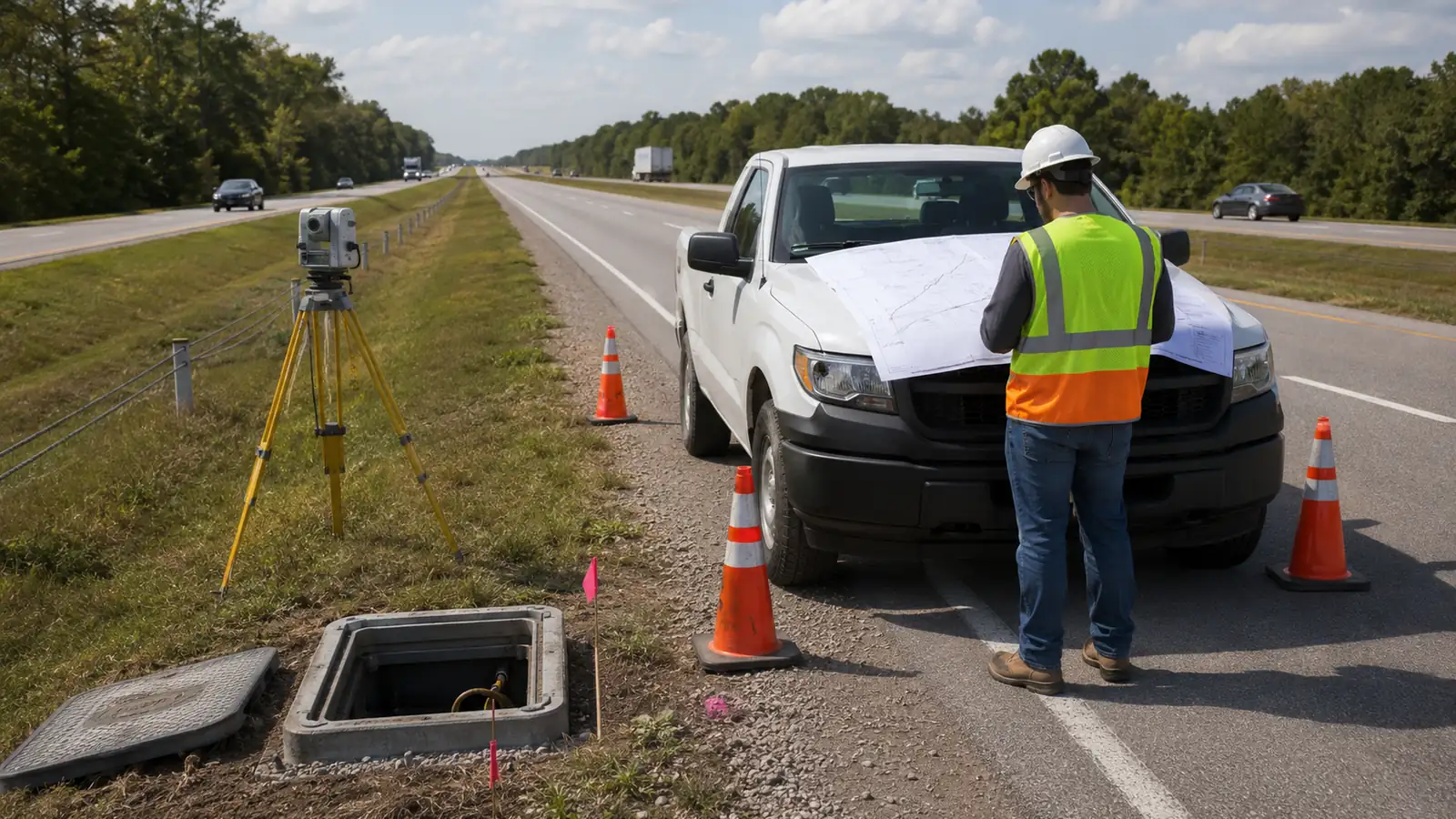
A telecom route can be technically sound and still fail at the highway boundary. The problem is usually not one drawing symbol. It is a broken chain between corridor screening, field evidence, agency criteria, utility conflicts, traffic control, permit comments, construction conditions, and final release.
This guide explains that chain without treating one transportation agency's manual as a national rule. We use the federal utility accommodation framework as context, then require the controlling state, district, local, owner, and permit documents for the actual route. Engineering remains in-house throughout the process.
DOT Permit Coordination Telecom: What the Process Controls
DOT permit coordination telecom is the controlled process for placing, crossing, constructing, and closing telecom facilities within transportation right-of-way. The federal context includes 23 CFR Part 645, while each application must follow the actual agency manual, district direction, permit conditions, and project documents governing that route.
The Federal Highway Administration Utilities Program explains the public-interest basis for joint utility use of public road right-of-way when safety and highway operation are protected. The current federal text is available through GovInfo's 23 CFR Part 645 record. Those sources set context. They do not replace the permit authority's current forms, utility accommodation policy, standard details, or reviewer direction.
We start before detailed design because route choices create permit choices. Longitudinal occupancy, controlled-access limits, crossings, bridges, drainage, intersections, clear zones, pavement limits, planned roadway work, utility congestion, and maintenance access can change the viable alignment. If those constraints appear only after sheets are complete, the team is revising route, profile, traffic control, quantities, and utility coordination at the same time.
A portal receipt is not a construction release. Agencies may separate application acceptance, technical approval, permit issuance, preconstruction requirements, notices, inspection scheduling, and final acceptance. We put every gate in one permit register with source, owner, status, dependency, and evidence. That prevents a schedule from treating an uploaded file as approval or an approved drawing as permission to mobilize.
Draftech's telecom permitting services keep route engineering, permit drawings, comment response, and utility coordination under an in-house engineering team. When construction is in scope, we offer full turnkey construction through Draftech-managed subcontract crews under Draftech QA/QC and safety oversight. Permit commitments remain connected to field execution without claiming the crews are all self-performed or describing our role as management-only.
Build the Agency and District Requirements Matrix
The requirements matrix is the basis of design for the permit package. It names the applicant, facility owner, highway owner, district, submission channel, controlling manual, utility accommodation policy, drawing standard, survey basis, traffic-control reference, insurance or bond prerequisites, review contacts, prerequisite agreements, and closeout obligations. Each entry carries a source date. We do not copy a requirement from a neighboring district and assume it applies.
Route classification and access control receive their own decision. A crossing and a longitudinal installation can follow different review paths even on the same highway. Work near a structure, drainage feature, interchange, or planned road project may add another office. The matrix identifies those interfaces early enough to test alternates, rather than asking the permit reviewer to discover every conflict after submission.
The team also separates required evidence from helpful context. Public GIS, parcel viewers, and available utility records can support screening, but final placement may require project survey, subsurface information, owner verification, or field measurements. We label the source and confidence of each input. A precise line drawn from uncertain data is still uncertain, and the permit set should never hide that distinction.
| Permit gate | Primary record | Review question | Release evidence |
|---|---|---|---|
| Route screening | Constraint map and alternate log | Is the corridor eligible and buildable? | Approved alignment basis |
| Application readiness | District requirements matrix | Are forms and prerequisites complete? | Controlled submission package |
| Technical review | Plan, profile, details, and responses | Does the design meet current criteria? | Resolved comment register |
| Preconstruction | Permit conditions and field matrix | Can work begin under stated controls? | Notices, meeting, and release records |
| Construction control | Inspection and deviation log | Does installed work match approval? | Accepted field evidence |
| Closeout | As-builts and completion register | Are restoration and records accepted? | Final agency release |
Turn Field Evidence into Reviewable Permit Drawings
Plan, Profile, and Crossing Logic
The plan shows the route continuously across sheet breaks, with consistent stationing, orientation, right-of-way, pavement, structures, utilities, crossings, work limits, and restoration references. Profiles are added where the authority requires vertical relationships or where a crossing cannot be judged from plan view. Details answer how the installation moves through a constrained point. The reviewer should not have to infer bore pits, offsets, depths, or structure relationships from separate notes.
Known, approximate, and field-verified information must remain distinct. We attach source notes and coordinate references to the controlled drawing set, then match them to the utility conflict record. Our utility coordination work connects marked facilities, records, owner responses, design changes, and unresolved exceptions. That traceability matters when a later comment shifts the route and affects more than one sheet.
Traffic Control and Construction Access
Traffic control is based on the actual work operation, not a generic detail selected to fill a sheet. Work duration, road configuration, speed environment, sight distance, pedestrian movement, equipment envelope, material staging, access, and emergency restoration all affect the plan. The controlling agency standard decides what is accepted. We coordinate that plan with route and method so the traffic drawing does not describe a work zone the contractor cannot physically use.
Means and methods belong to the qualified construction contractor, but they cannot conflict with engineering intent or permit conditions. Draftech's in-house engineers review design deviations. Draftech-managed subcontract crews perform accepted physical work under our QA/QC and safety oversight when full turnkey construction is included. This division keeps field planning practical while preserving the agency-approved alignment, structure relationships, traffic controls, and restoration commitments.
Comment Responses as Design Changes
Every comment enters a register with reviewer, date, drawing reference, requirement source, response, owner, affected sheets, and status. Clarification is separated from a change to alignment, depth, structure, traffic control, material, or restoration. We close a comment only after the answer and every affected deliverable agree. The word revised in a response letter is not evidence that the plan, profile, detail, schedule, and application now tell the same story.
Conflicting requirements are elevated as decisions, not buried in parallel email threads. The agency, facility owner, utility, traffic reviewer, and engineering team receive a focused issue statement with the controlling references and requested resolution. Our article on right-of-way permitting delays explains why unresolved dependencies distort schedules, while utility coordination during fiber construction carries the same issue discipline into the field.
Permit caveat: a technically acceptable field shift can still require agency approval. Freeze the affected work, preserve the evidence, and obtain the documented decision before the change disappears under pavement or restoration.
A resubmission gets its own controlled revision. Superseded sheets are removed from active folders, and the comment register identifies what changed. We also verify application values such as route limits and method against the revised drawings. Small differences become avoidable review comments because they force the agency to decide which document is authoritative. We remove that choice by synchronizing the package before upload.
Schedule reporting should measure the state of the review, not just elapsed calendar time. We separate time awaiting applicant action, owner action, utility information, agency review, and third-party decisions. That record does not promise a universal permit duration. It explains the active constraint and keeps a missing response from being mislabeled as agency delay. The same register lets the team see when a route decision is blocking several permit packages at once.
Quality control follows the route continuously from first sheet to last, then checks each crossing and structure against the requirements matrix. A second pass compares application, plan, profile, details, traffic control, utility notes, and response letter. We also test one representative station through every record. The point is not a ceremonial signature. It is to expose inconsistent geometry, method, identifiers, and status before the authority has to write a comment about them.
Carry DOT Permit Coordination Telecom into the Field
The permit conditions matrix converts approval language into field controls. It names notice requirements, approved hours, inspection contacts, traffic-control conditions, installation criteria, restoration, environmental controls, record requirements, and hold points. We review it at preconstruction with engineering, construction supervision, traffic control, utility coordination, and the permit owner. Critical conditions should not remain trapped in a long attachment while equipment waits at the right-of-way.
Field verification occurs before work becomes hidden. The team confirms alignment, offset, pits, structures, crossings, and utility relationships at the stages defined by the permit and project controls. Any deviation is recorded with location, reason, evidence, technical effect, permit effect, decision owner, and disposition. A verbal field acceptance cannot be the only record when the installed facility will later be inspected, mapped, maintained, or defended.
Inspection evidence should use stable route and asset identifiers. Photographs, bore logs, material records, traffic-control checks, restoration evidence, and redlines need to map back to the permit sheets. We sample that chain during construction rather than waiting for a final document dump. If an identifier or location reference fails while crews still have access, the correction is straightforward. After demobilization, the same gap becomes a separate investigation.
Closeout proves that the facility and right-of-way were left in the accepted condition. The exact package comes from the permit, but it may include as-builts, inspection approvals, restoration evidence, bore or compaction records, completion notices, photographs, and resolved punch items. We track each item to final release and archive the approved permit, conditions, correspondence, revisions, field evidence, and acceptance together.
The permit is not closed because construction billing is complete. It is closed when the authority's required evidence is accepted and remaining exceptions are explicitly owned. This distinction protects future maintenance and later permit applications. It also gives operations a reliable record of where the facility sits, what conditions remain, and which issue set governs the final installation.
Our closeout review traces a selected facility from the approved permit through inspection, redline, installed geometry, and as-built record. We then verify the corresponding permit condition and release evidence. A folder can contain every expected file and still fail this test if identifiers do not connect. Retrieval is the standard: another qualified person must be able to find the controlling approval and installed condition without rebuilding the project's email history.
Exceptions are closed or accepted explicitly. An inaccessible location, unresolved utility record, incomplete restoration item, or pending agency response needs an owner and disposition. We do not convert an open condition into a blank field just to make a dashboard look complete. The final index states what is accepted, what remains, who controls it, and where later evidence must be stored when the issue closes.
Decision Rules for Telecom Program Teams
Route planning team: screen highway ownership, access control, structures, drainage, utilities, road projects, and alternates before locking detailed design. The permit path is a route input, not an administrative task after route selection. Keep the same status logic in a fiber permit tracking system so each comment, resubmittal, condition, and release remains tied to the affected route segment.
Engineering manager: require one dated district matrix and one controlled source list for the package. Reject borrowed requirements that do not name the actual authority or current document. Keep plan, profile, details, application, traffic control, and comment responses synchronized.
Construction lead: translate permit conditions into notices, hold points, inspection calls, traffic controls, restoration work, and closeout records before mobilization. Escalate field deviations to in-house engineering and the agency when required. Do not let schedule pressure rewrite an approved route through conversation alone.
Owner and operations: accept the permit only with an indexed final record, confirmed release status, installed geometry, conditions, and open exceptions. The closeout package should support a maintenance decision without relying on the original project team's memory.
Permit failures usually appear as route redesign, repeat comments, conflicting traffic controls, undocumented deviations, open restoration, or missing closeout evidence. Our in-house engineering and permitting team removes those handoff gaps by controlling the route, requirements, drawings, comments, and field record as one workstream. For a scoped review, contact email our team.
The recommendation is unhedged: begin DOT coordination during route selection, issue only against a current authority-specific matrix, and refuse to treat permit issuance as the last gate. The work ends at documented agency release, not at upload, approval, or the final day of construction.
Talk to our permitting team about your telecom route. We can connect corridor screening, in-house engineering, agency comments, construction conditions, and closeout under one accountable delivery path.