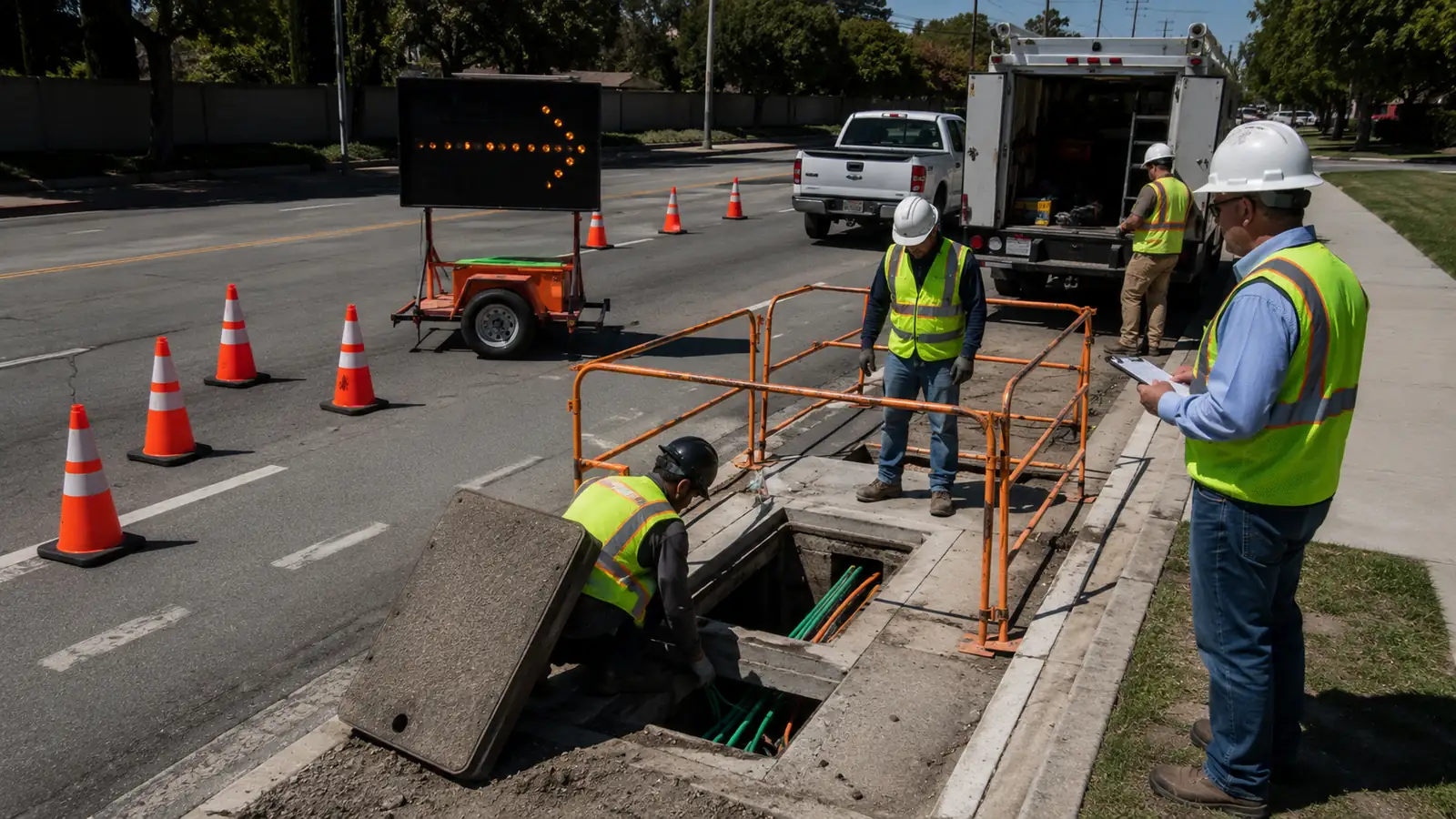
A standard detail is not a site plan. Telecom work can move from a shoulder survey to a handhole entry, bucket-truck setup, cable pull, bore pit, or short mobile operation, and each activity changes the work space and public exposure plus permit record. We start with the activity and the road, then select the control pattern.
This guide explains how we scope, draw, review, and hand off temporary traffic control for telecom work. It does not replace the controlling agency's current manual or permit conditions or a qualified field decision. The federal baseline is the FHWA 11th Edition of the Manual on Uniform Traffic Control Devices, including Part 6 for temporary traffic control.
What Is a Traffic Control Plan?
A traffic control plan documents how road users move through or around a work zone while crews perform the work. OSHA's construction standard 1926.200(g)(2) states that traffic control devices used to protect construction workers must conform to MUTCD Part 6. The controlling agency's adopted criteria and permit conditions define project requirements.
Qualified designers prepare the plan, and the controlling roadway authority reviews and approves it under its requirements. We prepare traffic control plans for telecom work with in-house engineering, using verified site conditions and the proposed operation. Before submission, we confirm what the receiving agency expects from the package and who will resolve its review comments.
The plan contents translate the operation into an installable layout. We show sign layouts, device spacing, tapers, flagger positions where required, and pedestrian routes relative to the work area. Work hours and duration belong with those drawings because a setup that fits a brief shoulder stop may not fit an extended excavation or the time allowed by the permit. Use our traffic control plan template to organize those layout references, work hours and activity details for the designer's review.
Gather site conditions, work details and permit requirements in a fillable planning record before a qualified designer prepares the layout.
A right-of-way permit requires a traffic control plan when the controlling agency calls for one to address the operation's effect on travel or access. We check that requirement before choosing a standard detail. An agency may call the package a maintenance of traffic (MOT) plan; our MOT plan guide for fiber construction addresses that terminology. Both describe maintaining movement around the work, but the agency's required scope determines the submission.
What the Traffic Control Package Controls
A telecom traffic control plan package is a site-specific drawing and operating record for moving road users around telecom work. Draftech reviews 6 control groups covering roadway, activity, warning, transition and access plus field changes. The controlling agency still determines the approved device layout and permit conditions plus qualified personnel requirements.
Roadway evidence comes first. We need current lane and shoulder geometry, posted and operating conditions, intersections, driveways, grades, curves, sight restrictions, sidewalks, bicycle facilities and transit stops plus the actual places where devices can stand. An aerial image can support planning, but it cannot prove that a shoulder is usable or a sign is visible or an accessible route remains open.
The telecom activity defines the work space. A splice vehicle parked behind the curb does not occupy the same footprint as a reel trailer, bucket truck, vacuum excavator or bore pit or open vault. We show the vehicle and equipment envelope, worker access and material movement plus each phase that changes the footprint. Otherwise a neat taper can lead directly into the crew's operating area.
Separate the Plan From the Installed Setup
The drawing is an engineering and permitting deliverable. The installed work zone is an operating condition that must be checked against that drawing and the permit plus current field conditions. We assign revision identity, installation responsibility, inspection responsibility and escalation triggers plus removal responsibility. That separation matters because an approved sheet does not correct a cone moved by traffic or a taper blocked by a parked vehicle.
OSHA's construction standard 1926.200(g)(2) states that traffic control devices used to protect construction workers must conform to MUTCD Part 6. We therefore keep worker protection, road-user guidance, permit compliance, and inspection in one review chain rather than treating traffic control as decoration around the telecom scope.
Draftech field rule: if the equipment footprint changes, recheck the traffic control footprint before work resumes. A different truck or pit location can invalidate a layout even when the road has not changed.
Classify Telecom Work by Activity and Duration
Classify by operation, not department. Survey, aerial, underground, splicing, restoration, and inspection labels are useful, but duration and movement determine how the work interacts with traffic. A stationary vault entry, a short-duration pole observation, and a mobile route survey need different review questions even when all 3 belong to one telecom permit package.
We use the table as a preview map. It does not prescribe spacing or a typical application. Those values come from the current controlling criteria and the verified site. The table tells the designer which evidence and failure mode must be resolved before a layout is issued.
Duration is part of the classification. The crew's planned time on site affects warning, device selection, inspection, and whether setup and removal create more exposure than the work itself. We record the operation as the applicable stationary, short-duration, or mobile category under the controlling criteria. We also distinguish productive work time from setup, equipment movement, material delivery, and restoration, because those supporting activities can occupy a larger area than the telecom task.
| Telecom activity | Primary space to verify | Typical conflict | Required plan decision |
|---|---|---|---|
| Route survey or inspection | Worker and vehicle stopping area | Repeated entry and exit near traffic | Stationary, short-duration, or mobile control |
| Aerial pole work | Truck, boom, outriggers, and overhead work area | Shoulder width or live-lane exposure | Vehicle position, buffer, and access path |
| Handhole or vault entry | Opening, spoil, ventilation, and rescue access | Pedestrian path or traffic wheel path | Barrier, detour, and protected opening |
| Cable pull or reel setup | Reel, pulling equipment, and cable path | Cross-road movement or larger footprint | Phasing, closure limits, and communication |
| Bore pit or trench | Excavation, equipment swing, and restoration area | Sidewalk, driveway, or lane interruption | Accessible route, channelization, and staging |
| Splicing and testing | Parked vehicle and technician access | Long occupancy with limited visibility | Warning, parking control, and inspection interval |
Survey and inspection work deserves a real decision. A crew that stops repeatedly can create more exposure than a fixed operation because the setup is recreated at each location. We document whether the operation is stationary, short-duration, or mobile under the applicable criteria, then match vehicle marking and advance warning plus worker movement to that classification. A generic note saying traffic control as required is not a plan.
Openings change the user problem. A handhole or vault near a sidewalk adds detectable edge protection, alternate routing, and access questions beyond vehicle channelization. We locate covers, vents, spoil, hoses and rescue access plus the path around the opening. The drawing must leave enough information for a reviewer to understand what is open and who is exposed plus how the route remains usable.
Phasing prevents false simplicity. A bore operation may begin with survey and utility locating, expand to excavation and drilling, then contract to pullback and testing plus restoration. We show the maximum credible footprint for each phase and identify when the traffic pattern changes. Combining all phases into one oversized diagram can be as misleading as drawing only the smallest condition. The field package should tell the supervisor which approved layout applies to the activity underway.
Coordinate Warning Signs, Tapers and Accessible Routes
Warning has to fit the approach. We select the applicable agency criteria, then test sign sequence, device placement, transition, buffer and termination plus downstream condition against the actual road. Curves, grades, intersections, queues, vegetation, and parked vehicles can remove the visibility assumed by a standard drawing. Where the criterion cannot fit, the exception goes back to the authority rather than disappearing into a field note.
Access is not secondary. The U.S. Access Board's Public Right-of-Way Accessibility Guidelines state that when a pedestrian circulation path or transit stop is temporarily closed by construction or maintenance, an alternate pedestrian access route or transit stop must be provided in accordance with the guidelines. We show that route as part of the plan, not as a note for the crew to solve later.
Check Every Interface, Not Only the Lane
Driveways, side streets, bicycle facilities, transit activity, business entrances, emergency access, and customer property lines can all cross the temporary route. We review each interface from both directions. A layout can guide through traffic correctly and still fail the person approaching from a parking lot, bus stop or doorway or cross street. Those are design conditions, not courtesy details.
Device schedules need drawing context. A schedule identifies sign and channelizing-device types, but it cannot replace plan geometry, orientation, stationing, or an installation note tied to a visible feature. We cross-check plan, detail, schedule, and permit language so the same device is not called by conflicting names on separate sheets. That quiet mismatch is exactly the kind of drafting error that sends a crew to the right corridor with the wrong interpretation.
For teams coordinating the drawing with the broader permit stack, our telecom permitting workflow works with the traffic control plan service and utility coordination scope to keep roadway review and utility restrictions plus telecom design under one accountable record. We do the engineering in-house, so comments return to the same design chain that produced the plan. The Draftech delivery model keeps that responsibility visible.
The surrounding permit work matters too. DOT permit coordination for telecom explains agency interfaces, while right-of-way permitting delays covers scope gaps that stop construction, and fiber construction safety requirements addresses the safety record around the plan. These are connected workstreams, not interchangeable approvals.
Inspection caveat: a pre-opening check is not lifetime approval. Reinspect after a device impact, material change, traffic shift, weather event, equipment substitution, or any complaint that indicates the public route is no longer working as drawn.
Manage Permit Conditions, Inspections and Field Changes
The permit has operating instructions. Work hours, blackout periods, notice, lane-closure windows, flagging requirements, police details, transit coordination, emergency contacts, restoration limits, and inspection expectations belong in a controlled permit matrix. We reference the approved revision on the field package so the crew is not choosing between an old PDF and a newer email plus an unmarked print.
The installed setup needs an acceptance check. Before work opens, a qualified person should compare signs, devices, visibility, stability, pedestrian routing, work-space limits, and access against the approved documents and current conditions. Inspection frequency and qualifications come from the controlling requirements and employer program. Our plan identifies triggers for additional review, such as impacts, traffic shifts, equipment changes or weather or an altered pedestrian route.
Write a Change Rule Crews Can Use
A usable change rule separates minor device maintenance from a change to the approved traffic pattern. We state who can restore displaced devices, who can adjust the setup within approved limits and what needs the designer or authority plus when work must stop. That chain prevents two bad extremes: freezing an unsafe setup because the sheet is approved, or improvising a new closure without review.
Records must be retrievable. We tie inspection time, location, revision, observed condition, correction, and responsible role to the same site identifier used in the permit and telecom drawings. Photographs help when they show orientation and context. A close image of one cone proves little. A record should let another reviewer reconstruct the setup and determine whether an exception was corrected.
Removal closes the control loop. The package should say when signs are covered or removed, when temporary markings and devices leave the site and how pedestrian routes are restored plus what evidence closes the permit condition. Work-zone records often stop at installation even though a forgotten sign or incomplete surface repair creates a new problem. We include removal and restoration in acceptance so temporary traffic control does not become an undocumented permanent condition.
Construction delivery is available as full turnkey work through Draftech-managed subcontract crews under Draftech's QA/QC and safety oversight. We do not describe that as management-only, and we do not claim every construction task is self-performed. The distinction is clear: engineering stays in-house, while physical construction and traffic-control installation are executed by managed subcontract crews within the approved field program.
Release the Traffic Control Plan for Field Use
Release is a decision gate. We confirm the controlling standards and jurisdiction, current site evidence, activity footprint, plan geometry, accessible route, permit conditions, revision block, installation responsibilities and inspection triggers plus change authority. Any unresolved item is labeled with an owner and closure event. A blank field and an approved exception are useful; a guessed value is not.
Our recommendation is direct. For a single fixed shoulder operation: use a site-verified application only when every assumption matches. For phased telecom work: issue phase-specific layouts or limits rather than making one sheet carry incompatible footprints. For mobile or repeated stops: design the operating method, not a fictional stationary work zone. For constrained pedestrian areas: solve the alternate route before submission.
The final package should also survive handoff between design, permitting and construction plus closeout. We issue native and reviewable files as required, preserve the approval stamp or reference, and keep superseded revisions out of the active field set. A recipient should be able to identify the current drawing, its controlling permit, open exceptions, and inspection record without searching private messages. If that retrieval depends on the original designer's memory, release is premature.
Our limitation is direct: no drawing can guarantee that cones remain upright or a parked vehicle stays clear or a field condition remains unchanged. Qualified inspection still matters. A work zone plan removes a specific delivery problem: it converts roadway evidence, telecom means and methods, permit conditions, public access, and field change rules into one coordinated package instead of separate records running on separate assumptions. That is the bridge from an approved telecom design to a setup a qualified crew can install and inspect plus close out.
If you need an in-house engineering review for a work zone package and are unsure what the receiving agency expects, reach out at info@draftech.com. Our permitting team can align the plan, permit matrix, and response log before the field date is committed.
Talk to our permitting team about your telecom work zone. Bring the route, activity list, equipment footprint, agency, and current site evidence so the first review starts with the real constraints.