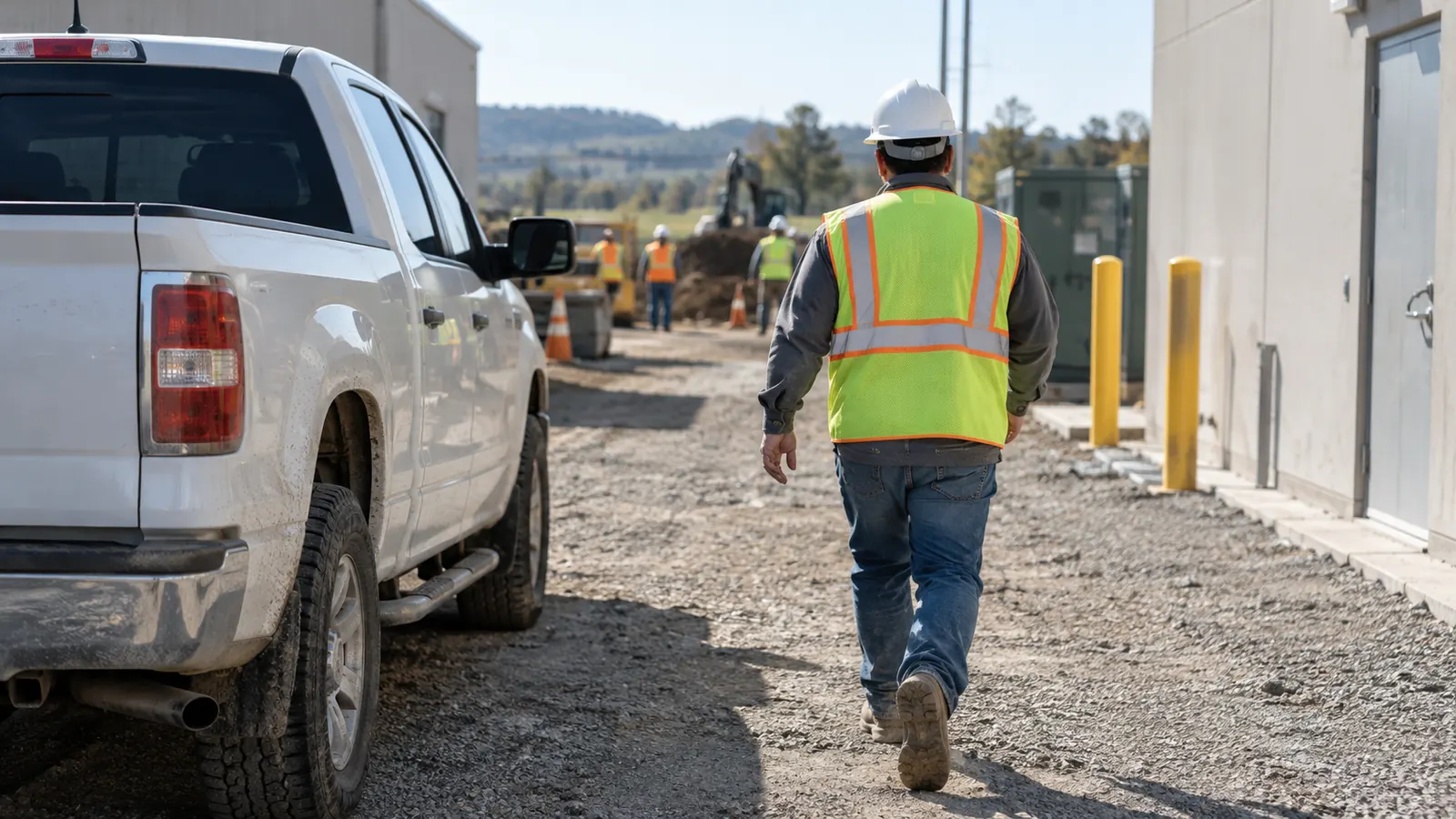
Two trucks sit at the tailgate while the field lead scrolls a tablet. The workfront on the screen is last week's revision. The owner released a different sheet. Rolling anyway is how a shift starts already behind.
This article is a shift-level guide for ISP, municipal, co-op, EPC, and carrier teams who need a field lead to run Draftech-managed subcontract crews against a released workfront. It covers the day's cadence only. It does not teach construction methods, and it does not take the employer's OSHA duty.
How to Manage OSP Field Crews Efficiently Starts With a Released Workfront
How to manage OSP field crews efficiently is a 6-step shift cadence a field lead runs for Draftech-managed subcontract crews: released-workfront check, dispatch, evidence capture, exception/RFI escalation, redlines, plus end-of-shift handback. Classify the activity under OSHA 29 CFR 1910.268 or Part 1926 before the first truck rolls.
A crew that is busy on the wrong sheet is not ahead. The field lead's first job is to refuse an unreleased workfront, not to invent a recovery date. We already defined the broader control function from issued design through closeout in our OSP construction management explainer. This page is the shift that has to survive after that freeze.
Released means the current issued revision and the current permit or access identity match the named asset set the crew is about to touch on this shift. The locate or owner-access state has to match that same set. If any of those identities is stale, the workfront is not released. Verbal confirmation can trigger a check. It cannot silently become the baseline.
We do not score the shift by footage. Footage without a source file is a rumor wearing today's date. The register that later becomes an owner control record is a different screen, and we keep that split honest in our construction progress reporting guide. The field lead's job is to feed that register with dated evidence, not to paint a dashboard green.
Classify the Shift Under OSHA Before Anyone Rolls
OSHA does not classify work by the company name on the truck. It classifies the activity. OSHA 29 CFR 1910.268 is the general-industry telecommunications standard. Title 29 was last amended September 9, 2026 and the eCFR display of 1910.268 was current as of September 14, 2026.
1910.268(a)(1) covers telecommunications centers and field installations, including installation, operation, maintenance, rearrangement, and removal of conductors and supporting structures on public or private rights of way. 1910.268(a)(2)(i) states those standards do not apply to construction work as defined in 29 CFR 1910.12. 1910.268(a)(3) sends construction operations to Part 1926.
29 CFR 1910.12 defines construction work as work for construction and for alteration or repair, including painting and decorating. New OSP plant that is being built or repaired is usually Part 1926 work. Maintenance or rearrangement of existing telecommunications field plant can fall under 1910.268. The field lead records which rule set the employer is working under for that shift. Guessing from the word "fiber" is how a JHA cites the wrong part.
When Part 1926 applies, 1926.20(b)(1) requires the employer to initiate and maintain programs necessary to comply with that part. 1926.21(b)(2) requires the employer to instruct each employee in the recognition and avoidance of unsafe conditions and the regulations applicable to that work environment. 1926.23 requires the employer to make first aid services and medical care available. Those duties sit with the construction employer. Draftech-managed subcontract crews work under Draftech QA/QC and safety oversight on turnkey work. We still do not take the employer's duty.
When 1910.268 applies, 1910.268(c) requires the employer to provide training in the precautions and safe practices in that section before employees engage in the covered activities. The employer certifies that training with a record that includes the identity of the person trained, the signature of the employer or the person who conducted the training, and the date the training was completed. That certification is prepared at the completion of training and maintained for the duration of the employee's employment. The field lead can ask whether that record exists for the people on the workfront. The field lead does not become the trainer by asking.
Classification hold. If the day's activity is not classified under 1910.268 or Part 1926, do not dispatch. The JHA and the approved traffic-control plan have to belong to the same classified workfront as the permit.
Traffic control stays on the approved plan. 29 CFR 1926 Subpart G covers construction signs and barricades. 1926.201 requires flagger signaling and warning garments to conform to Part 6 of the MUTCD. The MUTCD 11th Edition with Revision 1, dated December 2025, took effect on March 5, 2026 under that final rule and is the edition in force. Where 1910.268 applies instead, 1910.268(d)(1) requires warning signs or other traffic-control devices before work begins in the vicinity of vehicular or pedestrian traffic that may endanger employees. The field lead checks that the approved plan is the one on the ground. We do not rewrite it at the tailgate.
Run the Six-Step Field-Lead Cadence
Owners lose the shift when the field lead describes titles instead of freeze rights. We use the table below as Draftech selection guidance for one shift. It is not an OSHA form and it is not a production-rate model. If a cell is blank, the crew will invent a caller under pressure.
| Shift step | Field lead checks | Does not take | Hold if missing |
|---|---|---|---|
| Released-workfront check | Issued revision, permit or access identity, locate or owner-access state on the named asset set | Owner acceptance; employer OSHA program | Stale sheet or no release |
| Dispatch | Named workfront, classified activity, approved traffic-control plan present | Construction means and methods | Wrong workfront or missing approved TCP |
| Production and evidence capture | Asset ID, source-file identity, cutoff datetime | Quantity acceptance | Footage with no source |
| Exception and RFI escalation | Named exception, first-seen time, question owner | Design authority | Verbal field redesign |
| Redlines | Markup identity on the issued sheet | As-built acceptance | Markup with no sheet ID |
| End-of-shift handback | Remaining holds, evidence index, next-shift workfront | Portfolio report; closeout package | Crew leaves with open files |
How to Manage OSP Field Crews Efficiently Across One Shift
The cadence is the same whether one crew or several Draftech-managed subcontract crews are on the route. Each crew still needs a named workfront. A route-level assignment is not a workfront. If the lead cannot point to the issued sheet the crew is allowed to touch, dispatch has not happened.
Released-Workfront Check Is a Freeze
The check is a go or no-go on the named asset set. Pole batch, conduit run, splice window, crossing, drop group: pick the identity the drawings already use. Compare the physical tag or station to the issued sheet before anyone loads a reel. If two structures could satisfy the same note, that asset does not move.
Permit identity belongs on the same row. A status call is not a permit. Owner rules and the approved traffic-control plan belong to that same workfront, and so does the JHA, not a binder in the truck that covers the whole county. When the locate ticket is a designer notice instead of a current field ticket, hold. We do not let a superintendent promise a DOT approval date and call it dispatch.
Dispatch Does Not Mean a Tailgate
One limitation of our preferred cadence is that a field lead can treat the morning tailgate as the released-workfront check. A talk is not a freeze. People can hear the JHA and still roll onto last week's sheet.
When 1910.268 applies, 1910.268(e) requires daily inspection of personal protective equipment, protective devices, and special tools by the employee using that equipment. 1910.268(j)(1)(i) requires visual inspections of mechanical equipment by a competent person each day the equipment is to be used, and 1910.268(j)(1)(ii) requires tests at the beginning of each shift by a competent person to insure vehicle brakes and operating systems are in proper working condition. The field lead checks that those employer steps happened for the people and vehicles assigned to the released workfront. Checking is not performing. Performing those inspections remains the employer's work.
Dispatch names the workfront and the person who can stop work. If that person is "whoever answers the radio," you do not have dispatch. You have a hope.
Capture Evidence and Escalate Exceptions
Evidence is an index, not a camera roll. Each placed unit needs an asset ID and a source-file identity, with a cutoff datetime on that same row. Installed quantity is what the crew placed against the named workfront. Accepted quantity is a later owner act. Mixing those 2 columns is how a shift looks complete while closeout reconstructs the plant.
We want the photo or native file to join the same ID the issued sheet already uses. Date-stamped folders that cannot open the last span are entertainment. The software that captures that field record is a separate decision from this cadence, and we compare platforms in our telecom field data collection software comparison. This page only requires that whatever tool you use can retrieve the file by asset ID before the crew leaves.
I still catch myself asking for a status color before asking for the file identity. That is our own failure mode when a team copies this cadence into a kickoff deck and then runs production totals anyway. Software can display a Gantt that hides every unresolved pole. The contract should require the evidence index as a shift deliverable.
Evidence test. If the field lead cannot open 1 native file for the last span the crew called complete, the shift is not closed. Keep the index.
Exceptions need age. An open hold without a first-seen time is a theme, not a control. Keep the last-checked time and the next action actually inside the field lead's control. External dates from a DOT or a pole owner stay observed facts. We do not let a field lead promise an authority's approval clock.
An RFI is a named question. It has an owner. Engineering stays 100% in-house at Draftech, so a crew observation does not become design until engineering issues the accepted direction. Keep 2 states during review: the current issued sheet and the proposed change. If the crew cannot work the released sheet, hold that asset. Do not invent a drawing in the dirt.
The later construction package that carries those RFIs into the next workstream is not this page. OSP documentation for construction handoff is that later release standard. The shift only has to get the question into that path with a time stamp and a name.
Close the Shift With Redlines and Handback
Redlines are construction-period markups on the issued sheet. They are not as-builts. An as-built is the accepted operating record, and that acceptance is an owner act. If the markup cannot name the sheet ID and the revision it marks, it is a sketch. Sketches do not survive the next shift.
We keep that distinction sharp because crews will call a photo a redline when they are tired. A photo can support a redline. It does not replace the marked sheet identity. The comparison of those two records is a separate article. This page only requires that today's markup can be found tomorrow.
End-of-shift handback is the 1 packet the next field lead can open without calling anyone who already left. Remaining holds. Evidence-file identity. Open RFIs. Redline identity. Next-shift workfront, if one was released. If a native file is missing, the row stays open. Physical completion of a span is not that packet.
Handback is not portfolio reporting. A weekly owner slide can quote the handback. It cannot replace it. Handback is not package QA and it is not design handoff. Those jobs have their own seats. The field lead who tries to close all of them in one evening closes none of them.
Safety records stay with the employer. OSHA 29 CFR Part 1904 injury and illness recordkeeping, where it applies, is not a field-lead log. Do not merge the handback with the employer's 1904 file. Keep both. The handback names remaining holds on the workfront. It does not certify that the shift was safe.
Choose the Shift Cadence Decision
Staff the field-lead seat that matches how many workfronts can actually stop tomorrow morning. Keep the cadence in-house when one accountable lead can refuse an unready sheet. Buy coordinated field-lead coverage when interfaces and evidence volume exceed that capacity.
Small ISP, one workfront: keep the function in-house if one accountable person can own every release check and the evidence index for that shift. Buy a named field lead only if that person cannot also hold the freeze when the issued revision is stale or the permit identity does not match the named asset set. Inspection acceptance still sits with the assigned owner.
Municipal or co-op program with several Draftech-managed subcontract crews: name the field lead before the second crew rolls. The first deliverable is the shift table plus the handback packet, not a dashboard. Keep owner acceptance. Keep design-issue authority. If you do not yet have that named lead, the hiring gates sit on a separate page covering how to hire a construction manager for a fiber project.
Carrier or EPC with stacked workfronts: buy the partner first, then the supervisors the crews actually need. Pin the named field lead through the shifts you hired them for. If the firm swaps that lead after mobilization, the interview no longer matches the job. The partner's first artifact is still the released-workfront check. A Gantt demo is not that artifact.
Active in 24 states. Available across all 50 U.S. states. Draftech's shift-level fiber construction management can connect in-house engineering with a field lead who can refuse an unready workfront before the first truck rolls onto the route. Construction stays full turnkey through Draftech-managed subcontract crews. Engineering stays 100% in-house. We remain a single point of accountability for the work we take. We still do not take an owner approval the contract assigned elsewhere, and we do not certify OSHA compliance.
To compare an in-house field-lead model with managed delivery, send Draftech a sample workfront row and the current JHA identity. We will define the shift boundary and the handback packet before proposing staff.
If how to manage osp field crews efficiently is part of a qualifying route, Draftech engineers the first 20,000 linear feet at no cost, from feasibility and field survey through permit approval. Request the free design package. The owner reviews each request before Draftech commits the package.