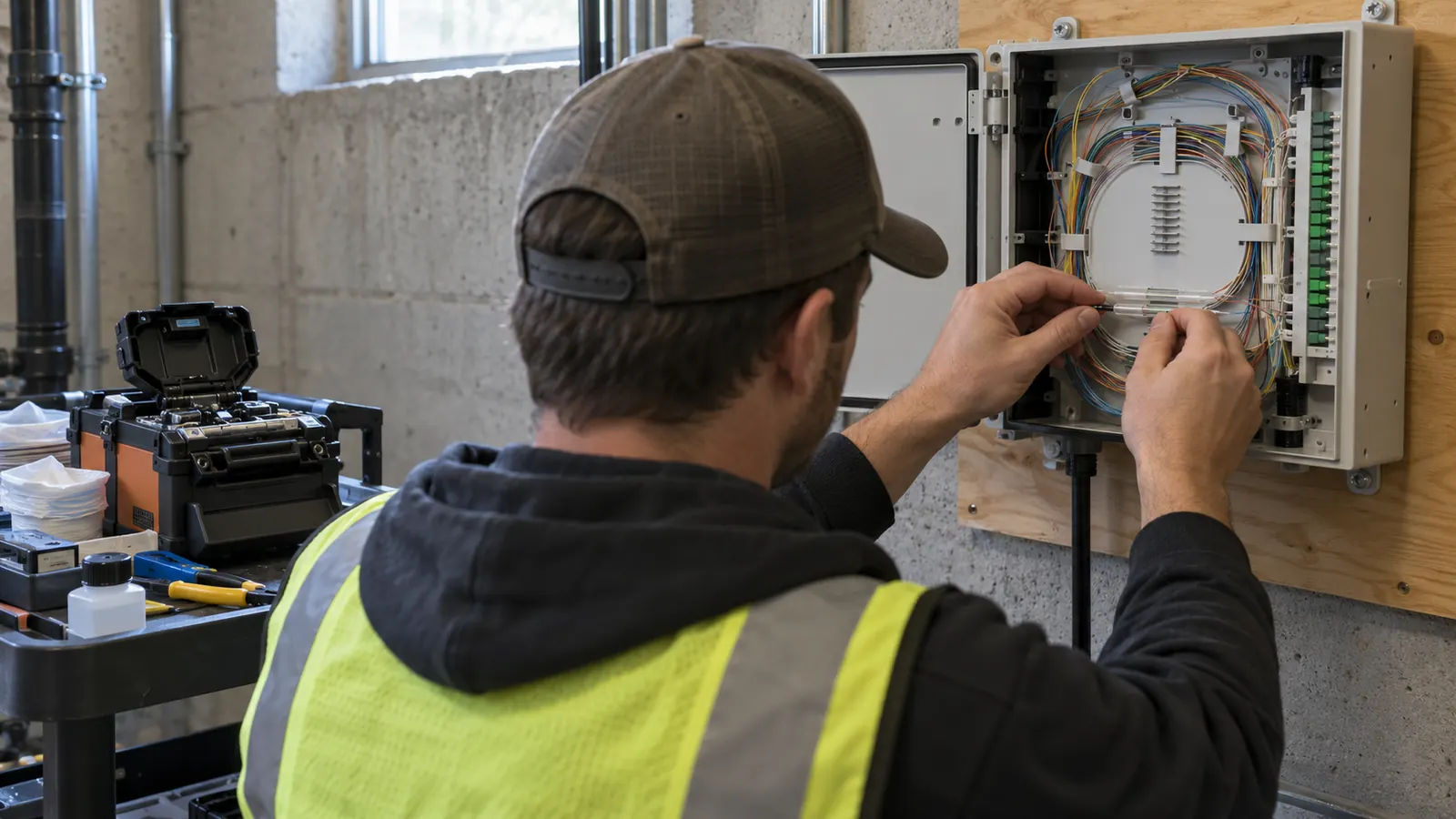
Fiber arriving at an apartment building can leave the hardest construction decision unresolved. The operator still needs a working connection from the telecom room to each occupied unit, and the owner still needs to know which walls must open before anyone can use it.
We compare fiber to the building with fiber extended to each unit by following that remaining route. Existing cable can make an occupied building easier to serve, but its condition and ownership determine whether reuse is a sound design choice.
The comparison also applies to commercial tenants. A shared equipment room changes who maintains the access electronics, while a fiber handoff inside each suite changes where those electronics sit and how technicians reach them. Those responsibilities belong in the scope before construction starts.
What FTTB changes at the building boundary
FTTB means fiber to the building: the optical access connection ends in a building telecom room, and another medium carries service to occupants. The comparison has 2 distinct handoff locations: the shared room or each unit. That boundary determines which equipment needs power and which existing cables must qualify for reuse.
The abbreviation describes where fiber stops. It does not specify the whole network. An operator can deliver optical service to a shared room and distribute it over twisted-pair copper, coaxial cable, copper Ethernet cabling or a designed wireless system, with different equipment and testing requirements for each arrangement.
We draw the optical termination and the customer handoff separately. That prevents a building entrance splice from being mistaken for the end of the optical access link when fiber continues through the riser to individual apartments. Our FTTH and FTTx definitions cover the terminology; here, the useful question is what the selected boundary makes the project build and maintain.
FTTB: retain a qualified in-building segment
A building-level handoff puts the shared access equipment close to existing distribution wiring. That can reduce cable replacement inside occupied units when the installed medium supports the intended service and the operator has permission to use it. We treat both conditions as design inputs. Neither follows from a cable being present.
Reuse needs evidence. A marked pair at a distribution frame may lead through undocumented joints before reaching an apartment, and a coaxial outlet may belong to a branched system with components unsuitable for the proposed service. Our survey must establish the actual route before an equipment schedule can describe a credible connection.
Fiber to each unit: extend the optical boundary
Unit fiber carries the optical path through the building to an endpoint inside the dwelling or commercial suite. The optical network terminal needs power there. The common route can remain passive when the selected architecture supports passive distribution, although an upstream equipment room may still contain powered equipment serving other functions.
Access shifts toward the tenant. We need an agreed endpoint location and an installable route through the unit entrance, especially where the owner restricts surface raceway or tenants cannot be available during ordinary work hours. The optical design and the appointment plan have to describe the same installation, or completed hallway work can leave service unfinished.
FTTB scope starts with the existing wiring
Cable condition decides how much construction a reuse plan avoids. We begin with the building records, but the survey checks whether those records match the occupied property. A drawing showing a continuous riser says little about a locked intermediate closet or a cable that was rerouted during a tenant renovation.
Trace the actual circuits. We want the unit identifier at the outlet to agree with the identifier at the shared termination, with ambiguous connections resolved before cutover. Otherwise a clean test on the wrong circuit creates false confidence and exposes an unrelated tenant to an outage when the crew moves the pair.
Test the medium that will carry service
Copper Ethernet cabling needs qualification for the selected Ethernet application over the installed channel. Voice pairs need assessment with the proposed access technology in mind. We do not use a continuity result as a substitute for service qualification, because electrical continuity alone says nothing about whether the required signal can operate reliably over that route.
Coaxial reuse calls for a topology review. Splitters and amplifiers can change the usable path, and an existing television service may need to coexist with the new network. Wireless distribution replaces a cable assumption with a radio design task; coverage through occupied rooms and available airtime must support the intended service rather than just a visible signal near the corridor.
Broadband Forum's TR-419 Issue 2, Fiber Access Extension over Existing Copper Infrastructure, published in June 2022, describes extending fiber access over retained copper infrastructure. It supports the architectural distinction, not a performance promise for an untested building. We use the proposed service requirements to set the acceptance criteria for the installed medium.
The scope differences below follow the service path from the room to the occupant. They identify work packages, not guaranteed savings; a building with damaged distribution wiring can require substantial replacement even when the optical connection ends at the shared room.
| Scope decision | FTTB with retained wiring | Fiber to each unit |
|---|---|---|
| Existing distribution | Qualify retained medium and repair exceptions | Install and test optical paths to unit endpoints |
| Room requirements | Accommodate shared access electronics and their power | Accommodate optical distribution and any remaining active equipment |
| Pathway work | Build the entrance route and address reuse failures | Provide continuous riser and horizontal fiber routes |
| Occupant access | Depends on wiring condition and endpoint changes | Required for the planned unit termination |
| Later upgrades | Retain a route for future unit fiber | Plan optical capacity and endpoint changes |
Record exceptions before selecting the reuse scope
Testing should leave a disposition for each route assessed. A failed channel needs a repair or replacement plan, while an inaccessible unit remains unverified until someone can inspect it. We keep those conditions visible in the design rather than treating every apartment in a stack as equivalent to the first accessible one.
Ownership can block technically sound reuse. The property owner may control the pathway while a separate operator controls the cable within it, and that distinction changes who can authorize a new termination. We ask for written permission covering the proposed work before relying on retained wiring in the construction package. Access arrangements need the same attention.
Keep the old circuit identifiable. Photograph and label the existing termination before any service transfer. A rollback is practical only when the crew can restore the correct connection without tracing the occupied building again.
Equipment room space and power follow the handoff
A shared room must fit the installed system and leave technicians room to work. Cabinet depth matters when the door opens toward another rack, and patching space matters when a bend-sensitive cord must turn immediately after leaving a panel. We check the service position of the equipment, not just its closed footprint on a plan.
Shared equipment needs an operating owner
Power needs a named owner. Our room schedule identifies the electrical supply and the party responsible for keeping it available, including what happens when building maintenance isolates the circuit. Backup requirements follow the service commitment and the chosen equipment load; they cannot be inferred from the letters FTTB or from the presence of an outlet.
Heat remains a building responsibility even after installation. A closet served by comfort cooling that shuts down after hours may behave differently from a room with continuous environmental control. We check operating conditions against the equipment requirements and establish how the operator will learn about a power or temperature problem before residents report lost service.
Our fiber network design scope connects these room decisions to the access architecture. Assigning the optical handoff without assigning its power source leaves an incomplete design, particularly when the building owner supplies electricity but the ISP maintains the electronics and needs access outside staffed hours.
Unit endpoints move work into occupied space
Fiber to each unit can remove shared copper distribution electronics from the common room, depending on the selected architecture. It still needs space for passive terminations and cable management. We reserve those positions on the room elevation so an apparently empty wall does not become storage before the distribution system is installed.
The tenant endpoint needs a usable outlet. Its location also affects the route to the customer's router, so a convenient optical termination beside the entry door may create a poor service arrangement inside a deep commercial suite. We settle that handoff with the operator before the installation crew arrives with a drop length based on the wrong room.
Maintenance access belongs in the comparison. A shared cabinet concentrates some repairs in a controlled common area; an endpoint inside a unit can require another appointment even when the fault is simple. Neither arrangement removes the need for support access, but each places that need under a different person's control.
Risers and horizontal routes set the construction burden
The vertical riser is only part of the route. Fiber must also leave the riser and reach each unit, often through finished corridors where the approved method of concealment matters as much as available cable space. We trace that transition during the survey instead of assuming a clear shaft provides a complete distribution path.
Separate vertical capacity from the last hallway run
An existing sleeve may be full. A spare conduit may end above an inaccessible ceiling. The construction drawings need a continuous route with pull access and suitable bend geometry, including the point where the cable leaves common space and enters the customer's premises. A disconnected set of available spaces cannot carry a drop.
We distinguish usable capacity from nominal dimensions. Occupied pathways need investigation before a design reserves space in them, and the installation method must account for cables already serving tenants. The broader multi-dwelling unit fiber design guide covers the building design package; this comparison asks which of those routes must be built now under each handoff choice.
Penetrations need explicit treatment. The selected pathway must respect the building's rated assemblies, with restoration coordinated through the applicable design and approval process. We describe the required work at each affected location so the contractor can identify it during construction, rather than leaving a generic note to resolve different wall conditions in the field.
Inspect the riser exit. Open the accessible ceiling or enclosure where the proposed cable turns toward the units. That transition can reveal an obstruction hidden by an otherwise clear vertical shaft and change the corridor construction method before materials are ordered.
Occupied buildings need a workable sequence
Construction access is a deliverable. A unit-fiber design can require common-area work before tenant appointments, with temporary protection and finish restoration coordinated around occupied space. We separate those activities in the package so a missed appointment does not prevent unrelated riser work from proceeding, and completed corridors do not have to reopen without a defined reason.
FTTB can reduce unit entries when existing wiring is suitable and customer equipment can be installed through the agreed service process. It cannot guarantee that every apartment stays untouched. Failed cables or undocumented outlets can still require access, and we want the exception process agreed before the owner tells residents that no appointments will be necessary.
Commercial tenant work deserves its own sequence. The handoff may feed a tenant network that must remain available during business operations, so the service transfer needs an approved interruption window and a person authorized to verify restoration. We include the boundary of our work in that discussion to avoid treating tenant equipment changes as incidental cable installation.
Preserve a practical route from FTTB to unit fiber
A later optical upgrade is easier to plan while the shared pathways are being worked on. We prefer to reserve a usable route to the units when the current project selects wiring reuse, because another corridor opening can involve the same access negotiations and finish work that the owner has already approved once.
The limitation of this phased approach is that it creates a second installation and service-transfer effort when unit fiber arrives. Preserving pathways reduces some future construction, but it does not eliminate tenant coordination or endpoint replacement. We make that deferred work visible when presenting the initial scope, especially if the owner expects the first project to finish the building permanently.
Reserve capacity with a destination
Spare space needs a destination. A larger entrance conduit helps only if the future fiber can continue through the riser and reach a planned termination position. We carry the reserve through the route drawings and check that it remains usable after current cable installation, rather than labeling an isolated empty sleeve as the entire upgrade strategy.
The fiber allocation should also distinguish installed service from future demand. We document how reserved capacity reaches the building distribution points and how a later crew can identify it. A new cable in an occupied pathway can damage or obstruct existing service if the future installation method was never considered when the first bundle was secured.
We preserve useful records at closeout. The installed route and termination identifiers should match the test records, with departures from the issued drawings carried into the as-builts. Our partner and delivery responsibilities make accountability visible; the building records must do the same for the person responsible for each handoff after construction ends.
Transfer service without losing the fallback
Cutover requires a customer acceptance point. We define how the new optical service will be checked before releasing the old connection, and who can authorize retirement of the retained wiring. A successful optical test at the building panel does not establish that the customer endpoint is working or that the tenant's network is connected to it.
Keep rollback possible during the agreed window. That means knowing what remains connected and what must be restored if the new service fails its acceptance test. Once the operator and owner accept the transfer, unused equipment can be removed under the agreed scope; removing it early can turn a correctable activation problem into an extended outage.
Choose the handoff by building condition and responsibility
For ISPs: select FTTB where qualified existing wiring supports the intended service and the building provides an operable shared equipment location. Confirm the support boundary before selling the service. Choose unit fiber when the service roadmap exceeds the credible reuse path, and define acceptance at the actual customer handoff rather than at the entrance enclosure.
For MDU owners: prioritize unit fiber during a renovation that already exposes the route to apartments. Access is the opportunity. In a finished occupied building with suitable wiring, consider FTTB with documented exceptions and a reserved future fiber path, while recording who pays for and authorizes the later unit installation in the project agreement.
For municipalities: define the network's responsibility at each building before procuring a connection program. A building passed by fiber and a unit ready for service are different deliverables, and the scope must distinguish them. Require an identified owner for any shared powered equipment so the public network does not inherit an undocumented dependence on a building's maintenance practices.
For commercial property owners: choose the handoff around tenant service boundaries and maintenance access. A multi-tenant building may need different endpoint arrangements by suite, while retaining a common pathway plan. Establish the permitted interruption window with each affected tenant; a technically straightforward transfer still needs someone available to accept the restored service.
Draftech International delivers turnkey telecom and power infrastructure through field survey, planning, construction drawings, permits, agency coordination, construction, as-builts and closeout. Our engineering is 100% in-house, and full turnkey construction is delivered by Draftech-managed subcontract crews under our QA/QC and safety program. To resolve the room ownership and occupied-route questions before scope is fixed, send us the building information and intended handoff, or write to info@draftech.com.
For a qualifying route connected to the building work, Draftech engineers the first 20,000 linear feet at no cost under our free engineering offer, from feasibility and field survey through permit approval. The owner reviews each request before Draftech commits the package. We use that review to establish the eligible route scope alongside the building's separate access and handoff decisions.