- What Is GPON and How Does It Differ from Active Ethernet?
- GPON Split Ratios: 1:32 vs. 1:64 and When to Use Each
- OLT and ONU Placement in OSP Design
- GPON Network Architecture: Centralized vs. Distributed Splitting
- GPON Design Considerations for BEAD-Funded Networks
- When to Upgrade to XGS-PON: Planning for Future Capacity
I've been doing OSP design for 30 years. I've watched active Ethernet deployments, HFC rebuilds, and more PON generations than I can count on one hand. GPON has been the dominant FTTH technology for the past decade and a half for one reason: it works, it's cost-effective at scale, and, when designed correctly, it can carry a community's broadband needs for the next 20 years without ripping up the ground again. The problem isn't the technology. The problem is how it gets designed.
Most of the GPON networks I've been called in to fix weren't broken because of bad equipment. They were broken because of decisions made at the design stage: wrong split ratios, OLT placed too far from the population center, no upgrade path built into the ODN. Bad GPON design is expensive to fix because the passive infrastructure is buried or lashed at 30 feet. You don't get a do-over on OSP without construction costs.
This guide covers what FTTH network design for GPON actually requires: what the technology is doing, where the key architectural decisions live, and how to think about each one before a single foot of conduit gets placed.
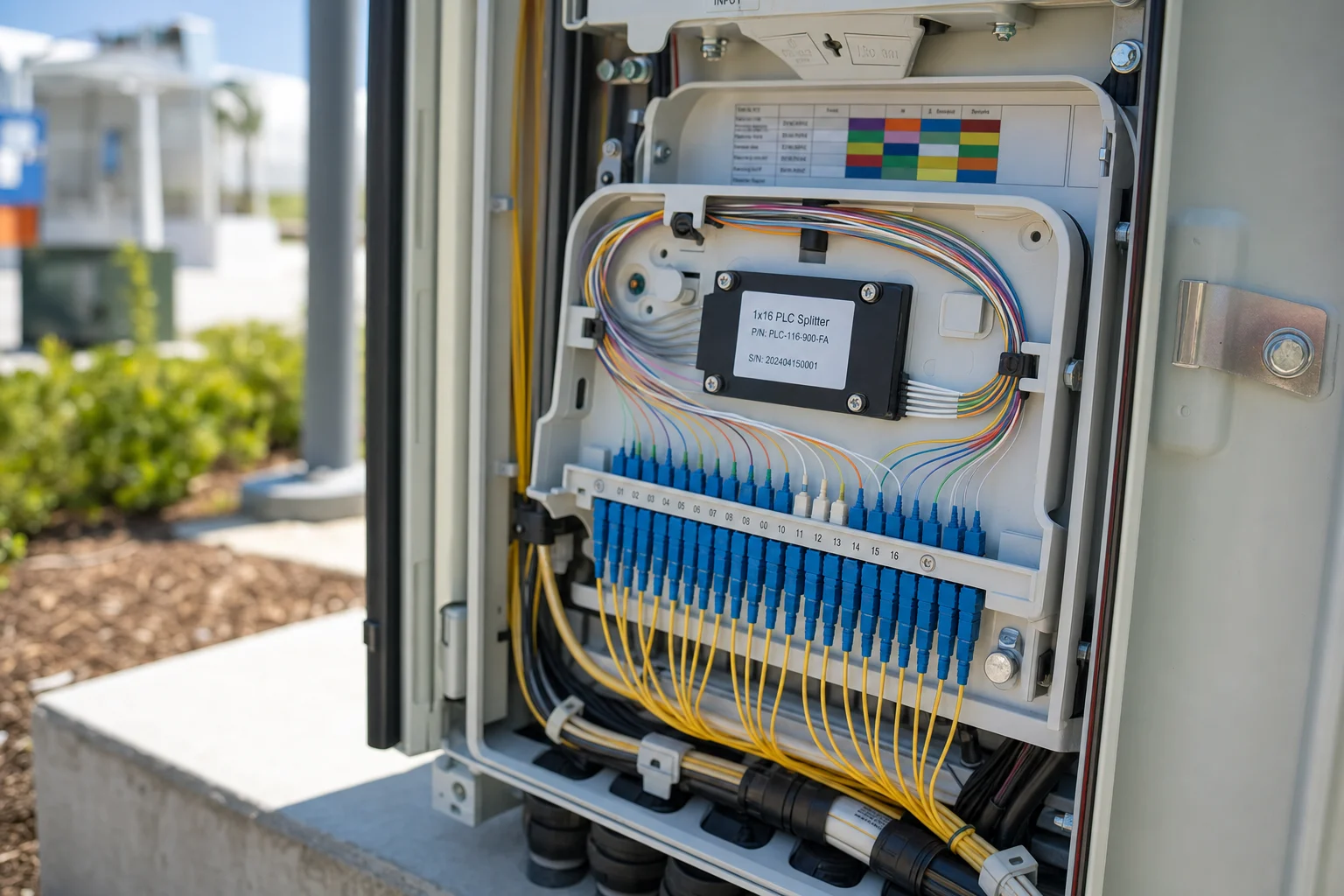
GPON is a gigabit-capable passive optical network (ITU-T G.984) in which one optical line terminal (OLT) port serves many optical network units (ONUs) over one fiber through passive splitters. It provides shared capacity of 2.488 Gbps downstream and 1.244 Gbps upstream. We plan around that shared capacity when sizing each PON tree for subscriber demand.
What Is GPON and How Does It Differ from Active Ethernet?
The fundamental difference is in the middle of the network. Active Ethernet runs a dedicated fiber strand from the central office to every single subscriber location, or routes traffic through active Ethernet switches placed in the field at fiber distribution points. Every switch in an active Ethernet network is powered equipment with an operational cost, a failure mode, and a maintenance requirement. GPON replaces those active field switches with passive optical splitters: no power, no moving parts, nothing to fail except the glass itself.
In a GPON system, a single OLT port shares one fiber strand among multiple subscribers using time-division multiplexing. Downstream traffic at 2.488 Gbps is broadcast to all ONUs on the PON tree simultaneously, and each ONU processes only the frames addressed to it. Upstream traffic at 1.244 Gbps is allocated in time slots by the OLT's dynamic bandwidth allocation engine. The shared medium is managed entirely in the electronics at each end; the passive ODN in between is just glass and connectors.
That passive middle is what makes GPON economics work in rural and suburban deployments. A typical 144-subscriber deployment using active Ethernet requires roughly 18 powered Ethernet switches in the field. The equivalent GPON deployment might use 6 passive splitter housings: no power, no cooling, no remote management, no battery backup. Over a 20-year network life, the operational cost difference is substantial. For an electric cooperative or rural ISP operating with a lean NOC, removing active field equipment from the network isn't just a capital savings. It's a reduction in operational complexity that matters every single week.
Active Ethernet does have real advantages (dedicated bandwidth per subscriber, simpler troubleshooting, no shared medium contention), and it's the right choice for certain high-density MDU or enterprise campus scenarios. But for the mainstream FTTH deployment that a rural cooperative or regional ISP is building under BEAD or similar programs, GPON's passive architecture is the right starting point.
GPON Split Ratios: 1:32 vs. 1:64 and When to Use Each
Split ratio determines how many ONUs share a single OLT port, and by extension, how much bandwidth each subscriber has available, how far your feeder fiber can reach, and how much margin you have in your optical link budget. This is the single most consequential design decision in a GPON network, and it's one where I've seen the most errors.
A 1:32 split means one OLT port serves up to 32 subscriber endpoints. A passive 1:32 splitter introduces approximately 15.6 dB of insertion loss. That's the fundamental optical splitting penalty before you account for connector loss, splice loss, or fiber attenuation. On a standard GPON B+ class OLT with a 28 dB loss budget, you have 12.4 dB remaining for the rest of your link after the splitter. At 0.35 dB/km fiber attenuation and 0.1 dB per field splice, that's roughly 20+ km of usable feeder reach in practice.
A 1:64 split introduces 18.6 dB of insertion loss, 3 dB more than 1:32. On the same 28 dB B+ budget, you're left with 9.4 dB for the rest of the link. That limits your practical feeder reach to around 14 to 16 km under the same conditions. You can extend it with C+ or C++ class optics, but that adds cost at the OLT and ONU level. More importantly, every subscriber on that 1:64 PON tree is now sharing 2.5 Gbps downstream with 63 other potential users. At full activation, the per-subscriber share is 39 Mbps downstream. That sounds fine until you account for simultaneous streaming households at 7 PM on a Tuesday.
The right rule: use 1:32 as your default for rural deployments with subscriber densities below 15 homes per route mile, long feeder runs, or any location where take rate uncertainty means you may be running the tree at 50% fill for the first 3 to 5 years. Use 1:64 in denser suburban areas where feeder distances are short (under 12 km), take rate confidence is high (above 65% expected), and your bandwidth planning shows adequate headroom even at full load. And always plan your splitter housings for two-stage capability: install 1:4 primary splitters and reserve space for the secondary 1:8 stages, so you can adjust the effective split as your network matures without rearranging OSP infrastructure.
One more thing on split ratios: don't mix them on the same feeder without thinking through your link budget on a per-PON basis. I've seen designs where someone mixed a 1:32 branch and a 1:64 branch off the same feeder fiber at different distances, then wondered why the 1:64 subscribers at the far end had marginal optical levels in cold weather when fiber attenuation shifts. Plan each PON tree as a complete link budget exercise, not a guess.
OLT and ONU Placement in OSP Design
The OLT is the head-end equipment, the central office or hub location that houses the line cards, aggregates all PON traffic, and connects to your upstream transport. ONU placement is at the subscriber premises. But the decision that actually drives OSP cost is where you place the OLT relative to your subscriber distribution.
A common mistake: building a GPON network where the OLT is co-located at the only available conditioned space, which often ends up being a central office 18 miles from the subscriber density center. That creates long feeder runs, higher fiber counts in the feeder cable, and a link budget that's already stressed before you add any splits. Sometimes that central office placement is unavoidable. When it is, you need to account for it explicitly in every PON tree's link budget, and consider whether a distributed OLT deployment, with a smaller chassis at a field site closer to subscribers, saves more in OSP fiber than it costs in equipment and power.
For most BEAD-funded rural builds, the practical approach is to place the OLT at the closest secured, conditioned, and utility-powered facility within 8 to 12 km of the service area centroid. That might be a substation building, a community facility, or a new hut. The fiber distribution hub sizing decisions downstream from the OLT (how many subscribers per hub, how many splitter stages, what enclosure format) flow from that OLT placement choice.
ONU placement is simpler in principle but generates most of the field headaches. ONUs need power at the subscriber premise, a weatherproof enclosure if exterior-mounted, and a battery backup unit if the ISP is making a voice service reliability commitment. On aerial FTTH builds, the ONU and NID typically mount to the side of the structure within 3 to 5 feet of the demarcation point. On underground runs, that same junction point usually requires a buried pedestal stub to transition from the underground drop to the riser at the structure. Either way, the ONU placement needs to be called out explicitly in the HLD and LLD design packages. I've seen field crews make that decision ad hoc on 200 homes, and the resulting as-built documentation is unusable.
GPON Network Architecture: Centralized vs. Distributed Splitting
Once you've established your OLT location and your target split ratio, the next architectural decision is where to place the passive splitters in the ODN. There are two primary models: centralized and distributed.
Centralized splitting places all passive splitters at a single location (the central office, a headend hub, or a central FDH) and runs individual dedicated fiber strands from that point to each subscriber zone. The feeder cable from the OLT is a high-count trunk (288F, 432F, or higher) that feeds a large FDH with all splits co-located. Advantages: simplicity of operation, centralized fault isolation, single splitter location to maintain and access. Disadvantages: very high fiber count in the feeder cable, long drop distances from the central FDH to subscribers, and limited flexibility if the network footprint expands.
Distributed splitting stages the passive split across two levels. A primary 1:4 or 1:8 split happens near the OLT or at an intermediate distribution point. Secondary splits, typically 1:8 or 1:4, happen in smaller field enclosures closer to subscriber clusters. The total split ratio is the product of the two stages: a 1:4 primary with 1:8 secondaries produces a 1:32 effective split. Advantages: lower fiber count in the feeder cable, shorter drop distances from field splitters to subscriber premises, and better geographic scalability. Disadvantages: more field enclosure locations to maintain, more splice points, and a more complex network map to document and troubleshoot.
For most rural FTTH builds in dispersed areas, the 8 to 25 homes-per-mile densities typical of BEAD-eligible territories, a single-stage distributed architecture works well. One primary split at the OLT or a central FDH, then a single passive splitter per distribution zone serving 16 to 32 homes. The feeder cable to each zone can be relatively low-count (24F to 48F), and the drop from the zone splitter to each subscriber stays under 1,000 feet in most cases.
Denser suburban areas with MDU clusters justify a two-stage approach, particularly when MDU buildings contain 8 to 24 units each. In that case, a field splitter outside the building feeds a building entrance terminal inside, which then drops to each unit. The FTTH design for BEAD networks in these mixed-density scenarios benefits most from a hybrid approach: centralized primary splits for the dispersed residential zones, distributed secondary splits for the MDU clusters, all on the same OLT chassis.
GPON Design Considerations for BEAD-Funded Networks
BEAD has added a layer of design requirements that didn't exist in most ISP builds five years ago. It's not just about getting fiber to the premise. It's about demonstrating that the network meets NTIA's technical standards, can be documented for grant compliance, and is designed to last long enough to justify the public investment. Let me walk through the GPON-specific points that matter most for BEAD compliance.
Speed requirements. BEAD requires 100/20 Mbps as the minimum for eligible projects, but the statute strongly favors networks capable of 100/100 Mbps symmetrical service. GPON's upstream at 1.244 Gbps shared across a PON tree means you need to be deliberate about your split ratio and tree utilization projections. A 1:32 tree with a 60% take rate and typical usage patterns can comfortably deliver 100 Mbps symmetrical to all active subscribers. A 1:64 tree at the same take rate is tighter and needs to be modeled explicitly. Don't assume it works: calculate it.
Scalability documentation. NTIA and most state broadband offices want to see an upgrade path. This means your GPON design should use XGS-PON-compatible ODN infrastructure from the start: specifically, splitters that pass the 1270/1577 nm XGS-PON wavelengths in addition to GPON's 1490/1310 nm wavelengths. All modern wideband splitters do this, but you need to specify it. Using narrowband GPON-only splitters to save a few dollars per unit in 2026 is a decision you'll explain to your board in 2031 when you need to upgrade and discover you have to replace every splitter in the field.
Documentation requirements. BEAD closeout packages require as-built documentation that reflects the actual deployed network, not the design intent. That means your design process needs to produce the GIS deliverables, splice records, OTDR traces, and power level logs that will eventually live in the grant closeout package. Don't treat design documentation and compliance documentation as separate efforts. The BEAD engineering requirements for 2026 grants are specific about what's required, and the time to build those documentation workflows into your project is at the design phase, not two weeks before closeout.
Redundancy and resiliency. Rural networks funded under BEAD are expected to provide reliable service. That doesn't mean GPON networks need full ring redundancy on every PON tree. That's not how GPON works and it's not what NTIA is asking for. But your transport network, the fiber carrying aggregated traffic from the OLT to your upstream transit, should have diverse routing or standby failover capacity. A single feeder cut shouldn't take down the entire service area. Design your transport rings at the OLT level, not at the PON level.
Draftech designs GPON and XGS-PON networks for ISPs and electric cooperatives across 24 states. We'll design your first 20,000 LF free, no commitment. → draftech.com/free-design
When to Upgrade to XGS-PON: Planning for Future Capacity
GPON will handle most ISP bandwidth requirements through the end of this decade without modification. But the right time to plan for XGS-PON is before you start building, because whether you can upgrade gracefully depends entirely on design decisions you make in the OSP today.
First, what XGS-PON actually delivers: 10 Gbps symmetrical shared across the PON tree, up from 2.5 Gbps downstream and 1.25 Gbps upstream on GPON. It runs on the same fiber plant and the same passive splitters as GPON, as long as those splitters are wideband-compatible. The upgrade path is an electronics swap: new OLT line cards and new ONUs at subscriber premises. No OSP rework, no new splitters, no new conduit. That's the correct upgrade path. It's only available if your original design specified wideband ODN components.
The PON technology comparison table below shows where GPON, XGS-PON, and NG-PON2 sit relative to each other. Most ISPs building today are making a GPON-versus-XGS-PON decision. NG-PON2 remains a niche technology for high-density metro applications and is not relevant to most rural or suburban FTTH builds in the current market.
| Technology | Downstream Speed | Upstream Speed | Typical Split Ratio | Max Distance | BEAD Eligible | Best Use Case |
|---|---|---|---|---|---|---|
| GPON (ITU-T G.984) |
2.488 Gbps shared | 1.244 Gbps shared | 1:32 or 1:64 | 20 km practical (60 km spec) |
Yes | Rural FTTH, electric cooperative builds, BEAD-funded greenfield, cost-sensitive deployments with subscriber densities under 20/mile |
| XGS-PON (ITU-T G.9807.1) |
10 Gbps shared | 10 Gbps shared | 1:32 or 1:64 | 20 km practical | Yes | Suburban FTTH, MDU-heavy markets, symmetric gigabit service requirements, GPON upgrades where ODN is wideband-compatible |
| NG-PON2 (ITU-T G.989) |
40 Gbps shared (4 × 10G TWDM channels) | 10 Gbps shared | 1:256 (wavelength × split) | 40 km | Yes (limited deployments) | High-density metro FTTH, campus/enterprise FTTH, operators requiring multi-tenant wavelength isolation on shared ODN |
The decision to deploy GPON versus XGS-PON today comes down to capital cost and subscriber demand. XGS-PON OLT ports and ONUs currently carry a 30 to 45% premium over equivalent GPON hardware, depending on vendor and order volume. For a 500-subscriber greenfield rural build where the subscriber mix is residential and projected demand is 100 to 500 Mbps per household for the foreseeable future, that premium is hard to justify. Deploy GPON with wideband ODN, and upgrade to XGS-PON when utilization drives the need, typically when sustained peak-hour PON utilization exceeds 65 to 70%.
For a 1,200-subscriber suburban build with a meaningful MDU population and business customers requiring symmetric gigabit, deploy XGS-PON from the start. The cost difference per subscriber amortizes over a 10-year service life, and you avoid a mid-deployment electronics swap that creates temporary service interruptions and requires ONU replacements at every subscriber premise on the upgraded PON trees.
Either way, the ODN design should be identical: same fiber, same conduit, same splitter housings, wideband-compatible passive components throughout. The only variable in the electronics choice should be the OLT card and the ONUs. If a vendor is telling you that your GPON ODN design needs to be different from your XGS-PON design, that's a red flag. The whole point of the PON architecture is that the passive plant is technology-agnostic. Lock in that agnosticism at the design stage and you preserve your upgrade optionality for the life of the network.
If you're at the design phase of a GPON or XGS-PON build and want a second set of eyes on your split ratio selections, OLT placement, or distribution architecture, that's exactly where Draftech adds value. We've completed FTTH network design work across 24 states (rural electric cooperative territories, municipal ISP builds, regional ISP expansion projects), and we've seen every variant of GPON design decision play out in the field. Our free fiber design offer covers your first 20,000 linear feet, no commitment required.