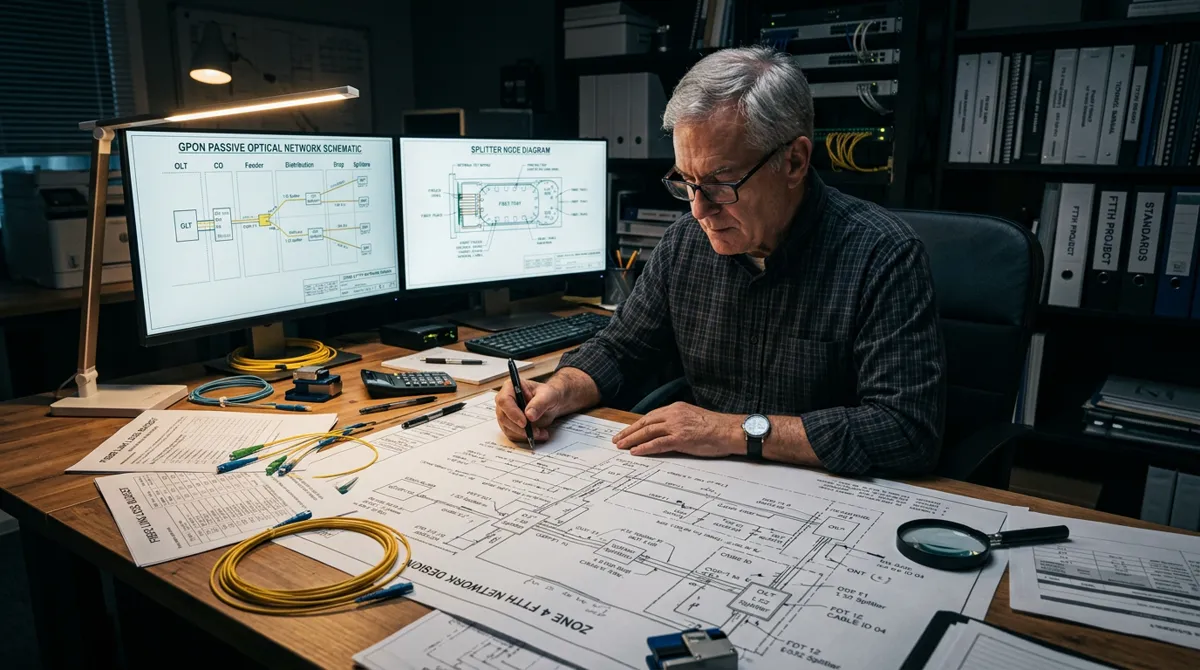
- Why BEAD FTTH Design Fails Before Construction
- Passive Optical Network Architecture: The Split Ratio Decision
- Distribution Cable Sizing and Route Selection
- Drop Architecture: The Part That Actually Determines Service Quality
- Splitter Placement and the Reach Problem
- Capacity Planning: BEAD Is a 20-Year Investment
- What a BEAD-Ready FTTH Design Package Looks Like
There's a version of FTTH design I see on BEAD projects that's technically correct and practically wrong. The strand counts work. The loss budgets close. The architecture meets the BEAD technical requirements document. And then construction starts and the problems arrive in waves: wrong drop lengths, split ratios that don't serve the density, distribution cable routes that don't match what's actually on the poles.
I've been designing fiber networks for 30 years. The first ten years, I made most of these mistakes myself. The last twenty, I've been watching other engineers make them on projects where the cost of rework is measured in BEAD milestone delays and budget overruns that nobody wants to explain to a state broadband office.
This isn't a walk through PON fundamentals. You know what passive optical networks are. What I want to cover is the specific engineering decisions that create the most rework on BEAD FTTH deployments, and why they happen even when the design looks right on paper. So why does a technically valid FTTH design fail in the field? Almost always, it's a decision that got deferred.
Why BEAD FTTH Design Fails Before Construction
The core problem isn't a lack of engineering competence. It's a sequencing problem. BEAD subgrantees are under pressure to move fast: from award to final design to permitting to construction start. That pressure compresses the design phase in ways that push decisions downstream that should be made upstream.
The worst of those deferred decisions is drop design. On too many BEAD projects I've reviewed, the distribution network gets designed at HLD, the feeder plant gets designed at LLD, and the drop architecture gets "figured out in the field." That last phrase is where the rework lives.
Drops aren't just the last 300 feet. They're where your split ratios get tested against real lot geometry, real terrain, and real distances that are almost never what the GIS data said they were. What happens when that distance comes back 20 percent longer than your design assumed? You've got a drop that doesn't reach. A drop design that's been deferred to the field is a drop design that will be wrong at some percentage of locations, and wrong drops mean truck rolls, rework, and delays that compound across hundreds of subscribers.
BEAD has specific technical requirements around served locations, and an FTTH design that can't document its drop architecture as part of the engineering package has a compliance gap that will surface at final inspection.
Passive Optical Network Architecture: The Split Ratio Decision
Every FTTH-PON design starts with a split ratio decision. 1:32 or 1:64. That's the first question. And you'd be surprised how often it gets answered by habit instead of math. Most engineers default to 1:32 for GPON deployments serving low-density rural areas. That's the right call most of the time.
But I've seen that default applied without checking it against the actual subscriber density and geographic clustering of the project area. Typical rural BEAD territory has clusters: a small town center with 60 premises in a quarter-mile radius, then 8 miles of scattered rural lots averaging one every half-mile. A 1:32 deployment designed around the dense cluster leaves the rural segments with optical power levels that don't close at the drops they're supposed to serve.
Run the loss budget from the OLT card through your feeder, distribution, and drop (including every connector and every splice) and then add 3 dB of margin for dirty connectors, temperature variation, and aging. If that number doesn't give you at least 1 dB of headroom at the worst-case drop, your architecture doesn't work at that split ratio.
The fix isn't always a different split ratio. Sometimes it's distribution node placement: moving a splitter node 0.8 miles down a county road to shift the center of mass of a rural cluster. That's a design decision that only shows up if you're doing the loss budgets route-by-route rather than using a single assumed loss figure for the whole project.
Distribution Cable Sizing and Route Selection
Distribution cable sizing, the fiber counts going from the feeder tap to the distribution node to the drop terminal, is where I see more under-engineering than anywhere else in BEAD FTTH design.
The minimum fiber count for a distribution route should cover: current subscriber assignments, 20% spare for first-year adds, a second splice window for future upgrades, and enough capacity to accommodate a port expansion on the OLT chassis without mid-span rebuilds. Engineers who size for the initial subscriber projection with no growth reserve are handing the subgrantee a capacity problem in year 3.
Route selection is a separate issue. The shortest path between two points is rarely the right distribution route on a rural BEAD project. You need to know what's actually on those poles (existing attachments, overloaded poles, poles that NESC inspection flagged for replacement) before you route your distribution cable down a 12-mile county road. I've seen distribution routes designed off satellite imagery that were technically unbuildable on the actual pole line because two-thirds of the poles had insufficient attachment capacity.
This is why field survey data quality matters so much before distribution design is finalized. You can do the optical design correctly and still produce an unbuildable distribution network if the underlying infrastructure data is wrong.
Drop Architecture: The Part That Actually Determines Service Quality
Drop design on BEAD FTTH, the fiber plant from the distribution terminal to the subscriber's ONT, is where service quality gets locked in or lost. It's also where most design shortcuts show up.
Here's what a complete BEAD FTTH drop design needs to specify:
- Drop length per served location, calculated from actual field survey data, not estimated from parcel GIS
- Drop cable type (aerial self-supporting, direct-bury, or aerial lashed) based on the specific access path to each premises
- Drop terminal type and port count, sized per the cluster served, not one-size-fits-all across the project
- Slack requirements: where and how much, based on the specific installation path
- ONT placement location: exterior weatherhead vs. interior, based on the structure type
Every one of those decisions has a rework cost if it's wrong. The most expensive is drop length. When estimated drop lengths are 15 to 20 percent shorter than actual, which is what you get when you're pulling lengths from GIS parcel data instead of field verification, you get drops that don't reach the ONT location. That's not a minor adjustment. That's a respool and a truck roll per failed drop, multiplied across however many premises share the same error.
On a 2024 project in rural Tennessee (417 FTTH drops over 29 miles of mixed aerial and underground), drop length errors from GIS estimation added 22 truck rolls in the first 30 days of installations. At $340 per truck roll, that's $7,480 in rework from one design shortcut. It doesn't sound catastrophic at that scale. Scale it to a 2,000-premise BEAD deployment and the math gets uncomfortable fast.
Splitter Placement and the Reach Problem
Splitter placement on a BEAD FTTH deployment isn't just a loss-budget question. It's a network management question that affects how the subgrantee operates and troubleshoots the network for the next 20 years.
There are two common approaches: centralized splitting (all splitters at the hub or remote node) and distributed splitting (second-stage splitters in the field at distribution nodes). Centralized splitting is simpler to build and easier to manage. Distributed splitting extends reach and can reduce fiber count on long rural routes. Which one is right depends on your route geometry and your subscriber density.
What I see go wrong is designers picking an approach based on what they've done before, not based on what the specific project geometry requires. A centralized split design applied to a project with 9-mile distribution routes and 2-mile average drops is going to struggle with optical power. A distributed split design applied to a compact suburban fringe area creates unnecessary field equipment and maintenance complexity.
The calculation isn't complicated, but it has to be done route by route. Not as a project-level average.
Capacity Planning: BEAD Is a 20-Year Investment
BEAD broadband infrastructure is supposed to serve these communities for 20+ years. The NTIA's technical requirements reflect that: minimum 100/20 Mbps symmetrical service is the floor, and the compliance language anticipates upgrade paths to multi-gigabit.
An FTTH design that doesn't build upgrade capacity in from day one is a design that will require physical plant rework within 5 to 7 years. That's not speculation. That's what happened to the first wave of rural fiber deployments from the ReConnect and CAF II programs. Networks designed to GPON 1G maximums are already being rebuilt to XGS-PON in active service areas because the capacity engineering didn't account for subscriber uptake rates that exceeded the original projection.
For BEAD FTTH, the capacity planning minimums I'd build to are:
- Conduit with innerduct wherever any underground segment is run: future cable pulls without open-cut
- OLT chassis with empty card slots for port expansion: don't fill the chassis on day one
- OSP fiber cable with 20 to 30% unused fiber count: future service tier upgrades without new distribution runs
- Splice cases with unused ports: FTTH upgrades typically require adding splices, not replacing cases
None of these add significant cost at the construction phase. All of them are significantly more expensive to retrofit after the network is built.
What a BEAD-Ready FTTH Design Package Looks Like
BEAD compliance documentation requires more from your FTTH design package than a standard commercial ISP deployment. Here's what a complete package includes.
The OSP design drawings (feeder, distribution, and drop) need to show served locations by census block, with fiber paths documented at the individual drop level. Your BEAD compliance audit will ask for served location documentation by address, and a design that only shows strand count and route geometry won't satisfy that requirement.
Loss budgets need to be per-route, not project-average. A project-average loss budget that looks fine might be hiding specific routes with no headroom, and a state broadband office reviewer who asks for route-level documentation during an inspection needs something more than "the project loss budget closes."
The subscriber count by distribution node, served location address list tied to GIS coordinates, and design version history, showing what changed from HLD to LLD and why, are all documentation elements that become important at the BEAD final compliance review. For a look at where BEAD projects stall before construction, design documentation gaps show up near the top of every list.
Hard-won note: On a 2025 BEAD FTTH deployment in western North Carolina (1,847 served locations across 67 miles of mixed terrain), the initial HLD had centralized splitting on all routes. During LLD, two distribution legs came in at 8.3 miles with 2.1-mile average drops. Loss budget audit showed those routes didn't close at 1:32 with centralized splitting. We moved to a distributed split architecture on those two legs, added three field splitter nodes, and the routes closed with 2.4 dB of margin. That design change, made at LLD before any material was ordered, cost 14 hours of redesign time. The alternative, discovering it during installation, would have cost 3 weeks and a change order. Catch it at the design desk, not in the field.
Our BEAD OSP engineering team does FTTH design that covers all of this: feeder, distribution, drop architecture, loss budgets per route, and compliance documentation that holds up at final review. If you've got a BEAD FTTH design underway and you're not sure the drop architecture is solid, reach out at info@draftech.com, or look at our free design offer as a starting point.