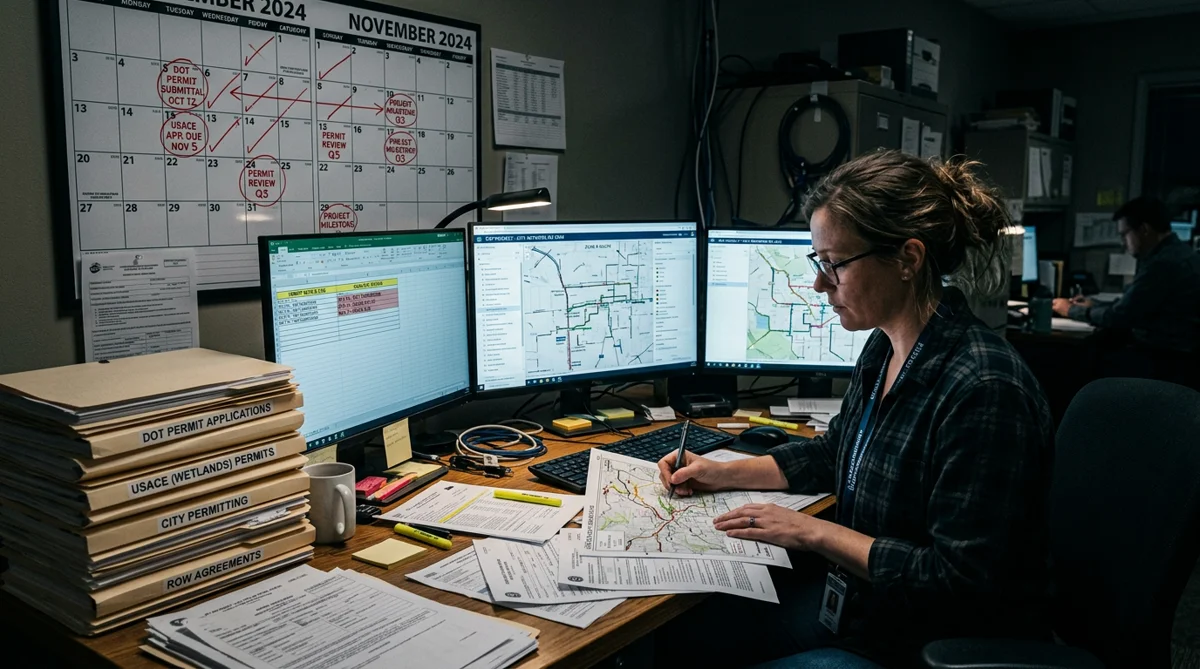
There's a number that shows up on almost every BEAD subgrantee project schedule I've reviewed: 45 days for permitting. Sometimes 60. Occasionally someone budgets 90 and feels like they've been thorough.
None of those numbers are realistic. Not for a project that crosses state roads, touches a navigable waterway, passes near a historic district, or runs parallel to an active rail corridor. And on BEAD routes, which by definition serve rural, unserved areas, you're almost always dealing with at least three of those four conditions simultaneously.
The real permitting timeline on a typical BEAD aerial build isn't 45 days. It's 6 to 12 months, compressed into your project schedule whether you plan for it or not. The subgrantees who hit their construction start dates aren't the ones who got lucky with fast agencies. They're the ones who started permitting at HLD, ran it in parallel with design, and built their schedule around how long agencies actually take, not how long they're supposed to take.
The Sequencing Mistake That Kills BEAD Schedules
Almost every project schedule I've seen treats permitting as a task that starts after LLD is complete. It's understandable: you want your design locked down before you go to the agencies. Makes sense in theory. In practice, it's how you end up 6 months behind your construction start date before you've broken ground.
Here's the math. LLD on a 20-mile BEAD route takes 10 to 14 weeks. Let's say 12. By the time it's reviewed, revised, and approved (add another 4 weeks minimum), you're at week 16. Then you submit your DOT permits. At 75 days, that's another 11 weeks. Simultaneously, your USACE NWP pre-construction notification is running 60 days. Your SHPO Section 106 review, submitted at LLD completion, not HLD, is at week 16. In a state like Mississippi or West Virginia, that's a 16-to-20-week review. Your railroad crossing, submitted the same week as LLD approval, is at the start of a 120-to-180-day clock.
Add it up and you don't have a construction start. You have a Gantt chart that ends somewhere past your NTIA milestone date.
The fix isn't complicated. At HLD (which gives you route geometry, crossing inventory, and project description), you have everything most agencies need to begin their review. Start every permit you can identify at HLD. Not after LLD. Not "once the route is finalized." At HLD. Most agencies allow minor route adjustments during the review period without resetting the clock, and a revised exhibit beats starting the review from scratch by months.
State DOT Encroachment Permits
State DOT encroachment permits, the authorization to place a fiber cable within the right-of-way of a state-maintained road, are the most common permit on any aerial or underground build. And they're where the most schedule damage happens, because project managers consistently underestimate them.
The published review targets vary. Most states say 30 to 60 days. Here's what I've seen in practice over the last three years, specifically on fiber builds:
| Agency | Typical Timeline | Notes |
|---|---|---|
| VDOT (Virginia) | 60 to 90 days | Longer for limited-access highway crossings |
| TxDOT (Texas) | 45 to 75 days | Traffic control plan required for some permits |
| GDOT (Georgia) | 60 to 90 days | BEAD volume has increased review times in 2025 to 2026 |
| NCDOT (North Carolina) | 45 to 60 days | Clean submissions turn faster; errors reset clock |
| MnDOT (Minnesota) | 75 to 90 days | Seasonal construction windows affect scheduling |
| CDOT (Colorado) | 60 to 90 days | Environmental review addendum required in some corridors |
| ALDOT (Alabama) | 60 to 75 days | Utility accommodation policy strict on attachment specs |
Two things drive the difference between a 45-day approval and a 90-day approval. First: submission quality. A permit application with missing pole IDs, an incomplete traffic control plan, or attachment specs that don't reference the state's utility accommodation policy gets kicked back. That restart is typically 2 to 4 weeks of lost time plus whatever the full review cycle takes. Second: submission volume. BEAD has flooded state DOT permit queues in 2025 and 2026. Agencies that historically ran 45 days are now running 75 or 90 because there are eight other ISPs submitting BEAD route permits in the same corridor at the same time.
Use 90 days as your working assumption on any state DOT permit. Budget for one resubmission cycle. And get the ROW permitting process started at HLD.
USACE Section 404: Wetland and Waterway Crossings
If your route crosses a wetland, a stream, a pond, or a jurisdictional water of the US (and on rural BEAD routes, it almost certainly does), you need USACE authorization under Section 404 of the Clean Water Act. For most fiber builds, that means a Nationwide Permit.
NWP 12 covers utility line activities. NWP 14 covers linear transportation projects. For fiber builds, NWP 12 is the standard pathway. The pre-construction notification process, which is what most NWP verifications require, runs 45 to 90 days at the district level. Not from submission date to approval. From the date the district office deems your PCN complete. If your PCN is missing a delineation report, lacks the required project description detail, or doesn't address secondary impacts, it sits in incomplete status until you fix it. That's not on their clock. It's on yours.
What actually takes 90 days? A PCN with multiple crossings, a project in a district with high workload, or a route where one crossing involves a special aquatic site: a wetland with particularly high ecological value, a mussel habitat, a designated critical habitat. Those trigger additional review. The district can add conditions, request project modifications, or, in the worst case, tell you your crossing doesn't qualify for the NWP and needs an Individual Permit.
Individual Permits are a completely different category. Six to 18 months, minimum, with public notice periods, interagency coordination, and a full alternatives analysis. I've seen a single borderline crossing route an otherwise straightforward project into an IP process that added 14 months to the schedule. Identify your crossings early. Get a wetland delineation done at HLD, not after LLD. And if any crossing looks like it might not qualify for NWP 12, initiate a pre-application meeting with the district office. Those conversations are free. The information they give you is worth months of avoided delay.
SHPO, Section 106, and Tribal Consultation
When federal money flows through a project (and BEAD is federal money), Section 106 of the National Historic Preservation Act applies. The subgrantee has to consult with the State Historic Preservation Officer before construction begins on any element that could affect historic properties. This isn't optional and it isn't fast.
For most rural aerial fiber builds, the Section 106 process starts with defining an Area of Potential Effect and filing a project description with the SHPO. The SHPO then has 30 days to respond to a finding of no historic properties affected, but that's the statutory minimum, not the practical average. In rural states with understaffed SHPO offices and heavy BEAD review loads, I've seen Section 106 consultations run 14 to 22 weeks. Mississippi. West Virginia. New Mexico. Kentucky. These states have real historic resources and not enough staff to process the volume BEAD is generating.
Hit a potentially eligible site (a structure over 50 years old within the APE, an archaeological resource in a sensitive area, a traditional cultural property), and the timeline extends to a Memorandum of Agreement process. That's 6 to 9 months on the short end.
Tribal consultation is separate and often the piece subgrantees are least prepared for. If your route passes through ancestral territory, near traditional cultural properties, or in an area with treaty rights, formal government-to-government consultation is required. Tribes aren't on your schedule. The consultation takes as long as it takes. I've seen tribal consultation add 4 to 6 months to a SHPO review that was otherwise on track. One project in Oklahoma added 8 months: the tribe requested additional archaeological survey coverage that pushed the APE review into a full Phase II assessment.
File your Section 106 APE at HLD. Don't wait for LLD precision. The SHPO doesn't need your splice point locations. They need your route corridor and project description. Give them that at HLD and you'll have 12 to 14 weeks of review time running while your design team is still in LLD.
Railroad Crossing Agreements
Railroad crossings are the longest individual permit on most fiber builds, and the one that surprises subgrantees the most, because the railroad isn't a government agency and isn't subject to statutory review timelines. They move on their own schedule.
Class I railroad crossing agreements (CSX, BNSF, Union Pacific, Norfolk Southern, CN) run 90 to 180 days for standard underground bore crossings. That's after you've submitted a complete application package with bore specifications, casing pipe details, depth below rail, flagging plan, and insurance certificates. Incomplete applications don't get reviewed: they sit.
If the railroad requires engineering review of your bore specs, which CSX and BNSF typically do for crossings within 25 feet of the centerline, add another 30 to 60 days. Aerial crossings over active rail lines involve additional safety review, and any crossing that requires a flagging agreement or a work window during scheduled maintenance periods can take 9 to 12 months total.
Short-line railroads are a mixed bag. Some have dedicated real estate departments and move in 60 days. Others have one person handling all permit requests and run 4 to 6 months. You can't tell from the outside which kind you're dealing with. What you can do is start the pre-application conversation immediately: call or email the railroad's real estate or engineering department at HLD, confirm what they require, and get your application in the queue before your LLD is finished.
Don't route around a railroad crossing you haven't pre-cleared. I've watched a project add 11 miles of underground conduit to avoid a BNSF crossing that the team assumed would take 6 months. The reroute cost $380,000 and 8 miles of extra conduit. The actual BNSF crossing process, which they initiated later on a different segment, took 97 days. Do the math before you reroute.
Municipal and County Permits
Municipal and county permits don't get the same attention as DOT and USACE, but they account for a disproportionate share of field-level permit delays. And on BEAD routes, which often pass through small rural municipalities with limited permitting staff, the variability is extreme.
A city with a dedicated utilities permitting department might turn a fiber ROW permit in 15 business days. A rural county with a single building inspector handling all permit requests might take 45 days, and that's if your application is complete and they know what a telecommunications facility permit requires. Some don't. I've had a county clerk send back an application because it was missing a building permit fee for an aerial strand. Not a ROW permit. A building permit. It took 3 weeks to get the right person on the phone to explain why that didn't apply.
The practical approach with municipal permits is early, personal contact. Call the county or city engineer before you submit. Ask what they actually require for a telecommunications encroachment permit. Ask whether they've processed BEAD permits before and if they have any specific requirements. That one phone call can save you a 3-week delay from an incomplete submission that you didn't know was incomplete. For a complete view of the pre-construction failure points on BEAD projects, the stall patterns all share the same root cause: things that should have been started earlier.
Building a Realistic Permit Schedule
Here's what a realistic BEAD permitting timeline looks like when you sequence it correctly, starting permits at HLD.
| Permit Type | Start At | Realistic Duration | Target Approval |
|---|---|---|---|
| State DOT Encroachment | HLD | 75 to 90 days | During LLD |
| USACE NWP 12 (PCN) | HLD | 60 to 90 days | During LLD |
| SHPO Section 106 | HLD | 90 to 150 days | During / after LLD |
| Railroad Crossing | HLD | 90 to 180 days | After LLD |
| Municipal / County ROW | LLD (60% complete) | 15 to 45 days | Before construction |
| Tribal Consultation | HLD | 60 to 180 days | Variable |
When you start at HLD, most permits clear during or shortly after LLD completion. Construction can start on schedule. When you start at LLD completion, you're adding 4 to 9 months of dead time between design approval and construction start, time you don't have on a BEAD timeline with NTIA milestone dates.
Hard-won note: On a 2025 BEAD project in rural Kentucky, 31 miles of aerial and underground on a mixed IOU/cooperative corridor, we tracked 14 separate permits across 9 agencies. Total permit timeline from first submission to last approval: 189 days. But because we started at HLD, every permit cleared within 3 weeks of LLD approval. Construction started on the originally planned date. The subgrantee's prior project manager had budgeted 60 days for permitting after LLD. If we'd followed that schedule, the project would have been 4 months late before it broke ground.
Our permitting services team manages the full permit coordination process (agency by agency, application by application), starting at HLD. We track submission dates, follow up on incomplete notices, manage resubmissions, and maintain the permit log your BEAD compliance documentation requires. If you're building a BEAD project and your current schedule has permitting starting after LLD, reach out at info@draftech.com, or take a look at our free design offer and see how we build permit sequencing into the project plan from day one.