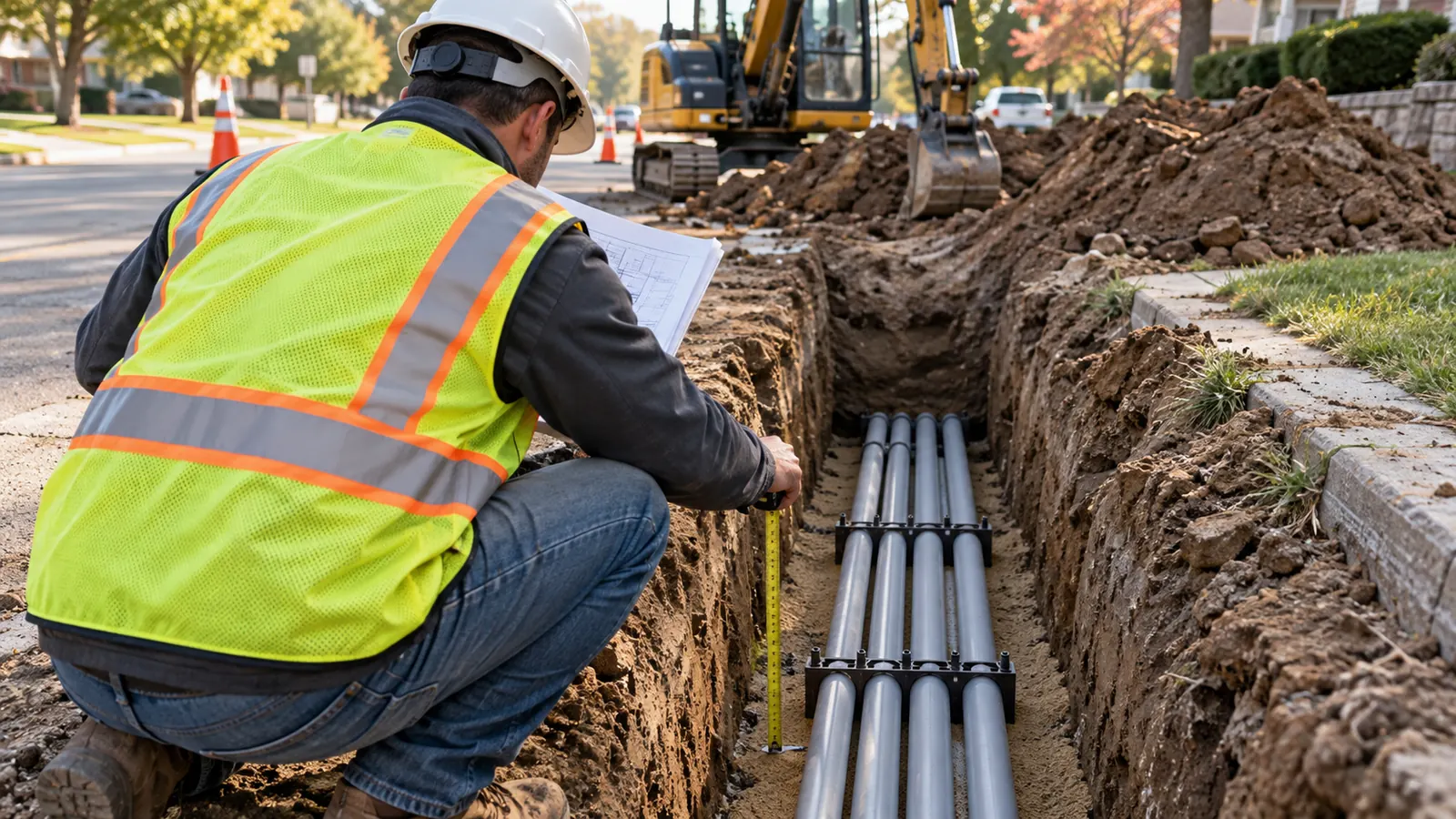
A newly energized underground circuit can leave a street lined with poles. The electric transfer is only part of the conversion: customer connections and telecom attachments have to move before the overhead plant can be retired. We plan those dependencies from the start, because they determine what the owner can call complete.
This guide covers conversion of existing electric distribution lines, from route selection through removal of the released overhead facilities. It explains why utilities pursue the work and where design decisions change the construction scope. Costs are discussed through their drivers, without applying a generic price to a corridor we have not surveyed.
What utility undergrounding changes
Utility undergrounding replaces overhead electric distribution lines with buried cable and the equipment needed to serve existing customers. We define completion at 2 distinct milestones: the underground system carries the load, and the released overhead plant is removed after every affected service and attachment has transferred to its approved replacement.
Reliability starts with the failure history. A utility should identify which line sections suffer repeated tree contact or wind damage and determine whether burying those sections addresses the recorded cause. Moving a lateral underground reduces its exposure to overhead damage, but customers still depend on the distribution facilities supplying that lateral. We separate the local improvement from claims about the entire circuit.
Dominion Energy describes this targeted approach on its Strategic Underground Program page: it identifies outage-prone overhead lines for conversion. That supports a screening method, not a universal performance promise. We would ask a utility to connect each proposed segment to its own outage records before calling the project a reliability investment, then identify what exposure remains beyond the conversion limits.
Storm hardening and repair access
Buried cable is protected from falling branches and windborne debris that can damage overhead conductors. Ground-level equipment still needs suitable protection. Duke Energy's article, Which power lines should go underground? It depends, published November 26, 2024, explains that underground systems can suffer water intrusion and can take longer to repair because their facilities are harder to reach.
Access survives the conversion. Operators need room to open equipment and replace components after construction ends. A transformer tucked behind a fence may improve the street view while making maintenance harder, particularly where a replacement vehicle cannot reach the pad without crossing private property. We evaluate those operating conditions before treating a visually attractive location as acceptable.
Aesthetics and the right-of-way
A streetscape project may seek clear sightlines and removal of poles rather than a quantified reliability improvement. That objective changes the completion test. Every remaining overhead user matters, including a telecom provider whose cable crosses the project without serving a property inside it. The project boundary must follow the facilities that need relocation, even when that extends beyond the proposed road work.
Underground space must be established independently. An existing pole alignment does not prove that the same corridor can accommodate a trench or equipment pad. Buried utilities may occupy the usable strip, and an overhead easement may need review before it supports the proposed installation. We compare the route against property rights and physical obstructions together, so a feasible electrical layout also has a buildable corridor.
Plan the utility undergrounding route and duct bank
Route selection begins with field conditions. Records provide a starting alignment; survey and subsurface investigation then resolve the conflicts that could change that alignment before the route is fixed for construction drawings. Where a proposed crossing depends on an existing utility's depth, the design team needs verified information at that conflict rather than a depth inferred from a record drawing. Road reconstruction and future widening also belong in the route discussion.
We establish the installation method before fixing the alignment. An open trench provides different working access from a directional bore, and the bore needs room for its entry and exit geometry. A shorter route can be harder to build if it forces tight bends or places access structures in traffic. When we compare the available alignments, we also check whether the route will allow the utility to replace cable later without having to reopen every finished surface.
The conversion package has connected work fronts. The table below identifies what each must resolve before the next team relies on it. Its purpose is to expose dependencies early enough to change a drawing. A project can finish its civil installation while customer services remain unready, which is why trench completion alone tells an owner little about the eventual cutover date.
| Work front | Decision to resolve | Dependency |
|---|---|---|
| Route and duct bank | Buildable alignment and pulling access | Verified conflicts and property rights |
| Cable and equipment | Ratings and compatible accessories | Loading basis and accepted equipment locations |
| Riser transitions | Connection to retained overhead plant | Pole arrangement and cable approach |
| Service conversions | Ready customer connection | Customer work and required inspections |
| Telecom transfers | Replacement path and migration | Provider design and service cutover |
| Overhead removal | Release of poles and attachments | All affected users transferred |
Duct geometry and cable installation
A duct bank layout must show usable conduit positions and the geometry between pulling points. We check bends against the selected cable's installation limits and examine pulling tension and sidewall pressure for the actual route. A drawing that fits within the available strip can still require a pull the cable manufacturer does not permit. That conflict belongs in design, before conduit is installed.
Concrete encasement depends on the application. Utility standards and the crossing conditions determine where it is required. The same applies to cover and separation from other facilities; a generic trench section cannot settle every crossing. We detail changes where conditions require them, and keep electric ducts distinct from telecom facilities even when the owners agree to shared excavation.
Vault and pad locations also affect drainage and restoration. Surface grading must avoid directing runoff toward equipment, and the designer must account for groundwater where it affects the selected enclosure or construction method. We reserve the necessary working space on the plans because later landscaping or a driveway adjustment can consume the access area that made the original equipment location workable.
Select cable, equipment and riser transitions
Electrical design follows the route's operating conditions. Cable ampacity depends on how heat leaves the installation, including the surrounding soil and nearby loaded circuits. We cannot carry an overhead conductor rating into an underground design by matching conductor size. The utility's loading assumptions and permitted operating configuration need to be settled before the cable schedule becomes a purchasing document.
Cable and equipment selection
The cable schedule must describe a compatible system. Conductor selection starts with loading and voltage performance, while the cable insulation and accessories must match the system voltage and utility requirements. Terminations and separable connectors need to fit the selected cable construction. Procurement substitutions therefore need engineering review; an available reel can change more than the material delivery date.
Transformers and switching equipment must fit both the circuit arrangement and the site. We review access clearances against the manufacturer's requirements and the utility's accepted details, then coordinate the pad with the civil plans. Equipment intended for a particular environment must be selected for that environment. A location exposed to flooding requires a deliberate siting decision rather than an assumption that buried cable makes every associated component flood-resistant.
Operating flexibility needs an explicit design basis. A radial conversion and a loop arrangement create different switching options. Before we finalize the operating design basis, the utility decides how the completed circuit will operate and identifies which devices will provide protection for each section. Our electric utility engineering services connect those owner requirements to construction drawings, with engineering performed entirely in-house. We document unresolved operating assumptions before they become construction instructions.
Riser transitions and retained poles
A riser connects buried cable to retained overhead distribution. Its design must address cable support and protection at the pole, with grounding and surge protection coordinated under the utility's requirements. The pole may also need structural review for the changed arrangement. We locate this interface where crews can work and where the underground route can approach without violating cable bend limits.
The retained overhead system remains part of the job. Removing a span can change forces on an adjacent pole, and retaining a riser may preserve a pole that a streetscape drawing expected to disappear. Show those exceptions before property owners review the route. For the detailed conversion package, our overhead-to-underground power conversion planning guide develops the interface between the new route and retained plant.
Convert services and coordinate telecom transfers
Customer connections control when the new system can take load. Each existing service needs a defined replacement connection and an identified party responsible for the work on each side of the ownership boundary. A utility-approved main route leaves these property-level questions open unless the service design addresses them directly. We track readiness by service location, so a missing inspection cannot hide inside an overall construction percentage.
Customer readiness and planned outages
An overhead service drop may need a new underground lateral and changes at the service entrance. The receiving utility determines its connection requirements, and customer-owned work may require a licensed electrical contractor and inspection. Confirm those responsibilities before scheduling the outage. A service that looks straightforward from the street can require work on equipment the utility does not own.
Cutover follows readiness. The utility's authorized operating personnel control switching and energization under its procedures. Construction teams provide the required installation and test records, while customer communications explain the approved outage arrangements. We carry exceptions individually rather than promising that every property will transfer together. Temporary conditions need their own accepted design and cannot be improvised to meet a street-restoration deadline.
Telecom attachers and overhead removal
Telephone and broadband facilities require their own relocation designs and cutovers. FPL's Underground Conversion FAQs explicitly tells customers to consider phone, cable television and internet services when planning a conversion. The electric utility's agreement does not replace those providers' decisions. We identify the owner of every attachment and assign a transfer contact, including facilities that appear unused but have not been released for removal.
Shared excavation needs agreed boundaries. Participating owners must approve the arrangement and their separation requirements before construction. They also need a clear allocation of restoration responsibility. A telecom route may require new splice access or a different service entry, so its drawing should be reconciled with the electric route before the trench detail is issued. Sharing a corridor does not mean sharing an electric conduit.
Ask each telecom owner to confirm its replacement route before finalizing shared excavation. A provider that needs a different crossing can change the civil work even when its pole transfer is scheduled much later.
Pole removal comes after the remaining users release their facilities and the pole owner authorizes removal. The removal package must address retained spans and any streetlighting that depends on the old plant. We also require the completed records to show what remains overhead. Our guide to electric utility as-built drawings explains why the permanent record must reflect installed conditions rather than merely reproduce the design.
Understand cost drivers without a unit-price shortcut
Excavation conditions can change the amount of work substantially. Rock requires different methods from readily excavated soil, while groundwater can complicate the work area and handling of excavated material. A route through finished pavement also carries restoration obligations that an open corridor does not. We keep those conditions visible in the scope instead of hiding them behind a single route-length allowance.
Congestion increases investigation and construction effort. Existing utilities can force offsets or additional crossings, and traffic restrictions can limit working hours. Trenchless work may avoid surface disturbance but still needs suitable ground and setup space. Equipment procurement can affect the sequence independently of civil progress. The estimate should explain these dependencies so the owner can distinguish a design change from a change in site conditions.
Service conversions deserve their own cost review. Customer-owned modifications and access agreements may vary from property to property, even where the mainline design repeats. Telecom participation introduces separate scopes whose readiness may determine when final restoration occurs. We identify responsibility for those costs before the owner presents a complete project budget, rather than assuming the electric installation covers every party's work.
Our design has a potential weakness. If we place an access structure for drawing convenience without checking how a crew will reach it, the owner inherits that mistake at construction and maintenance. We challenge that avoidable cost during review. The right correction may be a longer cable run or a different equipment site, provided the revised installation satisfies the electrical and physical limits.
Recommended next steps before construction
Utility and cooperative engineers: approve the conversion limits and operating arrangement before releasing equipment orders. Resolve the riser locations against the retained poles. Where the project is justified by outages, keep the supporting circuit history with the scope so later route changes can be checked against the original reliability objective. That gives design review a decision basis beyond the appearance of the plan sheets.
Municipal project managers: make pole removal an explicit acceptance milestone when the objective is a clear streetscape. Bring every attacher into the schedule before promising a finished corridor to residents. Confirm restoration requirements with the road authority while the route can still move. A completed electric cutover is useful progress, but it does not establish that the last telecom cable is ready to leave the poles.
Telecom owners: establish your replacement path and service migration obligations when the electric route is being developed. Waiting until excavation starts removes the opportunity to resolve conflicts on paper. Assign responsibility for releasing each attachment after transfer, and give the pole owner a clear record of that release. The electric contractor cannot decide that your customers have successfully migrated.
Draftech International provides turnkey telecom and power infrastructure from field survey through closeout. Our overhead-to-underground conversion service brings route conflicts and customer-transfer requirements into one coordinated delivery scope. Engineering is 100% in-house; full turnkey construction is delivered by Draftech-managed subcontract crews. The partner profiles identify our leadership, and our service-area pages describe our reach. Active in 24 states. Available across all 50 U.S. states.
For a route whose feasibility and permit requirements still need resolution, the free design offer provides a defined starting package: Draftech engineers the first 20,000 linear feet of a qualifying route at no cost, from feasibility and field survey through permit approval. The owner reviews each request before Draftech commits the package. Send initial scope questions to info@draftech.com.