- Why Electric Cooperatives Have a Natural Advantage in Fiber Deployment
- OSP Design Considerations Unique to Co-op Territory
- FTTH Architecture Options for Rural Co-op Networks
- Make-Ready and Pole Attachment on Co-op-Owned Infrastructure
- BEAD Funding and How Co-op Fiber Design Must Align
- When to Outsource OSP Engineering vs. Keep It In-House
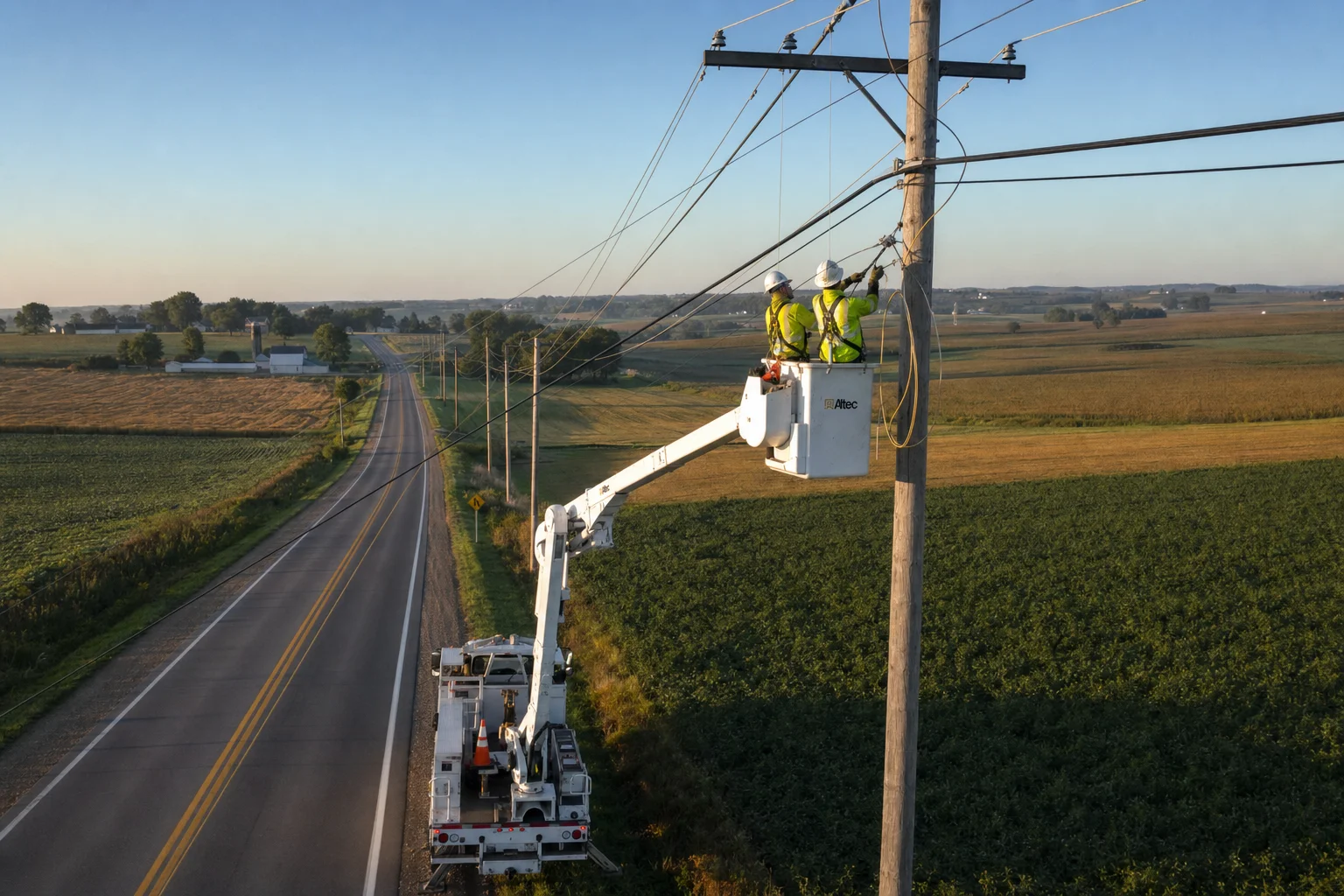
Electric cooperatives are deploying fiber at a pace that would have seemed unrealistic five years ago. They've got good reasons: member demand is real, BEAD dollars are available, and frankly, co-ops are better positioned for rural fiber deployment than almost any other type of organization. They own poles. They have easements. They know every mile of their territory. The infrastructure question is already half-answered before you ever open a design tool.
That said, knowing your service territory and knowing how to design an FTTH network are two completely different things. In our experience, the co-ops that struggle aren't the ones with hard terrain or low subscriber density. They're the ones that underestimate how technically demanding the OSP design phase actually is. This guide covers everything a co-op engineer or broadband manager needs to know before they start pulling strand.
Why Electric Cooperatives Have a Natural Advantage in Fiber Deployment
Existing ROW and Easements Are a Major Head Start
When a commercial ISP wants to build rural fiber, the first two years of that project are often spent acquiring rights-of-way, negotiating pole attachment agreements, and arguing with landowners over easement terms. Electric cooperatives skip most of that entirely. The easements that let your distribution lines cross private property almost universally allow for telecommunications attachments: it's baked into the standard co-op easement language that's been used for decades.
We've designed networks for co-ops where 90% of the route could be placed on existing co-op-owned poles with zero additional ROW negotiation. That's not a minor advantage. In a project where ROW acquisition might otherwise cost $800 to $1,500 per mile and take 18 months, a co-op can often cut that timeline to weeks. The time savings alone can mean the difference between capturing federal funding or missing a window entirely.
Pole Inventory and Load Data Already Exist
The other piece that commercial builders often don't have is reliable infrastructure data. Co-ops maintain pole inspection records, load calculations, and GIS-mapped distribution lines as a normal part of operating an electric utility. That data, when it's accurate and current, dramatically compresses the design timeline for a fiber network. You're not sending field crews out to GPS every pole. You're starting with a database.
The caveat: "existing data" and "accurate data" aren't always the same thing. Before you trust your pole records for fiber design, audit a sample of 200 to 300 poles in representative terrain. We've found discrepancy rates as high as 30% on co-op pole records that hadn't been formally updated since the last major rebuild. That kind of error rate will blow up your make-ready budget if you don't catch it early.
Member-Ownership Creates Deployment Efficiency
The member-owner structure matters more than people realize. When a co-op shows up to run fiber past a member's property, that member has a stake in the outcome. Easement access requests that would take months of back-and-forth with a rural landowner for a commercial ISP often get resolved with a phone call when a co-op makes the ask. We've seen co-ops complete 400-mile fiber networks in under 36 months, a pace that would be impossible for most commercial operators in the same territory.
OSP Design Considerations Unique to Co-op Territory
Low Subscriber Density and Long Route Miles
Rural co-op territory typically runs 4 to 12 subscribers per route mile. That's not a mistake: some co-ops in the Great Plains or Appalachia run even lower. The economics of fiber at that density only work if you're ruthless about design efficiency. Every unnecessary splice point, every oversized cabinet, every mile of unnecessarily redundant ring topology adds cost without adding meaningful reliability in a territory where a single cable cut will have a field crew on site within the hour anyway.
The OSP engineering services you apply to a co-op network should be calibrated for sparse topology, not dense metro design. Hub-and-spoke architectures with strategically placed distribution points typically outperform ring designs for co-ops from a cost-per-passing perspective. Save the ring topology for your hub-to-hub transport links where you actually need redundancy.
Mixed Aerial and Underground Plant
Most co-ops have a mix: aerial distribution along roads, underground service drops in subdivisions or newer builds, and direct-buried plant in areas where weather or aesthetics demanded it years ago. Your fiber design has to account for all of it. Aerial-to-underground transitions are among the most failure-prone points in any network: the riser hardware takes weather, UV, and physical stress simultaneously.
Specify armored cable for any aerial-to-underground transition riser. We use a minimum 18-inch sweep radius at every transition point and specify stainless steel riser guards in areas with high UV exposure or physical damage risk. These aren't premium upgrades. They're the baseline that prevents the 3 a.m. outage calls two years after your network goes live.
Substation and Hub Site Selection
Co-ops have a built-in advantage here too: existing substations with secured, climate-controlled buildings, backup power, and already-permitted structures. The question isn't whether to use them. It's which ones make sense as fiber hub locations based on the geographic distribution of your subscriber base. Optimal hub placement minimizes average distribution cable length while keeping total feeder fiber cost reasonable.
A good rule of thumb: no distribution splice point should be more than 12 to 15 route miles from a hub in a GPON or XGS-PON design. Beyond that, your loss budget gets tight and you're relying on the upper end of your optical power margin. In our experience, co-ops that try to push 20-mile distribution runs end up chasing splice quality issues that a better hub placement would have prevented entirely.
FTTH Architecture Options for Rural Co-op Networks
Three architectures dominate rural FTTH design conversations right now: GPON, XGS-PON, and Active Ethernet. Each has a legitimate use case, and the right choice depends on your subscriber density, budget, and how you plan to grow the network over the next 20 years. Here's how they compare:
| Architecture | Downstream Speed | Split Ratio | Distance Limit | Best For |
|---|---|---|---|---|
| GPON | 2.5 Gbps shared | 1:32 / 1:64 | 20 km (class B+) | Tight budgets, legacy-compatible upgrades |
| XGS-PON | 10 Gbps symmetrical | 1:64 / 1:128 | 20 km (class C+) | New rural deployments, BEAD-funded networks |
| Active Ethernet | 1 Gbps per subscriber | Point-to-point (no split) | 80 km (single-mode) | Very low density, enterprise-heavy subscriber mix |
GPON: Still Relevant, But Fading
GPON is mature, equipment costs have come down significantly, and there's a massive installed base to draw support from. A 1:32 split ratio with 2.5 Gbps downstream gives you roughly 78 Mbps per subscriber at full utilization, which sounds bad until you remember that average rural household consumption still sits around 25 to 35 Mbps. For a co-op trying to hit the 100/20 Mbps BEAD minimum on a tight per-mile budget, GPON can still get the job done.
The problem is forward compatibility. Most major OEM vendors are now shipping XGS-PON as their primary product line, and GPON-only OLTs are increasingly difficult to source at competitive prices. If you're designing a network that will be in service for 25 years (and most co-op networks are), GPON-only is a decision you'll be revisiting sooner than you'd like.
XGS-PON: Where New Deployments Should Land
XGS-PON delivers 10 Gbps symmetrical on the same passive optical network infrastructure as GPON, uses the same fiber plant, and increasingly costs within 10 to 15% of GPON equipment at scale. For co-ops doing a greenfield deployment today, especially if BEAD funds are in the mix, there's very little reason to specify GPON. The fiber you're burying will outlast the electronics by decades. Get the XGS-PON-capable infrastructure in the ground and upgrade the OLTs when demand catches up.
Active Ethernet: Niche, But Worth Knowing
Active Ethernet runs a dedicated point-to-point fiber from each subscriber to the hub. No splitting, no shared bandwidth: every customer gets their own strand. The tradeoff is fiber count and active electronics at every distribution point. In co-op territory with fewer than 3 subscribers per route mile, where you might be running 2 to 4 fiber strands to each served structure anyway, the incremental cost of going Active Ethernet isn't as dramatic as it sounds in dense deployments. We've used it effectively in co-ops serving farming operations with heavy-duty connectivity needs (grain elevators, precision agriculture systems, livestock monitoring infrastructure) where the enterprise-grade SLA justifies the architecture.
Make-Ready and Pole Attachment on Co-op-Owned Infrastructure
The Self-Attachment Question
When a co-op owns its poles and wants to attach its own fiber, the attachment process looks very different from what a commercial ISP faces when dealing with an incumbent utility. There's no FCC-regulated timeline, no 45-day make-ready window, no third-party pole owner to negotiate with. The co-op is both the attaching party and the pole owner. That's a significant advantage, in theory.
In practice, the co-op still needs to conduct a make-ready analysis before every attachment. The fact that you own the poles doesn't eliminate the physics: NESC minimum clearance requirements still apply, existing attachments from telephone or cable companies on co-op poles still need to be accounted for, and your pole loading calculations still need to show that the added fiber attachment doesn't push the pole over its allowable stress limits. Do this work before you start hanging cable, not after. Retroactive make-ready on an installed network is expensive and disruptive.
Third-Party Attachers on Your Poles
Most co-op pole lines in rural territory have at least some incumbent telephone company attachments, and many have cable TV lashing as well. Before you begin make-ready engineering, audit your poles for every existing attachment and confirm you have current contact information and valid pole attachment agreements on file for each attacher. If an attacher's equipment is non-compliant (sagging below minimum clearance, improperly bonded, or violating your current tariff), you have leverage to require corrections before your fiber project begins. We've helped co-ops use the fiber project as an opportunity to bring their entire pole plant into full NESC compliance, which reduces long-term liability and often results in additional attachment revenue from the corrected attachers.
Make-Ready Cost Budgeting
Don't underestimate make-ready. Co-ops that budget $200 to $300 per pole for make-ready work in mixed aerial territory often end up spending $600 to $1,200 per pole in sections with multiple existing attachers or deteriorated infrastructure. The variance is real and it will wreck your project budget if you base your estimates on best-case assumptions. A proper as-built documentation program that captures pole conditions, existing attachment heights, and make-ready requirements before construction begins is the only reliable way to control this cost.
BEAD Funding and How Co-op Fiber Design Must Align
Documentation Requirements Are Non-Negotiable
BEAD has real teeth on the engineering documentation side, and co-ops that treat design documentation as an afterthought are going to have a bad time at the closeout audit. The detailed BEAD engineering requirements include splice diagrams, optical link budgets, network topology maps tied to the FCC Location Fabric, and construction drawings that are specific enough to verify that the built network matches the funded design. Your state broadband office will have additional requirements layered on top of the federal baseline, and those requirements vary significantly by state.
We've designed networks across 24 states and the documentation requirements in, say, North Carolina are materially different from what Montana or Mississippi expects. Get a clear picture of your specific state's requirements before you finalize your design deliverable list. Discovering that your state requires OTDR test records at every splitter location, after you've already built 200 miles, is an expensive lesson.
Location Fabric Reconciliation
The FCC's Broadband Data Collection Location Fabric is the official record of "funded locations" for BEAD purposes. Your fiber design needs to demonstrate coverage to every funded location in your project area, not just the ones that are easy to reach. We've seen co-ops design networks that covered 96% of their funded locations and then had to explain to their state broadband office why 4% wasn't covered, or negotiate a service area modification that delayed funding draws by six months.
During the design phase, pull the current Location Fabric data for your project area and run a GIS overlay against your proposed network topology before you finalize drop assignments. Identify every location more than 150 feet from the nearest proposed strand placement: each one of those is a potential serviceability question you need to answer in your design package.
Technology and Speed Standards
BEAD requires that funded networks deliver a minimum of 100/20 Mbps to every served location, with a preference for technology capable of 100/100 Mbps symmetrical. In practice, most state programs are now requiring 100/100 Mbps or better as a baseline condition of funding approval. XGS-PON with a 1:32 split ratio delivers well over 300 Mbps per subscriber at realistic utilization levels, comfortably above any current or anticipated BEAD speed threshold.
The technology standard also carries implicit architecture requirements. Satellite and unlicensed fixed wireless are generally disfavored or explicitly excluded under BEAD rules for most states. If your co-op is planning a hybrid fiber-wireless approach, verify your state's specific technology eligibility rules before you design the wireless segments into your funded project.
Draftech has designed fiber networks for electric cooperatives across 24 states. If your co-op is planning a BEAD deployment or overbuilding your existing plant, we'll design the first 20,000 linear feet at no cost. No commitment. → draftech.com/free-design
When to Outsource OSP Engineering vs. Keep It In-House
What Co-op Staff Does Well
The best co-op fiber projects we've been involved with use a hybrid model that plays to each team's strengths. Co-op linemen know their territory better than any outside engineering firm ever will. They know which poles have soft wood at the base, which creek crossings flood in spring, which sections of road the county repaves every five years and thus need extra duct depth. That institutional knowledge is genuinely irreplaceable and shouldn't be discarded in favor of a pure outsource model.
Co-op staff can also handle field data collection, subscriber premise locating, and GIS data cleanup efficiently when they're given the right tools and workflow. We've provided co-op teams with mobile data collection protocols that let them gather 90% of the field data needed for a full OSP design package without requiring specialized fiber engineering training. That field data then feeds into the formal design process.
Where Specialized OSP Engineering Pays for Itself
Detailed splice diagrams, optical power budgets, make-ready calculations, NESC loading analyses, permit packages, and BEAD-compliant design documentation: these require dedicated OSP engineering expertise. Most co-op electrical engineering staff have deep competence in power distribution design, but fiber network design is a different discipline with its own standards, loss budget methodologies, and documentation requirements.
The math on outsourcing OSP design is straightforward: a qualified OSP engineering firm typically costs 8 to 12% of total construction cost. On a $10 million project, that's $800,000 to $1.2 million. Design errors that require rework during construction (wrong conduit sizing, inaccurate splice loss budgets that require splitter swaps, make-ready mistakes that halt construction) can easily cost two to three times the engineering fee to correct in the field. We've seen co-ops try to cut corners on engineering and end up paying far more in change orders and rework than a proper design package would have cost.
A Practical Decision Framework
Ask yourself these questions before deciding how to staff your OSP design effort:
- Does your team have direct experience designing PON networks, including split ratio planning, loss budget verification, and OLT port assignment?
- Do you have access to OSP design software (Bentley, IQGeo, Macropoint, or similar) and staff trained to use it?
- Can your team produce BEAD-compliant construction drawings with the level of detail your state program requires?
- Do you have dedicated OSP engineers who can serve as the technical point of contact with contractors, vendors, and state reviewers?
If the answer to two or more of those questions is no, outsourcing the OSP design phase is almost certainly the right call. A free fiber design offer like ours, covering the first 20,000 LF of your network at no cost, is a low-risk way to see what professional OSP engineering looks like on your actual territory before committing to a full program engagement.