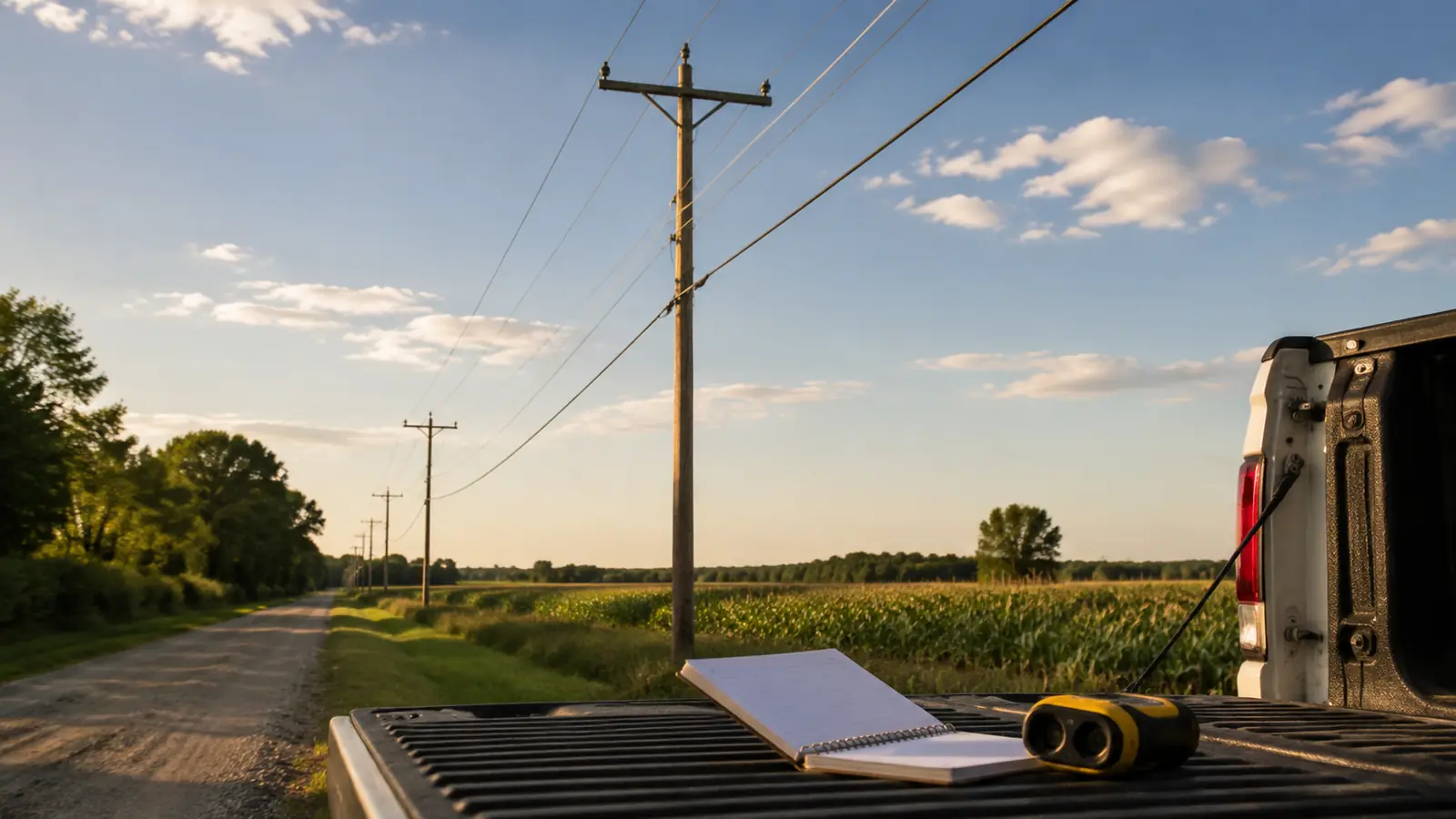
A cooperative fiber route is not simply a telecom attachment placed on convenient poles. Because it becomes part of an operating electric distribution system, pole records and working space must agree with the loading inputs while cable behavior fits the owner's construction standards. That changes the review. Maintainability matters before a package can move to construction.
We treat that agreement as a controlled engineering decision through our electric utility engineering practice, which starts with the cooperative's adopted standards and asset records before separating verified conditions from assumptions. This guide explains the evidence behind our review gates. It also identifies the records a cooperative should retain.
OSP Design Standards for Electric Cooperatives: Design Basis
OSP design standards for electric cooperatives are the owner-approved rules and evidence controls used to place fiber on an electric distribution system. Our 6-gate review starts with the design basis and route evidence before examining pole capacity; it then covers clearances plus cable method and final records, keeping each release decision traceable to a controlled source.
The design basis begins with the cooperative's current construction standard and staking or pole database; it also captures voltage configuration and grounding practice while aligning loading criteria with material requirements as well as drawing conventions. We do not replace an owner rule with a generic detail because the route looks familiar. We record the governing revision beside the affected design object, which lets a reviewer distinguish an adopted requirement from a drafting preference.
The IEEE National Electrical Safety Code program is a named reference for electric supply and communications facilities, but the project team still has to identify the controlling edition and local adoption. Owner interpretation matters. So does the project contract. We use that source hierarchy to frame questions rather than invent a universal clearance because voltage and conductor position shape the result alongside span behavior and attachment type. The cooperative's standard remains part of the engineering review.
Pole ownership changes workflow, not physics. A cooperative may control its own attachment decisions. Even so, every proposed cable adds a load case and occupies physical space. It can also affect future electric work. We first require pole identity; class and height follow where available. The record must show existing equipment with any guys, then connect span geometry to the attachment elevations so condition evidence supports a structural or clearance conclusion before release. Ownership is never accepted as proof of capacity.
We also define delivery boundaries at kickoff. Draftech engineering is performed in-house. The scope includes survey integration and OSP design as well as pole loading, while our team handles make-ready and construction documentation; when construction is included, Draftech provides full turnkey delivery through Draftech-managed subcontract crews under our QA/QC and safety oversight. That boundary matters. It keeps engineering authority clear while giving the cooperative one controlled path from design intent to field execution.
OSP Design Standards for Electric Cooperatives: Route Gates
Our route review ties each proposed segment to the electric asset record before settling the aerial method. We use the same review to define any make-ready scope and construction detail, while stable pole and span identifiers ensure that each photograph aligns with its loading model. The permit condition must point to the same structure; so must the material schedule and eventual as-built. A map label that cannot be reconciled to the cooperative's system is an exception, not a usable key.
We first distinguish owner records from measured field inputs. Third-party records remain separate. We also label design calculations and stated assumptions for what they are because that classification stops an old basemap line from carrying the same authority as a verified pole tag or approved loading result. Our article on electric cooperative fiber design explains how that source discipline supports route architecture beyond the individual pole.
| Review gate | Required record | Release test | Typical exception |
|---|---|---|---|
| Design basis | Owner standard and revision | Applicable rule identified | Conflicting detail |
| Route evidence | Pole and span IDs linked to segment ID | Geometry reconciles | Unmatched structure |
| Pole capacity | Existing and proposed loads | Accepted model result | Missing equipment |
| Clearances | Attachment and sag records for crossings | Required case checked | Unknown elevation |
| Cable method | ADSS or messenger basis | Hardware and tension coordinated | Blanket selection |
| Final record | Drawings linked to GIS decision records | One current issue set | Revision drift |
The table is a preview map, not a substitute for engineering. Each gate has a different release condition, and an exception at one pole does not need to hide the status of an otherwise reviewable route. At an exception, we isolate the affected structure and name the missing evidence; the record makes the responsible party explicit and states the event required for closure. That is more useful than marking an entire corridor incomplete without explanation.
- Source control: Name the standard and its revision; identify both the owner and affected assets.
- Field identity: Reconcile pole tags with map keys; connect photographs to span relationships.
- Model trace: Preserve model inputs and assumptions alongside the results; identify the reviewer and disposition.
- Change boundary: Keep proposed and approved states distinct from field-changed or as-built records.
The release question is deliberately strict: can a second qualified reviewer reproduce why this cable is here, at this elevation, on this pole, under this owner standard? If the answer depends on the original designer's memory, the package has not passed, so we apply the same principle across rural cooperative OSP engineering where sparse records make explicit assumptions even more important.
Pole Loading, Clearances, and Cable Method
Pole loading review starts from a complete representation of the existing structure, not just the proposed fiber. We compare pole geometry against the material and class data, then build the model around conductors and communications attachments alongside all installed equipment shown on the existing record. Guys and anchors must correspond to the span lengths. Line angles remain tied to the required environmental case. Unknown material input stays visible. We do not convert a missing pole record into a confident model value simply to keep production moving.
Clearance review is similarly conditional. Supply-to-communications separation has its own governing facts. The same is true for climbing and working space. Roadway or terrain clearance must be reviewed apart from structure clearance and midspan behavior, while we compare the proposed attachment against the controlling owner standard and applicable code basis for the actual arrangement. A single nominal dimension copied route-wide cannot prove clearance where the pole top geometry differs or sag shifts. Changes in grade and equipment also matter.
ADSS and lashed fiber are engineering methods, not slogans. ADSS can avoid dependence on an occupied communications messenger, but it introduces cable-specific tension and sag requirements; hardware choice and electrical-environment questions must follow manufacturer data as well as the cooperative's practice. Lashed cable may fit established communications-space methods, yet it can require attachment rearrangement or make-ready. We reject blanket route-wide selection until representative conditions and exceptions are understood.
Our preferred decision record states why the method was selected for a segment and what would force reconsideration. That record identifies the supporting pole evidence and the basis for cable hardware. It carries the loading and clearance dispositions, then notes any operations restriction. The deeper coordination questions are covered in NESC pole loading compliance for fiber attachments, including the need to preserve separation between supply and communications functions.
Make-ready remains relevant even when the cooperative owns the pole. The work may require attachment transfers or new guys. Anchor work and pole replacement may follow. Existing communications attachments can also create coordination with other occupants. We keep make-ready notes tied to structure IDs and do not release proposed fiber as construction-ready until dependencies are assigned and accepted under the owner's process. Pole ownership can simplify authority. It does not eliminate coordination.
Underground transitions need the same evidence discipline. We identify the transition structure and riser first. The record must also cover protective hardware and the conduit path. It locates the access point, sets the cable limits and explains the relationship to energized equipment. The drawing must show where the aerial cable method ends and the underground assembly begins without forcing a crew to infer the boundary. Where another owner or permit controls the underground segment, that dependency remains attached to the same route key.
Constructability review is not permission to rewrite engineering intent in the field. We ask operations and construction reviewers to test site access against the proposed equipment placement. They examine work sequence separately, then consider maintainability and material compatibility while the package can still be corrected. Accepted comments enter the decision log and affected records. Rejected comments retain a reason. This keeps contractor means and methods separate from changes that require engineering approval.
Funding Controls and Cooperative GIS Records
Funding requirements add a separate evidence layer to the electric design basis. The USDA Rural Development telecommunications programs page is an official starting point for current program materials. The cooperative's award and contract, together with its approved program documents, define the project-specific obligations. We map those obligations to design records rather than assuming that code compliance alone satisfies funding review.
Evidence control: Keep the funding crosswalk tied to the same route and structure identifiers used by engineering and GIS.
Our funding crosswalk connects eligible scope to the approved technology and route records. It links location evidence with material documentation. Environmental and permit evidence retain their own approvals, while changes and closeout requirements point to named deliverables. The crosswalk is a Draftech control, not an industry statistic. It lets the cooperative see where an engineering record also serves a program record and where a separate approval or certification is still required.
GIS is the bridge between those obligations and the operating system. Pole IDs should reconcile to the electric asset database. Fiber segments need stable relationships to structures and cables. Closures and serving areas share those keys. Design status must remain separate from as-built status; source or confidence fields must survive export. We require a data dictionary and coordinate reference system with the handoff so geometry and attribution can be maintained after the project team leaves.
A cooperative should also retain loading models with accepted make-ready dispositions. Approved drawings and field changes must connect to the final records in a retrieval structure that operations can use. A folder of PDFs is not a network model. Our review tests whether a user can select a structure and find its current fiber and electric relationships. From there, the user must identify the governing design issue and locate the evidence supporting the accepted condition.
Revision control closes the loop. We require a transmittal that states its purpose and identifies the current files. Superseded files must be named separately. Open conditions need a receiving role. Native design and GIS data should be delivered with reviewable documents when the owner requires both. A changed pole disposition must reach the model and drawing, then flow into the material schedule. Its GIS object and exception register must change in the same issue. Partial updates create a polished package with conflicting instructions.
Cooperative release: If your pole, clearance, funding, and GIS records need one coordinated review, talk to our electric utility engineering team about the route.
Release Decisions and Cooperative Handoff
The final review should decide whether each segment is released. If a named condition applies, state it within the release; a segment lacking specific evidence stays on hold. We do not accept labels such as nearly complete or field ready when pole-loading or clearance questions remain. Access and permit gaps count too, as do uncertain material or funding requirements. A condition must identify its owner and affected assets. It also states the required action plus closure evidence. Otherwise it is only a note.
Cooperative-owned aerial plant: Use the full 6-gate review and make the electric asset record the primary identifier. Ownership streamlines approval authority, but the cooperative still needs defensible pole-capacity results. It also needs clearances settled and the cable method justified; maintainability should be explicit. We recommend one current issue set shared across engineering and operations. Construction and GIS should use that same version.
Mixed ownership route: Add the outside owner's application process to the same segment register. Track its make-ready and acceptance steps there as well. Do not let cooperative-owned spans appear construction-ready while an interdependent third-party span remains unresolved. Our guidance on fiber design for cooperatives and rural ISPs shows why route architecture and ownership boundaries must be reviewed together.
Funding-backed build: Make the award and approved program materials part of the design basis, then crosswalk evidence before construction release. The correct verdict is hold when a material requirement is unresolved or the location has not been verified. Environmental approval and documentation gaps require the same result. Hiding that gap until closeout does not make the design faster. It makes the final record harder to defend.
The handoff starts with the controlled design basis plus route and structure records. It carries the loading and clearance dispositions. The cable and hardware basis should accompany make-ready status. Include approved issue drawings and material references. The exception register belongs with the data dictionary and required funding evidence. We ask a reviewer outside the production chain to trace representative structures from source record through drawing and GIS. Any broken relationship returns to correction before release.
Operations acceptance matters because the cooperative will maintain both systems after the project team is gone. We include maintainable identifiers and usable layer definitions. Attributes must carry any inspection or restriction notes, with a retrieval path for supporting engineering. The acceptance review should confirm that staff can locate a pole and understand its fiber relationship. They should find the current approved record without consulting the original designer's inbox. Any unresolved condition must also be obvious.
Before issue, we run a document-to-data comparison. Sheet titles must agree with the revision labels and structure IDs. Status fields must align with the cable methods. Exception references must match across the transmittal and drawings as well as the schedules and GIS export. We do not release a package merely because every file opens. The receiving cooperative needs one coherent instruction set, with superseded information clearly removed from active use and retained only where the record policy requires it. We confirm that boundary with the designated owner before transmittal.
One limitation of Draftech's route review is straightforward: it cannot turn a missing pole tag or unmeasured attachment height into verified field evidence. That gap still needs field resolution. Our electric utility engineering team is set up to prevent disconnected pole evidence and clearance notes from reaching construction on separate clocks. We apply the same control to funding requirements and GIS records. If you need an in-house engineering review and a controlled route handoff, email our team. We can also carry construction as full turnkey delivery through managed subcontract crews under Draftech QA/QC and safety oversight.