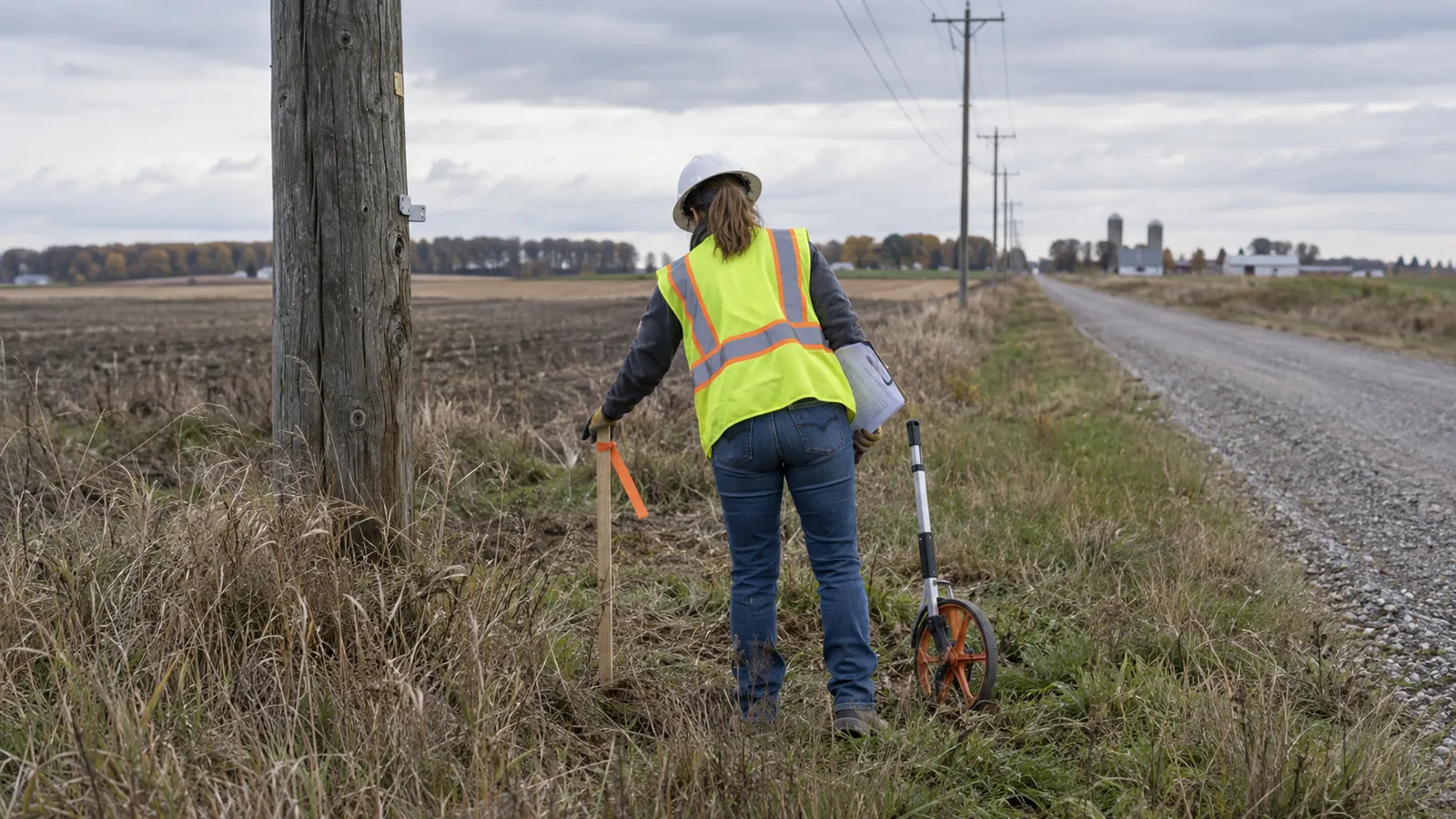
A work order can look finished while leaving the construction supervisor unable to order material. The route is drawn, but the assembly schedule still uses a different unit catalog from the warehouse. We treat that mismatch as unfinished design. A clean drawing matters only if its instructions survive the move from the engineer's desk to the field.
This guide covers electric cooperative distribution work orders, including overhead extensions and underground segments. We explain how to specify the design assignment and review its deliverables before construction release. The focus is the connection between field observations and buildable work instructions, with RUS bulletins identified as the technical references. Financing decisions sit outside this engineering scope.
How to Assemble a RUS Work Order Design Package
RUS work order design turns field staking into construction instructions tied to the cooperative's adopted standards. For a 24.9/14.4 kV overhead line, we prepare staking sheets, reconcile construction units with material quantities and document the approved revision for construction release. Our distribution work-order design keeps each assembly tied to its field location.
The work order is the boundary. We start by identifying what changes on the distribution system and where the assignment stops. A conductor replacement may retain existing structures, while a line extension needs a defined connection point and service endpoint. Those differences determine the survey effort and the engineering decisions that must be resolved before a unit schedule can mean anything.
Set the Engineering Basis Before Fieldwork
Our intake should establish the operating voltage and the cooperative's approved construction standard. We also need existing system records. Supply the requested load information. Identify the utility reviewer responsible for resolving discrepancies. An old map can support planning. It cannot establish that a pole still has the configuration shown when the record was created or that the proposed load fits the existing circuit.
We separate confirmed inputs from assumptions in the design basis. If a proposed connection depends on a capacity check that the cooperative has not supplied, the work order needs that dependency in writing. Drafting the connection does not complete the check. Our review of distribution line extension design explains why the service request and connection decision need to agree before a route becomes a construction package.
Name the RUS Bulletin and the Owner Supplement
For assembly nomenclature, the reference is RUS Bulletin 1728F-800, Assembly Unit Numbers and Standard Format, issued 10/16/2024 in USDA's guidance portal. It explains how RUS construction assembly numbers identify the corresponding arrangements. We use the applicable bulletin with the cooperative's adopted unit catalog, documenting the relationship where an owner code differs from the RUS designation. Similar-looking labels are not proof of identical assemblies.
Underground work calls for RUS Bulletin 1728F-806, Specifications and Drawings for Underground Electric Distribution, effective 10/11/2018. For the overhead voltage class named in its title, RUS Bulletin 1728F-803, Specifications and Drawings for 24.9/14.4 kV Line Construction, is listed by USDA with a 12/15/1998 date. These are scope-specific construction references. We identify the applicable edition in the work order rather than write a blanket claim that every RUS bulletin governs every distribution job.
The cooperative's supplement needs the same discipline as its adopted distribution design standards. We request the adopted detail book. Its revision matters. Record it before reusing an assembly from a previous assignment. When an owner detail conflicts with a governing requirement, our engineer resolves the conflict through the appropriate review instead of silently selecting whichever drawing is easier to price. A standard detail still needs site-specific engineering. It does not decide whether the proposed span or equipment arrangement works at that location.
Existing asset identifiers deserve attention during intake because they become the join between field records and office systems. We agree on how proposed structures will be identified before a surveyor labels them and a designer starts the staking sheets. If the cooperative assigns permanent numbers later, the package needs a mapping from temporary identifiers to final ones. Otherwise, a valid inspection can become difficult to locate after the assets enter operations.
The following review map separates the deliverables by the question each recipient must answer. It is a recommended package structure, not a claim that every cooperative uses the same forms. We want the utility reviewer to find an unresolved location without having to reverse-engineer a warehouse export, and we want the construction supervisor to see which revision is ready to use.
| Deliverable | What it establishes | Release check |
|---|---|---|
| Staking sheets | Where work occurs and what changes | Field location matches the proposed assembly |
| Construction-unit schedule | Which adopted details apply | Codes resolve to the correct catalog revision |
| Material estimate | What the approved design requires | Takeoff reconciles to the unit schedule |
| Construction handoff | Which instructions crews may use | Release status and change authority are explicit |
Staking Sheets That Identify the Actual Work
A staking sheet must make the proposed work locatable. We connect the station or structure identifier to the field record and show existing facilities separately from proposed work. The reviewer needs to distinguish a retained pole from a replacement without interpreting line color from memory. Use the cooperative's legend and make the status legible on the copy a supervisor will carry outside.
Resolve the Field Condition, Not Just the Symbol
For overhead work, our design review connects the proposed assembly to the observed pole configuration and the necessary engineering checks. The drawing should identify the conductor arrangement and show where the guying decision affects the site. A guy anchor drawn in a convenient blank area can still conflict with access or property rights. We require that conflict to return to the engineer before the sheet becomes a construction instruction.
Underground staking needs a usable route and clear transition points. Under Bulletin 1728F-806, section 5, plowing work includes a joint field review of staking sheets by the contractor and owner before construction. That requirement has a practical consequence: the field copy must be specific enough to discuss an actual obstacle. A broad corridor sketch leaves too much unresolved for that conversation to produce an approved change.
We should mark an inaccessible location as unverified and explain what remains to be observed. That is more useful than letting a proposed line imply a completed survey. When access becomes available, the engineer can assess whether the new observation changes the route or merely confirms it. The distinction matters to the cooperative because a route change can reopen permissions even when the work-order identifier stays the same.
Make Removals Visible
Retirement work needs its own instructions. We distinguish material to remove from material that stays in service, and we identify the interface with the retained circuit. Do not let a replacement symbol carry both meanings. The utility must be able to review the operating sequence separately from the physical replacement detail, particularly when an existing service must remain available during part of the construction.
Construction Units and Material Estimates Must Reconcile
The unit schedule translates the approved arrangement into repeatable construction definitions. Bulletin 1728F-800 explains the assembly-number format; it does not select the assembly for the engineer. We confirm that the chosen detail fits the design basis and identify any project-specific modification. A familiar code is useful shorthand only when everyone receiving it opens the same drawing.
Keep the Adopted Catalog Attached to the Design
Owner catalog changes can alter a takeoff without moving a symbol, so we identify the catalog revision used to generate the estimate and retain the approved mapping to stock items. If the cooperative changes an assembly during review, our designer must update the affected schedule and check the material output again. Copying the previous estimate forward defeats the purpose of revising the detail.
We also separate standard assemblies from exceptions. A special arrangement should carry enough detail for engineering review and a defined material takeoff, with its approval visible in the package. It should not borrow a standard unit label while quietly changing the hardware underneath it. Our electric utility engineering services connect those site-specific decisions to the cooperative's distribution work-order requirements.
Estimate Installed Requirements Before Purchasing Allowances
A material estimate begins with the approved design quantities, and we keep purchasing allowances identifiable so the warehouse can distinguish material required by the design from extra stock requested for field handling. The purchasing plan may account for packaging or reel availability, but those decisions should not silently change the installed quantity. The cooperative needs both numbers to reconcile issue and return records after construction.
Our weakness is trusting familiar design-tool exports too quickly. Our preferred correction is to trace a selected location from the staking sheet into its assembly definition and through to the material output. A balanced total can hide the wrong component. This check is particularly useful after catalog conversion, when software may accept a valid stock code that represents a different approved item.
Substitutions deserve engineering review before procurement treats them as equivalent. We need the relevant ratings and physical compatibility checked against the approved design, with the decision reflected in the released detail. A warehouse shortage is a reason to evaluate an alternative. It is not a reason to let a purchasing description become the new engineering specification without review.
Release a Package Construction Can Control
Construction handoff starts with release status. A sheet issued for review should not be indistinguishable from a sheet authorized for field use. Identify the approved revision. Make unresolved holds visible. The contractor should be able to tell whether a restriction applies to the whole work order or only to a defined segment before scheduling the work.
Walk the Changes With the Receiving Supervisor
We use the handoff to examine where the drawing depends on coordination outside the drafting file. The cooperative retains its operating authority, including approval of switching and outages. Property access must also be settled before the relevant work begins. A construction package can show the intended sequence without granting permission to interrupt service or enter land that has not been released.
Test the mapping before a full release. Ask the warehouse reviewer to resolve an assembly from the proposed schedule using the stated catalog revision. If the reviewer needs an unwritten substitution to fill the order, send that assembly back for clarification before accepting the estimate.
Bulletin 1728F-806, section 5, requires prior written owner approval for contractor changes to staking sheets on plowing work. Our handoff should therefore identify the owner representative who can resolve a proposed change and explain how that decision reaches every field copy. We carry that control into the work-order procedure without treating an informal discussion beside a truck as a revised construction release.
The crew also needs a workable route for technical questions, so we identify the engineering contact and distinguish a request for clarification from a proposed design change. A clarification can explain an existing instruction; changing the route or the selected assembly requires review of the affected design. Keeping that distinction visible prevents a short field response from being mistaken for authority to alter the released package.
Bring the Installed Record Back Into the Work Order
The construction closeout should preserve the relationship between approved changes and installed assets, so we ask for redlines tied to the same location identifiers used during design and reconcile those changes before updating the final record. Our guide to electric utility as-built drawings covers the documentation handoff in more detail. Closeout becomes harder when the engineer has to guess which field note belongs to which structure.
For a cooperative using its own construction workforce, we deliver the engineering package into its established release process. Where Draftech supplies full turnkey construction, Draftech-managed subcontract crews deliver the field work under our QA/QC and safety program. Engineering remains 100% in-house. The construction scope and its responsibilities must be agreed separately from the drawing deliverables so the work order accurately describes who is accountable.
How to Review a RUS Work Order Design Package Before Release
Cooperative engineering managers: commission a package that fits your adopted unit catalog and review workflow. Provide the current standard before fieldwork. Assign a reviewer to resolve exceptions. We recommend agreeing on the engineering acceptance criteria at intake, especially where your existing asset records conflict with field observations and the designer needs a utility decision before proceeding.
Warehouse and estimating teams: require the material output to retain a traceable connection to the construction-unit schedule. Ask for purchasing allowances to remain separate from installed requirements, and review catalog mappings before ordering against the package. Your acceptance decision should turn on whether the approved assemblies can be supplied as specified, with substitutions referred back to engineering when necessary.
Construction supervisors: accept a field package only when the released revision and the limits of authorized work are clear. Is access unresolved? Raise it before scheduling the affected task. The design handoff should give you a named path for clarification and a usable method for returning changes, while leaving switching authority with the cooperative.
Before requesting a proposal, define the deliverable format your systems can receive. We need to know whether the cooperative expects native design files or a specific work-management import, and who will validate that import. A PDF can be readable while its data still needs manual re-entry. Assign that conversion explicitly. Otherwise, a design assignment can end with accepted drawings and an unbudgeted administrative task waiting inside the utility.
Active in 24 states. Available across all 50 U.S. states. Our engineering and turnkey construction services can be scoped around the cooperative's distribution program, with engineering responsibility kept in-house. For a work-order scope discussion, email info@draftech.com with the adopted construction standard and the receiving system's requirements. We can use those inputs to define what the engineering package must deliver.
Where staking instructions and warehouse quantities disagree, Draftech's role is to reconcile the distribution design before the discrepancy reaches construction. A qualifying route may begin through our free-design offer: Draftech engineers the first 20,000 linear feet at no cost, from feasibility and field survey through permit approval. The owner reviews each request before Draftech commits the package.
Discuss your distribution work-order package with Draftech. Bring the cooperative's adopted unit catalog so the scope can address the actual handoff between staking and material procurement.