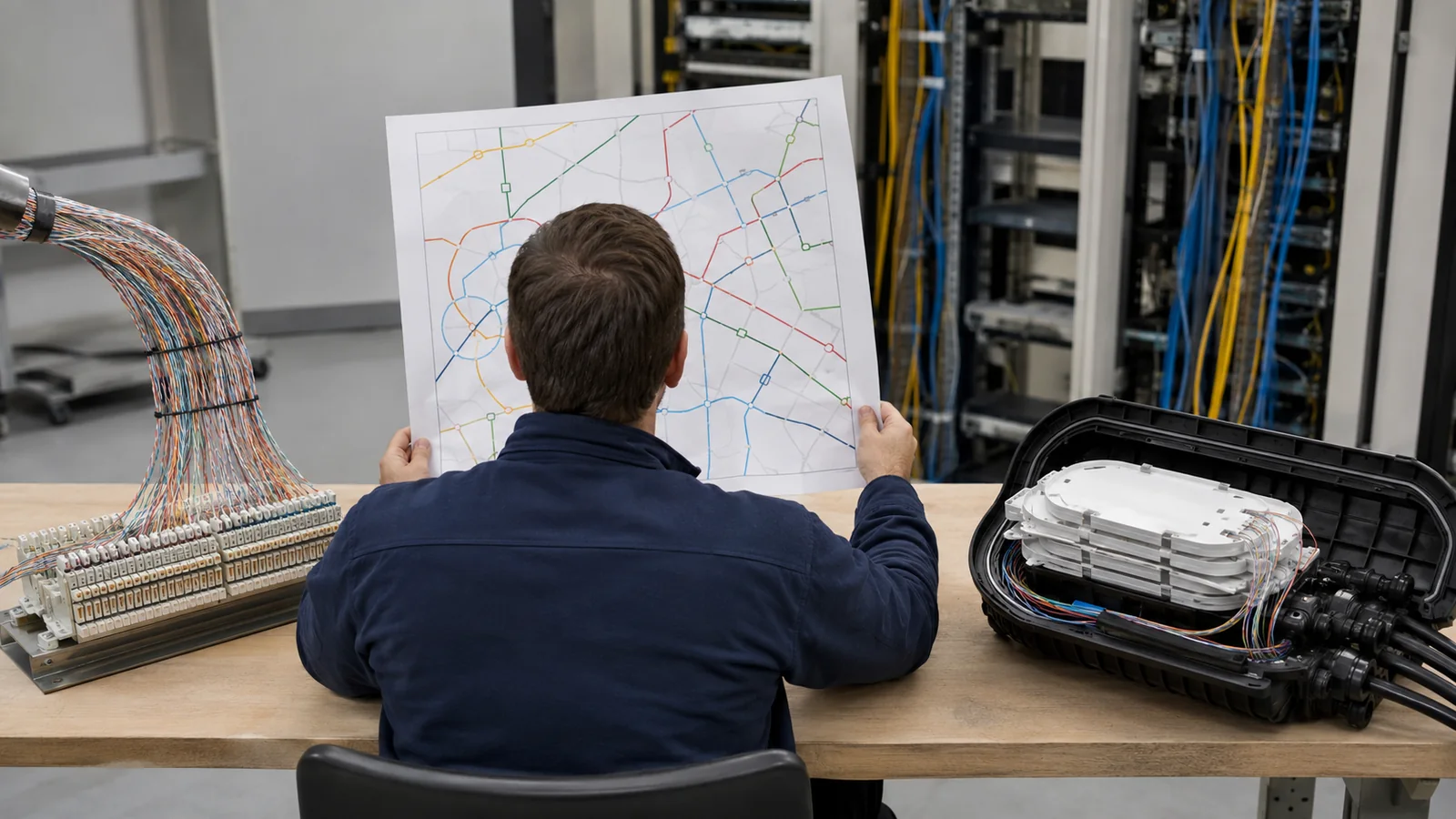
Legacy copper is two problems wearing one name. It is an aging physical system. It is also a live service platform somebody is still billing against. One corridor can hold inaccurate pair records beside abandoned electronics, an alarm circuit nobody inventoried plus a fiber overlay crew scheduled for next quarter, which is why a route-level obsolete stamp never tells operations what to do tomorrow. Calling the whole plant obsolete resolves none of that.
This guide is for the engineering lead who inherited that plant and now has to decide what happens to each piece of it. We work the problem as a segment baseline first and a disposition second, because target architecture is cheaper to argue once the baseline is honest enough that operations, migration and retirement teams are reading the same segment IDs.
Legacy Copper Network Engineering Creates a Segment Baseline
Legacy copper network engineering attaches 6 controlled records to each segment. Those records cover physical plant, pair assignment, service dependency, test evidence, record confidence plus disposition. The owner then assigns one of 5 dispositions (maintain, rehabilitate, hold/isolate, overlay plus retirement-ready). That model is Draftech project guidance, not a national regulatory workflow.
The segment boundary has to be practical. A cable sheath from one closure to the next is often the right unit for an OSP repair. A feeder route out of a central office or a remote terminal is usually the right unit for migration planning. A binder group or a single service-dependent circuit earns its own control record whenever a route-level status would hide the operational consequence of a pair-level fault.
Start with what is still active. A drawing labeled copper does not tell the receiving team whether the plant carries voice, DSL, alarm, telemetry or wholesale traffic. It does not prove that the pair assignment shown matches the field. Every material dependency needs a source plus a confidence state attached to it.
47 U.S.C. 251(c)(5) requires covered incumbent local exchange carriers to provide reasonable public notice of network changes. 47 CFR 51.325 implements that notice for changes that affect a competing provider's performance or interoperability, or that result in a copper retirement. Copper retirement under that section means the removal or disabling of copper loops, subloops, or the feeder portion of such loops, or replacement with fiber-to-the-home or fiber-to-the-curb loops as defined in 47 CFR 51.319(a)(3). That is a notice rule for covered incumbent LECs. It is not a plant-inventory schema.
This article sits earlier in the program than our copper-to-fiber migration engineering sequence, which follows overlay design through cutover and closeout rather than the live-copper baseline we need first. Here we stay in the period when copper is still carrying traffic, whether replacement starts next quarter or stays a long-horizon program.
The baseline produces two outputs. The first is a reconciled plant record with its unknowns written down as unknowns. The second is a disposition register naming the next action, the owner of that action, the trigger plus the evidence that closes it so a later reviewer is not guessing from a colored map. A map without disposition is an inventory. A disposition without traceable plant evidence is an opinion. The package needs both.
Reconcile Plant Records Against Service Dependencies
Reconciliation starts with topology. We trace the segment from source to destination through feeder, distribution, terminals, cross-connects, electronics plus every known branch point. The record preserves cable size, gauge where it is known, pair ranges, splice locations, loading devices, serving equipment plus each change of route medium so a missing value stays visible. Missing values stay missing until evidence resolves them.
Stable identifiers prevent false joins. A terminal number in a paper binder may not match a GIS feature or a field label. Do not merge those records because the locations look close on a map. Raise a discrepancy, keep both source values, then assign a resolution method. The same rule holds when a cable ID changes across a closure or when a pair range appears on two active records.
Service dependency is its own layer. Each confirmed service or service group attaches to the plant segment plus the serving electronics that must stay available. Customer detail lives in the owner's controlled system. It does not belong in a general engineering dashboard.
Build a Confidence Vocabulary a Reviewer Can Audit
Field evidence has to be bounded. A visible cable tag supports cable identity at one point on one cable. It does not prove the next splice. A cabinet photograph confirms installed hardware plus physical condition, and it proves nothing about the current logical configuration. Between those claims sit a tone test, a records trace or an operations confirmation. Which one you need is set by the question being asked plus the work you are permitted to do.
A data dictionary should define confidence in words a reviewer can argue with. We use confirmed by record plus field evidence, confirmed by test, source conflict, inferred, inaccessible plus unknown. Those are project controls, and an owner may prefer different labels. The requirement never changes. A downstream reviewer has to be able to separate a verified pair path from a plausible one.
Our write-up on network inventory control requirements works through evidence, confidence plus accountable next steps across software options. The legacy copper baseline applies that same discipline to a plant where the physical, electrical plus service records evolved on separate clocks.
One limitation of our 6-record baseline is that inventory work expands without a natural end. Scope drifts into old card files that change nothing about the next decision. One thing I have always found too easy is chasing another binder after the next action is already supported. The stop condition belongs in the scope before the first field day. We do not recommend an open-ended records phase.
Test the Segment Then Choose a Disposition
Testing answers a defined engineering question or it burns a truck roll. Test the copper is not a scope. Method, instrument, setup, result plus interpretation stay attached to the segment ID. A number without its setup is trivia.
7 CFR 1755.401 scopes the acceptance tests outlined in 1755.400 through 1755.407 to plant constructed by contract or force account. The borrower determines the overall test plan plus who owns each phase. Alternative methods that provide suitable alternative results are permitted with Rural Utilities Service concurrence. 1755.400 and 1755.403 remain useful examples of measurement categories. They are not a universal method for every network.
We keep evidence and action in one matrix so a reviewer never has to reconcile two documents. The five dispositions below are Draftech project controls rather than a published standard. Hold/isolate is an owner-approved risk-containment state, not unauthorized disconnection. Retirement-ready is an engineering-package status, not legal authorization to retire service or remove plant.
| Segment state | Evidence focus | Operational question | Engineering disposition |
|---|---|---|---|
| Stable and supported | Records agree with condition and test result | Can service continue under normal maintenance? | Maintain |
| Degraded but repairable | Defect and affected dependency are defined | Will a bounded repair restore required function? | Rehabilitate |
| Uncertain or high consequence | Records conflict, or the segment supports concentrated services | Can ordinary work proceed without an approved hold? | Hold/isolate |
| Overlay candidate | Fiber route and cutover dependencies are defined | Can migration proceed without premature retirement? | Overlay |
| Retirement-ready candidate | Services moved and notice or discontinuance review is identified | Is the engineering package sufficient, separate from legal authorization? | Retirement-ready |
A poor test result is not a diagnosis. The interpretation has to connect the number to segment topology plus service consequence. A fault that reads as minor on an idle pair can be unacceptable on a critical active dependency. A cosmetic enclosure defect should not trigger cable replacement unless the evidence shows it affects function, safety, access or owner acceptance on that specific segment.
Trend data earns its place only while the methods stay comparable. Measurements taken with different instruments or at different access points should not be graphed as one clean condition curve without a qualifier that tells the next engineer whether the change is physical or procedural.
Bounded evidence. A cable tag proves identity at one point on one cable. It does not prove the splice you cannot see. Write down which claim the evidence actually supports before it enters the disposition register.
Write the Repair Package with a Release Condition
A repair scope needs a release condition or it never closes. Engineering is not finished when a red cloud lands on a drawing. The team has to know what evidence closes the work, and that evidence has to be nameable before anyone mobilizes a splice kit or a replacement reel.
- Affected identity: Cable or pair range joined to the exact work location.
- Access and protection: Permission to reach the plant plus the service protection method.
- Material plan: Splice or replacement approach with the parts actually specified.
- Acceptance test: The method plus the result that releases the work.
- Record update: The assignment change plus the person who owns the final record.
Hold/isolate usually belongs before overlay or retirement-ready work. A network may need to separate abandoned pairs, remove uncertainty around a defective branch or establish a clean demarcation so later work cannot disturb active services. Isolation without owner approval is not a disposition we will sign.
Broadband Forum TR-419, Fiber Access Extension over Existing Copper Infrastructure, Issue 1, December 2020, is optional technical guidance for one specific fiber-extension-over-copper architecture. It is not law. It is not a design recommendation for every route. Keep everything or remove everything is a budgeting posture, not an engineering one.
Does the selected disposition reduce uncertainty and preserve the required service while moving the segment toward its approved future state? If the answer is unclear, the package is not ready for release.
Control Coexistence, Cutover, and Regulatory Interfaces
Coexistence periods carry more record risk than either steady state. Copper, new fiber, temporary facilities plus a moving list of assignments can share one corridor. The project needs a frozen pre-change baseline, an approved cutover package, a live issue log plus a post-change record tied to the same segment IDs.
Cutover authority is explicit or it is missing. Engineering defines the sequence, the test points, the hold points plus the rollback conditions. The operator or whichever party holds contractual authority decides when service actually moves. Construction progress does not authorize a service transition.
FCC Wireline Competition Bureau Order DA 25-252, released March 20, 2025, waived Commission filing requirements and the associated Bureau public-notice and objection processes for short-term network changes and copper retirements for two years unless extended. Other public and direct notice duties described in that order stayed in place. We treat that waiver as a filing-process fact for covered incumbent LECs. We do not treat it as permission to skip owner notice, 911 coordination or contract notice that still applies.
FCC 26-19, published at 91 FR 20913 on April 20, 2026, adopted permanent changes eliminating FCC filing, Bureau public-notice and objection procedures while retaining defined public and direct notice. Incumbent LECs still post public notice through industry fora, industry publications or a publicly accessible internet site, and they still provide direct notice of copper retirements and short-term network changes to directly interconnected telephone exchange service providers and to 911 service providers as the order describes. Amendments to 47 CFR 51.329 and 51.333 were delayed indefinitely pending a later effective-date notice. The remaining provisions of that rule were stated as effective May 20, 2026. Engineering should read the current official text with counsel rather than invent a national retirement date from a caption.
Keep Section 251, Section 214, and Physical Treatment Apart
Three questions get collapsed into one slide. Section 251 network-change notice is interoperability notice for covered incumbent LEC facility changes under 47 U.S.C. 251(c)(5) and 47 CFR 51.325. Section 214 service discontinuance is a separate authorization path when a network change also results in a service discontinuance. Physical removal, abandonment in place and property treatment are construction, environmental, right-of-way and owner-property questions. We keep those three lanes separate because a retirement-ready engineering package can exist while any one of them is still open. Do not treat the package as legal authorization.
The regulatory file should name the facility owner, the entity providing the affected service, the proposed change plus the person responsible for legal review. Engineering supplies accurate route, facility, service plus timing facts. Engineering does not supply legal conclusions.
Safety scope stays on the same page as the plant record. OSHA 29 CFR 1910.268 covers specified telecommunications center and field-installation work, including installation, operation, maintenance, rearrangement and removal of communications equipment and conductors. Subsection (a)(2) expressly excludes construction work as defined in 1910.12. Construction work uses applicable Part 1926 standards. The employer determines the applicable standard for the actual task. A copper record does not authorize entry, climbing, electrical contact, excavation or confined space work.
Where buried or aerial assets carry weak records, the existing infrastructure evidence rules separate visible condition from inferred continuity plus ownership and access. That separation becomes load-bearing the moment a fiber overlay wants the same pole line, conduit or cabinet site.
Change records carry the issued design reference, the field change, the approval, the affected services, the test result, the new assignment plus the final record update. Keep superseded values in history. Overwriting an old pair assignment makes later troubleshooting harder.
Hold is not a cut. Hold/isolate is an owner-approved containment state. It keeps ordinary work from touching a segment until the dependency is resolved. It is not a quiet disconnection and it is not a substitute for section 214 review where that review applies.
Retirement-Ready Stays an Engineering Gate
Retirement-ready is fail closed by design. A segment does not reach that status until the authorized team confirms that services moved, that records reconcile, that applicable notices were identified for legal review, that physical treatment is defined plus that a final evidence owner is named. A budget date is not evidence.
Where cable removal, abandonment in place, rights-of-way or property restoration enter the scope, the controlling owner, permit, contract plus environmental requirements each need their own review. Those reviews sit beside the engineering package. They are not completed by stamping retirement-ready on a drawing.
Choose the Next Legacy Copper Network Engineering Action
Five dispositions, five different next steps. Pick per segment, never per route. We will not let a program date overwrite a missing dependency.
Rural co-op or ILEC with mixed plant: maintain the stable segments and rehabilitate only the defects you can bound. Hold/isolate anything whose service list is still an argument. Overlay only where fiber design, cutover ownership plus coexistence controls already exist. Leave retirement-ready for the segments whose evidence package is actually closed.
Municipal or CLEC overlay program: write the 6-record baseline before the first cutover. Keep copper status visible until the retirement-ready gate closes on that segment. Do not treat a fiber activation record as proof that every copper dependency is clear.
Special-circuit or high-consequence plant: hold/isolate first. The point is to shrink the blast radius before repair, overlay or retirement-ready work proceeds. Ordinary maintenance on an unresolved critical circuit is how quiet outages get scheduled.
Active in 22 states. Available across all 50 U.S. states. Draftech's phased copper-to-fiber migration engineering covers assessment, overlay design, cutover planning plus retirement documentation after the baseline is written. Engineering stays 100% in-house. Where a program includes full turnkey construction, Draftech delivers it through Draftech-managed subcontract crews under Draftech QA/QC and safety oversight. We do not claim that construction is self-performed today.
If your copper records, service assignments, test evidence plus migration plan do not describe the same network, send the scope to info@draftech.com. A scoped assessment can start with one serving area, one route or one decision class, then expand only where the evidence supports it.