- Why the Copper Sunset Is Forcing ISPs and Telcos to Act Now
- How Copper-to-Fiber Migration Actually Works in the Field
- The Engineering Work Involved
- Common Mistakes That Blow Up Migration Timelines
- What the Design Deliverables Look Like
- How Draftech Handles Copper-to-Fiber Migration Projects
- Frequently Asked Questions
I've spent 30 years designing outside plant: copper first, then fiber, and now the migration between them. The engineering challenge isn't choosing between copper and fiber. That decision's already been made for most carriers. The challenge is executing a technically sound migration without destroying your budget, your schedule, or your regulatory standing in the process.
Copper-to-fiber migration engineering is not a cable swap. It's a full network redesign, affecting every layer from the central office to the customer premises, with a live network running underneath it the entire time. If you're an ISP or telco treating it like a construction handoff, you've already made your first mistake.
This is how it actually works.
Why the Copper Sunset Is Forcing ISPs and Telcos to Act Now
FCC Rules and Federal Funding Mandates Are Converging
The FCC's copper retirement rules under Section 214 of the Communications Act set a framework for legacy carriers to retire copper infrastructure, but they've never been a hard countdown clock on their own. What's changed is the funding environment. RDOF Phase I locked in $9.2 billion in commitments tied to fiber and fixed wireless deployment. The BEAD program ($42.45 billion) explicitly targets unserved and underserved locations with scalable broadband, and while it doesn't require fiber-only, virtually every state's BEAD initial proposal designates fiber as the preferred technology. That creates a capital availability problem for copper: you can't access federal grant funding to maintain copper plant, only to replace it.
Carriers sitting on aging copper in BEAD-eligible territory are staring at a compounding problem. The federal dollars are flowing, and the entities spending them are their direct competitors.
Copper Maintenance Cost Creep vs. Fiber OPEX
Here's a number I see get glossed over in business cases: copper outside plant maintenance runs $1,340 to $2,100 per mile per year in active rural territory when you account for water ingress repairs, splice case rehabilitation, buried cable locates, and the labor hours chasing pair degradation complaints. Fiber runs $380 to $650 per mile per year in comparable territory. That's not a minor efficiency. It's a structural OPEX advantage that compounds every year you delay migration.
Splice cases on 30-year-old copper fill with moisture. Buried cable insulation degrades. The pair counts that looked adequate for DSL deployment in 2008 are nowhere near enough for today's service requirements. You're not just paying more to maintain copper. You're maintaining a technology that can't serve the competitive market you're operating in.
Overbuilder Pressure Is Accelerating the Timeline
Every cable operator, electric cooperative, and fixed wireless provider entering your territory is using fiber, either as backhaul or as the access medium itself. The overbuilder problem isn't theoretical anymore. It's the primary driver pushing mid-size telcos to accelerate copper retirement timelines they'd planned to stretch over 15 years into 5-year programs. You can't win a broadband competition on copper. Period.
How Copper-to-Fiber Migration Actually Works in the Field
The OSP Audit: Strand Maps, Pair Counts, CO and DLC Inventory
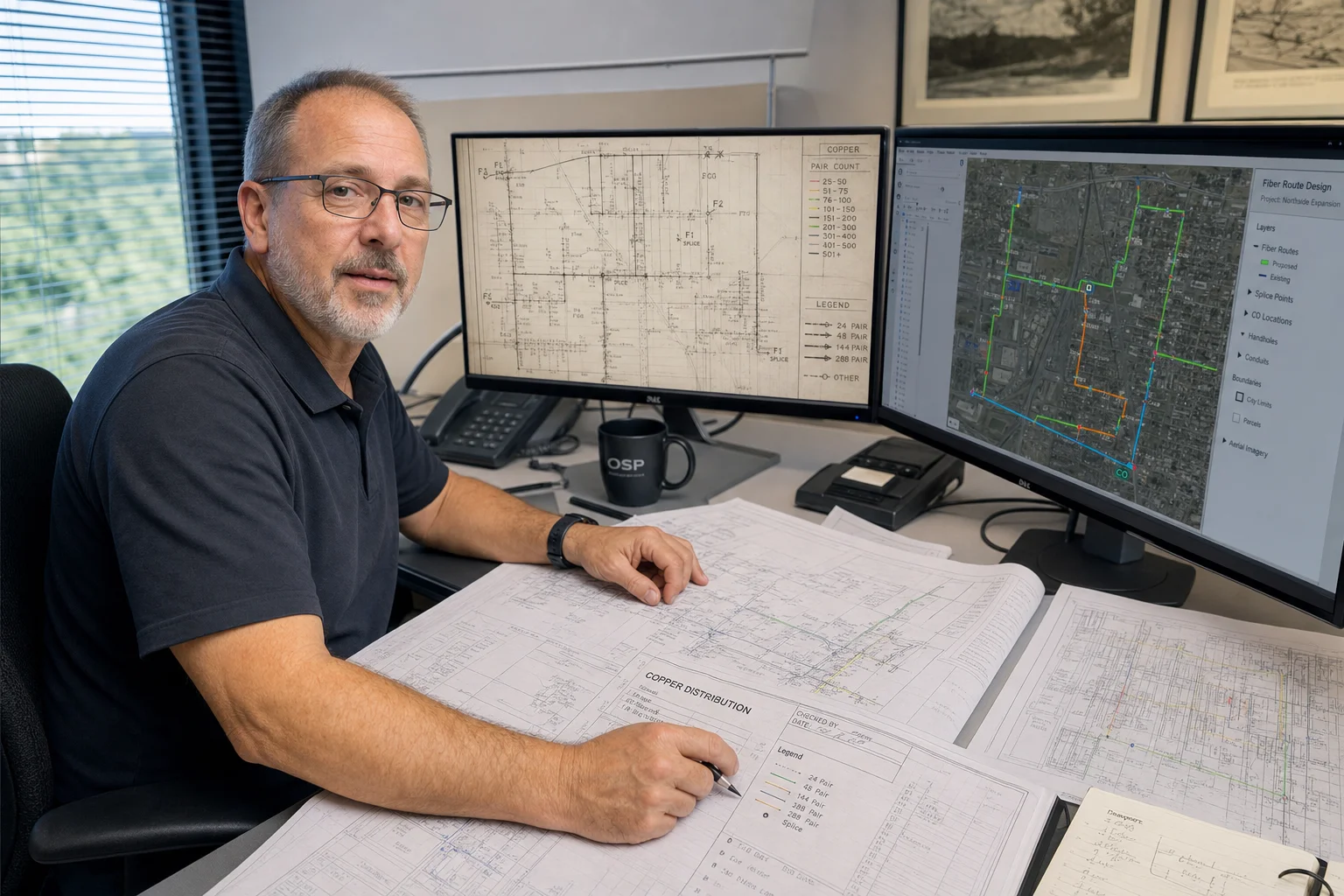
Before any fiber goes in the ground, you need an honest picture of what copper you're retiring. That means a full OSP audit: pulling strand maps, counting active working pairs versus spare capacity, documenting every central office and digital loop carrier (DLC) site on the network, and reconciling paper records against field conditions. This is not a desk exercise. Records for copper plant built in the 1970s and 1980s are often wrong, incomplete, or maintained in formats nobody on your current team can read.
We've audited copper plants where the pair count on paper showed 17,400 working pairs served from a CO, and the actual active working count came in at 9,300. The rest had been bridged, damaged, or repurposed over decades without anyone updating the strand map. That gap matters because it directly affects how much fiber capacity you need to design into the replacement network.
Feeder vs. Distribution Replacement Strategy
Not all copper migrates at the same time or in the same sequence. Feeder cable, the large-count cable running from CO or DLC to distribution points, typically migrates first because it delivers the biggest bandwidth gain per dollar of investment. Distribution, the smaller-count cable running from the distribution point to the tap or drop, often follows in a second phase, especially when a fiber-to-the-node (FTTN) overlay is the interim architecture.
The decision between feeder-first phasing and simultaneous feeder-distribution replacement comes down to three things: available capital, timeline pressure from competition or regulatory requirements, and the condition of the existing distribution plant. If your distribution copper is in reasonable condition and your feeder is the bandwidth bottleneck, phase it. If the distribution is degraded enough that you're generating service complaints regardless, do both in the same project cycle and avoid mobilizing twice.
FTTH Overlay vs. Rip-and-Replace, and Active Electronics Retirement
Fiber-to-the-home overlay means running fiber on the same routes as existing copper, activating fiber service to premises, and then retiring the copper after service migration is confirmed. Rip-and-replace means pulling the copper simultaneously. Most carriers do overlay. It's lower risk because you're not cutting off service if something goes wrong in the fiber activation. The tradeoff is carrying dual infrastructure costs during the transition period, which can run 6 to 18 months depending on customer migration pace.
Active electronics retirement (DSLAMs, DLC line cards, T1 channel banks) gets scheduled against the customer migration, not against the cable work. You can't pull a DSLAM until every customer served by it has a live fiber circuit. Sequencing this correctly requires coordination between your engineering team, your provisioning system, and your field operations. It's one of the places migrations quietly fall behind schedule.
The Engineering Work Involved
Route Design from CO or DLC to Premise
Fiber route design for a copper migration isn't a blank-sheet exercise: the copper routes constrain the fiber routes in real ways. Easements, conduit, pole attachments, and building entries that were acquired for copper plant generally transfer to fiber use, but the fiber routing has to be engineered independently because fiber has different span length limits, different bend radius requirements, and different splice location logic than copper. You're not just putting a fiber cable where the copper was. You're designing a new network that happens to follow similar geographic corridors.
Route design runs from the CO or DLC to the distribution point, then to the tap location, then to the premises. Each segment has different design criteria: fiber count, cable type (ADSS vs. OPGW for aerial, armored vs. non-armored for buried), and splice point placement. This is where a reference like LLD splice point placement guidance becomes operationally important: bad splice placement decisions at the design stage cost real money during construction and create maintenance headaches for the life of the network.
Make-Ready on Existing Poles: Overlash vs. New Strand
Aerial copper-to-fiber migration hits the pole attachment problem immediately. Fiber cables are typically installed on new strand: you don't lash fiber to copper messenger because the copper's coming down. That means new strand applications, pole loading analysis for every affected pole, and a make-ready process that runs parallel to your design phase. The make-ready cost per pole is one of the most reliably underestimated line items in migration budgets. Overlashing onto existing fiber strand is sometimes an option if a competing carrier has already built aerial fiber on the route, but that requires a joint use agreement and strand capacity verification before you design around it.
Pole loading analysis under NESC criteria isn't optional. It's a utility requirement before any new attachment permit is issued. For projects across multiple utility territories, that means running loading calculations in the tool each utility accepts, which might be O-Calc Pro in one county and SPIDAcalc in the next. NESC pole loading compliance for fiber attachments has specific requirements for wind loading, ice loading, and conductor sag that differ from copper, and getting it wrong means rejected permit applications and schedule delays you don't have room for.
Bonding, Grounding, GIS Migration, and Permit Packages
Fiber OSP bonding and grounding design is different from copper. Copper plant carries telecommunications signals on metallic conductors. Your grounding scheme is tied directly to surge protection and personnel safety. Fiber carries light, so you're only grounding the metallic elements: the armor, the messenger, and any metallic strength members. The bonding and grounding design has to be explicitly documented in your construction package because field crews used to copper plant will default to copper practices if you don't tell them otherwise.
OSP permit packages for copper-to-fiber migration include pole attachment applications, encroachment permits for buried work in public right-of-way, and in some jurisdictions, franchise agreement amendments when the technology change constitutes a material modification to the franchise. Each utility has its own submission format. Each municipality has its own ROW process. Managing that across a multi-county migration is a logistics challenge as much as an engineering one.
GIS migration from copper records is underestimated almost universally. Copper OSP records are often maintained in a mix of CAD files, paper maps, and legacy GIS layers that were never validated against field conditions. Migrating those records to a fiber-native GIS environment (with accurate splice locations, cable segment IDs, and port-level connectivity) is a weeks-long data engineering task. The firms that skip it end up with a fiber network they can't maintain because nobody can find anything in the records. More on GIS fiber network planning and how a solid records strategy reduces long-term cost.
Common Mistakes That Blow Up Migration Timelines
Underestimating Make-Ready and Skipping the Buried Survey
Two field realities that kill schedules. Make-ready, the process of preparing poles for new fiber attachments, is almost always larger in scope than the desk estimate suggests. Pole records show fewer existing attachments than are actually on the poles. Structural conditions are worse. Guy wire capacity is inadequate. You find all of this out after you've already submitted a schedule to your state broadband office or your board.
For buried copper migration, skipping the pre-design survey of the existing buried plant is the single fastest way to generate a budget overrun. You can't design a buried fiber route without knowing where the existing cable is, whether it's in conduit, what the conduit's condition is, and where the conflicts with water, gas, and electric infrastructure are. I've seen migration projects where the buried survey revealed cable running through privately held land with no documented easement: in one case a 3.2-mile segment that had to be completely rerouted before design could proceed.
No GIS Migration Plan: Bidding Before Engineering
Starting construction bidding before engineering is complete is the most expensive shortcut in outside plant. Contractors price risk. If your construction package doesn't include a complete route design, pole loading analysis, and permit package, contractors will add contingency that you'll pay regardless of whether those risks materialize. On a 50-mile migration, the difference between bidding a complete engineered package and bidding a preliminary design can easily be $400,000 or more in contractor contingency pricing.
The GIS gap is a separate problem. If you don't have a plan for migrating copper GIS records to fiber-compatible formats before construction starts, you'll end up building a fiber network whose records don't match the field, and your as-built documentation will be wrong from day one. State BEAD administrators are increasingly requiring as-built GIS data as a closeout condition. Discovering the records problem after construction is complete is not a recoverable position.
What the Design Deliverables Look Like
HLD Network Maps, LLD Splice Schematics, and Permit Drawings
High-level design (HLD) deliverables for a copper-to-fiber migration include network maps showing the fiber topology at the feeder and distribution level: route alignment, fiber counts, node locations, CO/DLC serving boundaries, and the relationship between the new fiber network and the copper it's replacing. These are the documents your executive team, your state broadband office, and your construction contractors all need to understand the project scope. For BEAD subgrantees, fiber network HLD for BEAD subgrantees has specific content and format requirements that differ from internal engineering documents.
Low-level design (LLD) delivers the construction-level detail: splice schematics showing fiber assignments at each splice point, tube and fiber color coding, optical loss budgets, and splice closure placement. A splice schematic that doesn't account for the 3.2 dB loss budget on a 14-span distribution run will result in a network that fails acceptance testing, and the fix is always more expensive than getting it right during design.
Permit drawings are separate from engineering drawings and have to meet the specific format requirements of each utility and municipality. Most utilities want a plan-and-profile format for buried work and a plan view with attachment heights for aerial. Some counties require engineered and sealed drawings. Managing that variation across a multi-county migration is a deliverable management problem: someone has to track which drawings are at which stage of approval, which permits have been issued, and which are pending revision.
Pole Loading Analysis, As-Builts, and BEAD Closeout Documentation
Pole loading analysis reports accompany every aerial permit application. The report format (analysis software output, loading criteria, compliance determination) has to satisfy both the NESC structural standard and the individual utility's joint use requirements. When a pole fails analysis, the report has to document the remediation path: guy wire addition, pole replacement, or route modification. The engineering decision that comes out of that analysis affects your make-ready scope, your budget, and your schedule.
As-built documentation is where a lot of migration projects leave money on the table. Sloppy as-builts create maintenance problems for years: field crews can't find splices, troubleshooting takes twice as long, and network records drift further from reality with every repair that doesn't get captured. For BEAD-funded projects, fiber as-built documentation for BEAD closeout is a formal requirement. Incomplete as-builts have caused grant disbursement delays in multiple states.
How Draftech Handles Copper-to-Fiber Migration Projects
Full-Scope OSP Engineering: 600 Engineers, 24 States
Draftech International brings 600 engineers to copper-to-fiber migration projects, operating across 24 states with the capacity to deploy across all 50. We're MBE-certified. We've designed copper plant and we've designed fiber plant, which means we understand both sides of the records problem, the GIS migration challenge, and the engineering translation work that happens between "retire the copper" as a corporate decision and "here's a construction-ready fiber design" as a field deliverable.
Our scope for copper-to-fiber migration typically runs field survey through as-built closeout: strand mapping and copper OSP audit, route design from CO or DLC to premise, make-ready drawings and pole loading analysis, permit package preparation and utility coordination, construction-ready engineering packages, and BEAD closeout documentation where applicable. We don't hand off a half-finished design and tell you to figure out the permits. The package is complete when it leaves our team.
Why Full-Scope Matters for These Projects
Fragmented engineering (different firms handling survey, design, and permitting as separate contracts) is one of the most reliable ways to generate coordination gaps that cost time and money. The firm that did the survey didn't communicate the buried conflict to the firm doing the route design. The firm doing the route design didn't flag the pole loading problem to the firm handling permit submissions. Each handoff is an opportunity for something to fall through.
On a migration project, that's not a theoretical risk. The copper is being retired on a schedule. There's usually a regulatory commitment or a customer migration deadline tied to that schedule. Coordination failures don't result in minor schedule slippage. They result in missed commitments that have real financial consequences.
Draftech handles the full scope, from copper records audit to fiber as-built closeout. Active in 24 states. Available across all 50 U.S. states. MBE-certified. We deliver field survey, route design, permit drawings, pole loading analysis, utility coordination, and construction-ready packages. Start with a free 20,000 LF design, no commitment required.
Copper vs. Fiber OSP: The Design Reality
The comparison table below shows where the engineering work and cost structure actually differ between copper and fiber outside plant. These aren't marketing numbers. They're field numbers from projects we've worked across telco, ISP, and electric cooperative clients.
| Factor | Copper Outside Plant | Fiber Outside Plant |
|---|---|---|
| Avg Maintenance Cost/Mile/Year | $1,340 to $2,100 | $380 to $650 |
| Design Software | AutoCAD, legacy strand map tools, pair assignment software | AutoCAD/MicroStation, ESRI ArcGIS, Comsof, VETRO FiberMap |
| Make-Ready Required | Minimal (existing attachments in place) | Yes: new strand, new attachment, pole loading required |
| GIS Record Complexity | High: aging records, mixed formats, pair-level detail | Moderate: fiber-native GIS, port and tube level |
| BEAD Eligible | No | Yes (in eligible service areas) |
| Bandwidth Ceiling | ~1 Gbps theoretical (GPON-over-copper); typical DSL 25 to 100 Mbps | 10 Gbps+ symmetrical; scalable without plant replacement |
The GIS record complexity number deserves a note. Copper OSP records are often more complex to migrate from than to maintain: they carry decades of pair assignments, splice records, cross-connect documentation, and load coil placement that doesn't translate directly to fiber. Cleaning and migrating those records is engineering work, not administrative work. Budget it accordingly.