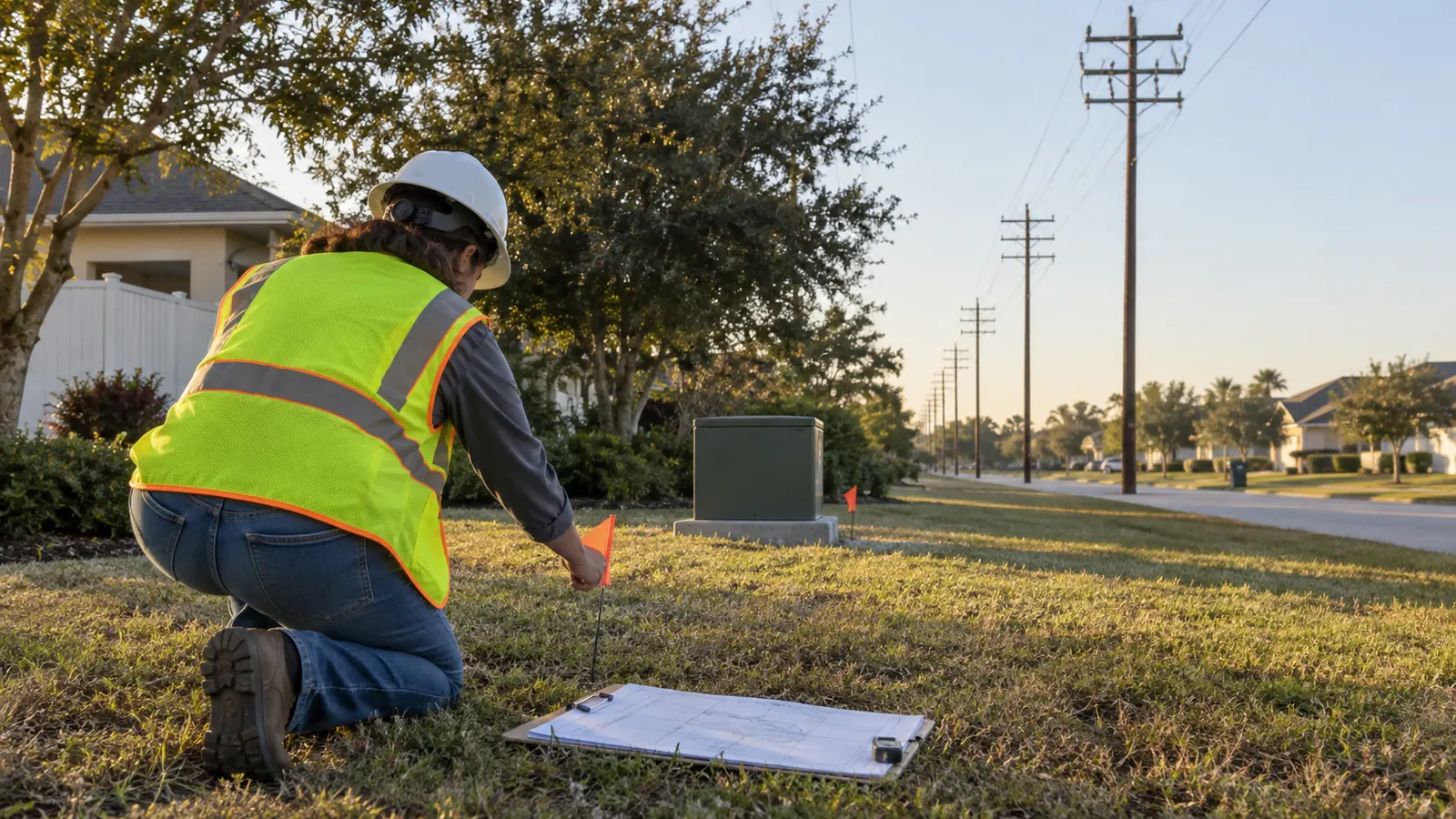
Budget committees still open a storm program with poles sorted by age. That ranking cannot show which outage cuts a backbone the utility cannot bypass. Operations needs the proposed work tied to a failure path it wants changed.
This guide covers pre-storm hardening on distribution feeders, with transmission excluded from our examples and offering. We evaluate hazard evidence against asset vulnerability using the utility's written criteria so each proposed treatment has a stated basis. No single treatment guarantees resilience, even when it addresses the failure path the utility has identified.
Start With Feeder Consequence to Prioritize Grid Hardening
Power grid hardening is pre-storm work that reduces named outage consequences on distribution feeders. Our 5-stage approach starts with feeder consequence, evaluates hazard exposure and asset vulnerability, then compares treatments before releasing work packages. The utility's priorities guide our engineering decisions, with each treatment tied to the failure it must change.
A broken pole is expensive because of what it disconnects. Restoration hours after the storm matter more than class stamps on a spreadsheet. On a short lateral the same class can be a nuisance outage. On a backbone the utility cannot bypass, that class becomes the bottleneck the first crew cannot walk around.
Before detailed production starts, we freeze a feeder consequence map built from customers and facilities the utility has already named. The map records topology and the switching points operations uses, with source dates and circuit identifiers clear enough for someone unfamiliar with the files to trace. A staking sheet cannot supply an accepted restoration case or recover a critical facility that the owner never put on that map.
We connect trouble tickets to devices using matching identifiers in the outage history and circuit model before ranking the feeder. Age belongs in a supporting column. It cannot explain why a storm took out the backbone while leaving a short lateral standing. The joined records give operations a basis for defending the feeder's ranking in terms of that outage consequence. A limitation of our consequence ranking is its dependence on outage and customer records, so gaps in those records delay the initial ranking.
Distribution Storm Hardening Design From Hazard to Work Package
We use the August 2024 U.S. Department of Energy and National Renewable Energy Laboratory report Current Practices in Distribution Utility Resilience Planning for Hurricanes and Non-Winter Storms to understand current practice. Its account of planning reflects differences in hazards and utilities, providing context for decisions while leaving each utility to determine how it ranks its feeders.
Each of the five stages needs evidence, beginning with hazard definition and feeder-consequence mapping to establish the problem. Asset-vulnerability checks test it against the hazard; option comparison then identifies the operating result, and work-package release carries the restoration reason into design. The table below connects each evidence form to the consequence of skipping that step. At the outset, the check is whether spending on visible wear will change the outage the utility wants to reduce.
Before our preferred feeder-consequence ranking becomes staking work, we require the utility to name its critical facilities in writing. Sparse outage history cannot identify facilities the utility has never named. Sorting hardware by age may leave restoration hours unchanged on the feeder operations cares about, so an age ranking alone gives us too little basis to release the design.
Keep Hazard Exposure Apart From Asset Vulnerability
Wind loads a span differently from the way standing water unseats a foundation, and falling vegetation creates another failure path. Exposure describes the event at a location; vulnerability describes how a particular pole or span responds. A switching arrangement needs separate evidence of its response to that event. Combining exposure with vulnerability under one color legend obscures the asset failure that should determine the feeder's score.
Hazard Maps Do Not Replace Asset Checks
The DOE and NREL distribution resilience planning report compares current utility practices without creating a mandatory national asset score. The utility selects models and thresholds for its territory. A hazard layer treated as a damage prediction without local asset checks ranks projects by color. Funding decisions based on that layer alone lack asset-level engineering evidence.
Inspection identifiers connect assets to the hazard layer and let us trace each record to its source file. The same keys tie pole class and remaining strength to conductor data and historical damage, while the pole file remains necessary. Terrain and vegetation records add context. Exposure narrows the search, but engineering evidence determines the change. Any disagreement between the map and inspection records puts ranking on hold until the asset is investigated.
Targeted underground conversion needs the same comparison against feeder consequences as other treatments. The overhead-to-underground distribution conversion guide explains its constraints, including soil conditions and crossings. We also record outage windows and future repair access in the option row. Crews need access to converted-segment faults. A conversion proposal missing those details goes back for completion before hardening approval.
Before assigning a feeder score, we document the failure mechanism and the evidence that a proposed treatment can change it. The map shows where the feeder is exposed. Color alone leaves the assessment incomplete. Funding still depends on explaining what can fail at that location and how the treatment addresses that failure.
| Decision | Evidence form | Consequence if unresolved |
|---|---|---|
| Hazard definition and consequence mapping | Dated outage history joined to the circuit model. Owner-named critical facilities stay labeled. | Capital chases worn hardware without reducing the outage the utility values. |
| Hazard maps versus asset checks | Utility-selected hazard layers joined to inspection records and pole data. | Projects are ranked by map color instead of a defensible failure mechanism. |
| Option comparison by operating verb | Pole and guying analysis with vegetation exposure. Switching and access sit in the same matrix. | The hardened asset survives one mechanism while the outage remains open through another. |
| Work-package production | Plan and profile where needed, with pole schedules and permit notes tied to the selected option. | Field changes consume the risk reduction that justified the investment. |
| Evidence-driven reprioritization | Feeder score basis kept apart from design maturity. Permitting status is a third field. | The utility funds the old list instead of the current risk picture. |
Rank Treatments by the Failure They Change
We compare hardening treatments by the failure mechanism or outage consequence each can change. A measure may reduce failure probability. It may instead reduce the number of customers disconnected, while another may speed isolation or improve restoration access after the storm. Because those measures solve different parts of the outage problem, the intended operating result guides our comparison before material selection begins.
Name the Operating Verb Before the Material
IEEE C2-2023 provides the current National Electrical Safety Code framework for practical safeguarding when adopted by a jurisdiction or utility, without ranking resilience investments or promising storm performance. We choose a measure for its effect on the identified failure and record the adopted edition beside the feeder. That record distinguishes a 2023 national clearance or loading value from a stricter owner overlay. A staking sheet citing only 'NESC' leaves the checker unable to reconstruct the applicable requirements after the next code cycle.
Overhead construction controls for the selected option are covered in overhead distribution construction controls. The option matrix selects the resilience treatment. If the program selects a familiar rebuild before testing whether it addresses the controlling feeder failure, the rebuilt asset may survive one mechanism while the same outage stays open through another weak point we could have named on the matrix before anyone ordered material.
- Vegetation exposure: if falling trees are the controlling failure, a new pole class standing in the same path does not change the outage.
- Guying and structure: a wind case can move with guys or a higher class while a flood case still fails at the soil.
- Sectionalizing study: isolation can cut consequence without cutting failure probability, but only after a switching study the storm can use.
- Targeted undergrounding: soil and crossings belong in the option row, along with future repair access, before anyone calls the conversion a resilience win.
If vegetation is the controlling failure and the proposal is only new poles: stop the staking. The treatment does not match the storm.
For sectionalizing to support a hardening proposal, its switching study must remain valid during the storm being evaluated, including the communications and crew access we check. A recloser symbol on a planning slide cannot establish whether communications will remain available. Crew operating access also needs verification. If the radio fails with the circuit, the treatment loses the isolation benefit assumed in the option matrix and that benefit must be removed from the case.
Turn the Selected Treatment Into a Distribution Work Package
We turn a resilience concept into a buildable work package by carrying its restoration purpose through detailed design. Survey work establishes the selected treatment's field basis. Loading and staking are also needed. Material and protection details must agree with permitting and access requirements so the field can build the option without rewriting the outage benefit that justified it.
Staking Sheets Have to Carry the Restoration Reason
For RUS borrower electric system facilities, 7 CFR 1724.50 requires compliance with the current NESC and applicable state and local requirements regardless of financing source. Paragraph (c) requires overhead distribution circuits to meet not less than NESC Grade C strength under the loads in NESC Section 25. This requirement applies specifically to RUS borrowers. We check the borrower's adopted edition and governing state or local overlay before applying 1724.50 to the feeder. The design record must identify the safety-code text used to check the staking sheets.
We address the access and outage windows shared by communications work and a hardening package through fiber and power corridor interfaces, keeping each project's scope clear. A fiber overlay supplies no hardening benefit by itself. Its construction schedule must leave room for the restoration window the storm package is intended to protect.
For each construction package, we tie segment-specific calculations to a named feeder section to support its expected outage benefit, providing plan and profile where geometry requires them. Pole schedules must match the selected option. Guying and equipment details appear with permit notes, while the staking sheet records why this section was chosen. Without that restoration reason on the sheet the crew holds, field changes and value engineering can return the design to last year's typical construction and remove the benefit that justified the investment.
We track readiness and consequence separately because permit delays can move a feeder within the portfolio without changing its outage consequence. Material lead times stay visible beside those fields. Risk reduction starts only after construction. Changes in permit status or delivery dates therefore call for schedule adjustments that preserve the reason the feeder was selected.
Access roads belong on the treatment-selection map so we can check whether crews can reach the feeder during the event assumed in the design. A flooded route stays visible as a constraint. Blocked access requires restoration case revisions. Replacing hardware leaves the outage consequence unresolved if the crew still cannot reach the open point after the storm.
Choose the Feeder Package That Can Explain Its Priority
Rural cooperative with long restoration hours: base the ranking on restoration hours and the critical facilities the board has already named. We use hardware age as supporting evidence and hold any proposal whose consequence case depends on an unlabeled assumption. Where the backbone cannot be isolated, sectionalizing and access deserve priority over changes to a pole schedule that leave that constraint unresolved.
Municipal feeder with short laterals: freeze ranking on switching and access before any conversion list. A new pole class that does not change isolation time is a different project. We exclude it from the hardening purchase and keep laterals on the consequence map so their outage effects remain part of the comparison. The owner still accepts the residual risk.
Investor-owned utility with a multi-year storm capital program: track consequence, readiness, cost and dependency in separate fields so the board can see what changes after new damage. We recompute those inputs from the available evidence. We document each rank adjustment's basis. A useful capital list can explain why project A moves ahead of project B after an outage, with permit stalls visible in readiness rather than hidden in the feeder's consequence score.
When New Outage Evidence Moves a Feeder
New outage evidence can move a feeder ahead of another when it changes the consequence or exposes a dependency behind the accepted ranking. Before the utility authorizes staking, we update the affected inputs and document the priority change through Draftech's in-house distribution engineering, including substations when purchased. Our scope excludes transmission. When the package includes separately purchased full turnkey construction, Draftech-managed subcontract crews carry out that work under Draftech QA/QC and safety oversight. The utility retains ownership and operating authority as the revised priorities move into design and construction.
Approve a portfolio whose priorities can be explained when new storm evidence moves project A ahead of project B. If the current list still sorts poles by age, we rebuild its scores around feeder consequence before releasing work packages. Each package then carries a documented reason for its place in the construction program, with enough evidence to reassess that position after the next storm.
Our distribution engineering service can review the work packages behind that portfolio, with the review staffed through our in-house engineering model. For separately procured turnkey construction, the managed crew framework explains who performs the work and how Draftech manages the crews. Email the current feeder consequence map to info@draftech.com so the engineering review can start with the priorities the utility has recorded.
When one feeder's restoration case is still disputed: keep it out of the staking release. Bring the changed evidence to the engineering review before anyone treats last year's rank as this season's work.
A feeder package that can explain its priority still needs an issued design behind it. For a qualifying new distribution or make-ready route, we engineer the first 20,000 linear feet at no cost, from feasibility and field survey through permit approval. The utility keeps the drawings and decides what residual risk to accept. Ask for the no-cost route design when the consequence map is ready; the owner reviews each request before Draftech commits the package.