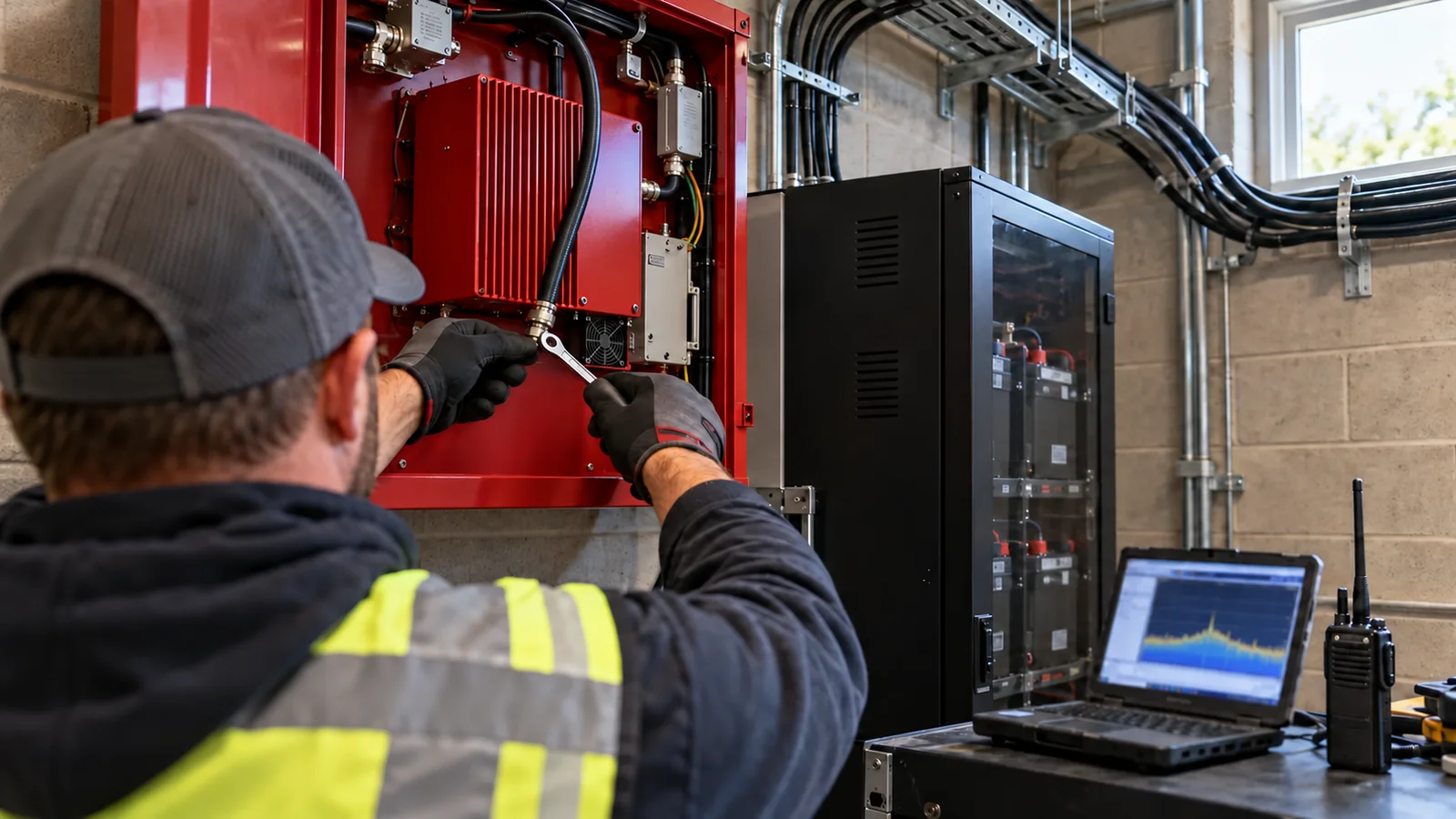
- What a Public Safety Distributed Antenna System Does
- Establish the Code Basis Before Selecting Equipment
- Measure Coverage Before Predicting the Antenna Layout
- Public Safety Distributed Antenna System Design Decisions
- Plan Acceptance and Turnover While the Design Is Open
- Choose the Next Step for Your Building
A responder stepping into a stairwell needs a radio connection that survives the change from an open corridor to an enclosed concrete space. A building can have good cellular service and still leave that responder without a usable public safety radio path. We treat that gap as a design question that requires measured evidence.
This guide explains how we approach the code basis and the coverage assessment before developing a public safety DAS design. It also separates building approval from radio system authorization, so an owner can assign the right responsibilities before purchasing an amplifier or scheduling acceptance testing.
What a Public Safety Distributed Antenna System Does
A public safety distributed antenna system carries emergency responder radio signals through a building using connected antennas. IFC Section 510 addresses in-building emergency responder communications, while NFPA 1225 provides technical requirements where adopted. The design must support communication into and out of the building under the jurisdiction's applicable criteria.
A radio can receive dispatch clearly near a window and lose that connection behind a concrete stair enclosure. The building changes the path. Steel framing and below-grade rooms can further weaken reception, so an outdoor coverage map cannot tell the owner whether a responder can communicate from the interior. We start with the building and the public safety radio system it must support.
How the system terms fit together
DAS describes the distribution network. A bidirectional amplifier, usually called a BDA, receives and retransmits radio signals in both directions and can feed that network. ERRCS means emergency responder radio communication system; ERCES means emergency responder communications enhancement system. Those broader names include functions beyond the antennas, such as backup power and equipment supervision. We define the terms on the drawings so a procurement label does not quietly shrink the scope.
The donor antenna connects an off-air design to the serving radio system, while the interior antennas distribute the signal within the building. Downlink carries traffic toward responders. Uplink carries their transmissions back. We evaluate both paths because a portable radio transmitting from behind a fire door faces different constraints from a radio receiving a strong signal inside the same room.
Public safety and commercial cellular have different obligations
A tenant cellular system serves phones and carrier services. Public safety coverage serves the responder radio system specified for the building. The approval paths differ. Our neutral host DAS explanation addresses shared commercial coverage; its carrier participation model cannot establish emergency radio acceptance. We keep the public safety criteria identifiable even when a building coordinates several wireless projects through the same property team.
The building owner should identify the public safety radio contact before choosing equipment. We ask which agencies and channels the design must support, then record who can authorize changes to those inputs. A contractor quote based only on floor area leaves those questions unanswered. It also gives the owner little basis for comparing proposals that assume different operating bands or different acceptance responsibilities.
Establish the Code Basis Before Selecting Equipment
Codes protect responder communication inside buildings. Adoption varies by jurisdiction. The International Code Council's 2024 International Fire Code, Section 510, addresses emergency responder communications enhancement systems; the adopted edition and local amendments determine the enforceable building requirements. We ask the fire code official which rules apply to the particular occupancy and whether the project involves new construction or an existing building. A model code publication alone does not settle those questions.
NFPA 1225, Standard for Emergency Services Communications, 2022 edition, includes in-building emergency responder communications enhancement systems in Chapter 18. We identify the edition referenced by the jurisdiction rather than silently substituting a newer publication or an older specification. The design basis should state the required test method and the designated critical areas. Those decisions shape antenna placement before any coverage prediction is useful.
Write the acceptance criteria down. We recommend a criteria sheet that ties each requirement to its adopted source and identifies who will judge compliance. Where the fire official supplies a local testing form, use that form to structure the survey records. An unresolved criterion belongs in the design questions log, with a named decision maker, rather than in a drawing note that says only to comply with applicable codes.
| Design workstream | Evidence to establish | Decision it supports |
|---|---|---|
| Baseline coverage | Mapped measurements under an agreed test method | Whether enhancement is needed and where |
| RF distribution | Link budgets and donor isolation assessment | Antenna layout and equipment configuration |
| Building coordination | Cable pathways and power/supervision interfaces | A buildable design with defined trade responsibilities |
| Acceptance and ownership | Witness procedure and turnover requirements | How performance is demonstrated and maintained |
This workstream map is a design sequence, not a universal permit checklist. We resolve baseline coverage before sizing the RF distribution, then coordinate the building interfaces before finalizing the acceptance plan. A change in the required radio channels can send the calculations back for revision even when the floor plan has stayed the same. The owner needs that dependency visible in the schedule.
Fire approval and radio licensee consent
The FCC's 47 CFR 90.219, Use of signal boosters, shown in the eCFR current through October 14, 2026, requires express licensee consent for a non-licensee to operate a booster on the intended frequencies. Keep that consent in a recordable form. Fire approval does not replace it. We make the radio system owner's coordination a separate design dependency so the permit process does not conceal an unresolved authorization.
The same FCC rule requires Class B booster registration and operation without harmful interference. We identify the proposed booster class and the party responsible for registration in the scope. Equipment selection should follow the approved radio requirements, with changes reviewed before procurement. A substitute that looks equivalent in a pricing schedule can change filtering behavior or introduce a configuration the licensee has never agreed to accept.
Measure Coverage Before Predicting the Antenna Layout
Baseline testing establishes what the building receives before an enhancement system is operating. We want measurements tied to identifiable locations on a floor plan, with the test conditions recorded beside the results. A colored heat map without the measurement method is difficult to interpret. It can hide whether a weak room was measured or merely assigned a predicted result because the surveyor could not get through a locked door.
Coverage describes location; signal strength describes a measurement
Coverage testing asks where the required communication works across the defined test area. Signal strength testing measures received radio power at a location under specified conditions. They answer different questions. A strong reading at an antenna does not establish performance across the floor, and a broad average can conceal a stairwell that fails the applicable acceptance criterion. We keep the individual locations visible in the report.
The acceptance plan must take its thresholds and coverage rules from the adopted requirements. We do not select a universal signal-strength value or passing coverage percentage for every building. The required bands and test arrangement matter. Digital audio quality or other operational checks may also be part of the approved method, so a power reading should not be presented as proof of intelligible communication by itself.
Building condition matters during measurement. An open shell with unfinished partitions can produce a different result from the completed interior, particularly after metal doors and equipment are in place. We label preliminary surveys accordingly and identify the later test needed to validate the finished condition. The owner can then use early results for planning without mistaking them for a final acceptance record.
An incomplete survey needs a visible boundary
Consider a survey where the basement electrical room remains locked. Mark the room as untested. The report should explain the access restriction and assign a return visit before anyone treats the floor as complete. We would reject a clean-looking floor summary that silently counts the missing room as passing because it gives the designer false confidence about the starting conditions.
Separate temporary access restrictions from genuine RF failures. We use the former to plan the remaining survey and the latter to inform the design. If a serving radio site or required channel changes during the project, check whether the earlier measurements still describe the proposed system. Reusing a report saves little when its assumptions no longer match the frequencies the responder will use.
Public Safety Distributed Antenna System Design Decisions
Antenna locations follow the RF analysis. We build the distribution design from the approved radio inputs and the building survey, accounting for losses through the chosen cable and passive components. The drawings must identify the actual signal paths. A generic antenna symbol repeated across rooms cannot show whether the farthest branch receives enough useful signal or whether a nearby portable radio can overload part of the system.
Balance uplink and downlink, then check isolation
Amplifier gain affects more than interior reception. Excessive uplink contribution can raise the noise presented to the public safety network, while a nearby radio can dominate equipment that must also serve a weaker transmission elsewhere. We assess those conditions with the radio system owner's requirements in view. Increasing gain to repair a weak room can create another problem outside that room, so the antenna distribution deserves attention first.
Donor isolation limits feedback. The design must provide adequate separation between the donor side and the interior distribution relative to the operating gain and applicable requirements. We evaluate placement and the building's shielding, then specify how isolation will be verified in the completed arrangement. If the donor antenna moves during coordination, the isolation assessment must be revisited rather than carried forward under the old rooftop layout.
Keep substitutions visible: A change in cable type or antenna location should return to the RF designer before it reaches the field. The change can alter the calculated path even when the equipment schedule still looks familiar.
Our preferred approach combines a predictive model with measured inputs, but its limitation is the uncertainty in material losses before the building is complete. We document that uncertainty. A model helps compare layouts and find vulnerable branches; acceptance testing determines whether the finished system meets the approved criteria. Concealing the difference makes an attractive prediction harder to defend when field readings disagree.
Coordinate pathways and equipment interfaces
A workable RF layout also needs a workable cable route. We coordinate equipment locations with accessible pathways and check penetrations against the building's fire protection requirements. Electrical design responsibilities must be clear before backup power is sized. The fire alarm interface needs the same attention: identify the required supervisory conditions and the party responsible for receiving them so a fault does not disappear between trade scopes.
Maintenance access belongs on the plan. A cabinet placed behind later tenant storage can become difficult to inspect, even if its RF connections were designed correctly. We ask the property team to preserve access and to identify who controls the affected rooms. Rooftop work also needs coordination with other equipment users, especially where a later relocation could change the donor path or separation from interior antennas.
These interface questions fit our wireless engineering design scope: we connect the radio requirements to coordinated drawings rather than leaving the owner to reconcile conflicting assumptions. For sites with outdoor coverage work, our campus outdoor DAS engineering guide explains the separate campus interfaces. An outdoor design can inform site coordination, but it does not establish acceptance inside an enclosed building.
Plan Acceptance and Turnover While the Design Is Open
Acceptance starts with an agreed procedure. We recommend defining the test locations and witness responsibilities while the design is being reviewed, so the owner can arrange access before the occupancy schedule becomes urgent. The procedure should distinguish baseline measurements from tests with the enhancement system operating. It should also identify how the team will demonstrate the return path to the public safety network.
Record each failed location. A passing summary should be traceable to the underlying readings and the building condition on the test date. We want any corrective change linked to the affected drawing revision, followed by the appropriate retest. Otherwise, the owner can receive a successful test report and an as-built package that describe different antenna locations, leaving the maintenance team unable to reconstruct what passed.
Turnover should preserve the approved configuration and the information needed to service it. We recommend checking the equipment records against the final drawings and identifying the responsible maintenance contact before handover. The adopted requirements and the authority having jurisdiction govern subsequent inspection and testing. Building alterations or radio system changes can justify renewed evaluation; an old acceptance report cannot describe conditions that developed after it was signed.
Resolve access before the witness visit: Have the building representative confirm that each required test area can be entered under the agreed procedure. An inaccessible critical room can prevent completion even when every accessible measurement passes.
Choose the Next Step for Your Building
Building owners: Commission the baseline assessment and obtain the jurisdiction's criteria before buying a BDA. Establish the need first. For an existing property, keep the current test records accessible to the design team and disclose planned renovations that may change radio propagation. That gives competing proposals a common starting point and keeps an unnecessary equipment purchase from becoming the project's organizing assumption.
Design and construction managers: Assign the RF and building interfaces before issuing procurement documents. Name the acceptance responsibilities. Require substitutions to return for engineering review, and keep the radio licensee's consent separate from the fire permit record. This avoids a late discovery that each trade priced its own equipment while assuming another party would close the supervision or testing scope.
Draftech International provides turnkey telecom and power infrastructure across the lifecycle, from field survey and planning through construction drawings, permits, agency coordination, construction, as-builts and closeout. Engineering is 100% in-house; general construction delivery uses Draftech-managed subcontract crews. For the public safety DAS scope discussed here, Draftech provides design. Our partner and company information explains that accountability. Active in 24 states. Available across all 50 U.S. states.
If your wider program includes a qualifying route, Draftech's free route engineering offer covers the first 20,000 linear feet at no cost, from feasibility and field survey through permit approval; the owner reviews each request before Draftech commits the package. The route offer has a separate scope from this building radio design. We can help distinguish those scopes when reviewing the program.
Bring the adopted criteria and available coverage measurements to the design discussion. We use them to resolve the weak-room questions and the building interfaces before the drawings reach procurement. Send the project context to info@draftech.com, including any unresolved radio licensee coordination, so our design review starts with the decisions that control the layout.
Discuss your building's public safety radio design with Draftech. Identify the occupancy stage and the authority reviewing coverage so we can define the next engineering step.