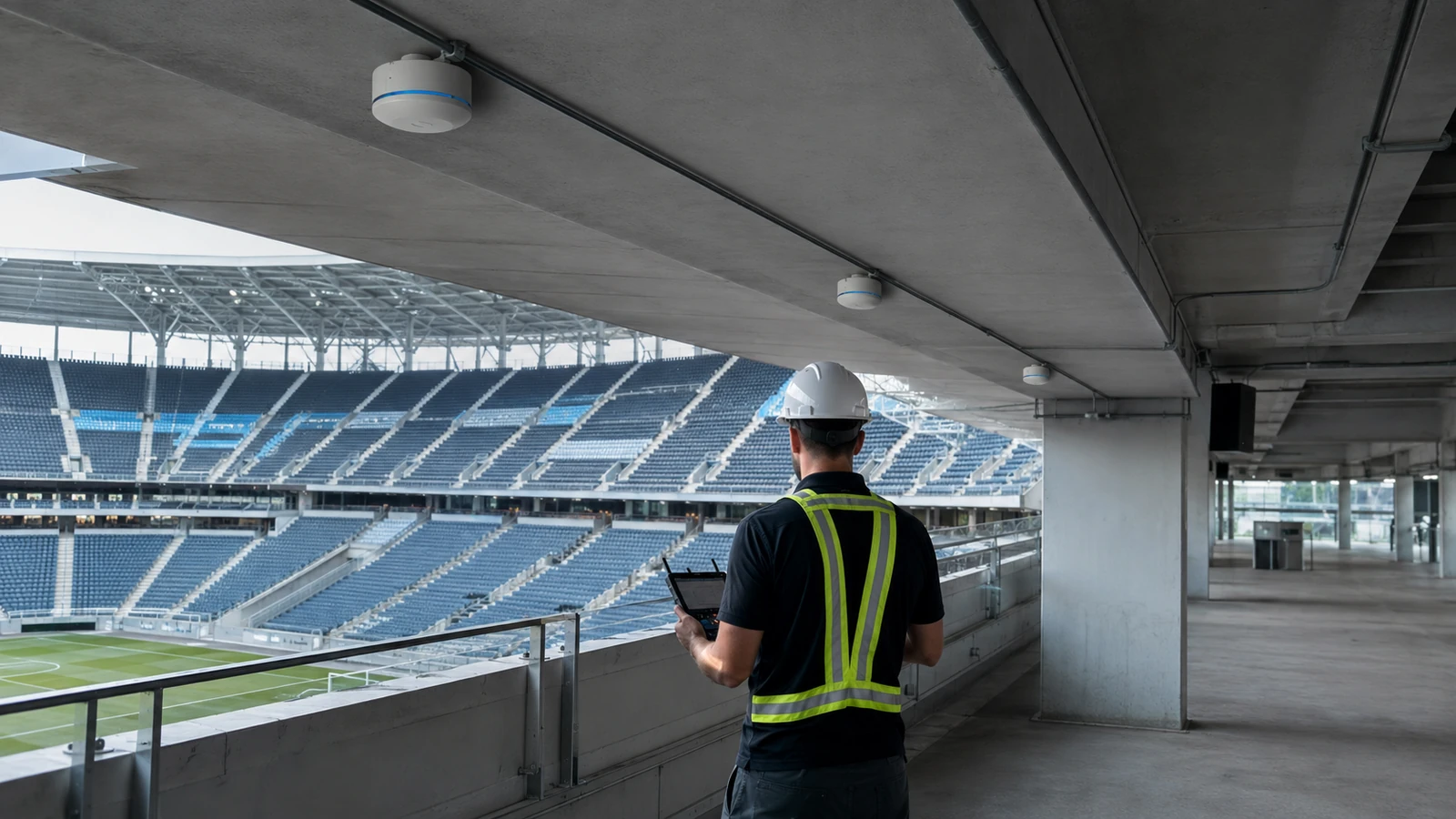
A stadium can show full signal bars on an empty Tuesday and still fail under event load. Concrete seating bowls, concourses, suites, service tunnels, parking structures, broadcast systems, thousands of active devices, and public-safety radio needs create several different performance problems inside one property. One coverage heat map cannot settle them all.
The owner decision is not simply whether to install more antennas. It is which users and bands the system serves, who has authority over each signal path, how the venue will behave during representative demand, and which evidence transfers the system from contractors to operations. We organize those decisions before equipment selection so the design can be tested against a stable purpose.
What DAS Design for Stadiums and Venues Must Control
DAS design for stadiums and venues is the coordinated RF, transport, power, pathway, and acceptance plan for distributed antennas across a large event property. A defensible 2026 scope separates 2 operating missions: commercial carrier service under crowd load and emergency responder communications under the adopted code plus licensee requirements.
Those missions may share pathways or rooms, but they do not automatically share authority over equipment or bands, nor do they share a test and acceptance path. The commercial side may involve one or more mobile network operators plus a neutral-host party. The venue and integrator also have separate roles. The emergency responder side involves licensed public-safety frequencies under radio-system owners and fire-code provisions. Operational controls remain separate. We start by drawing both authority chains.
The First Responder Network Authority's Roadmap domain titled Coverage and Capacity treats reliable coverage and sufficient capacity as distinct needs for public safety. That distinction is useful for a venue, but it does not create a universal stadium specification. We use it as a planning principle: a design must state whether a test demonstrates geographic reach, usable service at a location, or performance while many users contend for resources.
A venue basis of design should name user groups and target areas; event modes and supported bands; donor or base-station assumptions; headend boundaries and transport ownership; power and backup interfaces; monitoring responsibility; cybersecurity responsibility; the party that can accept each result. These are not decoration around an RF model. They determine which measurements mean anything when the building is occupied.
Map Operating Modes Before Antenna Counts
At minimum, map empty-building maintenance and ordinary non-event use. Add ingress and peak-event conditions, then egress and emergency operations when those modes apply. Crowd distribution changes by event type. A concert floor and football bowl place users differently from a convention hall or parking deck, even within the same complex. We require the design narrative to connect each mode to an occupancy assumption and a test that can be repeated.
The map should divide the property by function rather than by convenient drawing sheets. Seating tiers, suites, locker rooms, kitchens, loading docks, command rooms, stair enclosures, tunnels, plazas, and garages create different construction and service conditions. A single average obscures weak critical areas. We give every test zone a stable identifier so model predictions, cable routes, installation records, and post-installation measurements refer to the same place.
Owner test: ask which 2 operating missions each proposed antenna serves and who can accept the result. If the answer is simply better coverage, the scope is not ready for equipment selection.
Separate Commercial and Public-Safety Authority
Federal Communications Commission rule 47 CFR 90.219 defines a distributed antenna system within its PLMRS signal-booster rules as spatially separated antenna nodes connected to a common source over a transport medium. It also requires express licensee consent when a nonlicensee operates boosters on affected frequencies and assigns interference duties. We apply that rule only where its service and device scope fit.
Section 90.219 also requires Class B signal-booster installations to be registered and places signal-booster operation on a non-interference basis. Those controls belong in the public-safety authority matrix when applicable. They should not be copied onto every commercial-carrier component without analysis. The design record identifies licensees, consent evidence, device class, registration responsibility, interference escalation, and the person allowed to change gain or passband settings.
The 2024 International Fire Code Section 510 addresses emergency responder communications enhancement systems. The IFC is a model code, not a nationwide permit by itself. The governing edition, local amendments, exceptions, testing, survivability provisions, and approval steps come from the jurisdiction that adopted it and the authority having jurisdiction. We verify that local chain before labeling a venue design code compliant.
| Decision plane | Controlling party or document | Evidence before release | Failure if blurred |
|---|---|---|---|
| Commercial service | Participating carrier requirements and venue agreement | Accepted bands, source assumptions, capacity cases, and operator signoff path | Coverage is modeled for a signal source the carrier will not accept |
| Public-safety radio | Frequency licensee, adopted code, local amendments, and AHJ direction | Consent, device scope, design criteria, and test protocol | A commercial result is mistaken for emergency responder acceptance |
| Building pathways | Venue standards, structural review, firestopping, and access rules | Approved routes, supports, penetrations, and restoration details | RF design cannot be installed or maintained as drawn |
| RF exposure | FCC limits plus the responsible site RF program | Current evaluation, controlled work areas, and operating-state assumptions | A drawing is treated as a blanket safety clearance |
| Commissioning | Contract acceptance plan and authorized stakeholders | Calibrated results by zone, issue disposition, and signed release | Passing averages hide unresolved critical spaces |
This matrix is a Draftech project control, not a substitute for the adopted code or carrier standards. Its purpose is to keep each result attached to the party that can act on it. We do not let one stakeholder's approval silently close another stakeholder's issue. A venue owner may accept pathway workmanship while a frequency licensee still requires interference correction. Both states remain visible.
Write the Shared-Infrastructure Boundaries
Shared fiber, rooms, racks, power, grounding, monitoring, or cable supports can be efficient, but shared does not mean ownerless. The interface schedule names demarcation points and access rights. It states which party can disconnect equipment, who receives alarms, who maintains backup power, and how work on one system avoids interruption to another. We prefer a visible boundary over a vague promise of neutral-host coordination.
Interference and passive intermodulation risks need the same ownership. The design controls antenna separation, component ratings, connector quality, cable routing, isolation, filtering, and test evidence appropriate to the bands and architecture. A generic note to coordinate in field transfers a design decision to the most constrained moment. We place the hold point before concealment, while cable and component corrections remain practical.
Design RF, Fiber, Power, and Pathways as One System
RF modeling begins with a current architectural base and material assumptions, then assigns antenna locations by zone objectives rather than visual symmetry. Seating decks and low ceilings affect propagation differently from metal roofs or scoreboards. Glazing changes it again. Service spaces need their own assumptions. We model candidate positions, but the model stays conditional until construction materials and source levels are confirmed. Equipment behavior also has to be verified. Prediction is a design aid, not an acceptance certificate.
Capacity design asks a different question. Expected simultaneous use and sectorization shape the case alongside carrier resources and traffic distribution. Uplink behavior can change it. Event operations shape the case too. We do not invent a universal devices-per-seat ratio. The participating operators and venue must supply or accept the planning basis. A sensitivity case then shows which zones fail first when occupancy or traffic differs from the assumed event profile.
The transport network must preserve those sector and service relationships. Fiber counts and topology belong in the same controlled model as equipment rooms and splice points. The record also covers redundancy and latency; power and cooling; grounding and monitoring. Our fiber backhaul design comparison explains ring and spur arrangements as well as hybrid tradeoffs outside the venue; stadium transport applies similar continuity questions inside a denser operational boundary.
Pathway engineering protects constructability. Routes should avoid conflicts with life-safety systems and moving equipment; food-service heat and public reach; drainage hazards. Maintenance access must remain workable. Penetrations need accepted details and firestopping where applicable. Supports need structural coordination. Cable lengths and bend behavior must match the selected architecture. We coordinate these decisions through our wireless engineering and DAS services, with engineering performed in-house.
Verify the Venue Before Freezing the Model
A field walk should confirm room access and pathways; ceiling conditions and antenna mounting surfaces; cable transitions and power locations; grounding points and equipment clearances; construction phasing; operational blackout windows. The walk is not a casual tour. We assign each observation to a drawing zone and capture the owner of every unanswered question. Model revision then follows the evidence rather than memory.
Existing wireless equipment requires a baseline inventory. Record visible antennas, source equipment, passive components, accessible cable labels, known operating bands, and monitoring ownership without assuming that an abandoned rack is available. The venue may have legacy commercial, private radio, broadcast, Wi-Fi, or public-safety systems with separate agreements. The design team needs an authorized disposition before reuse or removal.
For projects that connect to outside transport or tower facilities, the wireless tower fiber route design guide covers the controlled handoff from transport node to shelter. The stadium scope begins where that external path meets venue-owned infrastructure. Naming the demarcation prevents both teams from assuming the other owns the final splice and optical budget. Surge protection and acceptance testing receive their own owners.
Commission Coverage and Capacity by Operating Mode
Commissioning starts before installation with a test plan. Define equipment and calibration evidence; the grid or route method; zone identifiers and test height; device state and signal sources; pass criteria and data fields; retest rules; acceptance authority. The plan should distinguish walk testing for coverage from representative-load testing for capacity. One cannot silently stand in for the other.
An empty-venue test is valuable for baseline coverage and installation diagnosis, yet it may not reproduce a sold-out event. If live event testing is required, operations, security, carriers, and the test team need an approved method that does not disrupt the venue. If representative loading uses simulation or controlled traffic, the record states that method and its limits. We label evidence honestly rather than calling every result peak capacity.
FCC OET Bulletin 65 provides guidance for evaluating compliance with federal radiofrequency exposure limits. It is not a site clearance and does not freeze the venue's operating state. The responsible RF program must use current transmitters and power settings; antennas and accessible areas; actual work locations. Work locations matter too. We keep exposure evaluation separate from service-performance acceptance because the two answer different questions.
Issue disposition must be spatial. A failed section or concourse, stairwell or command area receives a zone ID; measured condition and governing criterion; suspected cause and corrective action; an owner; a retest result; close authority. Average venue performance cannot erase a critical failed zone. Conversely, one failed commercial area should not be described as a public-safety code failure unless the criterion and system actually match.
Self-critical limitation: our preferred integrated test plan costs more coordination up front. For a small open venue with one carrier and no shared infrastructure, a narrower scope may be enough. Do not buy a stadium-scale governance layer when the authority map proves the interfaces are simple.
Make Closeout Usable During the Next Event
Closeout should include accepted floor plans; antenna and equipment inventory; fiber and passive-path records; rack elevations; power sources and alarm points; test datasets and calibration records; issue dispositions; applicable licensee or AHJ evidence; approved deviations; maintenance responsibilities. File names alone are weak control. We use stable equipment and zone identifiers so operations can connect an alarm to the installed path.
The venue also needs a change process informed by wireless utility coordination. Carrier additions and remodels can alter performance. So can scoreboard replacements or suite work. Seasonal layouts and roof equipment introduce other changes. Public-safety radio revisions require attention as well. Define which changes trigger design review or retesting. A system that passed once is not immune to physical and operational changes. The record must explain the configuration that actually passed.
Choose a DAS Design Partner by Acceptance Risk
Venue owner with several carriers: choose a partner that can keep operator requirements and neutral-host boundaries visible beside venue pathways and issue ownership. Require a carrier acceptance path before antenna placement is frozen. The strongest proposal will show how disagreements are recorded and resolved, not promise that coordination happens automatically.
Public-safety-led retrofit: choose a team that verifies the adopted code and local amendments; the AHJ protocol; frequency licensees and booster scope; the test procedure before design release. Commercial coverage experience is useful but not sufficient. We do not recommend treating a carrier DAS acceptance report as evidence that an emergency responder communications enhancement system has met the jurisdiction's requirements.
New stadium or major renovation: choose an integrated engineering path that joins RF design with architecture and structural support; pathways and fiber; power and grounding; firestopping and operations; phased construction. Full turnkey construction can be delivered through Draftech-managed subcontract crews under our QA/QC and safety program, while engineering remains in-house. The acceptance authority for engineering and construction stays explicit.
Existing venue with a narrow dead-zone problem: choose the smallest scope that can prove the cause. Baseline measurements and an authorized equipment inventory may show that a targeted correction is better than a complete replacement. We would not recommend a full neutral-host redesign merely because it is more comprehensive. The design effort should match the decision and the consequence of being wrong.
The release gate should require an accepted basis of design and authority matrix; a coordinated model; approved pathways and current source assumptions; a testing plan; an issue workflow; an operations handoff. That gate converts coverage promises into inspectable responsibilities. Review Devin Martinez's field and wireless delivery background when assigning the accountable technical lead for that work.
When the pain comes from conflicting stakeholders or untestable performance language, we remove that risk by tying every zone and source to its pathway. Every result still needs a named owner. Use our contact form to send the venue zones and stakeholder map. If you need a DAS design for stadiums and venues, email our wireless engineering team with the venue type and the operating missions that must be supported.