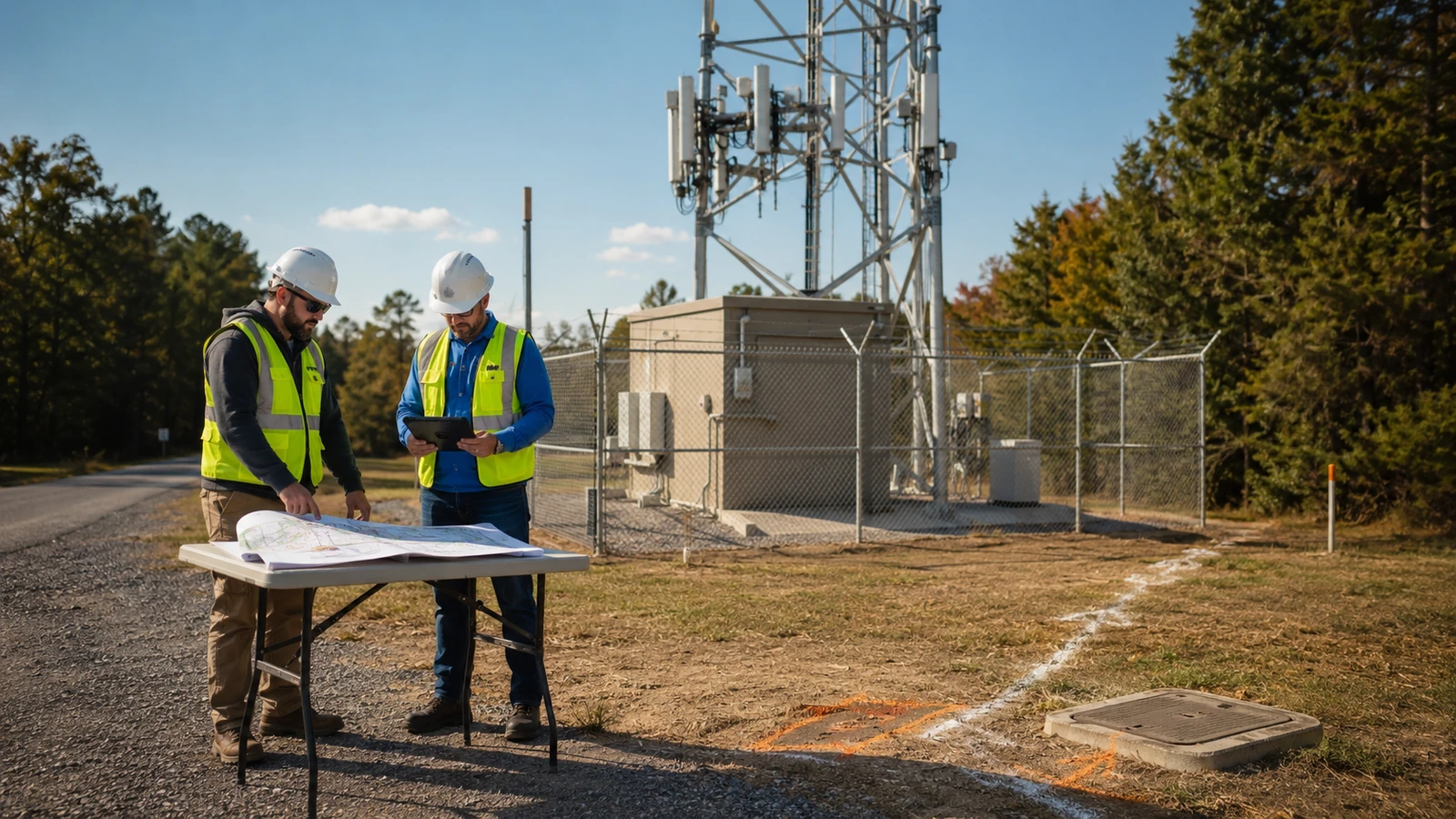
Fiber Backhaul Design for Cell Towers: The Decision Frame
Fiber backhaul design for cell towers is the in-house engineering of a fiber path, strand plan, splice plan, and site handoff that connects a radio site to its transport network. The first decision is whether the site needs 1 feed or 2 physically diverse paths, because that choice controls route, permits and structures plus failure behavior.
The radio team can state capacity and availability objectives, but the outside plant still has to cross real rights-of-way, enter a fenced compound and land in the correct demarcation space. It must leave records an operations group can trace. We treat the tower coordinate as the start of the investigation, not the end of the route. A clean schematic does not prove that a bore pit fits or that a pole line is attachable. Nor does it prove two routes fail independently.
We begin with the consequence of a cut. A single spur can be entirely appropriate for an edge site when its outage exposure is accepted. A protected ring earns its additional route only when the site or downstream aggregation justifies independent paths. A hybrid connects a spur or group of spurs to a protected transport segment. None is universally best. The mistake is selecting topology from a symbol library before stating the outage case.
The standards layer matters, but it must be used precisely. ITU-T Recommendation G.8032 is an in-force reference for Ethernet ring protection switching. It does not prove physical route diversity. That proof comes from route geometry, crossing ownership, conduit occupancy and pole alignment as well as splice placement. Two logical directions inside one sheath still share one failure point. We reject that as protection, regardless of how the network diagram is labeled.
Our engineering scope ties this decision to the civil package. We provide wireless backhaul design services with route development, field inputs, splice logic, permit drawings, and construction-ready records under one in-house engineering team. When construction is included, Draftech offers full turnkey construction through Draftech-managed subcontract crews under Draftech QA/QC and safety oversight. That is a single point of accountability without claiming every task is self-performed.
Compare Protected Ring, Single Spur, Hybrid, and Dual-Homed Routes
Start topology review with a failure map. Mark every sheath, conduit bank, bridge, railroad crossing, pole corridor and splice closure plus the building entrance that both paths might share. The line color is irrelevant if both routes occupy the same structure. We also trace what else a site feeds. A modest radio site can become operationally important when it aggregates several downstream nodes or timing sources. Management paths can raise the consequence too.
A protected ring needs independent civil paths far enough back into the network to survive the failure being designed against. A spur accepts one path and should be documented honestly as unprotected. Hybrid design spends diversity on the transport segment and uses shorter edge spurs where the outage consequence supports it. Dual-homed service may terminate at separate transport nodes, but its value disappears if both later converge through one bridge or duct bank or entrance.
One thing we criticize in our own preferred hybrid approach is its handoff complexity. It can place more responsibility at aggregation closures and create more route states for operations to understand. If the splice schedule, fiber allocation, and restoration logic are weak, the design saves route mileage while creating a troubleshooting problem. We choose hybrid only when the records can remain as disciplined as the geometry.
| Topology | Failure behavior | Best fit | Design proof |
|---|---|---|---|
| Protected ring | One route may fail while the alternate remains | Hub, aggregation, or high-consequence site | Independent corridors, crossings, splices, and entrances |
| Single spur | One path failure interrupts the site | Accepted edge-site exposure | Declared outage case and accessible restoration points |
| Hybrid | Protected core with selected edge spurs | Mixed site criticality | Clear aggregation boundaries and strand assignments |
| Dual-homed | Two transport terminations can reduce node dependence | Sites requiring separate upstream nodes | No hidden reconvergence or shared entrance |
| Diverse entrance | One compound approach can remain after the other fails | Sites with independent building or shelter paths | Separate conduits, handholes, and demarcation routes |
Protected Ring
The protected ring is the strongest default when a site carries aggregation traffic and the owner requires continuity after a single route failure. We withhold the word protected until field and records show independent paths. Separate strands in the same cable, separate cables in the same duct bank, and opposite directions that share one bridge are all common-mode routes. The ring drawing must name those dependencies so reviewers can challenge them before issue.
Ring design also changes splice and access strategy. Each leg needs closures positioned where a crew can work safely and where an emergency repair does not block the alternate leg. Fiber assignments should be readable in normal and protect states. We keep the physical route, logical service, and restoration notes in connected records, because a protected protocol cannot compensate for a maintenance crew cutting the wrong sheath.
Single Spur
A single spur is not a lesser design when its risk is accepted. It is often the clearest answer for a leaf site where the cost and permitting burden of a second approach exceed the service consequence. The honest package labels the site unprotected and identifies the nearest restoration point. It keeps slack and closures accessible. Calling a spur temporary does not excuse missing records, because temporary routes routinely remain in service longer than a planning note suggests.
Spur design should avoid needless splice events and ambiguous branching. We want a fault domain that can be isolated from the hub without tracing undocumented mid-span work. Capacity planning still includes known equipment, maintenance fibers, and owner-approved growth space, but we do not present a universal strand count as engineering. The count comes from the transport plan, ownership model and tenancy assumptions plus the cable standard named in the brief.
Hybrid Core and Edge
Hybrid topology is usually the practical network answer when site criticality varies. A protected backbone reaches aggregation points, and shorter spurs extend to selected edge sites. This model makes the boundary decision visible: which closure or cabinet is protected and which downstream segment is not. The record also names who accepts that exposure. We prefer it when route constraints make a full ring wasteful, but only if the route map and splice schedule express the boundary without interpretation.
The aggregation point deserves the most scrutiny. It concentrates splices, fibers, and restoration choices, so poor access or weak labeling can defeat the topology. Our review follows each service from the radio site through every closure to its upstream node, then repeats the trace in the protect state. That is not an anecdote or a claim about a past build. It is the acceptance method we specify for this architecture.
Dual-Homed and Diverse-Entrance Variants
Dual-homed service addresses upstream node dependence as well as route dependence. It can terminate the site on separate transport nodes, provided the fiber paths do not quietly converge before reaching them. A diverse entrance is narrower: it protects the final compound or building approach with separate conduits and demarcation paths. We keep those labels separate so a buyer does not assume entrance diversity equals end-to-end network diversity.
These variants demand exact interface ownership. The tower owner, carrier, transport provider, and engineering team may each control different segments, but the drawing must show the full path needed for the claim. Where one party will not disclose route detail, the design should record that limitation instead of filling it with an assumption. A qualified acceptance note is more useful than an unsupported line that appears complete.
Capacity, Optical Inputs, and the Physical Route
Capacity planning begins with the services expected at the demarcation, not a generic tower label. We collect interface requirements, active equipment ownership, growth events authorized by the owner and fiber-use policy. Restoration objectives stay explicit. Dark fiber can preserve options, but spare count is not a substitute for an approved forecast. We document what drove the count so later designers can distinguish reserved capacity from accidentally unused fibers.
Tactical caveat: route diversity must be checked again after permit comments. A reviewer-mandated shift can move both legs into one corridor even when the first issue showed independent paths.
Optical inputs and civil route length have to stay synchronized. A route change can alter fiber length, splice events and connector count plus equipment assumptions. ITU-T Recommendation G.652 identifies characteristics of single-mode optical fibre and cable, but the project link budget must use the actual cable, splice and connector criteria plus equipment criteria selected by the owner. We do not insert a generic reach number where an equipment-specific calculation belongs.
Aerial and underground segments create different controls. Aerial routing adds pole ownership, attachment applications, make-ready and clearances plus access to closures. Underground routing adds conduit proof, bore geometry, utility conflict work and handhole placement plus restoration. The common answer is often a route with both. Our comparison of small cell pole loading requirements addresses the aerial gate, while small cell fiber backhaul engineering explains the aggregation context.
The final site approach is easy to under-document because it looks short on the route map. We show handholes, conduits, entry points, grounding interfaces where required by the owner, slack location and closure position plus demarcation responsibility. We also confirm that construction access does not conflict with tower compound operations. Short distance does not mean low consequence when every service enters through that segment.
Fiber Backhaul Design for Cell Towers in the Permit Set
The permit package should carry the same route facts as the engineering database. Right-of-way line, alignment, stationing, offset, installation method, structures, crossings, restoration, and traffic control references cannot drift between sheets. The Federal Communications Commission Wireless Infrastructure resource page provides federal context, while the controlling agency manuals and permit conditions govern each actual corridor. We cite the applicable source instead of generalizing one jurisdiction's rule.
Construction release should include the route plan, profiles where required, cable and conduit schedule, splice and fiber allocation, structure details, permit conditions, owner standards and approved deviations plus open exceptions. We use stable asset identifiers across CAD, GIS and field evidence plus test records. The builder should not need to invent a name for a closure because the design never assigned one.
The field change path is part of the design. Draftech's in-house engineers evaluate changes to alignment, topology and capacity plus engineering intent. Draftech-managed subcontract crews execute accepted construction under our QA/QC and safety oversight when full turnkey construction is in scope. A supervisor's mark can document a condition, but it does not silently change the protection claim or fiber allocation. The approved change must reach every affected record.
Closeout reconciles installed route, structure coordinates, cable lengths, splice configuration, fiber assignments, permits and inspection evidence plus accepted test files. The operations record should support both normal tracing and restoration tracing. We link this work to the small cell network layer and small cell versus macro cell decisions, because site type changes the consequence without changing the need for exact records. Our in-house delivery model keeps responsibility visible, while a fiber loss budget calculation supports an early optical check without replacing project-specific engineering.
Which Backhaul Topology Should You Choose?
Aggregation hub or high-consequence macro: choose a protected ring when the owner requires continuity after one civil route failure. Demand proof of independent corridors, crossings and splice points plus entrances. Do not accept two strands in one sheath as diversity. Failure domains matter. Shared ducts do not. Records prove the claim. Access still matters. For an aggregation hub, the decision record should show how each route reaches an independent upstream node without sharing the civil structures whose failure the protection objective is meant to survive. For an operations group, the accepted package should make normal service and protection service equally traceable so a restoration crew can identify the correct sheath without relying on the original designer.
Leaf site with accepted outage exposure: choose a single spur and document it plainly. Spend design effort on accessible restoration points, clean fiber assignment and permits. Keep a record that reduces fault-isolation time. Protection theater is worse than an honest spur. Permits can change routes. Spare strands are not diversity. Test retrieval before release. Name every shared risk. For a leaf site, the useful design is a documented single feed with accessible repair points and an accepted outage consequence rather than an expensive second line that quietly shares the same corridor.
Mixed macro and small cell network: choose a hybrid when protected transport and selected edge spurs match the actual service consequences. Put the protection boundary on the route map and splice schedule. Our default recommendation is hybrid for mixed criticality, but only when operations can trace every state.
Separate upstream node requirement: choose dual-homed service only after proving the paths do not reconverge. Add diverse entrances where the final compound approach is itself a material failure point, and label the limits of each protection claim.
Poor topology choices surface later as shared crossings, inaccessible closures, strand shortages and permit redesign. Records may also fail to prove what was built. Our in-house engineering removes those disconnects by carrying capacity, route, splicing, permitting, and construction handoff as one controlled fiber backhaul design. If you need an independent topology and route review, contact email our team. Connect those topology choices to the small cell network deployment cost framework before the route is released.
The decision is direct: ring the sites whose outage consequence justifies two independent paths, spur the sites where one path is accepted, and use hybrid architecture only when the aggregation record is strong enough to operate. That is how we turn a radio-site objective into a fiber route that can be permitted, built, tested, and maintained without inventing facts in the field.