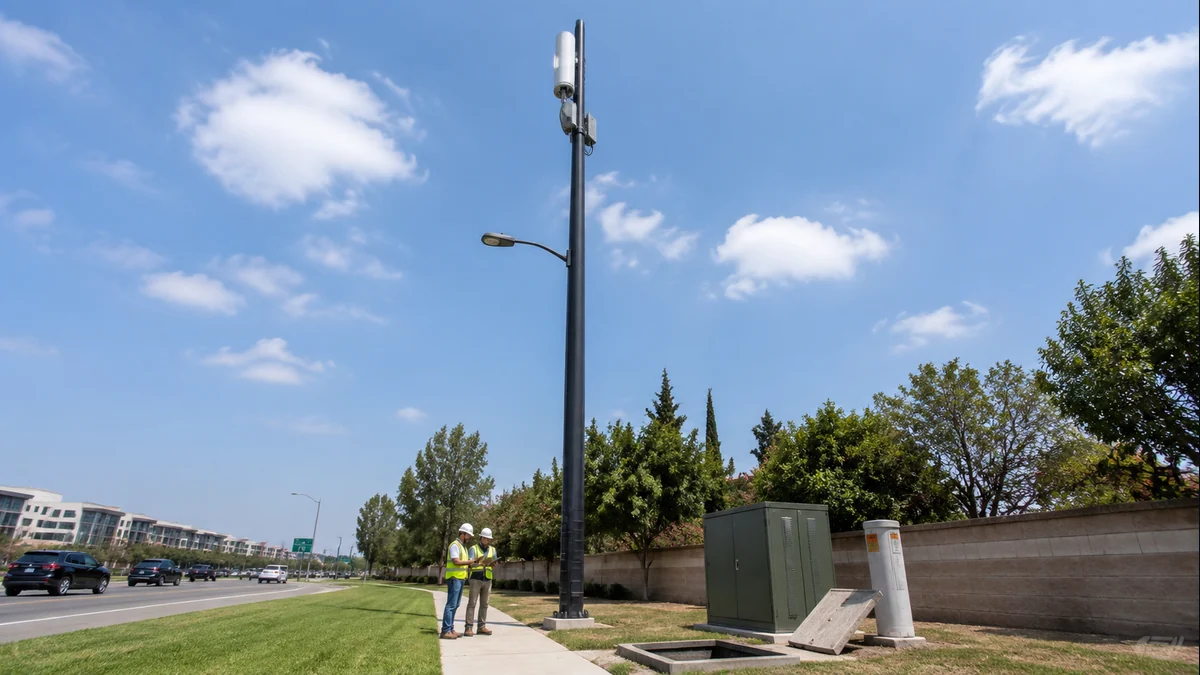
Ask three people on a project call what is a small cell, and you'll usually get three different answers. The RF team calls it a low-power radio node. The city planner sees a box on a streetlight. The OSP engineer sees the part everyone forgets: fiber, power, pole space, grounding, permits, and a route that has to work without tearing up half the corridor. The permitting piece alone can stall a deployment for months, and wireless site permitting exists as its own engineering discipline for exactly that reason.
That's the useful definition. A small cell is a compact cellular radio site placed close to users so a carrier can add coverage or capacity in a tight area. But the radio is only the visible piece. The engineering package behind it is what makes the node buildable.
We can select radios quickly while the fiber path takes far longer to sort out. The difficulty often sits in the field, even when the route looks straightforward on paper: poles with no usable riser path, abandoned conduit nobody will claim, and a municipality that requires a separate aesthetic review for every streetlight cabinet.
What a Small Cell Actually Includes
A small cell is a compact, low-power cellular radio node mounted on a streetlight, utility pole, building face, or strand to add 5G coverage or capacity in a small area, typically a few hundred feet to a few blocks. The civil work behind one node, fiber, power, structural review, and permits, typically adds 6 to 18 weeks before construction starts.
That's not a tiny macro tower shrunk down. It's a different category of structure, and the coverage footprint depends on spectrum, antenna height, clutter, and line of sight as much as it depends on the radio itself.
In the field, the node package usually includes these pieces:
- Radio and antennas: radio and antenna equipment, often with one or more compact integrated radio units.
- Fiber demarcation: a demarcation or junction enclosure for backhaul or fronthaul.
- Power and grounding: power service, meter or disconnect, grounding, and bonding.
- Mounting hardware: hardware designed for the pole, streetlight, wall, or strand condition.
- Permit documentation: permit drawings, photo simulations, structural documentation, and traffic control details where required.
That last line is where the real project work lives. The city does not approve a concept. The pole owner does not approve a rough location. They approve a package with dimensions, attachment heights, clearances, structural assumptions, power routing, conduit route, and restoration notes.
A clean small cell design starts with the site owner question, not the radio question: who owns the pole, who owns the conduit, who owns the right-of-way, and who can sign off on each part of the work?
The equipment list also hides a sizing problem. Every radio, cabinet, and concealment shroud has dimensions, and those dimensions have to coexist with the pole, the sidewalk, and the local design standard. A shrouded antenna on a smooth-top pole reads differently to a reviewer than exposed radios strapped to a wood distribution pole, and a ground-mounted cabinet raises clearance and ADA questions a pole-mounted disconnect never triggers. We draw the equipment stack to scale on every elevation, so the argument about whether it fits happens on paper instead of at the pole.
Seen as a package instead of a radio, the budget and schedule drivers get easier to name. Most of them are controlled by someone other than the carrier, which is why so much of small cell work is really owner and reviewer coordination. The table below maps the six drivers we check on every candidate list, who controls each one, and the number or rule that typically governs it. The sections that follow expand each row.
| Build Driver | Who Controls It | Typical Range or Rule |
|---|---|---|
| Permit review clock | Municipality, bounded by FCC shot clocks | 60 days for collocation on an existing structure, 90 days for a new structure (FCC 2018 Small Cell Order) |
| Pole loading analysis | Pole owner sets criteria; a qualified engineer runs the model | $45 to $75 per pole; NESC Rule 250 wind, ice, and combined load cases |
| Backhaul make-ready | Existing attachers, with One Touch Make-Ready available for simple work | Cost set by how many existing attachments must move; OTMR lets one crew handle simple moves in a single pass |
| Existing conduit | Conduit owner of record | Fast if access is real; useless if it misses the node by half a block |
| Power service | Serving electric utility | A nearby service point can save weeks; a new meter pedestal adds a separate utility schedule |
| Full OSP package | Carrier engineering and permitting team | 6 to 18 weeks of fiber, power, structural, and permit work before construction |
Where Small Cells Fit in a 5G Network
Macro cells handle broad coverage. Small cells fill the places where broad coverage is not enough: dense apartment blocks, stadium approaches, downtown corridors, campuses, transportation hubs, and pockets where a macro sector is overloaded or blocked by buildings.
A carrier might use small cells for capacity, coverage, latency, or all three. In mid-band 5G, one node can take pressure off a macro site by serving a busy 0.4-mile stretch of retail frontage. In mmWave, the node might cover only a tighter zone because buildings, trees, buses, and even wet foliage can make the signal behave badly.
Densification is the strategy word, but on the ground it is a siting exercise. The RF plan produces a search ring, and someone has to find a structure inside it with pole capacity, fiber within reach, power within reach, and a permit path the jurisdiction will approve. When one is missing, that single node can lag the rest of the corridor by months.
That is why small cell design belongs in the same conversation as wireless engineering services and small cell design engineering. RF planning decides where the node should go. OSP engineering decides whether that location can actually be built.
The distinction between the two structure types matters enough that it earns its own comparison. Our companion piece on small cell vs. macro cell breaks down coverage radius, capacity ceilings, and the specific conditions where a carrier should add nodes instead of leaning harder on an existing macro sector.
The OSP Design Scope Behind One Node
One node can require more coordination than a quarter mile of ordinary aerial fiber. The OSP scope usually starts with a field walk and existing-conditions pull: pole owner, pole class or streetlight model, existing attachments, sidewalk width, ADA path, nearest fiber source, nearest power source, traffic control constraints, and restoration requirements.
From there, the design has to answer a few plain questions. Where does the fiber enter the node? Is the route aerial, underground, or a hybrid? Is the design backhaul or fronthaul? Is there enough slack and splice capacity at the aggregation point? Does the pole need structural review?
Power gets less attention than fiber and causes just as many redesigns. Each node needs a service point, a metering decision the serving utility will accept, a disconnect the electrical inspector recognizes, and a grounding and bonding detail that satisfies both the pole owner's standard and the NEC.
For fiber architecture, the companion article on small cell 5G fiber backhaul engineering goes deeper into fronthaul, backhaul, fiber counts, and conduit sizing. The short version: never treat the fiber path as a line on a map until somebody has verified the real route in the field.
A practical small cell package also includes permit drawings that a reviewer can understand without a 45-minute explanation. Plan view, elevation, equipment schedule, conduit detail, grounding note, traffic control reference, restoration note, and photo location. Boring, yes. Necessary, absolutely.
The best RF location is not always the best build location. A preferred pole may have clean line of sight while the nearest usable fiber sits across a divided road with no existing crossing. Moving the node to the next streetlight can keep the coverage objective, avoid the road crossing and its bore permit, and take significant cost out of the early construction estimate.
Why Small Cell Builds Stall
Small cell projects rarely stall because someone forgot what a radio does. They stall because the physical site is messier than the RF plan assumed.
The common blockers are predictable: no acceptable pole owner agreement, missing structural data for decorative streetlights, utility pole loading failures, fiber conduit that stops 180 feet short of the preferred pole, and municipal comments about cabinet placement after the carrier has already locked the node list.
Pole work is its own track. A small radio can still add enough wind area and load at the wrong attachment height to trigger a make-ready requirement. For that side of the work, read the new breakdown of small cell pole loading requirements and the broader guide to pole loading analysis with O-Calc Pro.
The structural math is unforgiving. A pole loading analysis models the pole with every existing attachment plus the proposed equipment against the controlling NESC Rule 250 load cases: the district combined ice and wind loading, plus extreme wind and extreme ice where they apply. Shrouds and cabinets carry more wind area than their weight suggests, and attachment height multiplies the moment at the groundline. At $45 to $75 per pole, the analysis is cheap insurance against a failed pole discovered after the permit is issued.
Permitting can be just as unforgiving. One city may accept a standard small cell sheet set. The next may require photo simulations, cabinet color samples, separate traffic signal review, and a neighborhood notification window. That's why the ROW process should run beside design, not after design. Our article on ROW permitting delays in fiber deployment covers the same pattern on larger fiber builds.
There is a federal clock on top of the local process. The FCC's Small Cell Order, a Declaratory Ruling and Third Report and Order adopted in September 2018, set shot clocks of 60 days for small wireless facility collocations on existing structures and 90 days for new structures. Those clocks bound how long a jurisdiction can sit on a complete application. What the shot clock does not fix is an incomplete package: an application that draws a completeness objection resets the clock.
Backhaul attachment got its own federal fix the same year. One Touch Make-Ready, adopted by the FCC in 2018 under WC Docket No. 17-84, lets a new attacher use an approved contractor to complete simple make-ready in the communications space in a single pass, instead of waiting on serial truck rolls from every existing attacher. For a small cell backhaul run crossing a dozen joint-use poles, that is the difference between one coordinated visit and a queue that stretches across a season. It does not cover complex work or the supply space.
Cost and Schedule Reality
Small cell costs swing hard because civil work, rather than the radio, is the expensive unknown. Existing conduit and a cooperative pole owner can keep a node's cost down. New trench across a downtown block drives that cost up the most, before equipment, power service, and carrier integration are counted.
The build drivers in the table near the top of this article decide which end of that range a node lands on. The biggest swing is usually make-ready: whether existing attachers have to move their facilities before the backhaul fiber goes up, and how many poles on the route need that work.
Schedule behaves the same way. A 24-node build with clean aerial routes might move from fielding to permit-ready drawings in 6 to 9 weeks. The same node count in a downtown district with rail crossings, decorative lights, and unknown conduit can take 18 weeks before construction management even has a stable package.
And no, pushing the drawings harder does not fix a missing pole agreement. It just creates rework.
What Draftech Needs to Start Cleanly
For a clean start, we want the RF candidate list, preferred node coordinates, equipment cut sheets, power assumptions, carrier design standards, known fiber source points, and any municipal small cell handbook the client already has. If those documents don't exist yet, we can still start with field survey and route feasibility. We just label the unknowns instead of pretending they are solved.
Draftech's in-house engineering team supports field survey, route design, permit drawings, pole loading analysis, utility coordination, and construction-ready deliverables for wireless and fiber programs. Active in 24 states. Available across all 50 U.S. states.
If you're trying to turn a small cell candidate list into a buildable package, send the messy version. A spreadsheet, KMZ, and a few photos are enough for a first pass. Reach us at info@draftech.com and we'll tell you what is missing before it becomes a schedule problem.