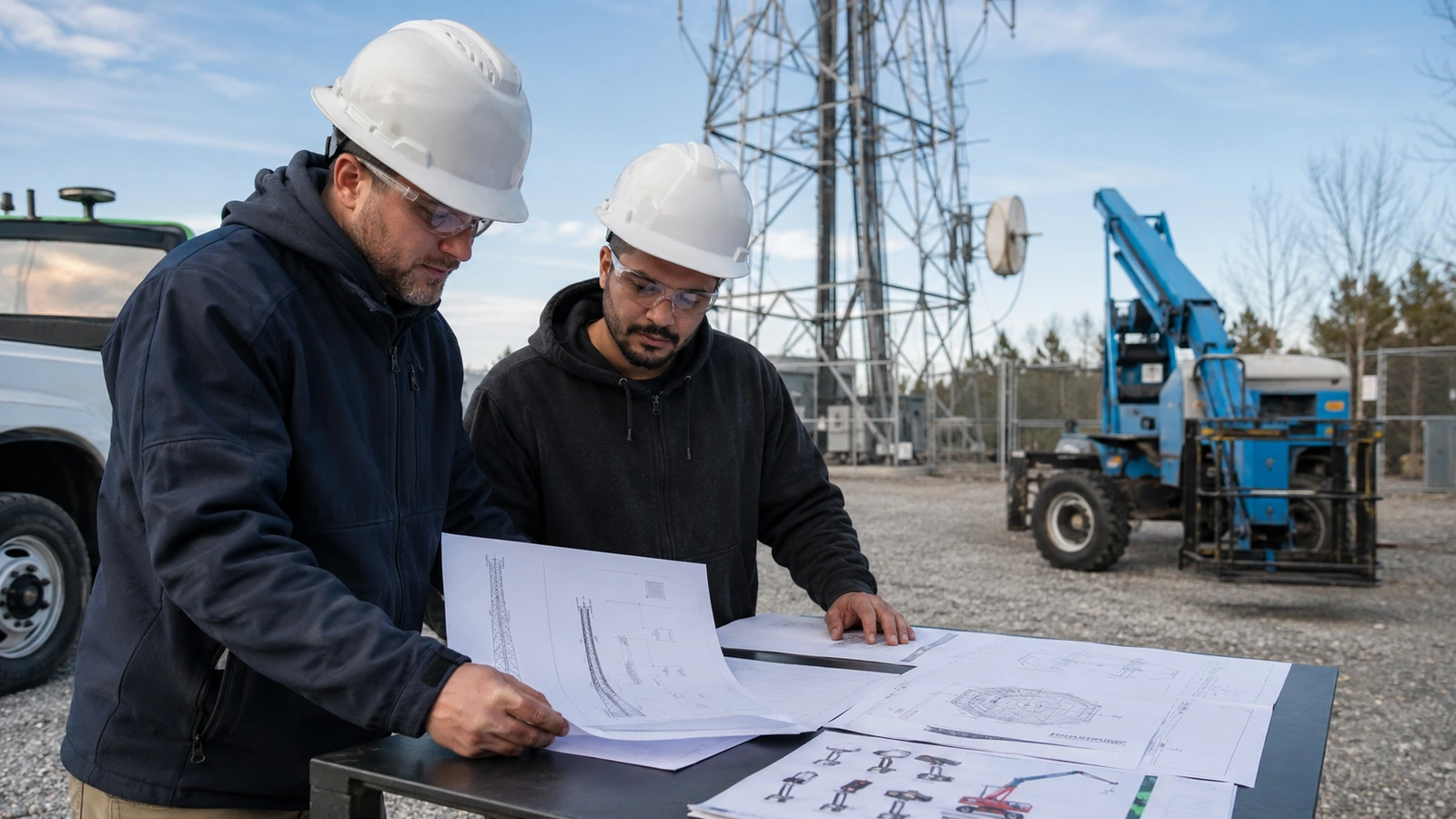
An antenna installation rarely fails because the antenna was forgotten; it fails because the mount revision does not match the structural analysis, the hoist plan assumes an access path that the site owner has closed or the integration window arrives before power and transport are ready. Each problem lives between work packages. That is where project management has to operate.
This guide treats installation as a controlled release rather than a calendar exercise; we connect design basis with site readiness and crew execution plus testing and closeout. Safety responsibilities remain with qualified parties under applicable rules and approved programs; engineering records do not replace a competent person's judgment, and a schedule milestone does not prove the site is ready.
What Antenna Installation Project Management Controls
Antenna installation project management controls at least 4 linked releases: design basis, site readiness, field execution and acceptance. The manager confirms that approved equipment and structural inputs match the work package, then verifies permits plus access and support interfaces before mobilization. Work closes only when tests, photographs and redlines reconcile to the installed configuration.
The project record starts with scope boundaries; a modification may replace antennas only, or it may add mounts and radios plus hybrid cable and power equipment. Some scopes include transport or shelter work. Others stop at a demarc. We identify who owns structural analysis and RF design plus permitting and installation; we also identify who can approve substitutions. That map prevents a vendor change from bypassing the discipline that relied on the original loading or interface data.
A date is not a release criterion; delivery dates are useful for sequencing, but mobilization requires evidence: the issued package; approved access; correct materials; resolved hold points; qualified resources; site-specific work controls; ready power or transport where required. We keep readiness evidence separate from percent-complete reporting; a task can be 95 percent complete while the missing 5 percent makes installation impossible.
Freeze the baseline and approval authority
Baseline control connects the antenna schedule to mount details and structural inputs plus cable routes and equipment elevations; every released drawing carries one revision. Bills of material use the same equipment identifiers. The field package includes the approved deviations and excludes superseded sheets. If the crew receives two mount details by email, the project has already lost configuration control; we require one source of truth and one named release authority.
Our candid limitation is that project management cannot certify technical work outside its discipline; a manager can verify that a structural approval is present and matched to the configuration. That person does not recreate the analysis from a checklist. The same boundary applies to RF exposure evaluation and rigging engineering plus electrical work; we route technical questions to the accountable qualified reviewer instead of converting coordination into an unsupported approval.
The Antenna Installation Control Gates
The gates below give each discipline a visible stop point. They do not replace the site owner's procedures or contractor safety program. Their purpose is to prevent assumptions from moving forward without an owner. A failed gate sends the package back to the source discipline. It does not become a field note that crews must interpret at height.
| Gate | Control question | Required record | Release trigger |
|---|---|---|---|
| Scope baseline | What configuration is being installed? | Equipment IDs; elevations; interfaces; revision | Owner scope approval |
| Technical release | Do analyses match the configuration? | RF basis; structural disposition; details | Discipline approvals matched |
| Site readiness | Can the planned work occur? | Access; permits; power; transport; staging | Open constraints assigned |
| Mobilization | Are people and materials ready? | Crew qualifications; material verification; work package | Pre-job release complete |
| Execution | Is field work following the baseline? | Hold points; issue log; approved deviations | Inspection evidence accepted |
| Closeout | Does the record match installed truth? | Tests; photos; redlines; inventory; exceptions | Operations acceptance |
Survey the interfaces, not just the tower
A useful survey verifies structure identity and access plus compound geometry and equipment locations; it captures mount configuration and available routes for cable or fiber. It records shelter and cabinet interfaces. It also documents ownership clues without presenting them as legal proof. Photos remain tied to stable site IDs and viewpoints; a broad photo set cannot compensate for a missing model number or an unreadable port label.
Survey confidence matters on active sites; a measurement taken from the ground is not equivalent to a close observation at the work location. Existing labels may be stale. Concealed connections remain unverified. We state access limits in the survey record and convert each decisive gap into a follow-up task; we do not let the cleanest photograph silently become the controlling technical source.
Match structural inputs to installed identity
Structural approval must match actual antenna and radio models plus mount geometry and elevations; feed lines or hybrid cables can also affect the modeled configuration. A substitution changes more than a procurement line; it can change weight and projected area plus attachment details. We therefore route substitutions through the designated technical authority before installation. Similar appearance is not evidence of equivalence. The released model list remains part of the closeout check.
Small cells create a related but distinct structural problem. The small cell pole loading requirements guide explains why compact equipment can still create significant wind demand when mounted high on a slender pole. Macro tower work uses different structural context. Project management should not collapse both into one generic antenna approval. The manager confirms that the right analysis path was followed for the actual support structure.
Configuration rule: if the equipment ID or mount geometry changes, stop the affected release. Do not ask the field crew to decide whether a substitute is structurally equivalent.
Manage Safety and RF Interfaces Without Overclaiming
Project schedules must make room for approved safety planning, but a blog cannot define a site-specific safe method; OSHA 29 CFR 1926.501 states the duty to provide fall protection under covered construction conditions. OSHA 29 CFR 1926.502 provides criteria and practices for fall-protection systems. The employer's competent and qualified personnel must apply requirements to the actual work; we verify required records and hold points without claiming that paperwork makes climbing safe.
Rescue planning cannot be reduced to an emergency contact line; the contractor and site owner need approved responsibilities plus resources and communication suited to the work location. Weather limits and access restrictions also belong in the daily release. The project manager records whether the accountable party has closed those prerequisites; we never publish a universal wind threshold or rigging method because equipment plus structure and employer procedures control those decisions.
RF status is a changing site condition
FCC OET Bulletin 65 provides guidance for evaluating compliance with FCC limits for human exposure to radiofrequency electromagnetic fields; the project manager must coordinate the installation plan with the responsible RF program and current transmitter state. A prior survey does not automatically describe the work window. Antenna azimuth or power state can change exposure conditions; site controls and authorized reduction procedures remain controlling.
RF coordination records the affected sectors and authorized control plus confirmation path before work starts. Restoration authority is equally important. A field team should know who can place equipment back into service and which test evidence is required first. We avoid casual language such as RF clear unless the term has an approved definition in the site program. Status must be traceable to the responsible party and time.
This boundary changes with site type. The small cell versus macro cell comparison shows how street-level nodes distribute work across many public locations while macro sites concentrate more equipment at height. Neither is inherently simple. Project plans need the correct RF and access model for each site rather than one checklist copied across the portfolio.
Coordinate Permits, Materials, and Site Logistics
Permit scope follows the actual modification. Some work may involve zoning or building review. Other work can trigger owner approval or electrical permitting. Antenna structures may also have federal registration-related obligations under applicable FCC rules, but registration status and marking requirements are site-specific. We verify the site's controlling records with the owner and responsible specialists. We do not infer approval from an existing tower or state that every modification requires the same filing.
Material control begins before shipment; model number and revision plus quantity must match the issued design. Mount kits need all specified hardware. Cable length assumptions need a field-change path. Serial tracking follows owner requirements. Receiving inspection records damage and shortages early; a pallet at the compound is not proof that the correct assembly is complete. Missing adapters or weatherproofing components can idle a qualified crew after mobilization.
Access and staging deserve engineered attention
The logistics plan checks gate dimensions and road condition plus turning space and ground restrictions; it identifies crane or lift staging only after qualified planning. It accounts for other tenants and live equipment. Neighboring property is not assumed available. Where public traffic is affected, the project follows the controlling authority's approved plan; we avoid prescribing traffic control from a generic drawing because local requirements and actual geometry decide the method.
Remote sites add travel and communication exposure. Urban rooftops add elevator or loading constraints. Street-level programs repeat smaller constraints across many nodes. The small cell engineering explainer helps teams distinguish that distributed delivery model from a tower-centered mobilization. The manager chooses a readiness template by site class, then retains site-specific exceptions. Standard fields help. Standard assumptions do not.
Draftech performs engineering in-house; when construction is included, Draftech provides full turnkey delivery through Draftech-managed subcontract crews under our QA/QC and safety oversight. Our delivery model preserves that distinction. Contractor supervisors retain their responsibilities for means and methods plus employer safety programs; field questions that affect the design baseline return to the named engineering authority.
Self-critical trade-off: our readiness gate can delay a planned mobilization when one decisive record is missing. That delay is visible. Sending a crew to discover the same gap at the site costs control and creates pressure to improvise.
Control Installation, Testing, and Closeout
Execution uses hold points tied to irreversible or concealed work; the plan identifies who witnesses each point and what evidence permits continuation. Deviations enter one issue log with location plus consequence and proposed disposition. Verbal direction is captured before it disappears. If immediate site conditions require a stop, the crew follows its approved authority; schedule pressure never converts an unresolved structural or RF question into permission.
Testing follows equipment and owner requirements; the package defines required records without inventing generic thresholds. Evidence includes the scope-required cable tests or alarm checks and commissioning outputs. The accountable technical team approves criteria before the window. Failed results receive a disposition and retest trail; a screenshot without site ID or timestamp is weak evidence. File naming and equipment relationships should be designed before the crew begins testing.
Closeout reconciles the installed configuration to the baseline; it includes approved redlines and equipment inventory plus labeled photographs and accepted tests. Permit closure or owner acceptance remains visible where required. Removed equipment gets a status. Open punch items keep owners and due dates. The package must support operations after the installation team leaves; a folder called final with three competing revisions is not closeout.
Portfolio managers should also preserve lessons as controls, not anecdotes. If repeated shortages involve one kit, update receiving verification. If access fails at one site class, add a targeted survey field. Draftech's service-area model supports coordinated delivery while local requirements remain controlling. We standardize decision records and escalation routes. We do not claim that one permit process or safety procedure applies nationwide.
Antenna Installation Recommendation by Release Trigger
Carrier program manager: release sites in evidence-based batches. Mobilize only when configuration identity and technical approvals plus access prerequisites match one revision. Hold a site when a substitution affects structural inputs. A smaller ready batch is better than a large schedule batch that sends crews into unresolved conditions.
Tower owner or neutral-host operator: make interface authority the trigger. Require each tenant change to name RF coordination and restoration ownership plus structural disposition and closeout evidence. Reject packages that ask site operations to interpret superseded drawings during the window. One controlled baseline protects every tenant sharing the structure.
Contractor delivery lead: demand clear hold points before pricing the mobilization plan. Confirm who can approve field deviations and who accepts tests. Stop when the installed model does not match the released configuration. Field ingenuity is valuable. It should solve means and methods within approved boundaries, not silently redesign the site.
Our recommendation is firm: if the structural configuration or current RF-control path is unresolved, the site is not ready for installation. Return it to the accountable discipline. Draftech's wireless engineering team can coordinate design and readiness records. For a scoped installation-control review, email our wireless project team.