- What Campus Outdoor DAS Engineering Must Coordinate
- The Six-Interface Draftech Outdoor DAS Control Model
- Design Fiber, Power and Hub Architecture Together
- Resolve Property, Permits and Installation Boundaries
- Commission the Built Network Against a Frozen Record
- Campus Outdoor DAS Engineering Release Decisions
Outdoor coverage gaps on a campus rarely follow property lines or organizational charts; a weak pedestrian path may lie between a carrier macro layer and an indoor system, while any remedy can touch landscaping, lighting, power, fiber, security and facilities operations.
This guide treats the distributed antenna system as a campus utility with named decision owners. The key question is not simply how many nodes to install. It is whether the RF basis, candidate sites, transport, power, approvals and commissioning record can support one buildable network.
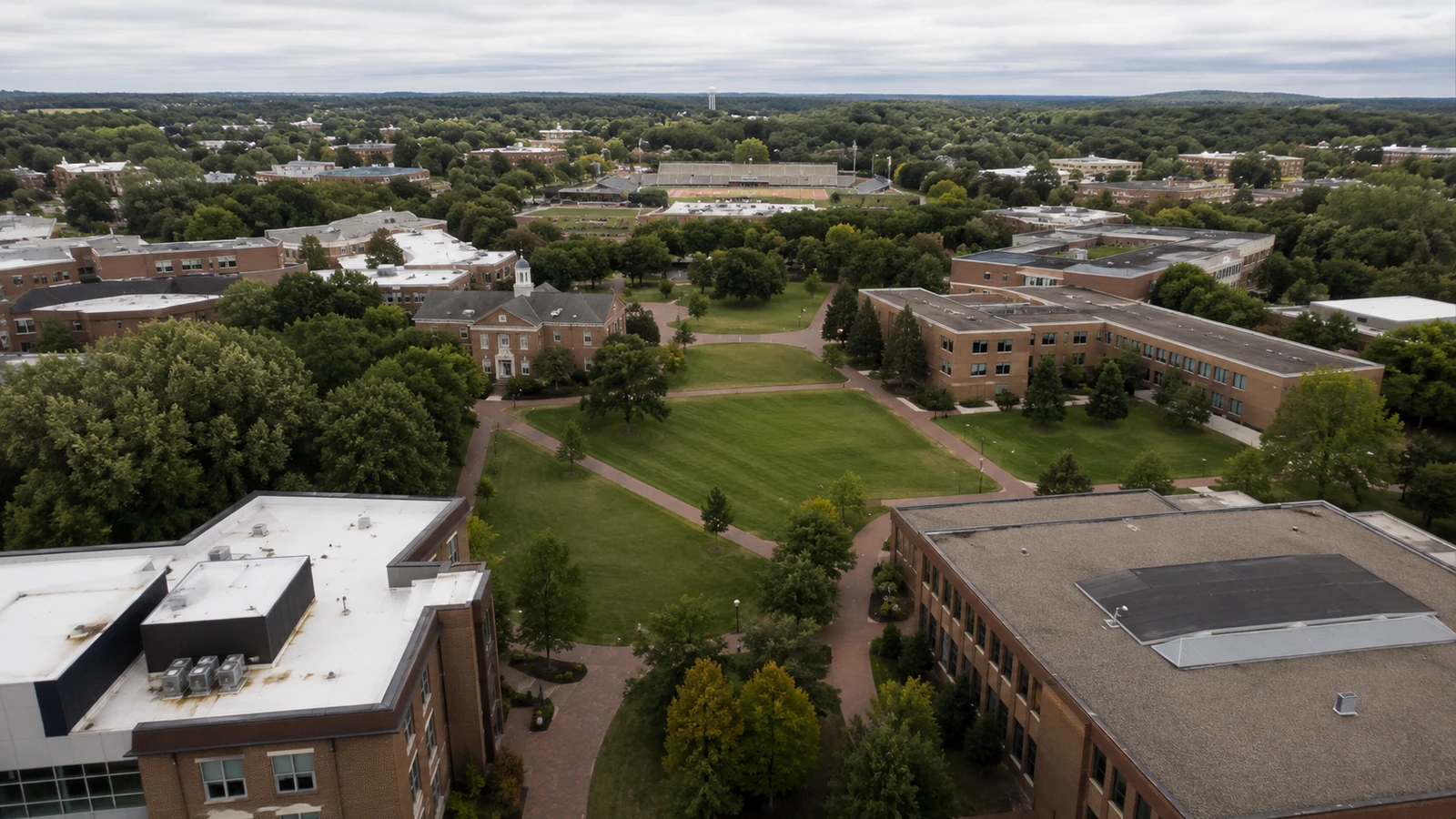
What Campus Outdoor DAS Engineering Must Coordinate
Campus outdoor DAS engineering turns carrier-approved RF objectives into buildable nodes and an operations record. This guide uses Draftech's 6-interface project-control model: RF intent, host sites, transport, power, siting approvals and commissioning. The count describes this workflow, not an industry standard; each interface retains its own decision authority.
A distributed antenna system extends radio signals through multiple remote antenna points rather than relying on one large site. Outdoors, those points may occupy light poles or purpose-built poles and building edges and other approved structures. The design still depends on the participating carrier’s spectrum and equipment plan. Property control alone does not authorize transmission or guarantee network integration.
FCC Order 14-153 describes distributed antenna systems as networks of spatially separated antenna nodes connected to a common source and discusses deployments on existing structures. That federal discussion does not approve a particular campus pole. The project still needs evidence for structural capacity, concealment, power access, property rights, local review and later maintenance access.
Define the coverage objective as a movement problem
A campus is not one uniform polygon. Pedestrians move between buildings while shuttles follow road loops; outdoor events concentrate devices while service teams need communications in distant loading and utility areas after hours. We divide the property into use zones and transition paths, then document the service expectation for each. That creates a testable RF brief without pretending every square foot needs the same experience.
The baseline survey should preserve measurement location and time, the device state, the serving layer and relevant environmental conditions. A single heat map can hide whether measurements came from an idle weekday or a crowded event. We avoid invented thresholds. Participating carriers and the owner define the project metrics, relevant bands, traffic assumptions and acceptance method.
The Six-Interface Draftech Outdoor DAS Control Model
The following table defines Draftech’s six-interface project-control model for this guide. It is not a universal design sequence or an industry standard. Carrier decisions can proceed in parallel with campus utility review, but every release still needs a named authority. Facilities cannot approve a carrier configuration and the RF team cannot promise a pole foundation without civil and structural evidence.
| Interface | Design evidence | Main conflict | Release authority |
|---|---|---|---|
| RF and carrier | Baseline survey, objectives, bands, sector plan | Coverage gain creates interference or overlap | Participating carrier and RF lead |
| Host sites | Pole inventory, structure details, access, appearance | Preferred RF point is not buildable | Campus facilities and structural authority |
| Transport | Hub locations, fiber paths, latency and diversity intent | Remote node lacks a controlled path | Transport engineering |
| Power and grounding | Load, source, disconnect, grounding and backup intent | Available circuit cannot support equipment | Electrical authority and owner |
| Permitting and property | Site rights, jurisdiction matrix, review package | Assumed campus control does not cover every asset | Property and permitting owners |
| Commissioning and records | Test plan, labels, configuration, as-builts, alarms | Built node cannot be traced to accepted sector | Carrier acceptance coordinated through the integrator for operations |
RF intent and carrier authority stay coupled
The RF model should state which outdoor gaps it is meant to correct and what existing layers it assumes. More signal is not automatically better. Added gain can produce overlap and interference or handover behavior the carrier did not accept. The FCC Signal Boosters FAQ warns that malfunctioning, poorly designed or improperly installed boosters can interfere with wireless networks and even emergency calls. A carrier-integrated DAS is not a consumer booster, but the interference lesson still matters.
Equipment selection follows the approved architecture. A neutral-host concept may share passive or active infrastructure while retaining carrier-specific configurations and acceptance; a single-carrier extension can simplify some interfaces but may not satisfy the campus's future tenant or visitor strategy. We document those commercial and technical boundaries before node positions harden into civil work.
A good RF point can be a bad host site
The ideal predicted location may be a decorative pole with no spare internal pathway, a tree-lined view corridor or pedestrian bottleneck. An asset owned by another party creates a different approval path. Site validation records pole material and dimensions and foundation clues, available space, access, nearby power, fiber approach against drainage conditions and conflicts with planting and drainage. Existing appearance does not prove structural capacity or ownership.
We compare reuse against a new purpose-built site. Reuse may reduce visual change, but concealed cable routing can be harder and the structure may carry unknown loads. A new pole offers a controlled equipment zone yet introduces civil work and a new visual element. Neither wins universally. The correct site is the one whose RF value survives structural review and utility coordination before property or maintenance approval closes.
Site walk rule: bring RF, facilities, transport, power and campus grounds reviewers to each candidate node. Separate discipline markups can silently describe different sites.
Design Fiber, Power and Hub Architecture Together
Outdoor nodes need a path back to baseband, radio or head-end resources under the selected platform architecture. That path may use fiber strands and intermediate distribution and equipment spaces with environmental controls. We document active and passive boundaries and connector interfaces tied to reserve strategy. Route-diversity intent then determines the test requirements. Fiber count without port and sector relationships is not an operations record.
Hub placement changes both transport and maintenance. A centralized room can simplify monitoring while extending field routes. Distributed hubs shorten some paths but create more powered locations and access points. The data-center fiber engineering guide explains why entrance paths and equipment-room handoffs need physical evidence, while this campus decision adds outdoor node access and RF sector identity.
Route diversity must match service consequence
Two route colors are not diverse if they share the same handhole, duct bank, bridge or building entrance that shares the same hub power source. We map common points and state the consequence of each. Some campus coverage can accept a spur; public-safety or mission-critical requirements may demand different controls set by the owner and authority having jurisdiction. The design must not borrow a resilience label from another system.
For a large campus, future capacity should be visible at the segment and port level. Reserve fibers are useful only when records show where they terminate and what equipment can use them. We do not assign universal reserve percentages. The owner’s expansion plan and carrier roadmap should drive capacity, with spare-path decisions captured in the same controlled model as current nodes.
Power is a site decision, not a late note
Each node requires an approved source, disconnect strategy, load information, grounding and bonding details, surge protection, backup intent, metering and safe service access. Qualified electrical and equipment authorities control those decisions. A nearby light pole does not prove that its circuit can support radio equipment or that shared switching behavior is acceptable.
Our integrated approach has a limitation: it can keep weak candidate sites alive too long while every discipline studies them. We now force an early fatal-flaw review. If a location has no credible power path or transport route and no acceptable structural solution, it leaves the plan before detailed RF refinement. Engineering effort should follow buildable options.
Resolve Property, Permits and Installation Boundaries
A campus may control its grounds without controlling every right of way or pole. Public streets and leased parcels and utility-owned structures can introduce separate applications. FCC small-wireless-facility rules include review timelines in 47 CFR 1.6003, but applicability and remedies depend on the facility and siting context. We use the current jurisdiction’s process instead of treating a federal shot clock as automatic campus approval.
Construction documents should connect each node ID to the host structure and equipment schedule and mounting details, conduit route, handholes, fiber assignments, power source, grounding, restoration and access responsibility for each commissioning sector. Draftech engineering is performed in-house. When construction is included, Draftech provides full turnkey delivery through Draftech-managed subcontract crews under our QA/QC and safety program.
Design for campus operations before installation
Facilities teams need to know when and how a node can be serviced. A lift route may conflict with trees or pedestrian events. Equipment doors may face the wrong direction. A handhole in a drainage low point can create repeated access problems. The design review should include the people who will issue access and coordinate outages after commissioning, not only the construction team.
The wireless utility coordination workflow provides a broader interface model, while wireless tower fiber route design focuses on reaching a single compound. Campus outdoor DAS engineering differs because many low-profile sites share one mobility objective and must remain consistent across facilities systems.
Authority check: mark every drawing note with the decision owner it depends on. Campus approval, carrier approval, structural acceptance and electrical acceptance remain separate releases.
Commission the Built Network Against a Frozen Record
Commissioning begins with a frozen design basis and an installed-equipment inventory. Each remote node needs a stable ID tied to location and host structure and equipment, sector or branch, fiber assignment, power source, configuration reference connected to its alarm path and supporting test result. Field changes must update both physical and logical relationships. A redlined pole sheet without the sector mapping is incomplete.
RF acceptance should repeat the agreed measurement method under documented conditions. Transport testing should match the specified interfaces and fiber path, while alarm and failover tests should prove operations can identify the affected node. We separate punch-list correction from accepted exceptions. One open landscape restoration item should not obscure an unresolved carrier configuration issue. That distinction matters.
Make the handoff useful after the integrator leaves
The closeout package should include approved designs and revisions and node coordinates, host assets, equipment and serial records where permitted, fiber and port assignments, splice relationships, power circuits, grounding records, configuration references, test evidence, photographs, warranties with access notes that identify every open exception. The owner determines retention and security. We avoid publishing sensitive configuration detail in general guidance.
A useful operating view lets staff move from an alarm name to the physical pole, then follow the upstream hub, fiber path, power source and approved configuration. If that trace requires knowledge held by one installer, the handoff has failed. The system may be operational today, but its record is not maintainable.
Campus change management continues after acceptance. Tree growth and building work and lighting replacements, carrier upgrades, event patterns and pathway repairs can all change the original assumptions. Operations should preserve a baseline and trigger focused review when a host pole or shared route changes. The record does not need to predict every future project. It needs to show which node relationships deserve revalidation.
Campus Outdoor DAS Engineering Release Decisions
Single-carrier coverage gap: keep carrier authority close to RF design and commissioning. Favor the smallest buildable node set that meets the accepted objective. Do not add shared infrastructure merely because neutral host sounds future-ready.
Multi-carrier institutional campus: establish the commercial and technical sharing boundaries before civil design. Freeze site IDs and utility routes while carrier configurations remain separately controlled. Require an operations record that can isolate each carrier path without losing the shared host context.
Mission-critical campus: let service consequence shape route diversity, backup power, site access and acceptance. Draftech’s in-house carrier network engineering connects outdoor transport and records to the broader network. Our engineering model keeps authority visible. Active in 24 states. Available across all 50 U.S. states.
Before construction release, hold one walk-through using the node schedule as the agenda. Confirm that every candidate has a viable host, an assigned utility path, unresolved decisions with owners and a testable acceptance basis. If you need an independent review of a campus outdoor DAS engineering basis, email our wireless engineering team.