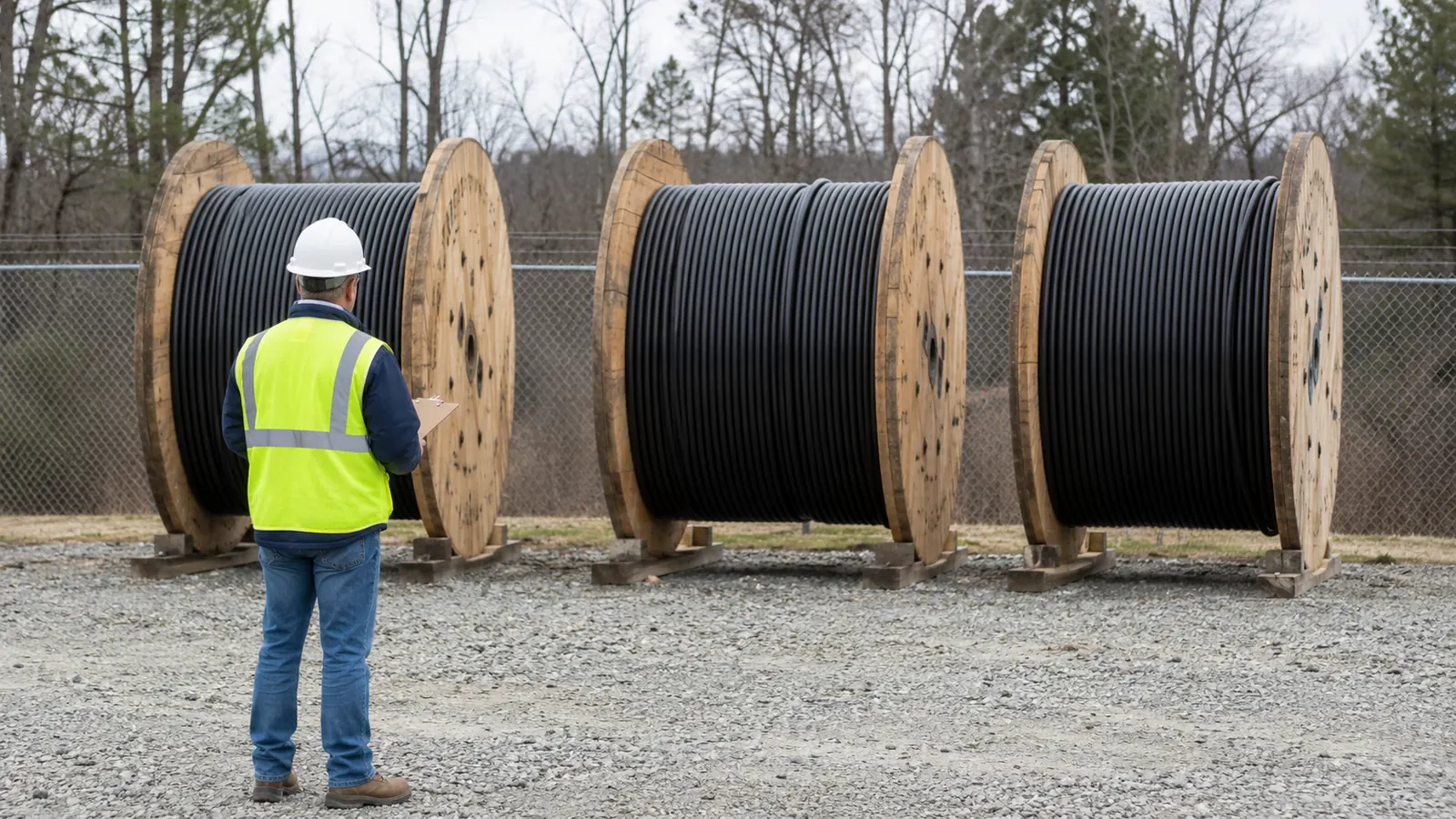
A fiber optic cable selection guide for ISPs must separate five purchasing decisions before a reel is released. Those decisions cover cable construction and glass category, plus the aerial-support method and armor as well as jacket listing. A requisition naming only 144 fibers can therefore specify the correct count while leaving the cable family wrong.
Buying the cable is a different job from designing the buried route or the aerial workfront. Those design packages live elsewhere. Fiber count is sized on its own sheet. Here we decide what to buy before anyone issues a reel.
Fiber Optic Cable Selection Guide for ISPs: Five Purchasing Decisions
A fiber optic cable selection guide for ISPs is a purchasing matrix with separate decisions for construction and glass, plus distinct decisions for aerial support and armor as well as jacket listing. ITU-T G.652 and G.657 set the glass. Telcordia GR-20 sets the OSP sheath baseline.
We keep those five lines on the same schedule. Mixing them is how a feeder that should have been G.652.D loose-tube arrives as indoor-rated ribbon with no water block. The warehouse will accept it. The route will not.
Recommendation ITU-T G.652, Characteristics of a single-mode optical fibre and cable, was approved on 29 August 2024 and is the edition in force. Recommendation ITU-T G.657, Characteristics of a bending-loss insensitive single-mode optical fibre and cable, was approved the same day. The G.657 file posted on 22 November 2024 was replaced on 5 December 2024 to correct a typo in the wavelength for the mode field diameter. We cite those 08/2024 texts, not the 2016 printings they superseded.
Telcordia GR-20, Generic Requirements for Optical Fiber and Optical Fiber Cable, Issue 4, published July 2013, is still the current GR-20 on the Ericsson Information Superstore and in the NSAI catalog as of this draft. ANSI/ICEA S-87-640-2023, Standard for Optical Fiber Outside Plant Communications Cable, ANSI-approved 5 May 2023, is the ICEA OSP companion. Neither document picks a manufacturer. We do not either.
Fiber count is a different question. Take rate, split ratio, spare policy and standard count steps belong in the separate fiber strand count design plan. This matrix assumes the owner already knows how many fibers the sheath must carry. Buying the wrong family at the right count is still a failed buy.
Draftech's in-house ISP network engineering writes the cable schedule against the route, not against a distributor's stock list. Engineering stays in-house. When construction is in scope, Draftech-managed subcontract crews deliver full turnkey under our QA/QC and safety program.
Cable Construction for OSP Purchasing
Construction is the first buy because it sets splice method, mid-span access and the diameter the duct or lasher has to accept. Glass and jacket ride on top of it. Get this line wrong and the later lines cannot save the reel.
| Decision | ISP choices | Default unless the route says otherwise | Document in force |
|---|---|---|---|
| Construction | Loose-tube / ribbon / microcable | Loose-tube on most OSP feeder | GR-20 Issue 4; ICEA S-87-640-2023 |
| Glass | G.652.D / G.657.A1 / G.657.A2 | G.652.D on long OSP; A1 at cabinets | ITU-T G.652 and G.657 (08/2024) |
| Aerial support | ADSS / figure-8 / lashed | Lashed on existing messenger | IEEE 1222-2019/Cor 1-2025; owner criteria and current manufacturer data |
| Armor | Armored or dielectric | Dielectric near supply; armor for crush or rodents | GR-20; NEC 770 for conductive members |
| Jacket listing | OSP PE / OFNR / OFNP | OSP outdoors; listed cable past 50 ft indoors | NFPA 70 2026 Article 770 |
Loose-tube
Loose-tube is still the OSP workhorse. Fibers sit in gel-filled or dry-blocked buffer tubes, SZ-stranded around a central strength member, so a tech can open one tube at a mid-span tap without disturbing the rest of the sheath. That is the construction that matches rural feeder in the Mountain West, where the usual event is a tap, not a mass-fusion factory splice.
GR-20 Issue 4 tests the finished cable for tensile load, compression, impact, cyclic flex, twist, temperature cycling and water penetration. ICEA S-87-640-2023 covers the same outdoor family for aerial, buried and duct placement. We write the product against those tests. We do not write a brand name on the schedule.
Ribbon
Ribbon earns the buy where mass-fusion splicing and high count in a small diameter matter. A 12-fiber ribbon that can be spliced in one arc is a hub lateral or a data-center handoff, not a farm-tap feeder. ANSI/ICEA S-87-640-2023 added a 200 μm coating option for ribbon. That option shrinks the stack. It does not make ribbon the right mid-span cable.
A 144-count ribbon specification can still be a poor fit when the planned work requires repeated single-tube access. Closure labor and access method belong in the selection record alongside fiber count. Write the splice method on the same line as the construction, or procurement may treat 144 as a ribbon trigger.
Microcable
Microcable is a reduced-diameter product intended for air-blown placement in microduct. Tensile and crush values are not the GR-20 duct-cable numbers. If the duct plan is not actually a microduct plan, do not buy microcable to save diameter on a drawing. The blow-in window is the product. Without that window, the smaller sheath is just a weaker OSP cable.
Indoor-rated microcable is a different listing again. Keep OSP microcable on the OSP line. The jacket section below is where OFNR and OFNP get written.
Glass: G.652.D and the G.657.A Categories
Glass is independent of construction. The same loose-tube sheath can carry G.652.D or G.657.A1. Mixing them in one span without a splice plan is how a cabinet that needed a 10 mm bend radius gets 30 mm fiber and a door that will not close without a loss event.
G.652.D
G.652.D is the low-water-peak single-mode fiber that remains the OSP default. Table 2 of ITU-T G.652 (08/2024) sets the mode-field diameter at 1310 nm in the 8.6 to 9.2 μm nominal range with a ±0.4 μm tolerance, and a 125.0 μm cladding. Macrobend performance is specified at a 30 mm radius, 100 turns, 1625 nm, 0.1 dB. That radius is fine on a pole line. It is not fine inside a 288-count cabinet.
Use G.652.D on feeder and backbone miles that stay relatively straight. The 08/2024 revision added statistical chromatic-dispersion guidance in a new appendix. It did not retire Category D. Older G.652 categories are historical. We do not specify them on a 2026 ISP buy.
G.657.A1
Category A of ITU-T G.657 (08/2024) is fully compatible with G.652. A1 is the cabinet and drop fiber. One turn at a 10 mm radius is limited to 0.75 dB at 1550 nm. Ten turns at 15 mm are limited to 0.25 dB at 1550 nm. Those numbers are why a pedestal in the Southeast can be dressed without a door-ajar loss complaint.
A1 splices to G.652.D. That is the point of Category A. We specify A1 where the route actually bends, not as a wholesale upgrade of every feeder mile.
G.657.A2
A2 tightens the bend further: one turn at 7.5 mm is limited to 0.5 dB at 1550 nm, and one turn at 10 mm to 0.1 dB at 1550 nm. This purchasing guide compares the A1 and A2 classes in the current 08/2024 edition. If a legacy schedule names a Category B fiber, verify that designation against the current selected-fiber datasheet instead of translating it automatically.
One thing I still catch in our own reviews: G.657.A2 written onto feeder miles that never see a 7.5 mm bend. That is a catalog habit. A2 belongs in trays and wall boxes. MDU shafts too. Paying A2 prices for rural messenger-lashed plant is how an ISP burns the material budget before the first tap.
Self-critical note: we have left A2 on feeder schedules because the catalog page listed it as the current indoor/outdoor glass. Compatibility with G.652.D is not a reason to buy the tightest bend class on every reel. Match the radius to the closure.
Aerial Support on Poles
Aerial support is a tension system, not a jacket color. The pole owner accepts the attachment. The cable either carries its own tension or rides a messenger the owner already accepted. Freeze that concept before anyone orders material.
ADSS
All-dielectric self-supporting cable carries its own tension in aramid or similar dielectric strength members. It belongs on electric-utility poles where no communications messenger exists, and where a metallic member next to supply is the wrong idea. IEEE Std 1222-2019, IEEE Standard for Testing and Performance for All-Dielectric Self-Supporting (ADSS) Fiber Optic Cable for Use on Electric Utility Power Lines, is the test basis, as corrected by IEEE 1222-2019/Cor 1-2025, published 8 October 2025. That corrigendum resets Aeolian vibration testing from 1 million cycles to 100 million cycles, matching the 2011 revision. A quote that still cites 1 million cycles is citing the uncorrected error.
IEEE 1222-2019, with Corrigendum 1-2025, is the current test and performance reference used here for ADSS. The selected cable manufacturer's current data and the pole owner's criteria still control span rating, sag-tension and jacket tracking under electric field. Those are design problems, not catalog assumptions. The installation path from pole to workfront is covered in our aerial fiber optical cable installation design guide. This section only picks the support family.
Figure-8
Figure-8 cable integrates a messenger in the same jacket, so the cross-section looks like an 8. Qualify the exact product against the pole owner's criteria and the current manufacturer's construction, loading and sag-tension data; this guide does not assign it to an unverified ICEA annex. Short self-support spans on a communications line are the usual fit. Long electric-utility spans are not. If the sag-tension sheet needs an ADSS model, figure-8 is the wrong buy.
Lashed
Lashed cable rides a separate messenger. It is still the cheapest telco default wherever strand already exists and the pole owner will accept the additional load. Overlash of an existing cable is a loading and clearance question, not a new-messenger question. We do not treat "lashed" and "ADSS" as interchangeable line items on a BOM. One of them needs a messenger the other does not.
Dielectric lashed cable stays dielectric. A metallic messenger is a separate bonding problem. Keep those two identities on the schedule or the entrance grounding note will be written against the wrong member.
Armor and Jacket Listings
Armor answers crush and rodents. Jacket listing answers fire. They are not the same column. A corrugated-steel-tape buried cable can still be unlisted PE, and an OFNP indoor cable can still be dielectric. Write both.
Armored cable is conductive cable under NFPA 70, National Electrical Code, 2026 Edition, issued 20 August 2025. Article 770 requires bonding or grounding of metallic members at the building entrance. Dielectric cable has no metallic member to bond. Near supply, dielectric is the usual OSP choice. In rock or rodent country, armor is the crush choice. A copper tracer on dielectric plant is how we keep the cable locatable without making it conductive.
Direct-buried construction, depth and restoration are not this matrix. Those live in fiber cable design for direct buried installation. Here we only decide whether the sheath that goes in the ground is armored, and why.
OSP jackets usually use UV-stable black polyethylene with moisture blocking. They do not carry a fire listing. OFNR is the nonconductive riser listing. OFNP is the nonconductive plenum listing. OFCR and OFCP are the conductive twins. General-purpose OFN/OFNG sits below riser. A PE reel that runs 80 ft across a Southeast hut backboard is an inspection problem. The Code's number is 50 ft.
NFPA 70 2026 Article 770 still permits unlisted outside-plant optical fiber cable to enter a building for 15 m (50 ft) from the point of entrance, outside risers and plenums, if it terminates in an enclosure. Rigid metal conduit or intermediate metal conduit can extend that point of entrance. Past the measured length, the schedule needs listed OFNR or OFNP. Vertical shafts and floor handoffs are riser cable design for multi-story buildings. This line on the matrix is only the listing we buy.
50 ft is not a suggestion. Unlisted OSP PE past the measured entrance is the listing failure an inspector can see without opening a closure. Write the transition on the schedule before the reel ships, or the crew will leave PE on the backboard because it was already on the truck.
Cable Selection Recommendations by ISP Type
Small rural ISP with a single-state plant: Keep the release process lean by assigning one owner to the controlled schedule and route evidence; whenever pole-owner or building-entry information remains unresolved, place only the affected segment on hold. Purchase release should wait until the selected manufacturer's data and the route record describe the same conditions.
Regional overbuilder on a 2026 BEAD schedule: Use segment-based release so engineering can clear one workfront while another remains in review. The controlled record should connect the approved route assumptions with the current splice method, then point procurement to the applicable manufacturer data and exception owner.
Campus or data-center ISP: Put facilities and network engineering on the same release record, with facilities owning the building-pathway evidence while engineering owns the interface decision and procurement waits until both authorities close their exceptions for the segment.
The useful outcome is not a vocabulary sheet. It is a controlled handoff that shows what can release now and what remains on hold. An exception can be corrected without reopening every accepted segment, and the next revision preserves who made the decision.
When the record is complete, the owner has a defensible material-release decision tied to current evidence.
Draftech keeps that schedule in-house. Active in 24 states. Available across all 50 U.S. states. If a live route needs the matrix applied before purchasing, start with a free 20,000-ft design review. For a cable schedule already in draft, reach out at info@draftech.com.