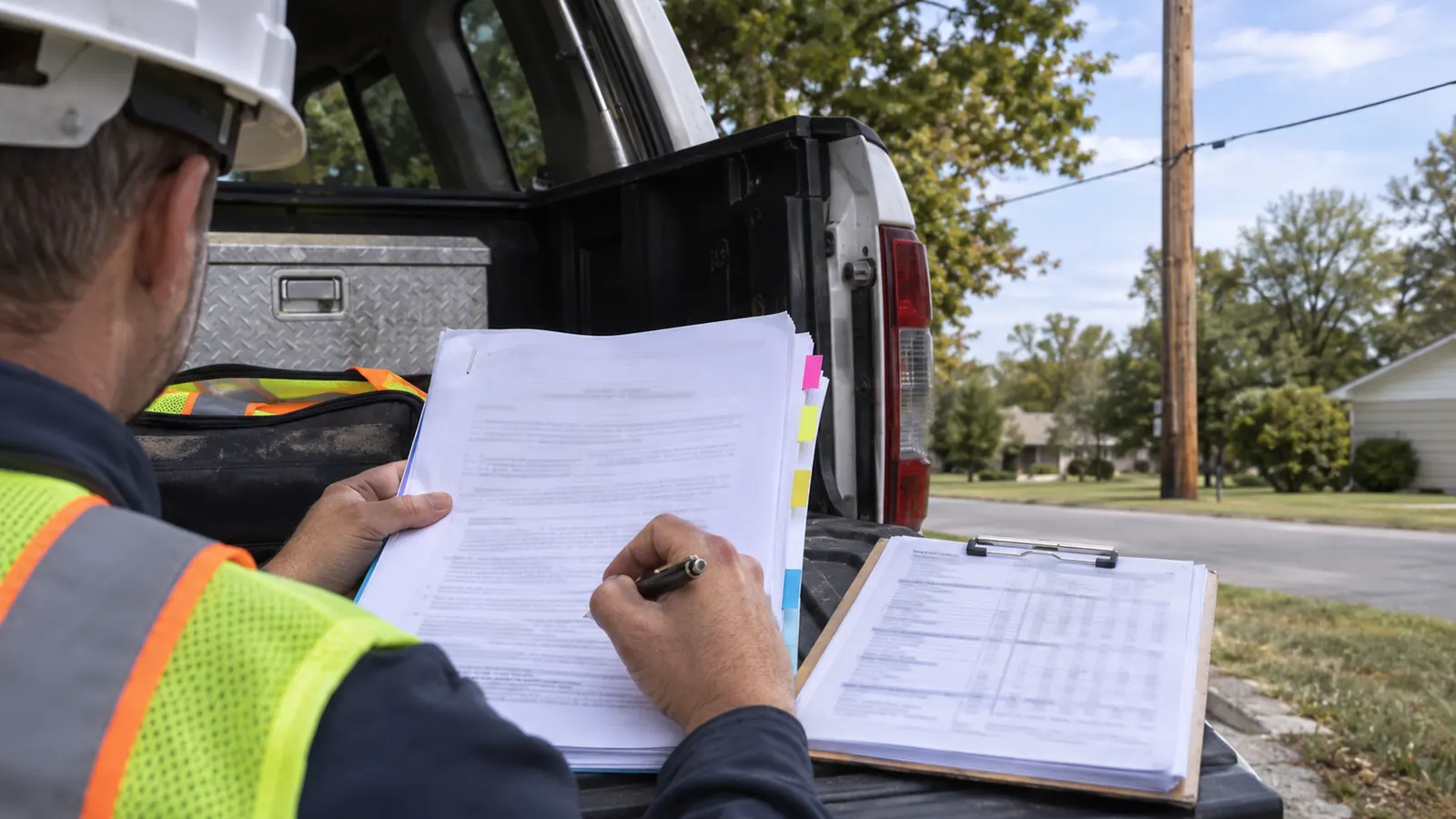
What a pole attachment agreement covers
A pole attachment agreement is the pole owner's license for an attacher to occupy its poles, documented in a stand-alone agreement, master agreement or, for some owners, a tariff. Its engineering requirements connect proposed facilities to applicable standards, including IEEE's 2023 National Electrical Safety Code, and to the owner's application process.
The signature establishes a working relationship. Individual poles still need review. For an ISP planner, the useful question is which obligations must reach the designer before a route becomes an application. A contract file that stays with procurement can leave our engineering team missing the owner's required attachment details, even when the client has already completed the commercial review.
Start with the governing documents. Ask the client for the executed agreement and the owner's current application instructions, then identify which construction standards those documents incorporate. An older attachment drawing can help explain existing plant, but it cannot establish which requirements govern a new request. Our package should let the reviewer connect each proposed facility to the correct owner and application record without having to reconstruct that relationship from email.
Counsel and the client control terms. Our role is to turn their direction and the owner's technical requirements into an engineering package; this article addresses that handoff rather than drafting clauses or interpreting contractual rights. The distinction matters when an application instruction appears inconsistent with the agreement, because the designer needs a resolved requirement before revising the work around an assumption.
Establish the owner and the licensed facilities
Ownership comes before form selection. A pole line can look continuous while the records identify different owners, and a carrier's existing cable does not by itself establish the right to add another facility. Ask the client to confirm the licensee's identity against the proposed application. Give us the relevant agreement reference with the pole inventory so the drawings use the same names and identifiers as the submission.
Under the U.S. Code's 47 U.S.C. 224, some pole owners fall within the federal framework and others do not; our discussion of pole attachment negotiation for ISPs explains why that distinction belongs in the client's review of the governing process.
Keep the continuing duties visible without letting them consume the design brief. Inspection and audit provisions determine what installed-plant evidence the attacher must maintain and provide, as discussed in joint-use audits. Transfers of attachment ownership can require notice or consent under the governing documents, so the client should resolve the licensee of record before applications change hands. Removal duties should identify how abandoned or retired facilities are documented and cleared from the owner's attachment records. Rent follows the applicable agreement or tariff and the licensed inventory, with the underlying concepts covered in our pole attachment rate calculation guide. A joint use agreement between pole owners governs their shared use of poles and is distinct from the license a communications attacher obtains to occupy them.
The pole attachment agreement application and its engineering
An application identifies the facilities the owner is being asked to accept. It needs a specific proposal. The FCC's pole access rule, 47 CFR 1.1411(c)(1), ties completeness to the information the utility needs under its procedures to make an informed decision, rather than to the presence of a generic drawing set. For our design work, that means reading the receiving owner's requirements before choosing the package contents.
Build from an identifiable pole record
Begin with the owner's pole identifier and reconcile it with the field location. A survey label created for routing may differ from the tag used in the owner's records; preserve that relationship so a calculation and an application row cannot silently refer to different structures. Photographs should support the recorded condition. If an identifier is unreadable or ownership remains uncertain, our submission notes should expose the unresolved item and assign it back for confirmation.
The drawing must distinguish existing plant from proposed work. Show the proposed attachment position and describe the cable assembly accurately enough for the reviewer to understand what will occupy the pole. Equipment dimensions belong with the equipment being proposed, while the loading inputs must reflect the actual cable and support arrangement. Manufacturer data should remain identifiable. Substituting a convenient catalog entry can change the calculation even when the plan symbol looks identical.
The agreement creates several different engineering handoffs. The table below separates the obligation from the evidence used to address it, so the client can identify missing inputs before our designers complete an owner-specific package.
| Agreement requirement | Design input | Application evidence |
|---|---|---|
| Identify licensed facilities | Confirmed owner and attacher identity | Pole inventory tied to the application |
| Describe the proposed attachment | Field observations and cable data | Existing and proposed attachment drawings |
| Establish required make-ready | Clearance and loading findings | Pole-specific work descriptions |
| Meet adopted technical standards | Applicable code and owner details | Calculations and referenced construction details |
Keep drawings and calculations consistent
Loading analysis should describe the same arrangement shown on the plan. If the designer changes an attachment height to address a clearance conflict, the analysis needs to reflect that change where it affects loading; the previous result cannot simply remain attached to the revised sheet. Check the adjacent spans. Their geometry and cable tension can affect what the structure must carry even though the application row names only the pole under review.
A package also needs an explicit treatment of missing information. An unverified pole class should stay visible as an unresolved input until the owner accepts a basis or the field record supplies the answer. Our preferred package review starts with those uncertainties because a neatly formatted report can still depend on an unsupported assumption. A real limitation of this approach is that document review cannot recover field measurements that were never collected.
Before submission, reconcile the pole count and identifiers across the application and engineering files. Revisions need the same discipline. Give us the owner's comment against the affected sheet or pole record, preserve the response, and check whether the requested change affects another part of the package. A corrected drawing with an unchanged attachment inventory can leave the reviewer looking at competing descriptions of the proposed plant.
Make-ready scope and who pays
Make-ready prepares the pole for the proposed attachment. The engineering task is to identify the work the design requires and explain why, while payment responsibility follows the applicable framework and the governing documents. Under the FCC's modification rule, 47 CFR 1.1408(b), allocation turns on the circumstances that necessitate a modification; a proposed replacement therefore needs a documented reason, not merely a replacement symbol on the drawing.
Separate the work from its allocation
The attacher generally funds work required to accommodate its proposed facilities, subject to the applicable allocation rules and agreement. That is a starting point for client review, not permission for an engineer to assign every observed defect to the new attachment. Preserve the existing-condition evidence. Where the pole already requires attention, our work description should distinguish that condition from the additional demand created by the proposed cable.
A clearance problem and a strength problem can produce different work. Moving an existing communication attachment may address available space, while a loading result may call for a different structural arrangement. The proposed solution needs to work as a whole. If a rearrangement changes the cable geometry used in the analysis, our designer must revisit the affected inputs before presenting the make-ready scope as ready for owner review.
The owner also determines the applicable process for work on its facilities. An engineering drawing should identify affected plant and dependencies clearly enough for the owner to assign or authorize the work through that process. Do not infer permission to move another attacher's facilities from a drawing note. The client needs the relevant authorization recorded against the scope being advanced, and our package tracking should preserve that distinction.
For a route whose attachment positions remain unsettled, our pole loading and make-ready engineering connects the proposed configuration to the analysis before it becomes the submitted work scope. The useful deliverable is a pole-specific explanation the owner can review. A route-wide note saying make-ready is required leaves the designer and the client without a clear basis for resolving comments on an individual structure.
Keep the reason attached: Preserve the observation or calculation behind each proposed make-ready action so a revised scope can be checked against the condition that prompted it.
Payment questions belong with the client's authorized reviewers once the technical basis is clear. Give them the relevant work description and the owner's supporting record, and keep their determination separate from the calculation result. Engineering can explain what the proposed attachment requires. The client then directs how the package should proceed under the agreed responsibilities, without asking our designers to settle the terms themselves.
NESC and the owner's construction standards
The design basis needs a named code edition. IEEE's National Electrical Safety Code, IEEE C2-2023, was published on 08/01/2022 and became effective on 02/01/2023; the applicable adopted edition and the owner's requirements must be confirmed for the proposed work. Record that basis with the package. The newest published book and the edition incorporated into a particular owner's requirements should never be assumed to be interchangeable.
Resolve the attachment geometry
Clearance review depends on what is being separated and the conditions used to evaluate that separation. A photograph gives context, but the design needs measurements and the applicable criteria. Our drawings should identify the proposed position clearly enough for the reviewer to check it against surrounding facilities. Where a field observation leaves the design uncertain, return the specific measurement question instead of placing an unsupported dimension on the sheet.
Owner construction standards address details the license incorporates into the work. These can govern acceptable assemblies or how facilities must be arranged on the structure. Use the relevant detail number and revision when the owner supplies them. If a proposed attachment cannot follow the published detail, our package should identify the departure and seek the owner's disposition through its process before treating that arrangement as accepted.
Strength screening serves a narrower purpose than a complete design. The free Pole Loading Calculator provides a screening pre-check of one tangent wood pole for NESC Rule 250B wind and ice load against its capacity by class and district; it is not a stamped pole loading analysis. Use that screening for the question it answers, then obtain the owner-required analysis for the actual attachment configuration.
Carry accepted changes through the package
A comment about attachment position can reach beyond the drawing where it appears. Changing the proposed geometry may affect the structural model or the make-ready work, so our response should identify the dependent files that need revision. Keep the owner's accepted disposition with the affected record. A designer joining the work later should be able to tell why the final configuration differs from the first submission.
Technical compliance and application completeness require separate checks. An analysis may support the design while the package still lacks a required owner form; conversely, every upload field can be filled while the drawings retain an unresolved clearance question. Our review should address both conditions before submission. The technical question needs engineering resolution, and the missing document needs the correct owner-specific evidence.
Next steps: turn agreement duties into an owner-specific package
ISP planning staff: Confirm the pole owner and the proposed licensee before committing the route to application production. Provide the governing documents with the pole inventory, and ask which uncertain locations could change the proposed path. That lets our designers focus field questions where the answers affect the route. Agreement coverage should be established before a planner treats an existing attachment corridor as available for new plant.
Carrier design staff: Establish the actual attachment configuration before asking for a final loading result. Supply the cable data and resolve discrepancies between the existing inventory and field observations. For screening under NESC Rule 250B, the selected district and pole class need a defensible basis; the full design must still address the conditions required by the owner. A model built around an assumed assembly cannot support a different assembly simply because both carry fiber.
Engineering-vendor permitting staff: Match the owner's intake requirements to the files being submitted and keep the comment response attached to the affected pole. Give us the current review record when taking over an application. A status label alone cannot explain whether an owner is waiting on a technical revision or a client decision. The handoff needs that distinction so the next submission answers the outstanding request.
Preserve the accepted revision: Before replacing an application file, retain the owner's disposition and identify which drawing version it addresses; an acceptance record should remain traceable after further design changes.
An engineering intake should name the unresolved decisions in plain language. State what must be confirmed, who can answer, and which deliverable depends on the answer. Our contact page provides a starting point for discussing the package with Draftech; include the pole owner's requirements and the proposed attachment scope so the conversation begins with the work the application needs.
Draftech's engineering is 100% in-house. Our pole attachment engineering service turns agreement duties into design inputs and an owner-specific application package, with attachment engineering, packaging and tracking connected to the same pole records. Counsel and the client retain control of terms. Send the engineering scope to info@draftech.com with the outstanding owner questions so we can identify the package inputs that need resolution.
For a route entering feasibility, the Draftech free-design offer can support the engineering work ahead: Draftech engineers the first 20,000 linear feet of a qualifying route at no cost, from feasibility and field survey through permit approval. The owner reviews each request before Draftech commits the package. That review gives us a defined basis for connecting the route's attachment requirements to the proposed engineering deliverables.