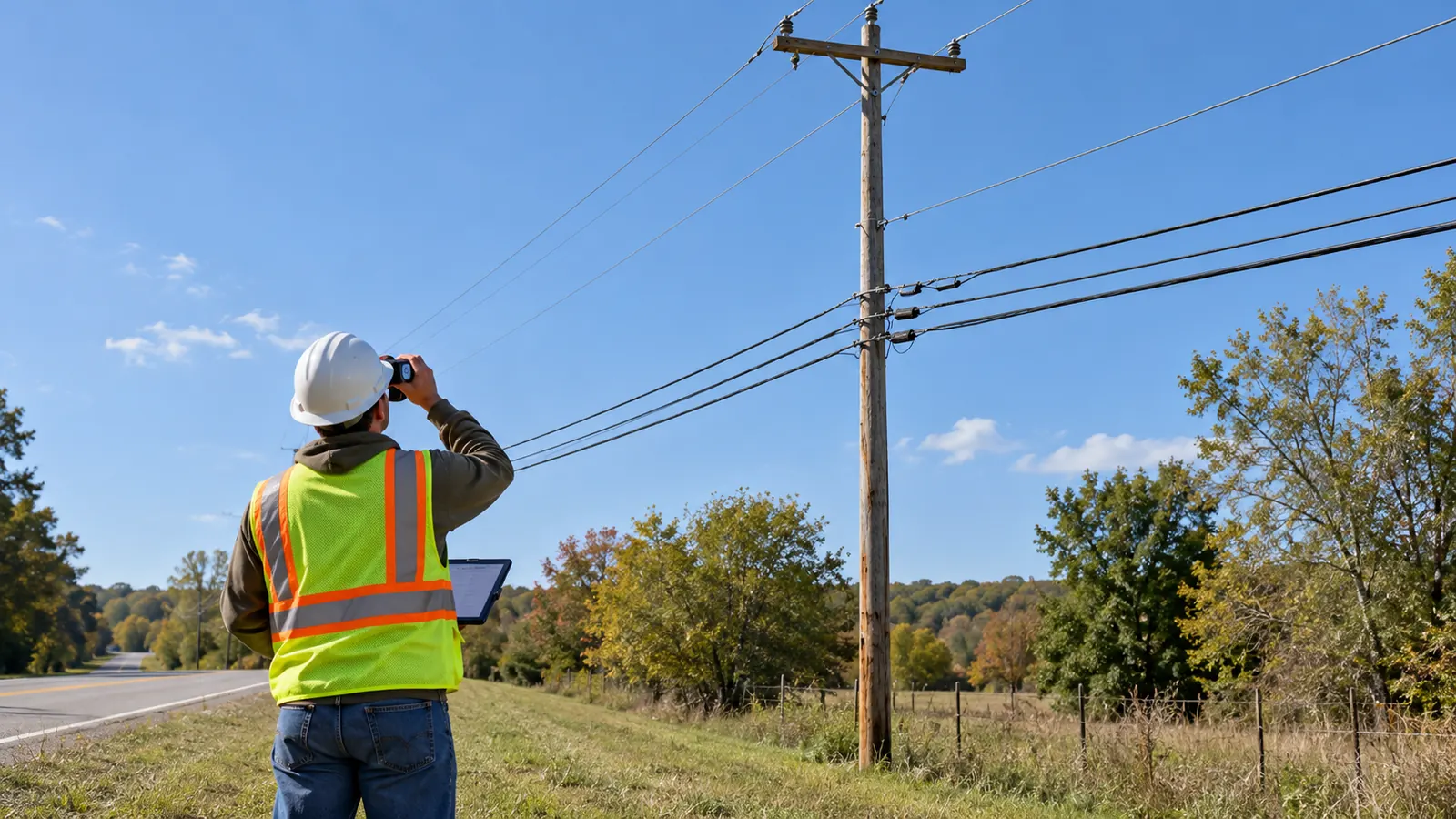
A pole inventory can disagree with the rental ledger without proving that an attacher owes another dollar. The equipment may have transferred to a different company, a replacement pole may carry an old identifier, or the permit may sit outside the database being searched. We start with the discrepancy and preserve the evidence needed to explain it.
An audit is useful to the pole owner when staff can act on its findings. This guide follows the work from defining the inventory through field collection and agreement review, then shows how we separate billing corrections from engineering work. It also explains what to leave unresolved when the evidence cannot support a finding.
What joint use audits establish for pole owners
For pole owners, joint use audits compare observed attachments with authorized and billed records across 3 linked questions: what occupies the pole, what the agreement permits, and what the account includes. We use the differences to identify possible unauthorized use, correct billing records, and refer observed safety concerns for qualified review.
Choose the decisions before choosing the fields
Before sending a crew out, decide what the audit needs to establish. An attachment census can support rental reconciliation. For a clearance review, the crew also needs measurements and a record of the conditions under which they were taken. A pole condition assessment has a different scope again. In our audit assignments, we name each required output so that a contractor cannot deliver a count where the owner expected an engineering assessment.
The owner should decide whether the inventory covers every attachment on owned poles and whether it also includes the owner's equipment on foreign poles. Keep those populations separate. A reciprocal joint use agreement can treat occupancy differently from a third-party attachment license, so the same physical arrangement may need a different account treatment depending on the parties and the governing documents.
When a crew observes a hazard, we refer it through the owner's established emergency or maintenance process without waiting for a disputed rental account to settle. The audit specification should identify the receiving contact and require a timestamped referral, while leaving electrical work and corrective access to authorized personnel under the owner's procedures.
Prepare records that analysts can reconcile
Before fieldwork begins, we ask the owner to retain the source inventory and its extraction date. The analyst can then distinguish a field discovery from a permit approved while the crew was surveying. Preserve later changes separately rather than overwriting the starting records and losing the basis for comparison.
The working package needs the executed agreements and their amendments, with the attachment permits tied to the pole identifiers used in the inventory. Billing staff should supply the applicable account structure and a defined billing period. Where records are missing, we mark the gap explicitly; an empty permit field alone cannot establish when equipment was installed or whether authorization once existed.
A visible cable, its supporting messenger, and equipment mounted nearby do not necessarily represent separate billable units under the applicable agreement. Settle that counting rule before the crew mobilizes. We keep the physical inventory detailed enough for review and apply the contractual counting rule afterward, so a change in interpretation does not require another field visit merely to recover observations.
Collect an attachment inventory that survives review
At each pole, record the visible tag and location, then compare them with the assigned asset record. If the two disagree, keep both values so the office can check the match. Where a tag is missing or unreadable, retain the location evidence and flag the proposed match for review. We want neighboring poles distinguishable even where the map places both at nearly the same point.
Record the structure and each attachment separately
With one parent record for each structure, we can link each attachment to the pole where the crew found it. Each attachment record contains the observed equipment type and the evidence for its owner, with an explicit unknown value when identification is uncertain. Capture the pole markings that can be read safely. Preserve the original observation when an office reviewer later confirms a different owner or corrects a transcription.
A whole-pole photograph gives the reviewer context for the closer views used to identify attachments. Crews should take those closer views only where it is safe and within the assigned scope. We require the images to remain linked to the pole and observation date. A folder of unindexed pictures makes a disputed attachment expensive to investigate, even when the relevant image is technically present.
Measured heights need a stated reference and method, including any obstruction that affects confidence. Record the attachment positions requested by the scope and relevant span context where clearance assessment is included. Do not infer a conductor's operating clearance from an isolated photograph. Temperature and sag conditions can matter, and the engineer needs enough information to determine what further measurement or modeling is necessary.
| Audit finding | Evidence to preserve | Owner's next decision |
|---|---|---|
| Observed attachment without a matched permit | Pole identity, ownership evidence and permit search | Request authorization records before classification |
| Billed attachment not confirmed in the field | Survey coverage and removal or transfer records | Verify absence and applicable billing treatment |
| Observed clearance or condition concern | Photos, measurements and observation conditions | Refer for engineering or maintenance review |
| Equipment remaining on a replaced pole | Both pole identifiers and transfer history | Assign the remaining transfer and removal dependencies |
Preserve uncertainty and check the collection
Cable color or position may suggest an owner. Before we use that identity in a notice, though, we look for a tag or seek confirmation from the attacher. Until then, the record should show that ownership is unknown. Record what the crew saw separately from the analyst's conclusion. That distinction lets an attacher challenge the interpretation without erasing the underlying field observation.
Test a pilot area before releasing the full assignment. Include difficult identification conditions and a replacement-pole location if those occur within the scope, then have office staff try to reconcile the delivered records. A limitation of our pilot approach is that later survey areas can present different collection problems even when the pilot records reconcile cleanly. We keep checking records during production rather than treating the pilot as proof of quality across the whole assignment.
Resolve rejected records early. Review a delivery while the collecting crew can still explain an obstructed view or ambiguous tag, and return the specific record with the missing evidence identified.
Electronic checks can catch duplicate pole identifiers and missing image links. To find out whether the records describe the attachments correctly, a reviewer must also compare selected entries with their photographs and arrange field verification where needed. We agree the acceptance criteria with the owner before collection. Otherwise, a technically valid spreadsheet can pass import while still leaving its attachment ownership unsupported.
Reconcile joint use audits to agreements and billing
Working from the governing documents, assign each attachment to the appropriate agreement and account, then trace the authorization record that applies to that pole. We keep the permit search result separate from the billing result because an authorized attachment can be missing from an invoice, while a billed attachment may still need its authorization history resolved.
Investigate unmatched attachments
When an attachment has no matching authorization, search former pole numbers and documented ownership changes before classifying it as unauthorized. Ask the apparent attacher to supply the relevant authorization, and preserve both its response and the owner's decision. If the agreement provides a dispute process, the notice should follow that process rather than borrowing a deadline from another utility's procedure.
Throughout that exchange, we retain one discrepancy identifier linking the field observation, permit search and final determination. The identifier stays with the finding even when the proposed owner changes. That continuity prevents a rejected allegation from reappearing as a new finding in the next export. It also shows billing staff which conclusion supersedes an earlier draft.
The collection date tells us when the crew observed the attachment; it does not independently establish when the equipment was installed. Keep that date visible during review. Any proposed retrospective charge needs the agreement's authority and evidence supporting the relevant period. Before proposing a charge, we ask the owner's contract administrator to review those inputs.
Resolve billed attachments that the crew could not confirm
If the crew cannot find a billed attachment, check whether it surveyed a replacement pole while the billing record still points to the retired asset. Vegetation may also have prevented a reliable observation. Check survey completeness before proposing a credit. We retain the original billed record until the responsible owner representative accepts the correction and its effective date.
A removal record can explain the discrepancy but still leave the account timing open. Match the documented removal to the contract's billing provisions and preserve the approved adjustment separately from the current inventory. This is where disciplined electric utility as-built records help: they give the reviewer a documented change to investigate instead of only an unexplained difference between two totals.
Before finance receives the accepted changes, each proposed addition or deletion needs its pole-level basis and disposition. Exclude contested entries from automatic posting. After processing, we reconcile the imported account totals back to the approved changes. A correct audit can still produce an incorrect invoice if a billing import drops identifiers or duplicates a batch.
Assign corrective actions without losing the finding
In the action register, commercial decisions and physical work need separate entries, including when attachment ownership remains unresolved. A record correction may close through administrative acceptance, while a clearance concern stays open until the responsible technical reviewer determines the required response. We assign a responsible party and closure evidence to each action. Scheduling a site visit alone does not establish that the underlying condition has been resolved.
Refer clearance and loading concerns
For the safety assessment, establish which code edition applies to the work. IEEE C2-2023, the 2023 National Electrical Safety Code, was published August 1, 2022, with an effective date of February 1, 2023. The owner and engineer must establish the edition and applicable revisions governing the particular work. We record that basis with the assessment instead of labeling every photographed spacing concern a confirmed violation.
Pole class and observed equipment give the engineer a starting point for a loading investigation. Reaching a capacity conclusion also requires evaluating the required geometry and loading assumptions. For the limited initial question, the free Pole Loading Calculator provides a screening pre-check of one tangent wood pole for NESC Rule 250B wind and ice load against its capacity by class and district; it is not a stamped pole loading analysis.
Do not close the finding on that screen alone. Where a referral leads to distribution or make-ready design, our electric utility engineering scope connects the inventory evidence with the engineering work needed to address it. The audit should retain the referral reference so the eventual disposition can be traced back to the observed attachment.
Separate urgency from disputed ownership. Send an observed safety concern through the owner's designated response process immediately when that process requires it, even if the responsible attacher remains under investigation.
Resolve attachments on replaced poles
Record both poles at a replacement location. Identify which attachments remain on the old structure and preserve the relationship to the new asset, rather than collapsing the pair into one map point. A transfer can remain incomplete after the supply work has finished. Our guide to pole attachment transfers explains the dependencies that determine who can move next.
We keep the old pole's disposition open until the owner has evidence that the required transfers and authorized removal are complete. A closed ticket can arrive while equipment is still in place; when that happens, retain the discrepancy and request clarification. The audit should describe the physical condition rather than adopting a ticket status as proof.
Before corrective construction begins, the owner decides the permitted scope and the parties responsible for execution under the applicable agreements. Draftech International provides full turnkey construction through Draftech-managed subcontract crews, with engineering performed 100% in-house. An audit finding can initiate that work, but its discovery alone grants neither access nor permission to alter another party's facilities.
Recommended next steps: accept the audit and maintain the attachment records
Staff accepting the audit need to be able to retrace how a decision was reached. Deliver the reconciled inventory with its data dictionary and preserve the original observations, then identify the unresolved exceptions without burying them inside a final total. We ask the receiving team to open selected attachments from the delivered database and follow them through to the supporting evidence before accepting the package.
Choose the next step by the owner's problem
For an owner with unreliable rental records: prioritize identity matching and agreement reconciliation before issuing account adjustments. Our first review batch should be small enough for finance to validate against its actual import process. This exposes account-mapping problems before the owner applies changes across the audit area, while allowing supported corrections to proceed separately from disputes.
For technical reviewers with unresolved field concerns: put qualified technical review ahead of a billing campaign. Assign each concern to the appropriate response process and retain the engineering disposition. Where safe access or adequate measurements are missing, require the follow-up needed to answer the question. A final report should say which conditions remain unassessed and why.
For coordinators managing recurring transfer backlogs: organize the open work by replacement location and dependency. Give the responsible coordinator a view of the attachment that prevents the next authorized task from proceeding. For us, progress means receiving accepted transfer evidence and a final pole disposition. Counting reminder messages sent to attachers tells the coordinator little about whether the equipment has moved.
Keep the accepted inventory current
After closeout, someone needs responsibility for maintaining the accepted inventory. New permits should update the attachment inventory through a defined process, and completed removals should reach billing with the accepted effective date. We retain revision history so the next audit can compare like periods. Without that maintenance, even a carefully reconciled census starts drifting as soon as field changes resume.
Audit frequency belongs in the owner's program and agreements. Set the next review around the governing requirements and the condition of the records, rather than assuming every owner needs the same cycle. Draftech International is a turnkey telecom and power infrastructure company; our company background explains the team behind the work. Active in 24 states. Available across all 50 U.S. states.
If unmatched attachments are keeping your staff from closing accounts or assigning corrective work, our joint use engineering for pole owners connects audit findings to actionable review. Send the scope question to info@draftech.com, including the inventory boundary and the decision your current records cannot support. We can then discuss the evidence needed to resolve that gap.
When audit findings feed a qualifying route project, consider Draftech's free design offer: we engineer the first 20,000 linear feet at no cost, from feasibility and field survey through permit approval. The owner reviews each request before Draftech commits the package, so the proposed route must be reviewed before that engineering scope is confirmed.