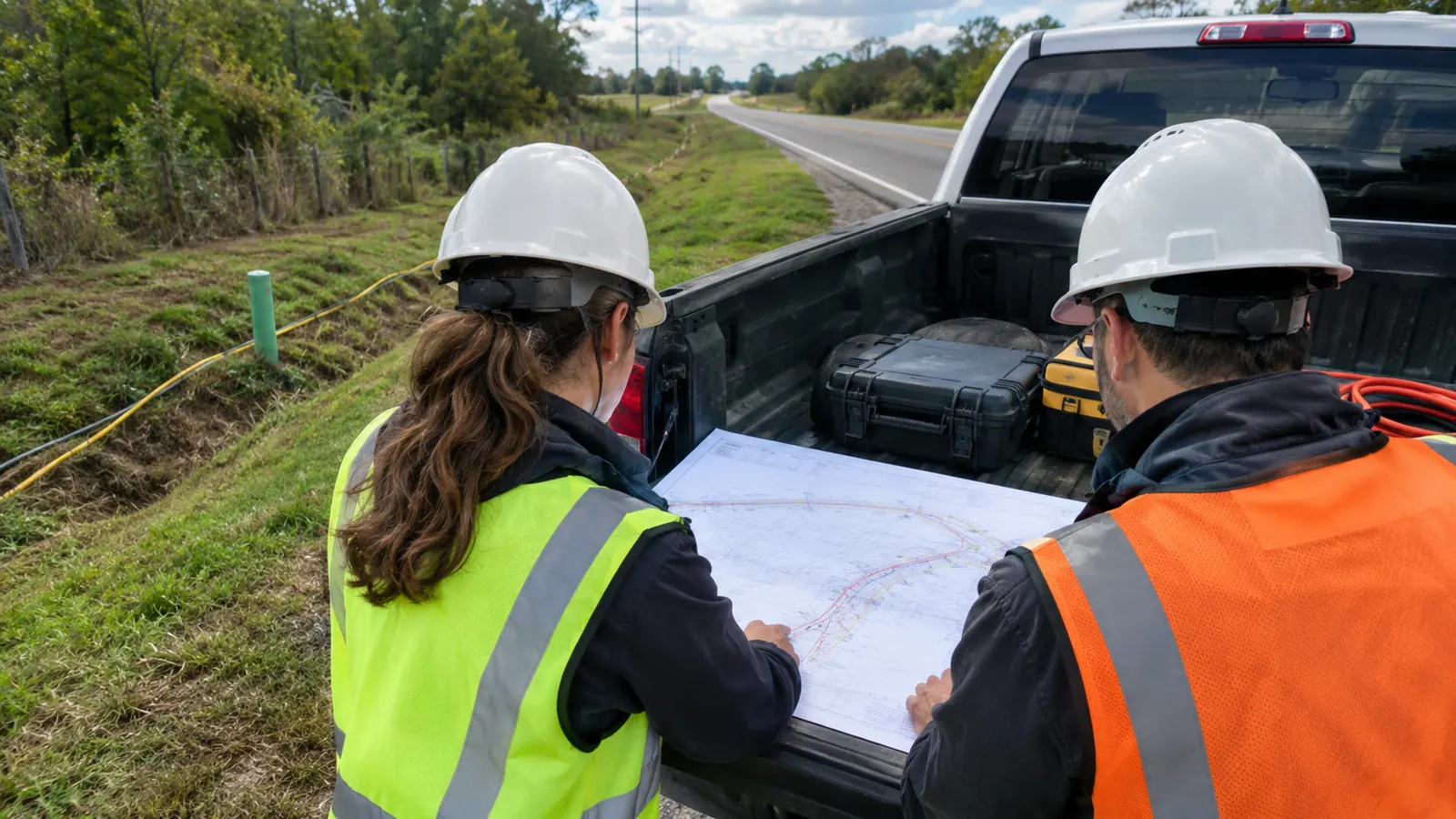
Closeout on a large fiber build starts long before the final sheet issue. One segment may reach drafting while the next is waiting on a crossing photograph. Elsewhere, a splice change remains in notes. If those states share one almost-complete label, the final set hides exactly where the record stopped being trustworthy.
This guide uses a rolling release model built around controlled segments. Evidence follows each segment into review and remains attached after owner acceptance. Operations receives a baseline it can query without calling the crew that installed the work.
How to Manage As-Built Drawings for Large Fiber Projects
How to manage as-built drawings for large fiber projects starts by dividing the network into controlled record units. This guide uses Draftech's 6-state project-control model: captured, evidence checked, drafted, technically reviewed, owner accepted and operational baseline. These are proposed control states, not a federal or industry minimum.
A large project needs more than a final closeout date. It needs a record architecture that can absorb continuous changes without mixing unfinished work into accepted plant. We assign stable segment and asset identifiers before construction, then link every redline, photograph, test record and permit disposition to those identities. The map is one view of that evidence chain.
FHWA’s Digital As-Builts program describes digital as-builts as a valuable repository of design and construction information for lifecycle asset management. The program calls for searchable, accessible records and durable geospatial information that supports interoperable exchange and later extraction. FHWA guidance is written for transportation agencies, not as a universal telecom specification, but those information qualities transfer directly to fiber operations.
Choose a record unit that can actually close
A whole county or ring is usually too large to control as one closeout object. One missing crossing can hold everything open, while teams start calling partial exports final. We use route segments with defined endpoints tied to splice enclosures and handholes. Pole or cabinet records connect each segment to the governing structure and permit. The unit stays small enough to inspect without losing network continuity.
Each unit receives a unique ID and a declared evidence package. Aerial and underground sections may need different attributes, yet they still share the same release logic. Boundaries should not cut through an unresolved splice relationship or hide a route transition. Good segmentation makes exceptions visible. Bad segmentation merely moves ambiguity to the edge of a sheet.
Use Draftech’s Six-State As-Built Release Model
The table below defines the six-state Draftech project-control model used in this guide. It is not a federal mandate or an industry standard. Owners can use different names, but each state should have an exclusive meaning. A segment cannot be owner accepted while it still awaits field clarification. That contradiction is the source of many unreliable final sets.
| State | Required evidence | Blocking defect | Release owner |
|---|---|---|---|
| Captured | Linked redlines, photos and coordinates tied to construction notes | Evidence cannot be tied to segment or asset | Field lead |
| Evidence checked | Required fields present and conflicts logged | Missing source or unexplained contradiction | Records coordinator |
| Drafted | Geometry and attributes updated to checked evidence | Drawing or GIS departs from evidence | CAD/GIS lead |
| Technically reviewed | Connectivity, quantities reconciled to tests under the permit effects | Network relationship or acceptance basis remains open | Engineering lead |
| Owner accepted | Package and exceptions formally disposed | Unapproved change or incomplete deliverable | Owner authority |
| Operational baseline | Accepted data loaded and retrievable in systems of record | Import changes meaning or breaks identifiers | Operations data owner |
Captured means linked evidence, not a marked sheet
A redline becomes useful when its mark is tied to a segment, feature, date, reporting person or crew, change reason and supporting evidence. A photograph needs the same relationship; otherwise, a folder of images named only by time cannot support clarification once the crew and location are no longer available. Construction should submit changes at a defined cadence.
The capture form should distinguish installed position from proposed position and observed condition from inferred meaning. Crews can report that a handhole moved or a bore exit changed. Engineering determines the effects on connectivity, cable length and permit compliance. The splice plan must reconcile with the asset inventory. Field staff should not approve consequences outside their assigned authority.
Evidence checked is the first real gate
We require the records coordinator to check completeness and identity before drafting. Every change needs a stable asset or segment ID. Coordinates and offsets establish position, while photos must support the recorded notes and measurements. Conflicts enter a discrepancy log with an owner and due date. They do not disappear into a general verify-in-field note after the crew has demobilized.
The fiber construction record accuracy method explains why source quality must remain visible. Large programs should classify evidence confidence by source type and intended use. A measured coordinate and a sketch derived from memory can both be retained, but they should never appear as equivalent certainty in the operational baseline. We preserve both observations because operations needs to distinguish surveyed location evidence from a remembered sketch before either value influences maintenance or excavation planning.
Closeout cadence: review field evidence while the segment remains active. Draftech often uses a weekly unresolved-item meeting as a project control when that rhythm fits construction, because missing facts still have an owner and a reachable location. The contract should set the actual cadence.
Keep Drawings, GIS and Splice Records in Parity
Large fiber projects usually have several valid representations: plan sheets, GIS features, splice diagrams, test files, permit records and construction quantities. They do not need identical schemas, but they need stable cross-references. A cable ID shown on a plan should map to the same cable in GIS and the same sheath relationship in the splice record. Otherwise, reconciliation becomes manual detective work.
We define a field owner for every class and a system of record for each accepted value. Geometry may be maintained in GIS, while signed permit sheets remain the controlling record for a jurisdictional condition. Splice relationships may live in a dedicated inventory platform. The as-built package should state those roles instead of forcing one file to pretend it owns every truth.
Propagate one accepted change through every affected view
A moved handhole can affect route geometry, cable length, stationing, permit offsets, splice access, maintenance notes and accepted quantities. The change log identifies affected artifacts before release. The post-construction as-built update workflow covers single-package correction. At program scale, the additional challenge is proving that the same disposition reached every dependent system.
We begin relationship review with a real event, such as a moved handhole. Follow the accepted location into GIS and inspect the cable IDs that touch it. The splice record should explain endpoint changes. If one view points to an asset that the next view cannot resolve, log the orphan against the source disposition rather than guessing which file is right. Automation can expose the broken reference; a reviewer with release authority decides what it means.
Freeze baselines without freezing legitimate corrections
Every issued package needs a baseline ID, issue date, included segments, source cutoff and approval status for each open exception. Later evidence does not overwrite that history. It creates a new revision with a reason and affected objects. Operations can then distinguish the handoff baseline from subsequent corrections. The baseline also states which exceptions remain usable for operations and which ones block release; a nearly complete package cannot hide the segment that controls continuity.
ISO 19650-1:2018 outlines concepts and principles for information management using building information modelling across built assets. It does not prescribe a telecom as-built naming scheme. Its emphasis on organized information management supports common data states and defined exchanges, while the owner’s contract must still establish exact file formats and authorities for a fiber program.
Manage Exceptions as First-Class Records
An exception is not a failure when it is explicit and controlled. A blocked survey point differs from a pending easement record. An inaccessible structure may require another field method, while a third-party splice needs outside evidence. Permit-restoration work and repeated tests follow their own closure paths. The log identifies consequence and owner before stating whether technical acceptance is blocked.
Do not use one percent-complete number as a proxy for record health. A program can be nearly complete by sheet count and still lack the one river crossing or backbone splice that controls continuity. We report acceptance by segment and defect class. That lets leadership see whether the remaining work is field evidence, drafting, engineering disposition or owner review before the record enters system import.
Keep redlines and accepted as-builts separate
Redlines are evidence of reported change. Accepted as-builts are the owner-approved representation after reconciliation. The redline versus as-built comparison explains why neither should silently replace the other. On a large program, retaining both states makes disputed changes traceable and helps auditors see whether drafting corrected a mark or invented a disposition. That distinction protects later audits because a corrected drafting mark has a different evidentiary history from an engineering disposition created after the field source was captured.
Our rolling-release model has a limitation: teams may optimize local segment acceptance while missing a network-wide contradiction. We counter that risk with cross-segment checks at ring and service-area boundaries. The reviewer follows cable and splice relationships across each shared boundary. Matching filenames, clean local sheets or two accepted status flags cannot prove network continuity.
Exception rule: we keep the segment state and exception state separate. Operations can use accepted data without forgetting the unresolved consequence and no open item disappears inside an accepted filename.
Load the Operational Baseline; Prove Retrieval
Owner acceptance is not the end when operations uses another platform. The accepted package must be imported and checked against stable IDs. Geometry, connectivity, attributes and document relationships must survive. Access controls still govern attachments. Because export formats can drop domains or truncate values, we compare the loaded result with a frozen acceptance sample and record every intentional transformation.
FHWA’s Guide for Digital As-Builts Using Simplified Digital Workflows, report HIF-24-062, describes as-built drawings as essential construction documentation that captures changes and deviations while supporting operations and maintenance. The companion integrated-workflow guide, HIF-24-061, addresses more connected digital delivery. Neither guide dictates telecom acceptance, but both reinforce designing the handoff for lifecycle use.
Test questions, not just files
Before declaring the baseline complete, give operations a maintenance ticket drawn from the real network. First ask staff to identify the accepted segment and continue the fiber path to the next enclosure. Then introduce a disputed structure location. The record should lead them to its photograph and controlling permit condition without help from the team that assembled the package.
Retention and access follow the owner’s policy. Some records may contain sensitive route or equipment information, so broad availability is not the goal. Authorized users need dependable retrieval, while revision controls prevent accidental overwrite. We record the archive location and its operational-system relationship. The export method names a custody owner who can prove the recovery procedure. That test is concrete.
Keep construction and engineering accountability accurate
Draftech performs engineering in-house. When construction is included, Draftech provides full turnkey construction through Draftech-managed subcontract crews under our QA/QC and safety program. Field evidence can come from managed crews, inspectors, survey teams or owner representatives, but technical reconciliation and release stay with the designated engineering and owner authorities.
The records team should not wait for the final invoice to discover the construction reporting format. As-built requirements belong in kickoff documents, subcontract requirements, daily or weekly reporting, inspection plans and change control. Payment gates apply only where the owner directs. Record quality is produced during installation. Closeout assembles and verifies it.
Choose the Next Release for a Large Fiber Program
While crews are still active: release the next segment only after its field evidence resolves to stable identities. A discrepancy needs an owner before the location becomes expensive to revisit. Drawing volume can wait for review.
When closeout becomes the workstream: sort the backlog by operational consequence. Backbone continuity should outrank cosmetic sheet consistency. If a system migration is also planned, load one representative accepted segment into the target platform before scaling the transfer. Preserve uncertainty instead of filling an evidence gap from memory.
Draftech’s in-house as-built documentation service connects field evidence to controlled records. Our engineering accountability keeps release authority visible. Active in 24 states. Available across all 50 U.S. states.
The next release should be the segment whose missing evidence creates the greatest operational risk. Backbone evidence outranks cosmetic corrections. An unresolved crossing may do the same. Once that segment enters the owner’s system and operations can retrieve the accepted evidence, the release has done real work. For an independent review of how to manage as-built drawings for large fiber projects, email our documentation team.
Field truth is cheaper to keep when the issued design was right to begin with. For a new segment, Draftech engineers the first 20,000 linear feet free, through permit approval, so the as-built program starts from an issued package with stable identifiers. Every request is reviewed before we commit.