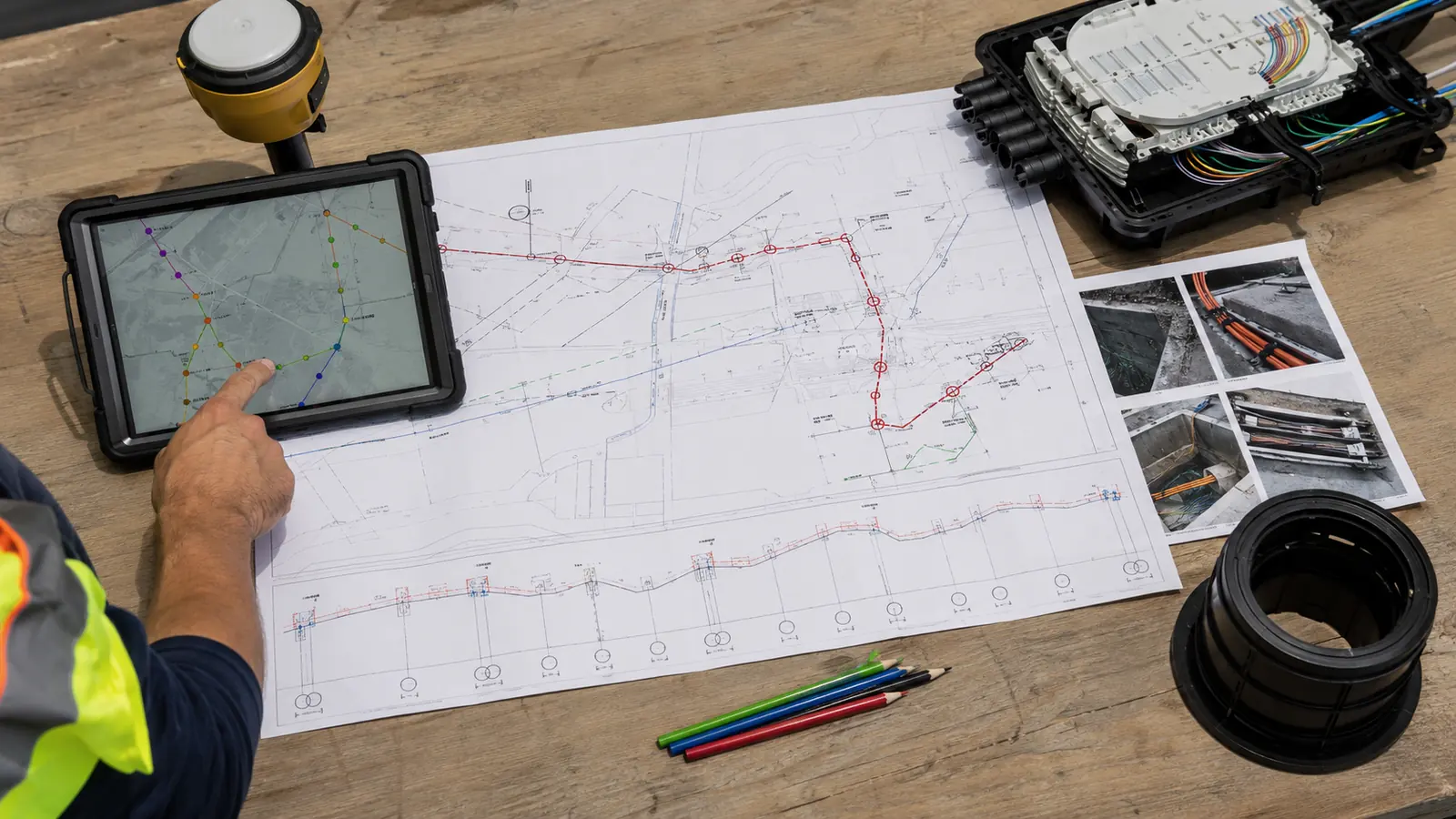
- What Should Fiber As-Built Drawings Include? 7 Connected Record Families
- Record Final Route, Structures, Cable, and Connectivity
- Tie GIS, Photos, Tests, and Revisions to Stable Asset IDs
- Reject Closeout Packages That Cannot Reproduce the Installed Network
- Release the Final Handoff Through One Controlled QA Record
A clean drawing can still be a poor as-built. If its route geometry is copied from design, its structures use unstable labels, or its splice sheets cannot be tied to test files, the page records intent rather than the installed network. Closeout succeeds when every important relationship survives the handoff.
This guide presents Draftech's recommended QA method. Owner standards, contracts, permits, funding requirements, and system-of-record rules remain controlling, and no company framework replaces a project-specific acceptance requirement.
What Should Fiber As-Built Drawings Include? 7 Connected Record Families
What should fiber as-built drawings include? They should record the installed network through 7 connected record families: final route, structures, cable, connectivity, GIS, evidence and revision control. This 7-family model is Draftech guidance, not an industry measurement, and each owner can require additional fields, formats, tests or approvals.
We define an as-built as the accepted installed record, not a redlined construction sheet and not a design file with revision clouds removed. It tells operations where the assets are, how cables and fibers connect, which evidence supports acceptance, and why the final condition differs from the issued design. The distinction protects every use that follows.
The authoritative baseline is clear. The FOA Installation Standard 2025, section 13.1, identifies OSP documentation including route or GIS location data, exact fiber paths and intermediate connections, fiber and cable identification, connector and splice styles and locations, insertion-loss data and optional OTDR traces. Project requirements can go further.
What Should Fiber As-Built Drawings Include for Reuse?
Our review question is practical: can a qualified person who did not build the package locate an asset, trace an optical path, find the supporting evidence, and identify any open condition? We use that retrieval test as Draftech guidance rather than a measured industry pass rate. If the answer depends on the original field collector's memory, the handoff is not ready.
Stable identifiers are the connective tissue. A pole, handhole, cable segment, closure, splitter, panel, port, photograph, and test file must keep consistent identities across drawings, GIS, schedules and the final index. We do not treat a close-up photograph or a test trace as evidence until its name and context tie it to the asset and accepted work.
For teams that want this control managed from field evidence through final transmittal, our as-built documentation services connect in-house engineering, GIS, drafting and QA/QC. Construction can be delivered full turnkey through Draftech-managed subcontract crews under our QA/QC and safety oversight, while engineering and final documentation control remain in-house.
Route and connectivity also need defined limits. A closeout package should say where its responsibility begins and ends, which adjacent records are references and which interfaces were not verified. We treat that boundary statement as part of Draftech's recommended handoff method, not a universal owner format. Clear limits stop a complete segment record from being interpreted as proof for an unreviewed upstream or downstream facility.
| Record family | Minimum relationship | Release test |
|---|---|---|
| Final route | Installed geometry to approved corridor | Can the alignment be found? |
| Structures | Asset ID to location, type and access | Can each support point be identified? |
| Cable | Cable ID to limits, type and fiber count | Can the segment be traced? |
| Connectivity | Splice, port and intermediate connection | Can the optical path be followed? |
| GIS | Geometry to attributes and coordinate metadata | Do map and drawing agree? |
| Evidence | Photos and tests to asset or segment IDs | Can acceptance be reproduced? |
| Revision control | Approved changes to final issue status | Is installed intent auditable? |
Start with the physical chain. Keep every limit explicit.
Record Final Route, Structures, Cable, and Connectivity
Route geometry should express the installed alignment and construction method at the level the owner requires. We reconcile approved redlines, field evidence, structure locations, transitions, crossings and defined limits before final issue. A design centerline left unchanged after an accepted reroute creates a confident-looking error, so source and revision status matter as much as linework.
Location data needs a stated coordinate reference and enough method metadata for the owner to understand what was measured. We do not assign a universal accuracy value because contract and system-of-record requirements vary. Where evidence has different confidence, our guidance is to preserve that status rather than convert every point into an apparently equal survey observation.
Structures provide the route's physical index. Pole, handhole, vault, pedestal, cabinet, building entrance, riser, and transition records should use the owner's required attributes and stable IDs. The as-built should also preserve the relevant pathway relationships, such as direction, occupancy, and connected structures, without assuming that every owner wants the same schema.
Cable records connect physical route to logical use. We capture the accepted cable identification, type, fiber count, segment limits, endpoints and owner-required status fields. Length or slack information is included only when supported and required. A number copied from design should not be presented as installed fact merely because the final form requires a populated cell.
Connectivity records identify intermediate connections, splice styles and locations, assignments, express paths, panels, ports, terminals and other owner-required relationships. The goal is an end-to-end trace that agrees across the splice record, drawing, GIS and inventory. Our fiber network as-built GIS standards explains why those links must begin during field delivery, not during final drafting.
We separate known, approved, rejected and open information. An unlabeled blank invites guessing; an explicit exception tells the next team what remains unresolved. That principle is Draftech documentation guidance, not a claim that every owner uses the same status names. The receiving system and contract determine the final vocabulary and acceptance authority.
Evidence needs identity. Files alone prove little.
Tie GIS, Photos, Tests, and Revisions to Stable Asset IDs
GIS and drawing deliverables must describe the same network even when they serve different users. We compare route geometry, asset identifiers, cable relationships, status and revision across formats. A correct PDF paired with stale GIS creates two sources of truth, while a correct database paired with an outdated closeout sheet produces the same operational risk in reverse.
Photographs should prove a condition, not merely show that someone visited the site. The file or index needs the asset or segment ID, useful context, orientation when required, status and relationship to the accepted work. We reject evidence that cannot be matched to the record. A close-up of hardware with no identifiable location is weak closeout evidence.
Test evidence follows the same rule. Insertion-loss data and any required OTDR trace need naming and cross-references that identify the path and endpoints under the owner's test plan. We avoid inventing universal limits, wavelengths, directions or acceptance criteria. Those values come from the controlling specification, and every exception must carry its disposition and retest evidence when required.
The grant-compliant as-built services guide works best when record naming is established before testing begins. Waiting until turnover forces a documentation team to reverse-engineer abbreviated files, handwritten splice changes and duplicate structure labels. We prefer a controlled index generated from stable IDs so evidence lands in its final relationship as it is collected.
Revision history should preserve why installed conditions differ from design. Field redlines are inputs, not final approval. We reconcile each material change to its engineering or owner disposition, show where the accepted response reached the drawings and data, and keep issue status clear. Deleting history may make the sheet look cleaner while making the final condition harder to defend.
Draftech closeout guidance: test the links before polishing the sheets. Trace a structure, cable, fiber path, photograph and required test through the record. This is a recommended QA method, not an industry performance statistic.
Grant or program records can add another receiving format without changing the control principle. The BEAD as-built closeout guide shows why route, status, and evidence must remain traceable when data leaves the design environment. State and owner rules vary, so we do not generalize one program's closeout fields into a universal fiber standard.
Export checks deserve their own attention. Layer names, domains, attachments, links, coordinate metadata, and character encoding can change when a source system creates a delivery file. We compare the delivered output rather than assuming a correct source database guarantees a correct export. Our QA record identifies the export date, accepted issue, reviewer, and any transformation the receiving team must understand before import.
Reject Closeout Packages That Cannot Reproduce the Installed Network
A package can be complete by file count and still fail technically. Typical breakdowns include routes that remain at design status, duplicate IDs, cable schedules that disagree with GIS, splice records that stop at intermediate connections, photos without context, tests without endpoints and redlines without approval. Our QA review checks relationships rather than rewarding folder volume.
We recommend two review lenses as Draftech guidance, not an industry benchmark. The first checks format, completeness, identifiers, coordinates, required attributes and file access. The second checks whether the installed system makes engineering sense across route, structures, cable, connectivity, evidence and revisions. Passing the first lens cannot compensate for a broken optical path.
Automated comparisons can identify duplicates, missing relationships, status conflicts and geometry differences. They do not decide whether an approved field change is technically acceptable. In-house engineering reviews the exceptions that affect design intent, while documentation QA confirms that the accepted answer reached every dependent output. Our network documentation software comparison explains why a tool cannot replace data ownership.
Construction positioning also belongs in the record. Draftech offers full turnkey construction through Draftech-managed subcontract crews under our QA/QC and safety oversight, never management-only and never as a claim that all physical work is self-performed today. Engineering is in-house. Accepted field changes and crew evidence must therefore reach the same controlled closeout package.
The rejection decision should be specific. We identify the asset or relationship that fails, the controlling requirement, the evidence needed for closure, the responsible party and the accepted disposition. Vague comments such as fix as-builts force the preparer to guess. A precise exception shortens review without weakening accountability or altering the owner's acceptance authority.
Review comments should preserve closure evidence, not disappear when a sheet is corrected. We keep the finding, response, reviewer decision and affected deliverable linked in the QA record. This does not mean every markup belongs in the operating system forever. It means the accepted issue can be traced to a documented review, and an open exception cannot be hidden by producing a newer-looking file.
A candid limitation of our record-first method is that it cannot recover facts nobody captured in the field; a disciplined index exposes a missing splice photograph, but it cannot recreate one after closeout. That hurts. Our in-house documentation chain reduces handoff gaps while leaving the receiving owner's schema and acceptance authority in control.
Release the Final Handoff Through One Controlled QA Record
For owners with a mature records team: accept contractor-prepared files only when your team controls the schema, reviews exceptions, and can reproduce the installed route plus connectivity from the submitted evidence. For programs with fragmented field inputs: use one controlled as-built workstream that links stable asset IDs to drawings, GIS, photographs, tests, revisions, and the receiving authority before final acceptance.
Final release begins with a transmittal index that names the accepted drawing issue, GIS or database export, cable and splice schedules, photograph index, required tests, change record, open exceptions and receiving authority. The 7-family grouping remains Draftech guidance. It is useful because it exposes a missing relationship without pretending every owner needs the same file names.
We verify that native data and reviewable documents carry compatible identifiers and status. Native files support future edits and system import; reviewable files preserve the accepted issue. Both are only deliverables when the contract requires them. We do not infer a universal format rule from one owner, state or funding program. The receiving requirements control.
For owners with a mature records team, a contractor-prepared package can work when the owner controls the schema, acceptance and integration. For programs with fragmented field inputs, our recommendation is direct: use a controlled as-built workstream that connects field evidence, in-house engineering, GIS, drafting and QA/QC before final acceptance.
Operations then performs the practical retrieval check. Find an asset, trace its route and connectivity, locate the supporting evidence and identify any restriction or open condition. This one retrieval exercise is Draftech guidance rather than an industry measurement. It reveals whether the handoff works for a new user rather than only for the team that assembled it.
Retention and access must match the owner's information rules. We identify the final storage location, access responsibility, superseded issues, and linked evidence without inventing a universal retention period. The handoff should remain usable after temporary project folders and personal working directories are gone. A file that exists but cannot be opened, interpreted, or connected to its asset is not an operational record.
Final acceptance is recorded by the authority named in the project requirements. Our QA recommendation is simple: release no package while its index and accepted files disagree.
If your closeout scope has conflicting formats, unstable identifiers, or no agreed evidence index, email info@draftech.com. We can help define the record relationships and acceptance path before late-stage reconciliation turns a documentation problem into a construction or operations delay.
Talk to our as-built documentation team about your handoff. Bring the owner requirements, current data model, sample field evidence, and known exceptions so the review can start with the actual record chain.