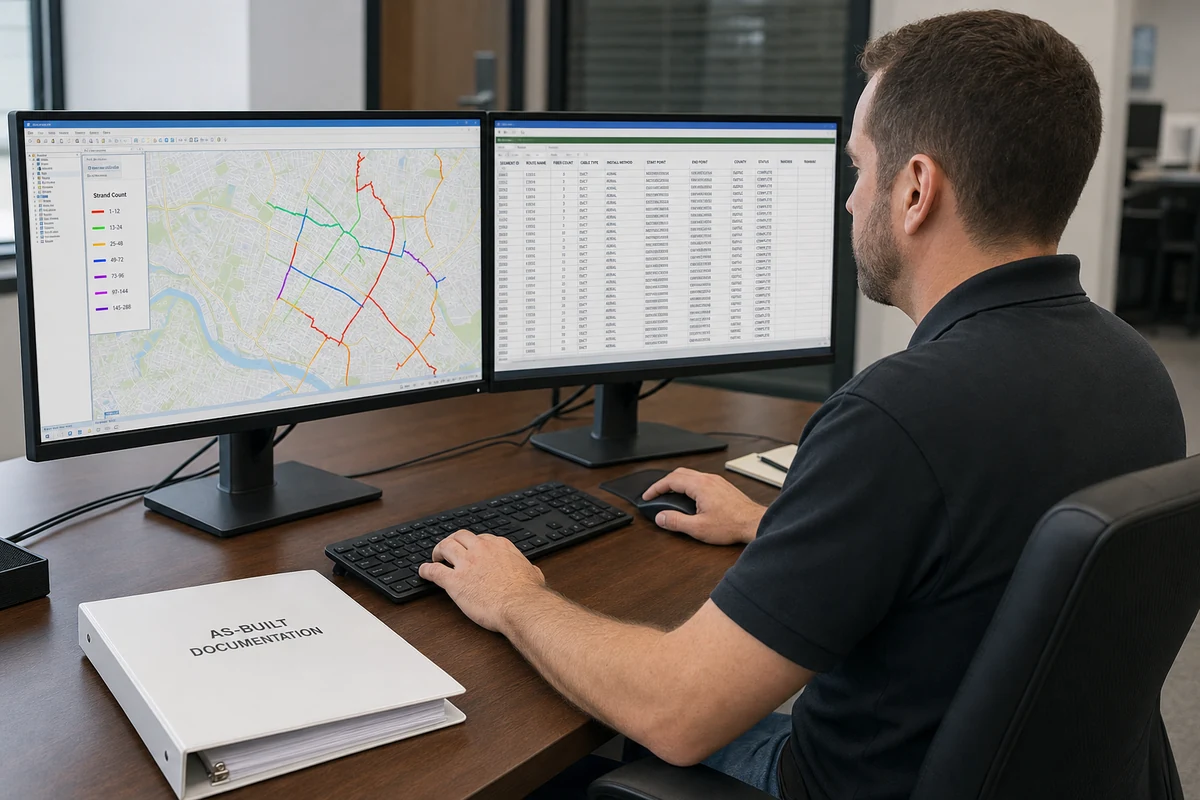
The grant doesn't close until the as-builts pass. And most first-time BEAD and ReConnect recipients don't know what "pass" means until they get their first rejection notice. Grant-compliant fiber as-builts are not the same as construction as-builts. They require a specific GIS schema, PE-stamped drawings, photo documentation standards, and formatting that matches your state or federal program office's data requirements. The gap between what your construction contractor delivers and what the program office will accept is often the difference between a timely closeout and a 90-day correction cycle that delays your final draw. This article covers exactly what's required, what gets rejected, and how to spec your as-built deliverables upfront so you're not retrofitting them 90 days past your closeout deadline.
What "Grant-Compliant" As-Built Documentation Actually Means
There's a definition gap that burns a lot of first-time grant recipients. Most engineers and ISPs understand "as-built" to mean updated construction drawings reflecting what was actually built versus what was designed. That's a construction as-built. It's useful for operations, maintenance, and future upgrades. It is not the same thing as a grant-compliant as-built.
Grant-compliant as-built documentation is construction documentation plus a GIS data package in a specific attribute schema, photo documentation tied to GPS coordinates, PE certification, and a submission package formatted to match your program office's portal requirements. Each element is independently required. Missing any one of them means a rejection, not a conditional approval, not a revision request you can fix in a few days. A rejection with a formal correction window.
NTIA BEAD requires specific GIS attribute fields: fiber strand count, deployment status codes, location type codes, technology codes, and ownership fields, among others. USDA ReConnect has its own schema, with its own required fields and submission format. And state broadband offices, who administer BEAD subgrants, add requirements on top of the federal baseline. Virginia has different additional requirements than Mississippi. Mississippi has different requirements than Minnesota. The program office you're reporting to matters.
If your engineering firm has never closed out a BEAD or ReConnect grant package, they're learning on your dime. The documentation requirements are not intuitive from a standard OSP engineering background. They're grant administration requirements that happen to apply to engineering deliverables. That distinction is worth understanding before you execute a contract for as-built services.
See also: fiber as-built documentation for BEAD grant closeout for a full breakdown of what BEAD closeout packages require at the program office level.
The NTIA Broadband Data Collection Schema
NTIA's Broadband Data Collection (BDC) schema is the federal baseline for BEAD as-built GIS. Understanding it precisely is the difference between a GIS package that passes automated validation and one that fails before a human reviewer ever sees it.
The BDC schema defines required and optional fields for three record types: location records, fiber line records, and infrastructure records. Required fields for location records include: provider_id, location_id (must match NTIA's official Broadband Fabric location IDs, not your own internal address IDs), technology code (FTTH = 50), deployment_status code (deployed = 2), speed_down and speed_up in Mbps, latency, business_residential code, and the CAI (Community Anchor Institution) flag.
That last item, location_id, is where a significant number of GIS packages fail. Your served locations must match NTIA location IDs from their official Broadband Fabric dataset. This isn't your address database. It's not your own geocoded point layer. It's NTIA's fabric, and your locations must align to it. Coordinate mismatches between your GIS and the fabric, even small ones, trigger automated validation failures. If your project serves 1,200 locations and 47 of them don't match fabric IDs, those 47 locations are rejected. That's a partial denial of your closeout package.
Fiber line records require geometry (as LineString), strand count, deployment type, and route classification. Infrastructure records cover FDHs, splice enclosures, headends, and midspan repeaters, with location, ownership, and asset-type fields required for each.
The GIS data must be submitted in a format compatible with FCC's Broadband Map, typically Shapefile or GeoPackage. State broadband offices then layer their own additional attribute requirements on top of the federal baseline. For a comprehensive breakdown of GIS standards for fiber networks, see our piece on fiber network as-built GIS documentation standards.
Getting the federal schema wrong means your GIS package fails automated validation before a human reviewer even sees it. At that point, you're waiting for a correction notice, a correction window, and a resubmission review cycle. In a BEAD program where state program offices are managing dozens of subgrantee packages simultaneously, correction cycles don't move fast.
PE Sign-Off: What It Covers and What It Doesn't
A PE stamp on as-built drawings certifies that the PE has reviewed the documentation and it accurately represents what was constructed in compliance with the approved design and applicable engineering standards. It does not certify that every physical measurement was personally observed by the PE. Understanding that distinction matters when you're managing PE involvement on a project that spans hundreds of route miles.
In practice, the PE reviews construction photos, GPS-verified record drawings, field technician documentation, and contractor as-builts to certify accuracy. The stamp goes on the drawing set, typically one PE-stamped plan per route segment, organized by sheet. Some state program offices require an additional PE certification letter separate from the stamp itself. That letter is a separate deliverable. It's not the same as the stamp on the drawing.
The failure mode that costs the most money: PE review happening on a drawing version that gets revised afterward. A PE stamp certifies a specific version of a document. If your construction team makes field changes after the PE reviewed the package and those changes get incorporated into the drawings without a follow-up PE review, the stamp on the current version is invalid. That's not a technicality. Program offices check revision dates and stamp dates. If they don't match, you get a rejection.
Adding PE involvement retroactively after closeout documentation is assembled is expensive. The PE has to reconstruct the review process: re-examining photos, re-verifying GPS coordinates against the drawing set, re-confirming that field changes were properly documented. That's billable time, and it's time you didn't budget for. Know your program office's PE requirements before construction begins, and build PE review into your documentation workflow at defined milestones rather than treating it as a single closeout event.
For a complete overview of engineering compliance requirements, see the BEAD subgrantee engineering compliance checklist.
Photo Documentation Standards for Grant Closeout
Both BEAD and ReConnect require photo documentation, but the specifics vary by program and state. What doesn't vary: photo documentation is independently reviewable by the program office, and gaps in photo coverage are among the most common rejection triggers in grant closeout reviews.
At minimum, your photo documentation package needs to cover: installation photos at each infrastructure element (FDHs, splice enclosures, midspan repeaters) showing the completed installation with the element clearly visible; aerial attachment photos showing compliant pole attachment heights and any make-ready work that was completed; bore pit and conduit installation photos for underground segments, including photos of conduit placement and depth where required; and GPS-tagged photos that can be tied to specific route segments in your GIS package.
That last requirement, GPS metadata on photos, is where construction crews consistently fall short. Most field technicians are not thinking about GPS metadata. They're thinking about getting the splice done. If you don't establish a photo protocol before construction mobilization that includes GPS-enabled capture and metadata verification, you will not have GPS-tagged photos at closeout. You will have a folder of photos with no location data, and you will spend weeks trying to reconstruct which photo corresponds to which route segment using visual context clues and contractor memory.
Common failure modes beyond missing GPS data: photos that don't show the element clearly enough (wrong angle, poor lighting, the splice enclosure is partially obstructed), and missing coverage for specific segments that the program office chooses to spot-check. BEAD state program offices are increasingly conducting targeted spot-checks on photo documentation, not just verifying that photos exist. They're verifying that the photos actually show what they're supposed to show, at the locations they're supposed to cover.
A photo documentation protocol needs to be established with construction crews before they start. Not after closeout when you're trying to reconstruct what was done from two-month-old field markups and contractor recollections.
What Gets Rejected at Grant Closeout
Based on the closeout packages we've worked through, the rejection triggers cluster into a consistent set of categories. Knowing them in advance lets you structure your documentation process to avoid them.
GIS attribute errors are the most frequent. Wrong technology codes: a common error is submitting technology code 40 (fixed wireless) for a project that deployed FTTH, which should be code 50. Missing required fields, particularly the CAI flag and location_id fields. Coordinate errors: served locations that don't align with NTIA fabric location IDs. These errors cause automated validation failures before human review and require a full GIS package resubmission.
PE stamp on wrong document version is the second most common. Construction field changes get incorporated into drawings after PE review. The stamp date no longer matches the revision date. The program office catches it. You need a new PE review of the revised package.
Photo documentation gaps: missing segments or elements, photos without GPS metadata, photos that don't clearly show the documented element. Spot-checked segments with incomplete photos generate correction requests.
As-built drawings that don't match construction: the design was revised during construction, the revision was flagged in the field, but the documentation wasn't updated to reflect what was actually built. This happens when contractor as-builts aren't properly reconciled against the approved design before submission.
Data formatting errors: submitted in wrong projection, wrong file format, wrong attribute field names. Some state portals have strict upload format requirements. Submitting a GeoPackage when the portal requires Shapefile, or vice versa, triggers immediate rejection regardless of data quality.
BEAD state program offices are conducting more rigorous technical reviews than USDA ReConnect rounds 1 and 2. The tolerance for incomplete documentation is lower. The review criteria are more specific. And subgrantees who are accustomed to the ReConnect process are discovering that BEAD closeout documentation requires a higher level of precision. Plan for it.
How to Spec As-Built Services Upfront
The questions to ask your engineering firm before construction starts, not during closeout:
Does your team have documented experience closing out BEAD or ReConnect grants? Not "have you worked on BEAD projects": specifically, have they assembled and submitted as-built packages to a program office and received approval. These are different things. An engineering firm that designed a BEAD network but handed off closeout to another party has no useful closeout experience. You need a firm that has been through the submission-rejection-correction-resubmission cycle at least once.
Can you provide the GIS attribute schema you'll use and confirm it matches our program office's requirements? Ask for this in writing before you execute a contract. A firm that can produce this document immediately has the schema built. A firm that needs to research it is starting from scratch on your project timeline. The schema documentation should reference the specific NTIA BDC version they're working from and any state-specific additions applicable to your project location.
What photo documentation protocol do you use with construction crews? This should be a written protocol, not a verbal understanding, that gets distributed to all construction crews at mobilization. It should specify GPS-enabled capture requirements, required angles and coverage for each infrastructure element type, and the file naming and organization system that ties photos to route segments and GIS coordinates.
Who is the PE of record and what's their review process? Specifically: at what project milestones does PE review occur, how are field changes communicated to the PE for stamp validation, and what's the turnaround time for PE review at each milestone? A PE who reviews at a single closeout event is a higher-risk arrangement than a PE who reviews at defined construction milestones throughout the project.
What's your revision turnaround if the program office requests corrections? Some correction windows are 30 days. Some are 60. If your engineering firm's standard revision cycle is 45 days, a 30-day correction window is a problem before it starts. Know the answer before you're in a correction window.
Draftech's as-built process includes schema validation against program office requirements before construction begins, not after. We maintain a parallel GIS dataset throughout construction, updated as field work progresses, so the closeout is verification and QC rather than reconstruction. We've closed out BEAD and ReConnect packages for projects from 50 to 800 route miles across 24 active states. For more on the design-to-closeout workflow that supports compliant documentation, see our overview of fiber network HLD requirements for BEAD subgrantees and the broader field survey, route design, permit drawings, pole loading analysis, utility coordination, and construction-ready deliverable standards for OSP fiber networks.
"Grant closeout documentation is where underprepared engineering firms get exposed. Draftech has closed out BEAD and ReConnect packages for projects from 50 to 800 route miles. We know what state program offices reject, because we've already solved those problems."
Approaching grant closeout? Draftech delivers PE-stamped as-built documentation, GIS packages in NTIA-compliant schema, and photo documentation coordination for BEAD and ReConnect projects across all 50 U.S. states. See our as-built services or request a project consultation.