IN THIS ARTICLE
A replacement pole can change the fiber route before anyone orders an automated switch. The proposed cabinet needs working space, the communications cable needs an approved attachment position, and a planned underground crossing may move the point where both systems meet. We scope those interfaces while the design can still change.
For electric utilities and co-ops, this guide connects distribution improvements to buildable work packages. We cover physical plant and the communications supporting field devices, with the operating utility setting the required electrical functions. The practical question is which decisions must be settled before a drawing reaches a crew.
What does grid modernization include on distribution systems?
Distribution grid modernization upgrades the physical network and the communications that support its operation. We organize this guide around 4 connected workstreams: pole replacement and hardening; undergrounding; distribution automation; and joint-use fiber attachments. A useful project scope identifies the condition being corrected and the acceptance evidence for each affected asset.
The work starts with an operating need. A utility may want remote visibility at a feeder device or a replacement for deteriorated pole plant. Because those objectives lead to different drawings, we separate the intended function from the proposed construction method so an early equipment preference does not dictate the entire route.
Separate physical exposure from operating visibility
Hardening addresses the physical vulnerability of distribution assets. Automation addresses what the utility can observe or command through field devices and its operating systems. Both can belong in one project, but installing a communications cable on an exposed pole line does not remove the exposure of the poles carrying it.
To guide the survey, we ask the owner to describe the unresolved condition in terms that can be checked at acceptance, such as an inaccessible cabinet location or a field device without an approved communications path. The same statement gives reviewers a reason to question scope additions that do not serve the stated objective.
Set a clear boundary for the route
A route boundary should follow the work that must function together. Stopping a fiber drawing at the last pole leaves an unresolved interface if the cable still needs to enter a cabinet across a private parcel. We identify the termination point and the party responsible for the connection beyond it.
For readers defining the underlying assets, our distribution system guide from feeder to service drop explains where the work sits. A modernization scope should visibly distinguish existing assets that remain from those being changed. Without that distinction, a sheet showing proposed equipment can be mistaken for authority to alter adjacent facilities.
The owner also needs a usable baseline for later comparison. Our baseline preserves the starting asset identifiers and the reason each location entered the program, rather than keeping only a map of the final proposed route. A future inspection can then distinguish a corrected defect from a location deferred for further investigation.
How to scope grid modernization before equipment selection
The initial package should connect the utility's objective to field conditions. We request available asset records and compare them with the proposed limits of construction before deciding where detailed collection is needed. Where records disagree, even a pole number appearing on a map needs a defensible match to the physical structure before it can support the design.
Resolve field uncertainty where it changes the design
Survey effort should follow the decisions it supports. At a replacement pole, attachment geometry and access can change the proposed arrangement; at an underground crossing, existing utilities and entry conditions can change the alignment before a contractor develops its installation plan. We keep unresolved observations attached to the affected location in the design record.
Photographs provide context, but they cannot establish every concealed condition. Underground records need an appropriate verification plan, and a pole's visible condition does not answer every structural question. For each uncertainty, our design record names the unresolved condition, assigns someone to resolve it and identifies the evidence needed before design can proceed.
Scope boundaries also need agreement between departments. The communications group may own fiber acceptance while operations owns permission to place a connected device in service. Before issuing construction drawings, we name both receiving parties because a completed cable test can leave the operational handoff unfinished even when the physical installation is acceptable.
A single location register helps connect these decisions without forcing every discipline into the same drawing. We use the register to relate asset identifiers to proposed work and open questions. Each discipline can keep its necessary detail while giving the owner enough information to trace a changed cabinet location into the affected fiber sheet.
| Workstream | Scoping question | Evidence needed for release |
|---|---|---|
| Pole replacement and hardening | What condition or exposure drives the change? | Verified pole arrangement, supporting design and transfer responsibilities |
| Undergrounding | Where can the route enter, run and terminate? | Investigated alignment, crossing details and approved surface equipment locations |
| Distribution automation | What must the field device communicate? | Owner requirements, communications interface and acceptance procedure |
| Joint-use fiber attachments | What must change before the cable is installed? | Attachment approval, make-ready disposition and transfer sequence |
Choose pole hardening or undergrounding by the condition
Pole replacement changes more than the structure
A replacement pole requires a proposed arrangement that accounts for the facilities staying on the line. We examine the existing attachments against the intended construction and identify which parties must move their facilities. In addition to pole height, the proposed configuration must satisfy the applicable loading and clearance requirements, which the design needs to address for that arrangement.
Hardening can include replacing deficient poles or changing structural arrangements where the engineering supports that treatment. The chosen treatment needs to address the vulnerability identified for that asset. Our distribution grid hardening engineering connects those field conditions to the construction package, and our guide to prioritizing distribution hardening develops the treatment-selection question further.
Transfer work deserves its own attention. If a communications attachment stays on the old pole while power facilities move to the replacement, the drawings and coordination record need to identify that interim condition and who closes it. We make completed transfers a condition of removal, keeping a clear disposition for retained infrastructure in the pole-replacement package until those transfers are finished.
A pole position that works structurally may still leave too little space for installation equipment or future maintenance, making access part of the location decision. We ask for access constraints during fielding and carry them into the review, so the proposed structure is evaluated in the place where managed crews will have to build it.
Undergrounding needs a complete transition
Moving a distribution segment underground changes the route's exposure and its construction constraints. The alignment must work between the overhead transitions, with accessible locations for the specified surface equipment. Checking the ends first can expose an unresolved riser or termination location at the parcel boundary, even where the intervening trench corridor looks usable.
At crossings, we use available utility information to develop specific details and identify further investigation needed before committing to the proposed alignment. A general note to avoid existing utilities cannot establish a buildable path when the available space and the proposed installation method have not been reconciled.
The trade-off with undergrounding is that it reduces exposure to some overhead hazards while making access to buried assets dependent on the route and its surface conditions. Equipment locations still need appropriate treatment for their environment. Our recommendation for selective conversion depends on whether the investigated route addresses the owner's defined problem and can be maintained.
Power and fiber may share a corridor without sharing a conduit arrangement. We keep their installation requirements distinct and coordinate where their routes interact. The owner must accept the proposed separation and access provisions. Where an easement covers one use, the scope also needs confirmation that it authorizes the other proposed use before construction release.
Construction access can change at a road crossing even when the proposed alignment remains fixed. We identify the space needed for the selected installation approach and coordinate the surface work with the relevant agency requirements. Showing that working area on both the permit and construction drawings helps the agency and contractor review compatible uses of the same corridor.
Connect distribution automation to a usable fiber path
An automated device needs a defined communications function before a fiber route can be designed around it. We ask the utility what information must reach the operating system and how the device is expected to behave when communications are unavailable. Those operating decisions remain with the utility; we carry the resulting requirements for the approved connection and access into the physical package.
Design the connection through the cabinet
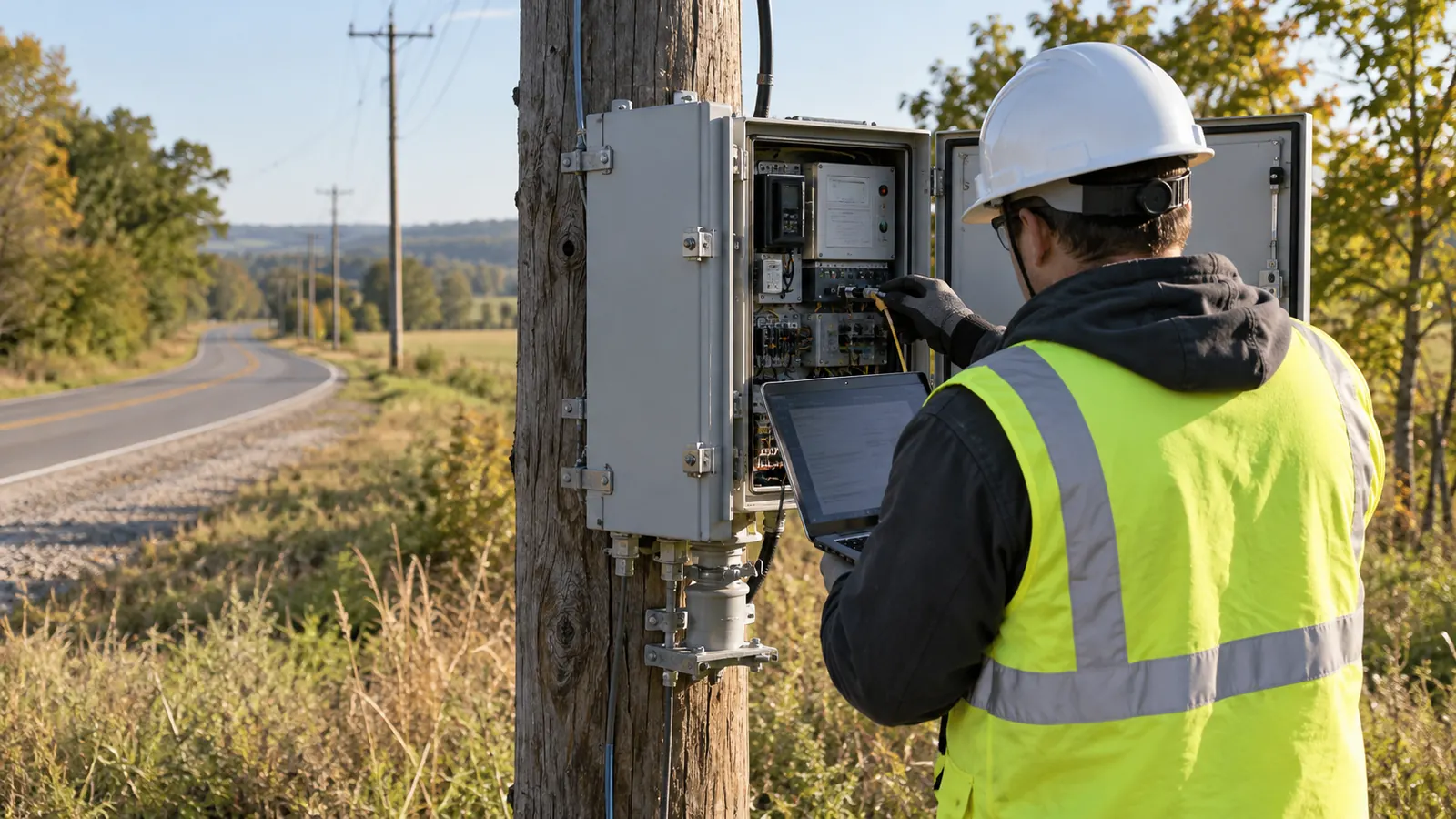
A fiber route drawing should reach the actual termination interface. We identify where outside cable enters the enclosure and how it reaches the designated termination hardware. A procurement change to the selected equipment triggers a review of cabinet space, including whether the entry arrangement and working space still support the approved installation.
The U.S. Department of Energy's report Distribution Automation: Results from the Smart Grid Investment Grant Program, published in September 2016, treats communications planning as a core part of automation deployment. Its discussion of fiber and wireless networks reinforces the need to plan connectivity around the operational requirements those networks must support.
Fiber does not have to serve every device directly. A utility may select fiber for the backbone and another approved communications method for the final connection, particularly where the physical route to a remote device changes the construction scope. Documenting the boundary between those systems gives the owner a specific interface to test, so we include it in the connection record.
Check the final connection: Ask the receiving operations team to identify the exact termination they will accept before approving the fiber route. That answer should appear on the relevant drawing, where a change can be reviewed.
Evaluate shared exposure and acceptance separately
Two fiber paths provide limited physical diversity if both depend on the same pole line or crossing. We flag shared exposure on the route map so the utility can decide whether the arrangement meets its communications objective. Tracing both paths helps identify a common physical event that could interrupt them together, including exposure that may be less apparent on separate drawings.
The acceptance procedure needs to distinguish cable performance from successful communication with the intended device. For the handoff, we keep separate records for the installed optical path and the owner's functional acceptance, tied to the same equipment identifiers. Reviewers can then see whether the cable alone has been accepted or whether communication with the operating device has also been accepted.
Network access and device configuration belong with the utility's authorized teams. We coordinate the physical interfaces against their requirements and record which party performs each acceptance activity. For an owner connecting these route and cabinet decisions, our electric utility engineering scope provides a place to define the distribution package and its boundaries.
Cabinet power deserves an explicit handoff. The utility should identify the approved supply arrangement and any required backup function, while the construction package shows the physical provisions assigned to the route contractor. Although fiber carries the signal, the active equipment at either end of the connection still needs its own energy supply, which the handoff must account for.
Carry joint use and make-ready into construction release
Fiber on power poles introduces an attachment decision even when both networks support the same modernization program. Ownership and existing agreements determine the approval path. We establish who controls the pole and who will own the new cable before developing the attachment package. Shared purpose does not eliminate the need for a reviewed arrangement.
Distinguish approval from completed make-ready
The proposed attachment position must be checked against existing facilities and applicable requirements. Where the arrangement needs changes, make-ready defines the work required before the attachment can proceed. Our records tie that disposition to the pole identifier so a location with an incomplete transfer remains visible within a route-wide approval.
Construction sequencing follows those dependencies. A replacement pole may need to be set before another attacher can transfer, and a fiber installation may depend on that transfer even after the utility's own work is complete. With the responsible party identified for each interface, we can base field release on the accepted condition at the individual location, including transfers by other attachers.
Scope changes need the same discipline. Moving an attachment or shifting a pole can affect a neighboring span, so the revised drawing should identify the affected limits rather than treating the change as an isolated mark on one sheet. Consequential changes come back to our engineering team for review before crews proceed under an arrangement that the changed field conditions have made obsolete.
A release package should distinguish approved work from work awaiting a decision. We mark the affected locations directly on the issue set and keep the reason for each hold in the accompanying register. That gives crews a usable boundary around unresolved attachments, even when the rest of the route is released for construction.
At Draftech International, engineering is 100% in-house. Our turnkey telecom and power infrastructure delivery runs from field survey and planning through construction drawings, permits, agency coordination, construction, as-builts and closeout. Full turnkey construction is delivered by Draftech-managed subcontract crews under Draftech's QA/QC and safety program, with field changes returned to our engineering team.
Close the asset record with the work
As-builts should show the installed condition and preserve a traceable relationship to the approved design. We ask the owner to define the required asset identifiers before collection begins, so a replacement pole and a new cable segment can be loaded into the receiving records without an avoidable naming mismatch. Our collection needs to capture those changes while the installed condition remains observable in the field.
Acceptance should also account for incomplete transfers and retained facilities. A construction segment may be usable while an old pole still awaits another party's work. The closeout package needs to distinguish that usable segment from assets awaiting further work and state who retains responsibility for bringing them to their final condition.
The receiving asset system should be considered before the final file export. We check the owner's required format and naming conventions against the collected records, especially where pole replacement changes a familiar identifier. Preserving the relationship to the old asset lets maintenance staff connect an earlier condition report to the installed replacement when they later review its history.
Choose the next work package by the unresolved dependency
For co-ops replacing aging pole plant: Set the replacement arrangement and transfer responsibilities before attaching the new fiber scope to the program. Our location-level review of shared-pole dependencies gives the co-op a practical release boundary, with unfinished third-party transfers still identified separately from completed utility construction.
For utilities adding field automation: Obtain the operating team's communications requirements and acceptance interface before selecting the final cable path. Working outward from the device connection, assess whether the proposed route has the physical availability and access needed to support that function, including any exposure shared by nominally separate paths.
For owners evaluating underground conversion: Confirm that both transitions and the intervening corridor can support the proposed installation before expanding the package. In our packages, unresolved crossings stay on hold for investigation until the alignment is supported well enough to enter the construction drawings. Surface equipment access remains part of the route decision after the cable goes below ground.
A coordinated scope gives our engineering team a defined problem to carry through construction and closeout, whether the unresolved interface is a pole transfer or a cabinet entry. The Draftech partners and delivery team provide accountability across that work. Bring the route limits and known constraints to our project scoping conversation; we can use them to define the next package. Send route questions to info@draftech.com.
For a qualifying route, Draftech's free design offer covers engineering the first 20,000 linear feet at no cost, from feasibility and field survey through permit approval. Each request goes to the owner for review, giving the proposed route a clear decision point before Draftech commits the engineering package to the project.