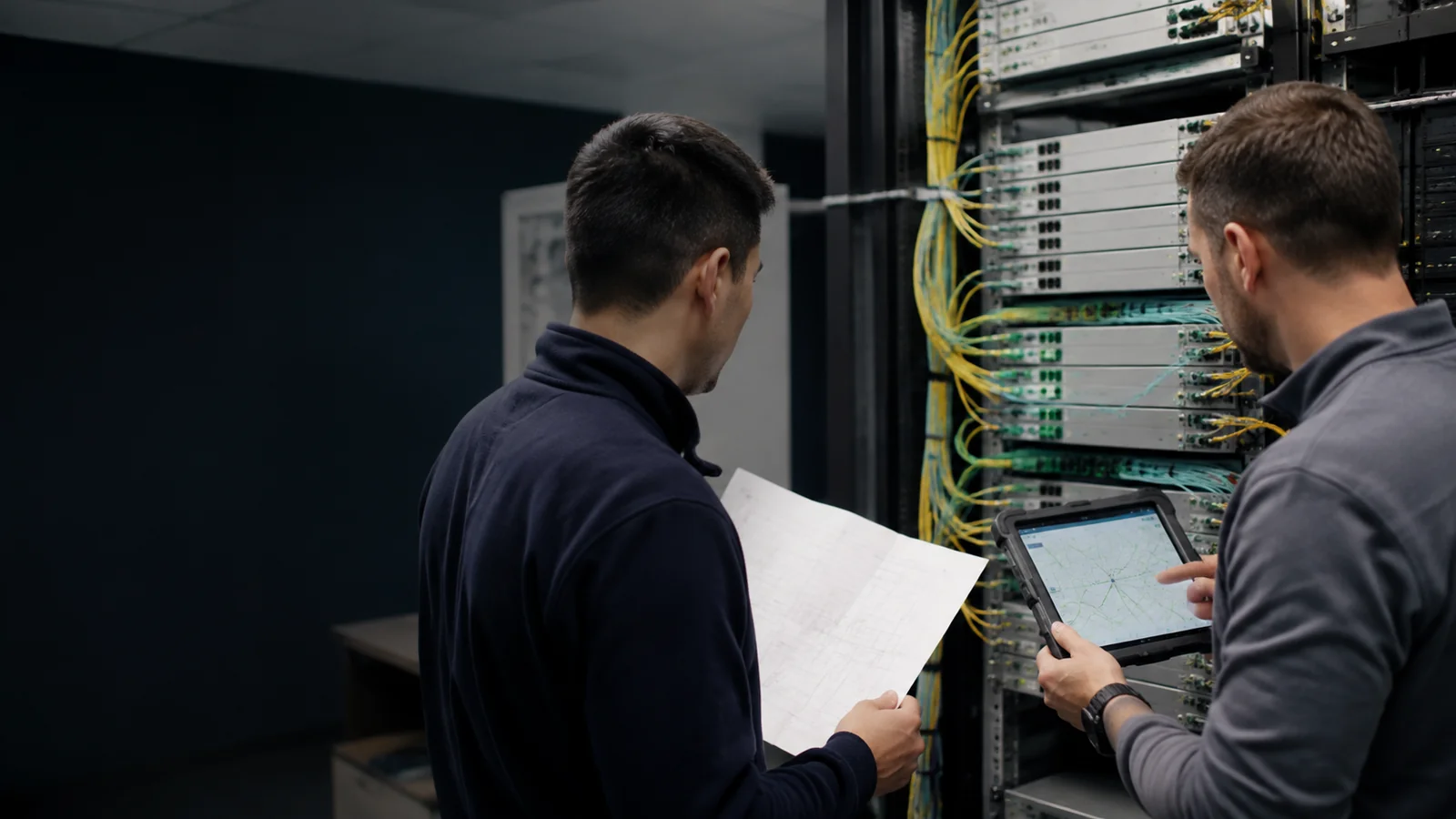
A search for OTL can send a fiber operator in the wrong direction before the records review begins because the technical materials checked for this article use optical line termination or optical line terminal, abbreviated OLT. They do not establish OTL for this workflow. The letters still reveal a real operator need: managing the already accepted network record around the serving OLT without inventing an acronym expansion.
This article starts from an accepted operating baseline and controls the passive path served by an OLT port after an assignment changes. It does not repeat design choices from our GPON network design guide, prescribe a universal GIS schema, inventory every record family or decide whether an incoming package deserves acceptance. The job is narrower: keep port-to-fiber relationships coherent through a controlled update after acceptance.
What Fiber OTL As-Built Management Means
After acceptance, fiber otl as-built management is the post-acceptance control loop that keeps an optical line termination (OLT) port and its passive tree aligned after an assignment changes. It uses 2 read-backs: trace the controlled delta from port to endpoint, then reverse the path before updating evidence and recording publication.
In ITU-T G.988 (11/2022), Broadband Forum TR-385 Issue 2, and ETSI ETS 300 681, the checked materials use OLT; none establishes OTL for this workflow. We preserve the requested search phrase while stating that bounded finding. If an owner uses OTL as a local code, its controlled glossary should define the meaning before anyone maps that code to operating records.
ITU-T G.988 models management information exchanged between an OLT and an optical network unit (ONU), while Broadband Forum TR-385 Issue 2 addresses OLT data models and subtending ONUs. Neither document is an as-built schema. They support a useful boundary: active equipment can identify the serving interface and managed endpoint, while the accepted physical record explains the optical distribution network between them.
We use the OLT port as an anchor rather than the whole network because a port can be active while its documented feeder assignment is stale. The inventory can list a splitter while omitting the numbered output relationship, and an endpoint can appear online even though the field terminal ID differs from the map. Each symptom points to a join that needs control. No dashboard repairs that join automatically.
The Fiber Optic Association (FOA) page The FOA Reference for Fiber Optics: Fiber to the Home Installation describes a feeder cable extending from the OLT to the fiber distribution hub that houses the PON splitter. Distribution cable continues toward the subscriber, and the drop reaches the optical network terminal. We use that connected path as the record spine. Owner naming can differ. The relationships cannot disappear.
Interpretation rule: treat OTL as a likely OLT transposition unless the owner's controlled glossary says otherwise. Do not expand OTL on guesswork. Record the local term, its source and the approved mapping before applying it to an already accepted operating baseline.
Define the Accepted OLT Baseline and Record Keys
Start with the already accepted baseline by naming the OLT site and equipment position, then identify the PON interface and the feeder area it governs. A persistent port key should survive label formatting or a later screen change, while field-path keys remain stable so an electronics replacement cannot silently create a new identity for every passive asset downstream.
The control boundary states which accepted baseline is current before the event and which port or PON tree the assignment change affects. It may cover one splitter branch, one tree or several ports in a feeder serving area. We keep the scope object-specific because a post-acceptance update should not reopen unrelated plant. The owner-controlled operating procedure remains the authority for changes.
Use the table as a loop after acceptance rather than a deliverable inventory. Every row advances one assignment change from event capture to publication receipt, and the fields are Draftech guidance. Owner procedures still control role names, system permissions and any required approvals; this article does not decide whether an incoming package may become the baseline.
Persistent keys need reuse rules, so we never assign a retired OLT port record key to a different physical interface merely because the display label became available. Historic alarms and work orders may still reference it. A replacement receives a new identity or an explicitly versioned equipment relationship, while the predecessor link remains visible for later evidence read-back. This is slower than editing one label. It is far safer for evidence retrieval.
Serving-area identity also deserves control because a marketing zone or construction package name may change without altering the optical path. The record must distinguish that display boundary from the affected PON tree. We recommend a baseline key that resolves to the accepted pre-change state and a change-set key that resolves to the exact relationships updated afterward. Keep unrelated paths outside the delta.
| Loop stage | Controlled record | Required read-back | Completion evidence |
|---|---|---|---|
| Capture assignment event | Change ticket plus event source | Prior assignment and reported new value | Timestamped event with affected service context |
| Identify affected port and tree | OLT port key plus PON tree key | Feeder, splitter and terminal relationships in scope | Explicit changed and unchanged boundaries |
| Record controlled delta | Relationship-level old and new values | Source revision plus predecessor links | Delta that does not overwrite unrelated records |
| Validate in both directions | Port-to-endpoint and endpoint-to-port traces | Same stable keys through every passive join | 2 read-backs with exceptions attached to exact joins |
| Update evidence index | Current and superseded path artifacts | Method context and governed-path key | Retrievable evidence for the changed path |
| Record publication receipt | Baseline revision and receiving-system entry | Effective time, predecessor and archive reference | Receipt that reproduces the published state |
The boundary is not a capacity promise because an unassigned fiber or splitter output may be unavailable because of reserve policy, pending work or an unresolved record. We show observed assignment state and its source. Available capacity comes from the owner-controlled planning process. That keeps the as-built from making a decision it was never created to make.
Reconcile the OLT Port with Every Passive Path
Reconciliation runs in both directions, beginning at the OLT port before tracing through the feeder cable plus fiber to each splice relationship. Continue through the splitter input and numbered output, then follow distribution fiber to the terminal port and endpoint reference before reversing the test from the endpoint. A one-way trace can hide an orphan that only appears when evidence is read back toward the equipment.
Keep active telemetry separate from physical proof because ITU-T G.988 explains the managed information exchange between OLT and ONU, and that management view can confirm an association seen by the access system. It does not prove the installed closure location or the fiber path drawn between two assets. We reconcile the logical association to the passive record without treating either source as universal authority for every field.
Source authority belongs at the attribute or relationship level. Equipment inventory can control the installed interface identity. An accepted splice record may control continuity. Verified field evidence can control a moved terminal location. The current evidence index identifies which result belongs to a path. For each delta made after acceptance, we record the source plus prior value and validation result across those domains.
- Port read-back: start with the equipment key. Resolve the feeder area and current passive-path release.
- Fiber read-back: start with one cable and fiber key. Return to the serving port without relying on a filename.
- Splitter read-back: start with a numbered output. Resolve one downstream relationship and its current assignment state.
- Endpoint read-back: start with the field terminal port or subscriber endpoint reference. Return through every passive join.
A software platform can enforce some relationships, but platform selection is a separate decision that belongs in our fiber network inventory software comparison, which covers data models and evaluation tests. Here we judge the operating record itself. A spreadsheet can pass when its keys are disciplined. An expensive application can fail when imported relationships remain unverified.
Exceptions stay on the relationship they limit, so if the feeder fiber is known but one splitter output is disputed, we do not mark the whole tree unknown or hide the dispute under a broad status. The exception identifies the affected output and operational consequence. It names the evidence needed for correction and remains visible until the existing owner procedure resolves it.
Validate the controlled delta against the accepted baseline rather than staging another receiving decision. Snapshot the affected port and tree before editing, record the old and new relationships, then run the outward and return traces on those changed joins. If validation fails, correct the same change set or supersede it with a linked revision. The accepted pre-change state remains reproducible throughout.
Control Revisions and Test Evidence by PON Tree
Revision control begins with an assignment event rather than a filename because a feeder reassignment changes the serving path, while a splitter replacement changes a passive branch identity or relationship. A terminal-port move may change distribution continuity. We capture the event source, affected keys, old values and proposed values. The accepted baseline remains current until the validated delta is published under the owner's existing procedure.
Shortcuts fail here because a file named FINAL2 does not state which PON tree it controls, while a current date does not prove that the splice sheet and evidence index changed together. We use a publication manifest that names the affected object set and exact evidence revisions. Superseded files remain accessible as history, but they stop presenting themselves as the current operating view.
FOA's Standard for Installing Fiber Optic Cable Plants, 2025 V1, Section 13.1 treats documentation as integral to design and installation as well as maintenance. It names exact fiber paths and intermediate connections. It also identifies fiber IDs plus splice locations and insertion-loss data, with optional optical time-domain reflectometer (OTDR) traces. FOA guidance is a technical reference. Contract terms and owner procedures decide what this project requires.
Test evidence needs path context because FOA's Testing Fiber to the Home explains that troubleshooting depends on knowing the architecture and expected losses, while emphasizing system documentation before testing. We link each current artifact to the segment or end-to-end path it evaluated. Direction and wavelength belong with method context when applicable. The prior artifact remains indexed as superseded rather than disappearing.
Our OTDR acceptance criteria guide handles measurement interpretation, while this workflow after acceptance answers a different question: can an operator retrieve the evidence that corresponds to the newly published assignment from either end? A trace from another fiber cannot support the update merely because its distance looks plausible. Evidence identity comes before comparison. Context still controls.
FHWA-HIF-24-098, Digital As-Builts: Getting Started How-to Reference, Section 1.1 describes digital as-builts as living records that continue through operations and maintenance; that is transportation-agency guidance, not a rule for every private fiber owner. We use the lifecycle principle carefully. An accepted OLT-path baseline needs a governed route for later assignment changes. The owner still sets operating authority and retention.
Self-critical note: our PON-tree control model creates a real trade-off. It adds relationship checks and revision work after acceptance, especially when legacy identifiers conflict. We would not recommend that effort for decorative mapping. We recommend it only when operations expects assignment changes to remain traceable across ports, passive paths, evidence indexes and publication history.
Run the OLT Post-Acceptance Change Loop
Begin only after ISP acceptance has established the operating baseline. Capture the assignment event and identify the affected OLT port plus PON tree. Record a controlled relationship delta. Trace from port to endpoint, then return from endpoint to port. Update the path-specific evidence index after both read-backs resolve, and finish with a publication receipt for the changed baseline.
That sequence preserves the article boundary. The as-built inventory page owns record-family completeness, while the GIS standards page owns fields and location controls. Closeout governs collection through acceptance. Future-maintenance guidance starts with a fault or planned work event. The ISP acceptance article decides whether delivered records may become the baseline. This article starts afterward and keeps OLT-facing assignments coherent when they change.
Validation matches the assignment delta because a feeder move needs port-to-fiber relationship read-back, while a splitter-output edit needs both upstream and downstream joins checked. A terminal-port change also needs endpoint references tested from the return direction. We attach each result to the change-set key. This is not initial import acceptance; it is verification of a bounded update to a baseline already in use.
Known limitations remain beside the changed relationship because one disputed terminal ID may affect a branch without making an unrelated branch unreadable. The change record states that exact scope and preserves the prior value. We do not infer permission from silence or convert an unresolved join into a new fact. Existing owner procedures govern disposition and publication authority outside this technical loop.
Engineering and record-document work remain in-house. When construction is included, Draftech delivers it full turnkey through Draftech-managed subcontract crews under Draftech QA/QC and safety oversight. Field observations keep their source attribution. The network owner separately retains authority over acceptance, operating permissions and publication approval. Our delivery model keeps those responsibilities visible.
The publication receipt closes the loop by naming the changed baseline revision and affected port or tree, then recording the receiving system, effective time, load result and archive reference. Current and superseded evidence remain indexed. Operations can reproduce what changed without reopening initial package acceptance, and the prior assignment remains a predecessor instead of disappearing. Keep the receipt short enough to use during an incident.
Choose the Fiber OTL As-Built Change-Control View
Network operations lead: choose an event-centered view when technicians begin with an assignment ticket or serving interface. Show the affected port and PON tree, then require 2 read-backs across every changed passive relationship. Keep known limitations beside the trace. Reject a publication record that depends on a private construction spreadsheet operations cannot access.
GIS or records manager: choose a delta-centered view with persistent keys and predecessor relationships, then require attribute-level source authority for every disputed edit. Preserve the accepted pre-change state plus validation results and publication receipt. Do not let a clean map export hide a broken splitter output, an orphan evidence reference or an unrelated object changed outside scope.
Program or construction manager: choose a provenance-centered view that carries the assignment event into the exact port and tree records it affects. Confirm that contractor evidence keeps its source and that construction corrections return through the responsible party. Record-document editing does not replace field verification, and this loop after acceptance does not grant owner approval.
The operating question is direct: does the latest published assignment still resolve through the same OLT-facing path in both directions? We recommend publication only after the controlled delta and evidence index produce matching read-backs for the affected tree. Known exceptions remain attached to their exact joins. The accepted predecessor remains reproducible. Initial import acceptance and authority to adopt a package belong outside this workflow.
For an authored review of your port-to-fiber controls, email Ashish Kumar Meena at Draftech. Bring one accepted OLT port plus a recent assignment event. Add the affected splitter-output record, one endpoint and the current evidence index. We will start with the 2 read-backs that operations must reproduce.
Our fiber as-built record engineering service can organize that delta after acceptance into controlled CAD, GIS and evidence views without changing the owner's authority. We scope the review to the affected port and tree. Nothing is labeled validated until the source, prior value, read-back result and publication receipt are recorded.
Ask Draftech to review an OLT-centered operating record. Share one accepted port path, one assignment change and the current evidence index. We will test whether the changed OLT key and passive relationships resolve in both directions, then check whether the publication receipt identifies the same governed baseline.