- What As-Built Fiber for GPON Network Operations Must Control
- Build the GPON As-Built Around Stable Identifiers
- Reconcile Field Changes Before Loading the GPON GIS
- Attach GPON Test Evidence to the Fiber Path
- Run GPON As-Built Acceptance Checks Before Handoff
- Choose a GPON Record Release Model Operations Can Maintain
A GPON network can pass an optical test and still be hard to operate. The trouble starts when a trouble ticket names an ONT, the GIS names a cable, the splice sheet names a tray, and nobody can prove which splitter port connects those records. Closeout is not complete just because the route line is redrawn.
This guide treats the as-built as an operational control system. It explains which relationships must survive construction; how field evidence becomes a trusted record; and where acceptance checks should stop a handoff. The design context belongs in our GPON architecture and OSP planning guide; the focus here is what operations needs after the plant is built.
What As-Built Fiber for GPON Network Operations Must Control
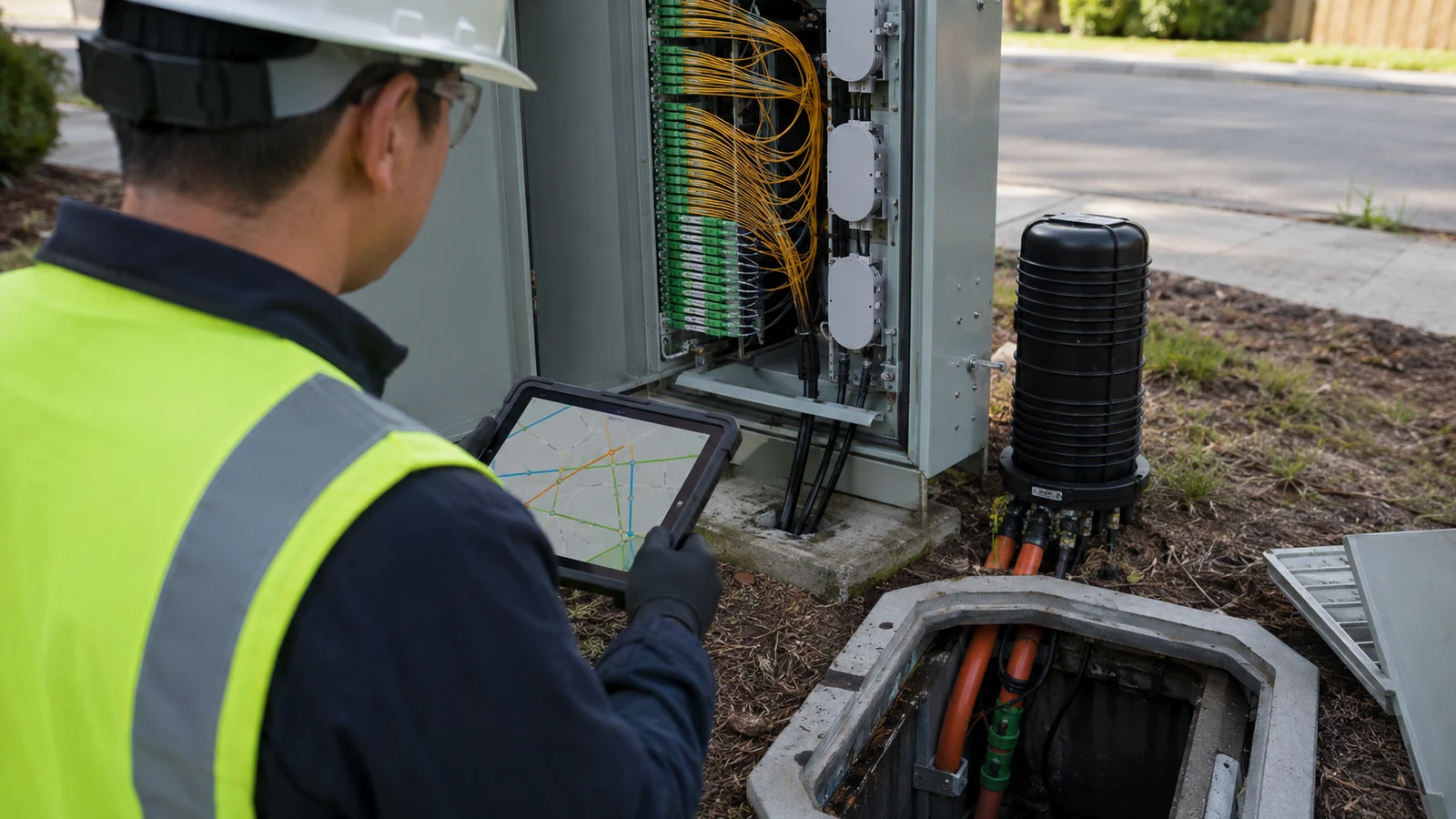
As-built fiber for GPON network operations is the verified relationship among 4 record layers: OLT and PON ports, splitter inputs and outputs; physical fiber paths; and field acceptance evidence. A usable record lets an operator trace one customer-facing endpoint back through every passive connection without guessing which drawing; spreadsheet; or technician note is current.
The route geometry is only the outside shell. Operations also needs the cable ID, sheath position, fiber count, fiber number, splice closure, tray or cassette, splitter location, splitter ratio, input fiber, output port; terminal port; and serving OLT interface. Each object needs a stable identifier that survives a drawing revision. Renaming a feature for cartographic neatness must not sever the relationship that a technician follows during restoration.
ITU-T Recommendation G.984.3, Gigabit-capable Passive Optical Networks: Transmission Convergence Layer Specification, defines the GPON transmission framework and management relationships around optical network units. The standard does not write an operator's GIS schema. It does reinforce the point: a PON is a connected system, not a collection of unrelated map symbols. The record has to preserve that connectivity from the OLT-facing side to the field endpoint.
A route record should also distinguish proposed, installed, tested; accepted; and retired states. Those labels are not interchangeable. A cable can be physically present while its fibers remain untested, and a splitter can be tested while its port assignment is still disputed. We keep the lifecycle status on the asset or relationship it governs instead of placing one broad final label across the entire package.
Operations test: give a reviewer one terminal port and ask for the OLT interface, splitter output; complete splice path; and latest optical evidence. If the answer requires a memory call to construction, the record is not ready.
Build the GPON As-Built Around Stable Identifiers
Start with identifiers, not presentation. A feature can appear on a plan sheet, in a web map, and in a maintenance application while retaining one asset ID. We separate the persistent identity from display labels such as sheet callouts or abbreviated pole names. That choice matters when a cabinet is moved 18 feet; a closure is replaced; or a splitter is rehomed during construction. The physical description changes. The change history should remain attached.
A GPON closeout works best when each relationship has an explicit parent and child. The cable contains fibers. A closure contains splice events. The splitter consumes one feeder-side optical path and exposes numbered outputs. A terminal maps those outputs to ports. The OLT interface anchors the logical path. We do not bury those relationships in a free-text note because free text cannot reliably answer whether two records describe the same asset.
| Record layer | Required control | Acceptance question | Common failure |
|---|---|---|---|
| OLT and PON | Stable equipment and port IDs | Can the serving interface be traced from the field endpoint? | Port lives only in an activation sheet |
| Splitter | Location, ratio, input, numbered outputs | Does every used output have one downstream path? | Splitter shown as an unlabeled point |
| Physical fiber | Cable, fiber, closure, tray, splice relationships | Can continuity be followed without inference? | Cable geometry lacks fiber connectivity |
| Acceptance evidence | Test file, wavelength, direction, date, linked asset | Is evidence attached to the path it verifies? | PDF folder cannot be reconciled to assets |
| Change history | Source, reviewer, disposition, revision | Can operations explain why the record changed? | Final overwrite erases field decisions |
The table is a control map, not a software shopping list. A small ISP may keep these records in a disciplined geodatabase and document store. A larger carrier may synchronize GIS; inventory; and provisioning platforms. The same acceptance questions apply. The Draftech delivery model aligns the operating model with the design deliverables so the handoff does not force operations to reverse-engineer construction intent.
Identifier governance needs a written rule for reuse. We do not recycle a retired cable or closure ID for a replacement asset because historic work orders may still point to it. The replacement receives a new identity and a relationship to the retired object. That preserves the maintenance history and prevents an old test file from appearing to describe new plant.
Reconcile Field Changes Before Loading the GPON GIS
Field markup is evidence, not automatic truth. A redline can show that a cabinet moved, but it may not identify the new splitter assignment or the feeder fiber that was used. A splice sheet may be more precise about connectivity while carrying weaker location information. We maintain a source hierarchy by field: surveyed geometry can control position, approved splice documentation can control fiber continuity, and commissioning records can control optical evidence. One source should not silently overwrite every attribute.
Each change should enter a reconciliation log with its source, affected asset, old value, proposed value; reviewer; and disposition. That is six controls, but the important one is disposition. Accepted, rejected, and unresolved changes must remain distinguishable. If a redline conflicts with a test record, the loader should not choose whichever file was edited last. The conflict stays open until a responsible reviewer resolves it.
For multi-market engineering programs, disciplined CAD and GIS controls protect operations. We preserve the drawing context while building structured relationships that applications can query. Geometry receives coordinate and topology checks. Attributes receive domains and required-field checks. Connectivity receives path checks. That separation exposes whether the defect is a location problem; a naming problem; or a broken optical relationship.
- Geometry source: record the survey; redline; or verified base used for every moved structure.
- Connectivity source: identify the approved splice or splitter record that controls each path change.
- Evidence source: link the final test artifact to the cable section or optical path it actually verifies.
- Open exception: retain unresolved conflicts in a release log rather than forcing a false final value.
Loading should be repeatable. A corrected source package must update the intended records without duplicating structures or silently deleting unrelated assets. We compare row counts, identifiers, relationship counts, and exception totals before and after each controlled load. The loader's log becomes part of the closeout evidence because it states what changed in the system of record, not merely what the source file contained.
Attach GPON Test Evidence to the Fiber Path
A directory of OTDR traces is not yet an operational record. The file needs enough metadata to identify the tested path, test direction, wavelength, date, equipment; launch conditions; and acceptance disposition. The path identifier should reconcile to the cable and fiber records. Our OTDR acceptance criteria guide covers test interpretation; the as-built task is to make the evidence retrievable from the asset that operations is troubleshooting.
GPON adds a passive branching problem. A feeder-side trace does not automatically prove every distribution leg, and a test captured from one direction can emphasize different events than a bidirectional review. The record should state exactly what was tested. We prefer a link from each accepted test artifact to the governed segment or optical path, plus a clear status for paths whose evidence is missing; superseded; or awaiting retest.
The operational payoff appears during an outage. A technician can select a serving path, see the expected splitter and closures, and retrieve the evidence that established the baseline. That does not diagnose the fault by itself. It narrows the search and prevents a restoration crew from trusting a trace that belongs to a different fiber. The distinction is small in a closeout meeting and expensive at 2 a.m.
Evidence versioning matters when retests occur. We retain the superseded test with its status and link the accepted replacement to the same governed path. Deleting the failed trace erases the reason for the retest. Treating both files as equally current creates a different problem. One accepted baseline should be obvious, while prior evidence remains available for audit and diagnosis.
Self-critical note: structured records create extra review work at closeout. We accept that cost because a faster handoff built on unlinked PDFs transfers the labor to operations, where every ambiguity arrives as an outage risk.
Run GPON As-Built Acceptance Checks Before Handoff
Acceptance should test the record as a system. Completeness checks confirm required assets and fields. Domain checks catch invalid status values or splitter ratios. Topology checks find disconnected lines; duplicate structures; and impossible cable paths. Relationship checks find fibers without parent cables; splitter outputs without downstream paths; and terminal ports with competing assignments. Evidence checks confirm that required files exist and resolve to the identifiers stored in the record.
Sampling alone is weak for relationship defects because one broken reference can hide inside an otherwise accurate route. We run deterministic checks across the full dataset, then use focused visual review where context matters. The complete population can be tested for duplicate IDs or missing parent keys. A reviewer still has to judge whether a field change is plausible, whether a closure symbol sits on the correct side of a crossing, and whether an exception is acceptable.
A useful release package carries the current dataset, schema description, source register, exception log; revision record; and linked test index. It also states the acceptance date and the responsible reviewer. The fiber inventory management guide explains how software supports change control after handoff. Closeout must establish the baseline before any platform can maintain it.
- Path continuity: every active terminal port traces to one splitter output and one serving PON interface.
- Asset identity: every structure, cable, closure; splitter; and terminal has one persistent identifier.
- Exception ownership: every unresolved conflict has an owner and a documented release decision.
- Evidence retrieval: every required acceptance file opens from the asset or path it governs.
The acceptance team should retain the query output that identified every failed relationship because a total issue count cannot show whether the same cable generated 40 errors or 40 separate cables each failed once. Reviewers should classify the root object before assigning corrective work so one repaired parent relationship can clear its dependent records without encouraging bulk edits that mask the original defect. After correction, rerun the complete validation set against the same release candidate and compare both the exception IDs and the population totals to the earlier result. This makes the closeout decision reproducible for operations personnel who were not present when construction staff explained the field change. Keep the evidence. A signed acceptance memo has more value when the attached results prove which dataset was tested and which exceptions remained open at release.
Release metrics should state both the population and the exceptions. A report that says 99 percent complete is weak unless it names the denominator and the missing records. We prefer counts by asset class, path state; evidence state; and exception severity. Operations can then decide whether an open issue blocks acceptance or belongs on a controlled punch list with a due date. The report should also preserve the validation rules and the software version used for the check. When a later edit changes the count, operations can rerun the same control instead of debating whether the original result came from a different query. Reproducible acceptance is more useful than a screenshot of a green dashboard.
Choose a GPON Record Release Model Operations Can Maintain
A small network with one construction package may release a single controlled geodatabase; an indexed test repository; and a concise exception log. A multi-market operator needs a repeatable schema; automated validations; and ownership rules for edits after acceptance. The right platform varies. The minimum operational contract does not: stable identity, connected relationships, source provenance; review status; and retrievable evidence must travel together.
The handoff meeting should assign who can edit geometry, who can change connectivity, who closes exceptions, and how emergency field repairs return to the system of record. Four named responsibilities are better than a vague promise that GIS will be updated. If one group owns every change, create a second-person review for connectivity edits. If several groups contribute, require a shared change ticket and one release authority.
Single-market operator: release one controlled dataset with a named schema version, one indexed evidence repository, and an exception log that identifies every open path. Keep the edit group small. Require a second-person check for changes to splitter or splice connectivity, because one incorrect relationship can redirect every downstream troubleshooting step even when the route map still looks correct.
Multi-market carrier: standardize the identity and relationship rules before standardizing the screen layout. Regional teams can use different collection methods, but they should deliver the same required keys and evidence states. Run the same automated validation package against every market. Publish the results by market and asset class so a strong score in one area cannot conceal an incomplete handoff somewhere else.
Grant-funded network owner: preserve the accepted baseline plus the source register that explains each material field change. Funding closeout and daily operations are different review contexts, yet both depend on the ability to trace a reported asset back to evidence. Mark unresolved records explicitly. Do not convert an open exception into a final value simply to produce a cleaner completion percentage.
Draftech's fiber as-built documentation services address the specific failure this guide describes: field changes, splice relationships, GIS attributes, and acceptance evidence arriving as separate closeout products. We bring them into one reviewed record while keeping unresolved conditions visible. The goal is not a prettier final drawing. It is a network record operations can interrogate; maintain; and defend.
If your GPON build is approaching closeout and the OLT, splitter, fiber, and test records do not reconcile, email info@draftech.com. We can review the handoff structure before the final package becomes the operating baseline.
Talk with Draftech about a controlled GPON as-built handoff. Bring the current plan set, splice records, GIS export, test index, and open-exception list so the first review starts with evidence.