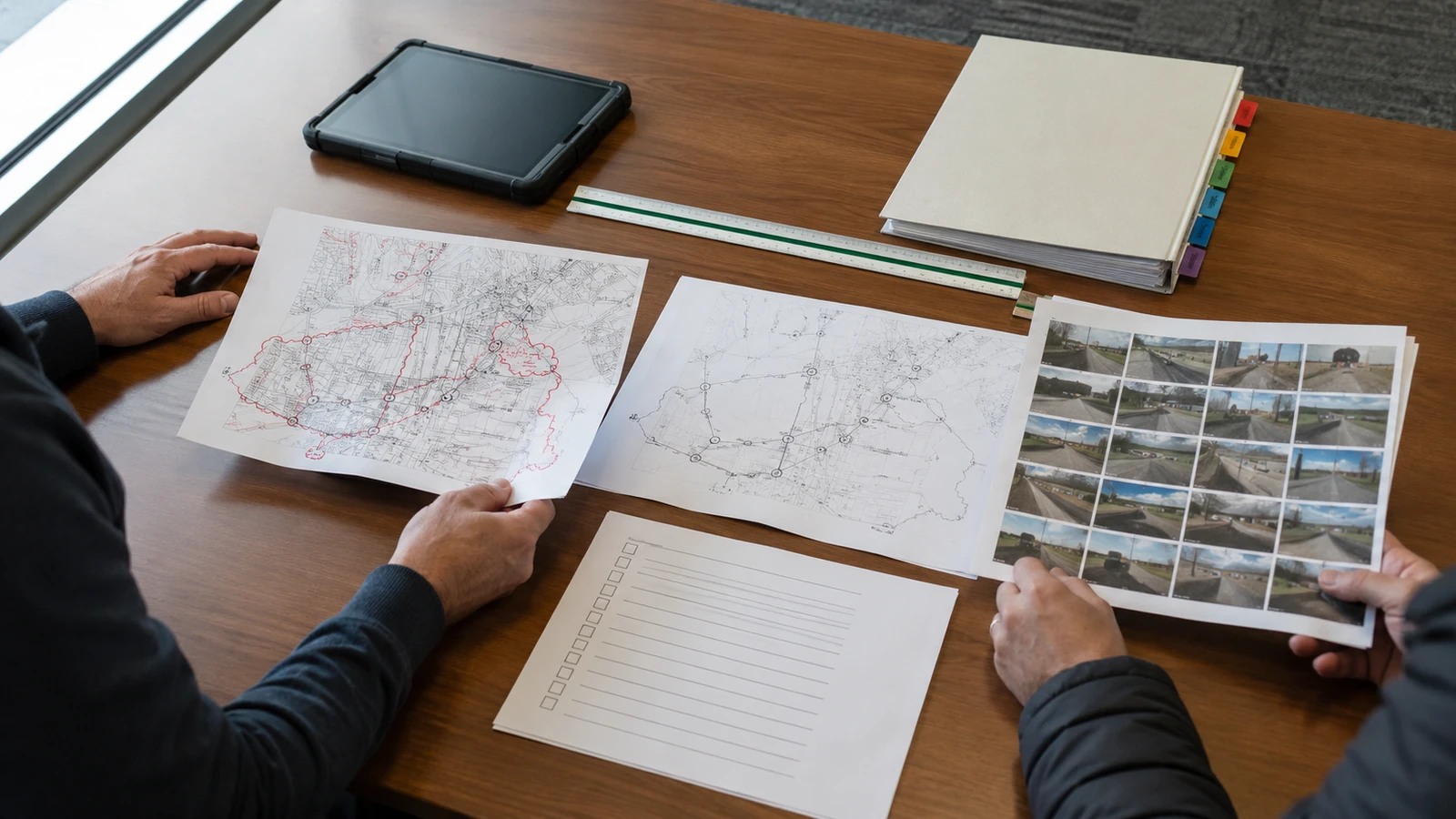
A telecom build can be physically complete while its owner still cannot accept it. The usual obstruction is not one missing PDF. It is a conflict among the route drawing, splice evidence and permit record that leaves the final network state uncertain.
This guide treats closeout as an evidence chain. We explain what belongs in the package, how to control revisions and when a segment is ready for release. Contract terms still govern acceptance. Grant conditions or authority requirements can add records, so the project matrix must name those obligations before construction starts.
Telecom Construction Closeout Documentation: The Acceptance Package
Telecom construction closeout documentation is the controlled evidence that installed network work matches the accepted scope and can enter operations. A practical package has at least 6 linked record families: approved drawings, field redlines, test evidence, permit closure, material records and an exception log tied to the final revision.
Closeout begins with the contract. We extract every deliverable from the agreement, owner standard and permit condition into one requirements matrix. Each row names the required format; it also identifies the responsible party and acceptance authority; a generic checklist is useful for planning, but it cannot override a utility's naming convention or a grant recipient's retention duty. The matrix is the controlling index.
We organize the package around stable asset identifiers. A route segment, structure, cable and splice location should keep the same identifier across redlines and test files. Permit references need that same crosswalk. Without it, an OTDR trace can look valid yet remain impossible to assign to the strand path shown in GIS. Naming discipline is not clerical polish. It is how a reviewer reproduces the claim.
Physical completion and documentary acceptance are separate states. A crew can finish restoration while one bore profile remains unverified. The network owner can energize an emergency segment under its own authority while formal closeout remains open; we record those distinctions instead of labeling an entire route complete. A segment status should say what is installed and what evidence remains blocked. Short labels help. Vague green cells do not.
Federal grant rules illustrate why the governing basis matters. Under 2 CFR 200.334, federal award records generally must be retained for 3 years from submission of the final financial report, subject to listed exceptions; that rule does not prescribe a universal fiber closeout folder. It sets a retention baseline for covered awards, while the award and recipient procedures define the actual technical evidence.
Our preferred approach uses one package register with four explicit states: expected, received, technically accepted and superseded. Here is the self-critical note: a limitation of that register is the upkeep. If field leads postpone updates until the end of a week, the dashboard becomes a polished lagging indicator; we require artifact links and dated reviewer actions, not status claims without evidence.
Package ownership must stay visible from mobilization through turnover, because a requirement assigned only to a company name usually has no person watching the evidence deadline. We assign a preparer plus technical reviewer for every record family, while the acceptance authority remains a separate field that cannot be completed by the delivery team. When staffing changes, the replacement receives the open exceptions and repository access before the prior owner leaves the workflow.
Closeout control: Freeze the segment identifier before test collection. A valid trace attached to an ambiguous cable is still an unresolved record.
Closeout Deliverables and Release Gates
A good closeout table is a release map, not a document dump. The following 6 gates are our recommended control structure. They are not a claim that every owner uses these labels. For each project, we replace the generic acceptance question with the exact contract clause or authority condition that governs the work.
| Gate | Controlling evidence | Typical defect | Release question |
|---|---|---|---|
| Scope reconciliation | Approved work limits and change log | Installed route is outside the accepted revision | Does final scope have authority? |
| Field record | Dated redlines and location evidence | Markup lacks asset identity | Can drafting reproduce the installation? |
| Network test | Trace files and test register | Result is not mapped to a fiber path | Is each accepted path evidenced? |
| Permit closure | Inspection and restoration records | Authority condition remains open | Has the permit owner closed the work? |
| Asset record | As-built CAD or GIS and splice data | Drawing conflicts with database | Do systems describe one final state? |
| Handoff | Exception register and acceptance record | Known defect disappears from the package | Can operations accept the residual risk? |
Scope and Change Authority
Scope reconciliation starts with the last approved design plus every authorized change; we compare installed quantities by asset class without turning quantity variance into automatic proof of error. A changed bore length can be legitimate. It needs a linked field basis and approval path. Unapproved field convenience is different. The closeout register preserves both the reason and the decision owner.
The final redline set records deviations at usable precision. It should identify abandoned facilities and changed offsets. It should also show added structures or revised splice assignments. Our guide to fiber as-built documentation for grant closeout addresses the grant-facing layer. We keep that layer connected to the construction record rather than recreating it from invoices after the field team has demobilized.
Test and Permit Evidence
Test evidence needs context. The package identifies the test method and instrument record. It states launch configuration plus direction when those facts matter. Most critically, the test register maps each filename to cable identity and fiber endpoints. The OTDR testing acceptance criteria guide explains why a trace image alone cannot establish acceptance. A PON power budget calculator supports design planning only. Criteria must come from the contract or approved test plan.
Permit closeout follows the issuing authority's process. We preserve final inspections and restoration evidence. Required traffic-control removals or environmental commitments remain visible until accepted. A permit number on an index is not closure proof. The register points to the authority response or approved inspection record, then captures restrictions that operations must retain. No invented universal timeline belongs here.
For federally funded work, closeout timing also depends on the award relationship. 2 CFR 200.344 gives a non-federal entity 120 calendar days after the period of performance ends to submit required final reports and liquidate obligations, unless the federal agency or pass-through entity authorizes an extension. Subrecipients generally receive 90 days. Those periods concern covered federal award closeout, not owner acceptance of a telecom segment.
Material reconciliation supports asset stewardship and financial review. We connect issued reels or installed assemblies to the approved scope at the level the owner requires. We do not fabricate exact installed quantities from purchase orders. Returns and damaged stock stay separate from placed assets. If a serial-controlled item is required, its identifier must survive into the asset record or an explicit exception.
Restoration records deserve their own evidence path when the authority or owner makes surface acceptance a closeout condition, since a route drawing cannot prove pavement or vegetation was accepted. The package identifies each inspection area by permit reference and segment identity, then records the authority response without translating a conditional approval into final closure. Any seasonal follow-up remains assigned to an owner whose obligation survives the construction team's demobilization.
As-Built Production and Quality Control
As-built production starts from accepted redlines, not from memory. We retain the design base and create a controlled final revision. Each change carries source evidence. Drafting resolves legibility and symbology, but it does not silently decide whether a field note is correct. Ambiguous notes return through an exception workflow. That slows one sheet. It protects every downstream system that will trust the final asset geometry.
The UFGS 01 78 00 closeout specification is a useful public example of explicit requirements. Its tailored federal construction framework distinguishes as-built drawings from record drawings and addresses redlines plus geodatabase files. We do not apply that specification to private telecom work by default; we use it to show why projects must define file types and transformation responsibilities in the contract.
CAD and GIS can carry different views of the same network. CAD may be the signed sheet record while GIS becomes the operational asset system. We cross-check stable identifiers and geometry. Connectivity deserves a separate test. A line that appears connected at map scale can still end at the wrong structure or splice object. Visual review alone misses that defect. Topology and attribute validation are different gates.
Our QA pass samples neither at random nor only by neatness. We target high-change locations and transitions between contractors. We also examine permitted crossings and splice-rich segments because revision risk concentrates there. Automated checks detect duplicate IDs or null required fields. A reviewer then traces representative assets from source redline through final drawing and test evidence. Both layers matter.
Revision rule: A clean PDF never cures a source conflict. Keep the affected asset blocked until the field record and acceptance decision agree.
We package native files with controlled PDFs when the contract asks for both. The native set retains coordinate reference information and layer definitions. It also preserves fonts or reference dependencies in the required delivery form. The PDF remains a fixed review artifact. Checksums can support transfer integrity, but they do not prove engineering correctness. We document what each format is intended to control.
Splice documentation needs an object relationship that survives export, because a tray image or worksheet filename rarely communicates the full upstream and downstream fiber path. We compare enclosure identity with the accepted cable records and termination assignments, then hold any ambiguous strand mapping outside the operational import until the network owner resolves it; this review protects later outage isolation from a closeout package whose individual files look complete but describe incompatible connectivity.
Exceptions, Acceptance and Operations Handoff
An exception register is part of closeout, not evidence of failure by itself. Each item states the affected asset and the requirement that is not met. It names the temporary disposition, approval authority and closure evidence. We avoid the label pending without a next action. A reviewer should be able to tell whether the item blocks service, blocks financial closeout or only requires a later record update.
Acceptance should be recorded at the level actually reviewed. If an owner accepts 1 contiguous segment while another remains under restoration review, the package must not imply route-wide closure. We preserve the accepted revision and date. Later corrections advance the record through a new revision rather than overwriting the artifact that supported the original decision. History is operational evidence.
Operations needs more than drawings. The handoff should identify active asset systems and retained test repositories. It should name warranties or maintenance restrictions that remain applicable. Contact roles belong in the controlled owner directory rather than frozen inside every drawing. We test access before turnover. A link that works only for the construction manager is not a delivered record.
Repository design affects whether the package remains usable after acceptance, especially when native drawings point to reference files stored under temporary contractor paths. We test the delivered folder structure in a clean environment and confirm that named owner roles can retrieve restricted test evidence without inheriting unnecessary construction permissions; the handoff register records the repository location plus retention owner, so a later platform migration has a controlled inventory rather than scattered project links.
Our in-house telecom as-built documentation service turns field evidence into controlled CAD or GIS records while preserving the exception trail. Construction, when included, is delivered full turnkey through managed subcontract crews under Draftech QA/QC and safety oversight. We do not replace the owner's acceptance authority or the engineer responsible for project-specific certification.
Grant-funded teams can use the BEAD engineering checklist as a planning aid, then map every item back to the actual award and state process; the checklist is not legal approval. It helps expose missing owners before the reporting clock becomes the project plan. That distinction matters.
Telecom Closeout Release Recommendation by Decision Owner
The candid limitation is straightforward: documentation cannot prove a concealed condition that was never observed, and it cannot convert an unauthorized change into accepted scope; we can trace evidence and isolate uncertainty. The contract owner or authority still decides whether a deviation is accepted. That boundary belongs in the package rather than behind a confident cover sheet.
A release meeting should resolve decisions against the register rather than invite another broad review of every folder, because late unstructured comments can reopen accepted work without identifying consequence. We present blocking exceptions first and state the exact segment affected, then record the decision and required evidence in the same controlled item. Nonblocking corrections receive a due date that follows the responsible owner into operations instead of disappearing after substantial completion.
For an ISP construction manager: release only the segments whose scope and tests map to the final asset record. Keep restoration or permit exceptions visible by segment. Do not hold a clean area hostage to an unrelated defect, but never label the full route accepted when the decision was narrower.
For a grant compliance lead: choose the retention basis from the award and written recipient procedure. Link invoices to the accepted physical scope without treating payment evidence as an as-built. Preserve the final-report date that starts the applicable federal retention period, then monitor any exception that extends it.
For an operations owner: reject a package that cannot trace asset identity across drawing and test repository. Verify access before release. Require a named system of record plus an exception owner, because six folders with different final dates are not one usable network record.
For an acceptance reviewer: require the submitted revision to identify exactly which contract deliverables it satisfies and which open records sit outside the requested decision. Approve or return specific segments against cited evidence, because a route-wide response to one local defect creates needless ambiguity for construction and finance. Preserve the review response beside the package register so future staff can distinguish accepted scope from a merely uploaded file.
If your closeout package contains valid pieces that no longer agree, email our documentation team. We will inventory the controlling requirements, crosswalk identifiers and isolate unsupported changes before another final revision reaches the acceptance reviewer.
Talk to our closeout documentation team. We can reconcile redlines with tests and asset records while keeping unresolved authority decisions explicit.