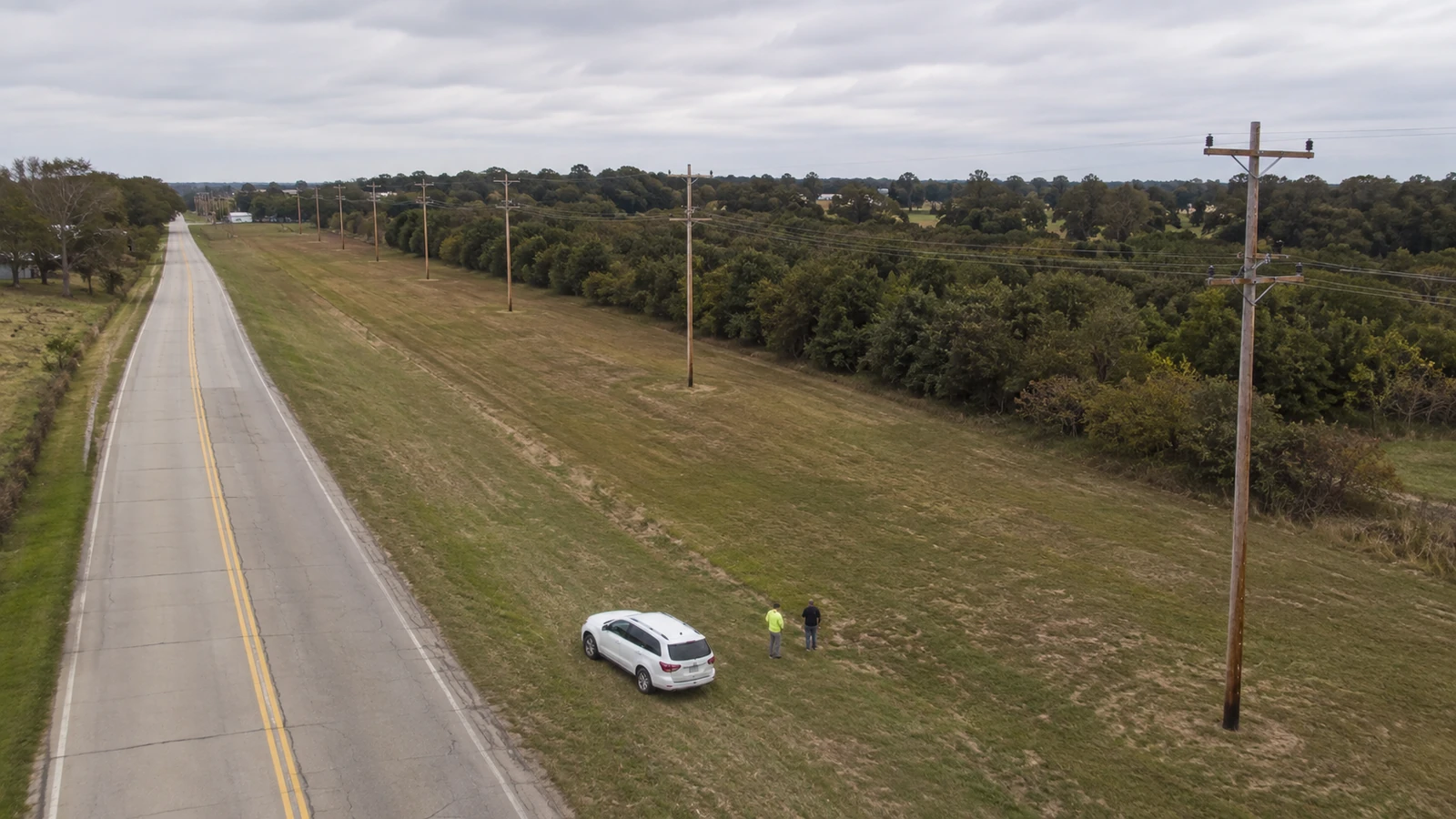
The useful comparison is not software versus a clipboard. It is one evidence model versus another. A photo-centered workflow can preserve measurable images and structured asset relationships. Direct manual collection can place an instrument on a specific observation and adapt quickly to owner forms. Either can fail when the procedure, calibration, review and deliverable contract are weak.
A buyer should choose the method after defining what the pole owner and engineer must accept. Required attachment heights, midspan data, pole attributes, equipment records, location precision, photo views, file schema and field-safety boundaries belong in that definition. The collection tool follows the evidence contract, not the other way around.
What the Katapult vs manual pole survey decision changes
The Katapult vs manual pole survey choice determines where measurement happens and what evidence a reviewer can revisit. A Katapult-centered route relies on calibrated photo sets; a controlled manual route relies on documented instrument readings with attached context. The 10-business-day completeness review in 47 CFR 1.1411(d) applies only within the rule's scope. It does not choose the method.
Define “manual” carefully. It may mean paper forms and a height stick or it may include a laser rangefinder, GNSS receiver, digital level, camera, spreadsheet and mobile form that are not integrated into one pole-attachment platform. The quality range is wide. A disciplined manual workflow with calibrated tools, mandatory photos and second-person checks can outperform a poorly configured software workflow. Comparing brand names without procedures produces little buying insight.
Katapult's field manual says collection centers on photo documentation and its mobile interface. It instructs crews to create time-stamp photos before fielding so later uploads can associate camera images with collected locations. The manual then separates pole photos from midspan and equipment views. These procedures can support traceability, but they do not decide which attributes a pole owner requires or whether a specific photo is measurable.
The federal rule supplies process context rather than a survey specification. Within its scope, 47 CFR 1.1411(d) makes completeness depend on the information needed under the utility's written requirements to begin its survey. That subsection also sets deadlines for application review and survey work. Later subsections address estimates, make-ready and self-help. Utility procedures, contracts, state rules and stated exceptions still control the actual submittal.
Write the evidence contract before the field form
An evidence contract names every required observation and its proof. For each pole, it can define identifier, coordinate, ownership clue, class and height marking, species when available, condition observations, equipment, guying, anchors, attachment heights, communication-space occupancy, proposed attachment point, clearances, ground line, roadway relationship and photo views. For spans, it can define endpoints, span length, wire identity, midspan measurements, crossing class, lowest point and obstruction notes.
Our pole loading analysis workflow adds model provenance to that contract. A value can be measured, read from a tag, supplied by the owner, calculated, inferred or assumed. We do not collapse those categories into one number. The engineer needs to know which field facts support the model and which missing inputs require conservative assumptions, owner direction or recollection.
Where a manual pole survey remains strong
Manual collection earns its place when a direct reading is mandatory or the approved photo method cannot capture the condition. It also suits a small route under a fixed owner form because a crew can record an exception without first rebuilding a platform workflow. The advantage is not the clipboard. It is an established field manual tied to tool calibration and a checker who knows the owner's acceptance examples.
Direct readings can reduce interpretation for a specified dimension, but the device does not remove field judgment. The crew needs a known reference and a stable setup, and the recorded value must remain attached to the correct pole. A transposed unit or a span note filed under the next pole can survive office review unless the record also shows how the reading was taken. For critical dimensions, we often require a setup photograph even when the instrument supplies the final value.
Mixed-owner programs expose a different manual advantage: the common record can feed a utility spreadsheet and a separate municipal inventory without forcing both owners into the same interface. That flexibility disappears when each export becomes a hand-edited copy. We keep one controlled source record and generate every export through a tested transformation. Crews should not type the same pole into parallel files.
| Decision factor | Katapult-centered workflow | Controlled manual workflow |
|---|---|---|
| Measurement proof | Measurable photos, calibration, markers and structured records | Instrument reading, field note, setup photo and checker record |
| Field pace | Can standardize repeated collection when views and workflow fit | Can adapt quickly to unusual conditions or owner forms |
| Office review | Reviewer can revisit photos and associated asset data | Reviewer depends on notes, photos and documented instrument use |
| Correction loop | Issues can be assigned within the same data environment | Issues need a clear return path from QA log to crew |
| Integration | API and platform exports can connect downstream tools | Custom database or scripts can match legacy deliverables |
A pilot needs difficult poles. The table is a pilot hypothesis, not a universal winner. Test it on the buyer’s poles, owner rules, terrain and deliverables. A representative pilot should include straight-line poles, angles, dead ends, road crossings, congested communication space, vegetation, shadow, backlight, obstructed ground lines and unusual equipment. Measure acceptance and correction effort, not just poles collected per shift.
Manual quality depends on form design
A blank notes field is not a field procedure. Use required fields, controlled values, units, range checks, dependencies and explicit unavailable codes. If a crew marks an attribute as unknown, the record should prompt for the reason: tag missing, view obstructed, unsafe access, owner record needed or instrument limitation. That distinction lets the office decide whether to infer, request data or recollect instead of treating every blank alike. Our form review tests those unavailable states before crews mobilize.
Crew training should use the same acceptance examples as office QA. Show valid and invalid photo framing, span naming, attachment-point selection, instrument placement, coordinate capture and exception notes. Our telecom field-survey data management guidance treats training examples as controlled project records. When the form changes, the examples and test cases change with it.
Where Katapult’s photo workflow changes the review model
A photo-based workflow shifts part of the measurement work from the roadside to the office. The original image gives a reviewer another look at attachment identity or equipment arrangement without an immediate return visit. That benefit depends on disciplined capture: the pole must be framed from an approved position with a visible reference, and every image set must stay attached to the correct asset. If geometry or occlusion defeats measurement, the record needs an exception instead of a confident-looking number.
Katapult's public v2 API documentation, which the company labels as legacy, shows one export model. It documents optional output for height markers and existing or proposed heights. Other options expose pixel selections, anchor calibrations and calculated proposed midspan heights. The same repository directs new integrations to v3. A buyer should still ask which values are field observations, photo-derived measurements, calculations or design proposals. Exported precision should not be mistaken for field accuracy.
- Capture geometry: define photographer position, pole framing, reference visibility and required supplemental views.
- Calibration: specify the approved reference, placement, visibility and rejection rule for invalid calibration.
- Association: prevent duplicate or shifted pole identities through route order, map checks and photo-set review.
- Exception handling: create explicit paths for obstruction, glare, unsafe position, inaccessible property and unusual equipment.
Unsafe evidence is not usable evidence. Ground-level collection can reduce the need to enter the power space, but it does not remove roadside, traffic, terrain, weather, animal or electrical hazards. The project safety plan governs. Crews should never move into an unsafe position merely to satisfy a photo rule. An exception code and planned recollection under proper controls are better than an image obtained from a dangerous location.
Photo measurability is an acceptance item
A sharp photograph may still fail as measurement evidence. A clipped pole top is obvious; a hidden reference or a shallow viewing angle can be easier to miss. Office QA should decide which required markers the image actually supports and send the record back while the route is still active when it does not. We treat overview photographs as context unless they meet the measurement standard written for the job.
Photo recovery depends on original files. The strongest advantage is often recoverability. When a question concerns an attachment identity or equipment arrangement, the office may inspect the original image set. Manual projects can achieve similar recoverability if they require systematic photos and stable naming, but that discipline must be built. In either method, compressed screenshots and exported thumbnails are weak substitutes for original files with preserved association.
Let the dominant evidence failure choose the method
Start with the failure that would make the record unusable. If the reviewer must revisit image geometry across a long route, the Katapult-centered model has the stronger recovery path. A direct reading may be mandatory. That points toward the manual procedure. Where both needs occur, a hybrid is defensible only after the project names one controlling record and writes the exception handoff.
Hybrid records need one authority. A hybrid design can use photo measurement for attachment inventory and reserve direct instruments for specified crossings or obscured points. It can also keep one platform as the source record while importing owner data for a prescribed application. The handoff is where trouble starts: if two systems contain the same field, the project must name which one controls and how a reviewer resolves conflicts. Provenance cannot disappear at export. The released value should still show whether it was observed, derived or approved as an exception.
Recollection is a production outcome. A buyer can compare methods with 5 pilot measures: first-pass acceptance; correction rate; recollection rate; reviewer time; and export defects. We record safety observations and the reasons photographs cannot be used beside those measures. Poles visited per shift is incomplete. The more useful denominator is a pole record that has cleared review and can support its stated engineering task.
Self-critical note: Platform familiarity can bias a method decision. We do not treat tool proficiency as proof that every project fits the tool. A pilot must expose failure cases, include manual fallback rules and record whether office effort or recollection cancels the expected field benefit.
Check owner and contract acceptance before scaling
Some pole owners prescribe survey methods, qualified personnel, file formats, photo views, application portals and engineering seals. Obtain those requirements in writing and confirm the current version. Under 47 CFR 1.1411(d)(1), an application is considered complete when it gives the utility the information necessary under a master service agreement or publicly available written requirements to begin surveying the affected poles. Completeness therefore turns on the applicable requirement, not on a vendor's default template.
Our pole loading field-measurement review separates collection sufficiency from engineering sufficiency. A dataset may satisfy an application intake form yet omit inputs needed for a pole model. Conversely, a detailed engineering survey may still fail an owner’s naming or upload rules. Map both acceptance gates so the team does not discover the second one after field demobilization.
Choose the pole survey method with an acceptance plan
Pole owners: set the acceptance boundary. Start from the written procedure. A manual-centered process is the practical choice when direct readings or fixed forms are mandatory. Where measurable image sets already fit the acceptance system, a photo-centered pilot can show whether the method reduces total correction effort. We would not scale either approach until the pilot explains its recollections rather than merely counting them.
Attachers and engineering managers: follow each required input through application review, loading analysis and correction. Selected dimensions may justify a hybrid path, but the source of the released value must remain visible. Our engineering team stops the handoff when field evidence cannot support the intended use and sends a specific question back to the active route.
Form changes can invalidate earlier records. The acceptance plan begins with the schema and field procedure, then connects them to the office review. It assigns device control and route uploads to named roles. It also explains who can revise a form, how an active crew receives that change and which earlier records must be revisited. We test the entire loop during a working shift because a form that succeeds only in a conference-room example is not ready for production.
Sampling alone is not enough for fields that determine design. Automated checks can test completeness, units, value ranges, duplicate identifiers, coordinate gaps, span connectivity, required views and orphan photos across 100 percent of records. Qualified reviewers then inspect engineering-sensitive evidence and exception cases. The sampling plan should state which records receive full visual review and which receive targeted checks based on risk.
Rejection labels support diagnosis. Use a rejection taxonomy so quality data improves the procedure. Categories can include wrong pole, missing view, invalid calibration, hidden reference, clipped top, unreadable tag, wrong units, bad span association, unsupported attachment identity, coordinate outlier and incomplete note. The team can then distinguish training issues from form defects, equipment problems, access barriers and office interpretation disagreements.
Our field and engineering team performs pole-survey planning, field collection, engineering and design in-house, so field evidence does not cross an outsourcing boundary before it reaches the model. When the approved work proceeds into full turnkey construction, Draftech-managed subcontract crews deliver that construction under Draftech's QA/QC and safety program through the vendor framework. The record still names who collected, checked, corrected and accepted each pole.
Method approval expires when the evidence conditions change. Attach the pilot report to the survey specification and date the decision. Reopen it when the governing owner procedure changes or when field conditions repeatedly defeat the approved capture method. A platform revision that changes an export deserves its own transformation test. This keeps approval tied to the conditions that produced it.
To review a survey specification, send the survey scope or email Draftech with the owner requirements, sample deliverable, pole count range and known field constraints. We can return an evidence matrix and pilot acceptance plan before full deployment.