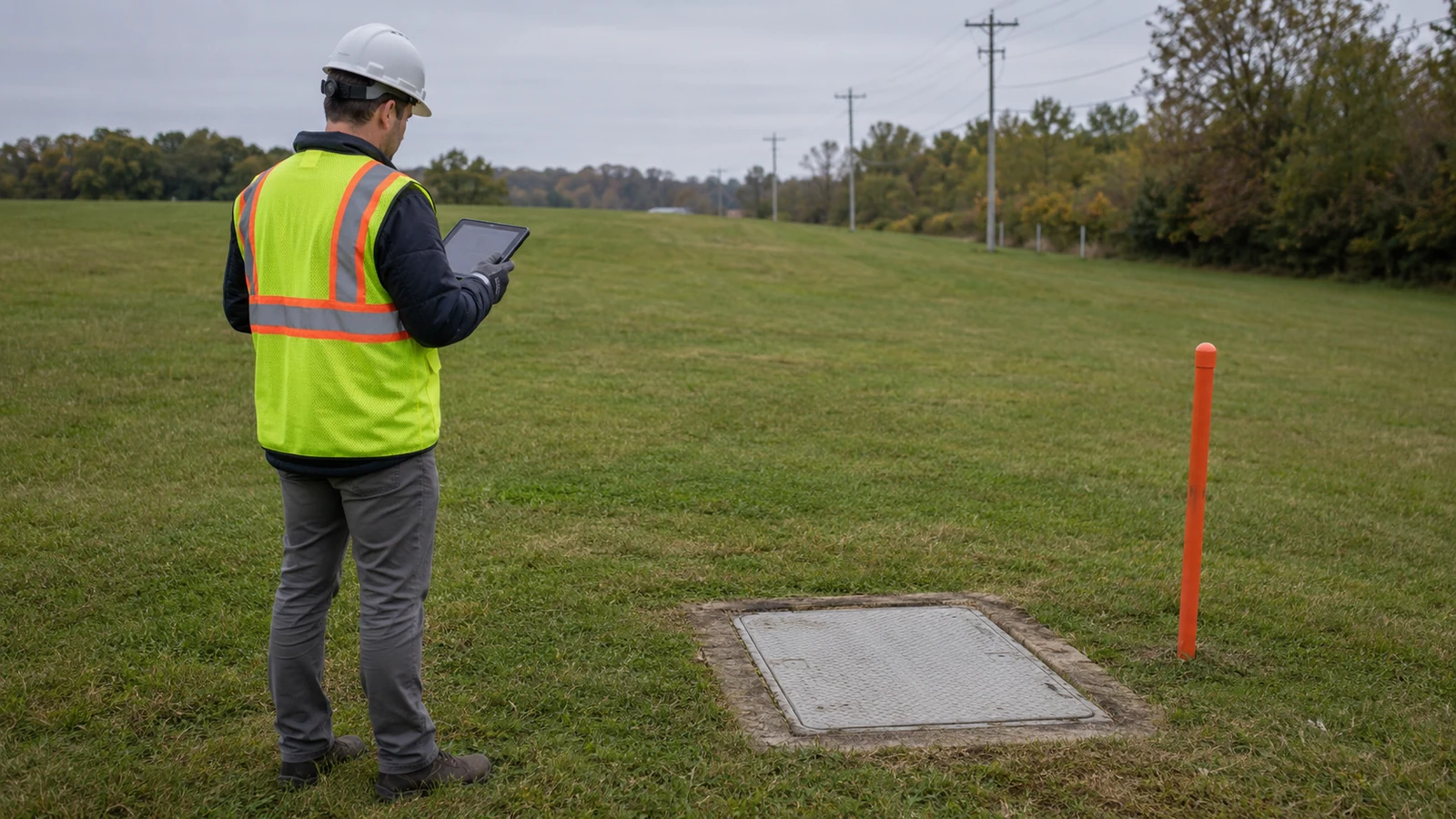
Engineering can receive hundreds of route photographs and still lack enough context to decide whether one segment is usable. A reviewer may trace a finding back to its location and then discover that the collection method lives in another file, while the reasoning survives in an email thread. A field condition report brings that trail together and marks the edge of the visit's knowledge. Concealed plant stays unknown. An approved method must reach it before the finding expands.
This guide focuses on the buyer's specification for the report and the review used to accept it. Survey staffing and field-data management shape the inputs. Broader infrastructure studies and construction inspection operate at their own lifecycle stages. The working product helps a receiving team make one bounded route decision.
Fiber Field Condition Report Services Create a Decision Record
Fiber field condition report services should connect at least 6 project-defined fields in one record: assignment boundary, asset identity, location method, observed condition, supporting evidence and accountable disposition. Draftech uses this as a project-control schema. It gives the receiving engineer a direct path from each route decision to the collection event and its limits.
Suppose a technician photographs standing water through the opening of an identified handhole and safe entry is unavailable. The image supports an exterior vantage point at that structure on that date. Continuity beyond the visible duct mouth remains unverified. We place the access boundary beside the finding, where the receiving engineer sees it while interpreting the image. Records review or another approved method can establish the evidence required for a route-level conclusion.
A clear photograph may still fail review. Without a stable asset ID, the reviewer has to search a route map and message history before deciding what it depicts. That reconstruction is too dependent on memory. We require the collection event and stated observation to travel with the image so another reviewer can follow the same path through the record and reach a decision from the preserved evidence.
FHWA's Site Characterization and Utility Locating guidance addresses subsurface utility work for transportation projects. It says detected utilities should be documented on a field-drafted site diagram and surveyed so their locations can support a site plan. Its reporting discussion also pairs site conditions with the methods used and their limitations. For a fiber condition report, that federal guidance offers a useful design principle: plan the collection around the way the receiving team will use the record.
Our existing infrastructure survey guide covers verification across inherited aerial and underground assets before reuse. The condition report works at the unit level. It explains what the evidence means for the handhole, crossing or span under review and records any exception that interrupts the decision. The route retains its open questions wherever the field method had limited reach.
Scope test: Hand the proposed report outline to the receiving reviewer before mobilization. If the reviewer cannot identify the decision each evidence field will support, adding attachments later will not repair the undefined use.
Set Scope and Evidence Before the Field Visit
Before mobilization, we divide the route into condition-reporting units that can support a decision on their own. A crossing may remain one unit because a single access constraint affects the whole passage. Along an aerial run, the useful boundary might follow one pole and the spans that depend on it. The engineering decision sets the unit. Application counters follow those units.
Give Every Unit a Stable Identity
Each planned observation begins with an identifier already present in our assignment. When the crew discovers an unlisted structure, the record receives a provisional ID under the project's naming rule. Borrowing the nearest known identity would create a false match. The record also carries the assignment version, allowing route edits to be reconciled while a valid photograph stays attached to the object that the crew actually visited.
FHWA publication HIF-16-019, Guide for Efficient and Effective Utility Asset Data Collection Using Geospatial 3D Techniques, places information requirements before collection. The federal guide follows those requirements through the data model and into quality management for the deliverable. It was written for utility asset programs. We borrow that sequence for telecom work because the receiving data contract has to exist before a crew can collect against it and before QA can judge the returned package consistently.
| Report field | What the field preserves | Review question | Possible disposition |
|---|---|---|---|
| Scope | Intended use and route limits | Is this unit inside the assignment? | Accept scope or correct assignment |
| Asset identity | Stable segment or asset ID | Is this the intended object? | Accept ID or reconcile conflict |
| Location | Method, coordinates and quality metadata | Is the position fit for its stated use? | Accept location or recollect |
| Condition | Defined observed state | Does the evidence support the label? | Accept state or reclassify |
| Evidence | Photographs, measurements and notes | Can another reviewer trace the finding? | Accept evidence or supplement |
| Disposition | Decision, limitation and next owner | Is the required next action controlled? | Resolve status under owner criteria |
State Position Quality Instead of Implying It
We report coordinates with their method because an unqualified position invites more confidence than it may deserve. The Federal Geographic Data Committee's Geospatial Positioning Accuracy Standards Part 1 provides a reporting methodology. Part 3 describes testing geospatial data against an independent source of higher accuracy and calls for at least 20 well-defined checkpoints under its national method. That count belongs to the cited method. The project separately defines its collection procedure and acceptance basis according to the intended use, available control and consequences of a location error.
ArcGIS Field Maps product documentation shows how a configured workflow can store GPS metadata and apply project-selected settings for accuracy or confidence. A supervisor may then use those controls to find records outside the configured threshold. The software carries criteria chosen by the organization; it does not set an owner's tolerance. The scope comes first. We configure the application to follow the asset's intended use.
Our evidence plan gives every required view a review question. For an aerial unit, one contextual image might establish which pole was visited, while a closer frame shows the attachment condition that prompted the finding. Inside a structure, the viewing direction has to be clear before a duct opening can be tied to the route. Extra photographs leave missing logic untouched. Images earn their place by answering a question about identity or condition.
Safety boundaries belong in the assignment. OSHA 29 CFR 1910.268 is a federal regulation covering specified work conditions and practices at telecommunications centers and field installations; applicability follows the work performed and the employer's program. A report request carries no added access authority. Before the crew arrives, the scope identifies ordinary observation and any activity that needs separate authorization.
Our field-to-design data controls cover the broader path from assignment through validated export. The condition report uses the result of that gate sequence. At package level, we ask whether every assigned unit has usable evidence or a documented reason for the missing observation. A reviewer can then distinguish an approved access limitation from an accidentally blank field without opening a separate collection log.
Classify Condition Without Hiding Uncertainty
A condition label earns its place when the reviewer can trace it to evidence and understand what the label permits. One project may separate usable plant from assets that require investigation. Another may use maintenance categories. The owner's decision rule controls both the label and the resulting action. Blocked access receives an observation-limit code, leaving the asset's condition open until someone can examine the required area.
Separate Observed Facts from Inference
Seeing an empty duct opening establishes what was visible at one end of the structure. Continuity to the next access point requires an accepted test or support from a reliable record. The same discipline applies when a pole label conflicts with the owner's system of record. The report shows the observed label beside the unresolved ownership conflict and sends that identity question to the person who can reconcile the field mark with the owner's record. A complete-looking package would be a poor substitute for resolving it.
A condition word can conceal an evidence gap, so we express confidence in relation to the method. Calling a structure serviceable after an exterior-only visit gives the adjective more reach than the evidence. The report describes the exterior finding and records the failed access to the required interior view. It also names the next step needed before reliance can extend inside. That account gives a designer something concrete to work with.
Negative findings deserve particular care. A statement such as no conflict observed reaches as far as the approved method could see during that visit. Concealed conditions remain outside the claim. We place the method limit in the same unit record, immediately after the finding, so the reader encounters both before making a route decision.
Review Whether the Evidence Proves the Finding
Photographs need an evidence test that reflects the claim being made. A close frame may show a cracked component clearly yet provide no clue about which structure contains it. The wider frame restores context. When the review needs both views, the report links them to the same unit and finding. When one view answers the question, we stop there. A fixed photo quota would add volume without strengthening the finding.
Metadata improves traceability. Automated checks can flag a blank field or an absent attachment and direct attention to an incomplete record. The engineering judgment begins after that mechanical check. A reviewer still has to confirm that the image shows the intended asset and that its visible condition supports the stated finding. We keep that comparison in the acceptance workflow because the software sees field presence, not evidentiary meaning.
Explicit limitation: A structured form can capture every expected attribute and still suppress the unusual condition that changes the route decision. We provide a controlled exception path to a named reviewer. The regular schema remains intact, while the exception carries the fact that the form did not anticipate.
An exception starts with the affected unit and ends with a question for someone who has authority to resolve it. Between those points, the record explains how the evidence conflicts with the expected condition. Defined fields carry the routine facts. The exception preserves what the approved form did not anticipate and gives the reviewer enough context to correct the unit record or revise the schema.
Review Exceptions and Issue Controlled Dispositions
Before interpreting condition, we reconcile every returned unit to the assignment and check that its evidence opens with enough context to be understood. Position quality belongs in that pass. Identity failures send the record back. An image that may show another structure gives the reviewer no dependable basis for a usability decision.
Once the package is traceable, we test whether it is usable. The reviewer reads condition against the underlying evidence and stated confidence, then considers the proposed disposition in light of the intended use. Sometimes every field is complete and the approved method still leaves the receiving question open. We log an investigation gap. Administrative completeness remains true, but it does not decide the engineering issue.
Give Exceptions Their Own Register
The exception register is organized around the affected unit. It also tells a manager who owns the unresolved question and how that question changes the workfront. One crossing may stop the adjacent segment. Another finding can undermine the assumed route beyond its location. Resolution evidence stays on the entry. Ordinary notes make a poor queue because urgency disappears inside narrative and no one is assigned to close it.
Package status comes from the controlling owner document. Some contracts allow acceptance within a named limitation; others send the affected unit back when its evidence cannot support use. The status entry quotes that governing boundary and identifies who can change it. Our project-control language helps people follow the decision, while contractual acceptance authority stays with the party named in the governing document.
A revisit needs a defined decision gap. If the report lacks the one view needed to identify a structure, the exception states exactly what the returning technician must capture. A conflicting owner record may require a records reconciliation or another verification method. Sending the same crew back with the same photo request is likely to reproduce the first gap at additional cost.
The survey delivery model decision compares internal crews with external capacity. Procurement can choose the staffing arrangement that fits the schedule. Engineering acceptance still turns on the specified use and the evidence behind each observation. A familiar internal spreadsheet and a polished outside export face the same review questions.
Change control continues when a new owner record arrives or construction exposes something beyond the original visit's view. We retain the accepted observation as a dated baseline. A revision explains the later evidence against the affected unit and points to any downstream decision that needs review. The comparison then shows why the conclusion changed and which information was available at each decision date.
An OSP construction inspection checklist belongs to a later lifecycle gate, where installed work is visible and corrective action can still be controlled. The field condition report usually informs an earlier decision about whether existing conditions can support the proposed next step. Construction acceptance needs its own inspection record. Keeping the two records distinct preserves their dates, methods and approval authority throughout closeout.
Choose the Condition Report for the Receiving Decision
Route planners often begin with a corridor comparison. At that stage, reconnaissance can support a choice if the acceptance language carries forward unresolved ownership and concealed-conflict questions. A corridor selected on that basis still needs the evidence and reviewer authority required for construction readiness. We recommend writing those later gates beside the selection so an early preference does not quietly become a release that the field record was never built to support.
For Reuse, Follow the Unit Evidence
At adjacent handholes, engineering may have a complete interior record for one structure and no structure at the mapped location of the other. The reuse decision should follow those separate unit records. Keep the investigation open for the missing handhole and let the observed neighbor proceed as far as its own evidence allows. One route-wide label would erase the very difference that engineering needs to manage.
A preconstruction manager has a different immediate need: show where the field evidence diverges from design, identify the affected workfront and route the blocker to someone with authority. The reconciled field record makes the outstanding permit or engineering approval visible. Release then follows the governing process with a specific gap in view.
For operations, service consequence sets priority. A visible defect on a redundant route may carry a different consequence at a single-fed site, so the operator supplies the severity definitions and maintenance response. Immediate safety escalation follows the governing program as soon as the condition is recognized. Routine record cleanup can continue after that handoff is secure.
Draftech's fiber field survey and data collection services can be scoped backward from the receiving decision. We carry bounded field evidence into in-house engineering and QA/QC. When an engagement expands to full turnkey construction, Draftech manages subcontract crews under our QA/QC and safety oversight. Construction authorization follows the governing release process, and our in-house engineering model keeps acceptance ownership visible.
A productive scoping exchange begins with a marked route record and the receiving decision written beside the affected segment. Known access limits belong on the route too. Teams can email our field survey team for a boundary review that defines which evidence will be usable and which questions will remain for another method.
Decision boundary: A condition report is complete when the receiving team can act without guessing what the field visit proved. The same boundary anchors Draftech project intake.